
The Queer Catholic Group Trying to Reclaim the Church
At a time when our politics is openly hostile to LGBTQ+ rights, communities like New Ways Ministries are offering a vision of religion not as judgment but as sanctuary.
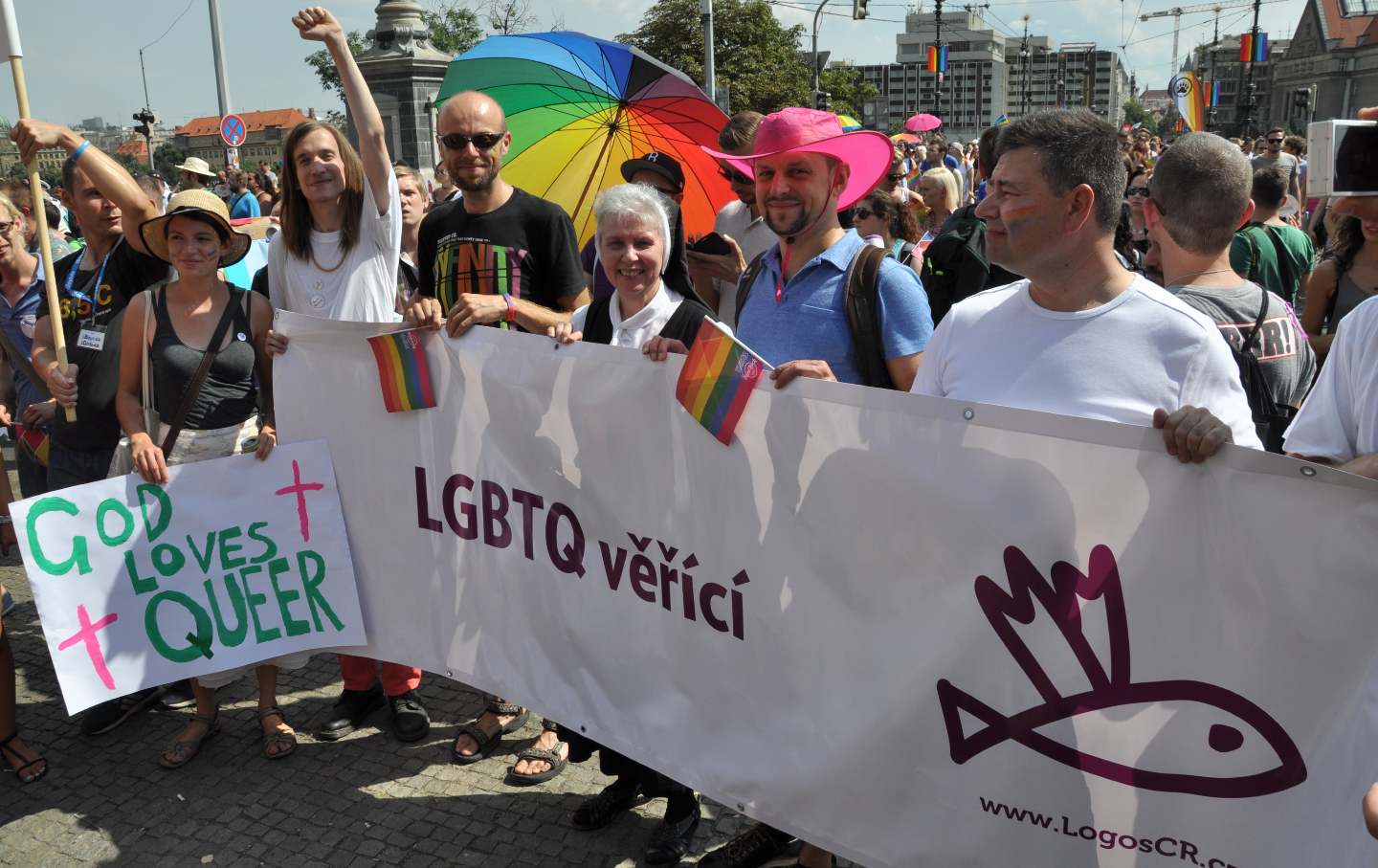
Sister Jeannine Gramick marching alongside individuals at Prague Pride for faith and inclusion, holding a banner that reads “LGBTQ věřící” (“LGBTQ believers”).
(New Ways Ministries)Sitting on the border of Maryland and Washington, DC, on a suburban street shaded by lush green trees, lies a small two-story ministry. As both a physical and digital sanctuary, New Ways Ministry works to educate Catholics of all identities on LGBTQ+ advocacy. From religious leaders seeking to expand their knowledge on LGBTQ+ individuals to LGBTQ+ individuals seeking security within their faith, this ministry is among the underrepresented religious groups aiming to educate, advocate and equip leaders to build bridges between the church and civil society. Queer Catholics and their allies are reshaping the church from within by reclaiming values that are, as Francis DeBernardo of New Ways Ministry says, “at the heart of the gospel message.”
Religion has been weaponized against LGBTQ+ people in the United States for years, a trend that continues today with figures like JD Vance. The vice president has used theological concepts like ordo amoris, or the idea of a “rightly ordered love,” to justify anti-immigrant policies, arguing that Americans owe moral duties to their own families before “outsiders.” This thinking led to criticism from both Pope Francis and Pope Leo XIV, who insisted that Christian love must be universal and must apply to all individuals, especially those of marginalized communities.
But what does it mean when queer Catholics and their allies inside the church start using that same institution to fight back, not by leaving it but by reshaping it from within? At a time when our politics is openly hostile to LGBTQ+ rights, religious communities are offering something quietly radical: offering a vision of religion not as judgment but as sanctuary.
New Ways Ministry has been around since 1977, when it was founded by Sister Jeannine Gramick and Father Robert Nugent, a nun and a priest, who learned to advocate for LGBTQ+ people inside the Catholic Church through conversation and community. Based in Mount Rainier, Maryland, where it primarily does its advocacy work, New Ways was one of the earliest groups attempting to broaden the ways that Catholics deal with LGBTQ+ issues. Its mission is to both educate church leaders and advocate for LGBTQ+ individuals through non-pastoral work.
Though based in Maryland, the state with the second-largest Catholic population per capita, New Ways Ministry sponsors regular meetings with priests and ministers who serve in parishes outside of the region, including Boston, Chicago, Denver, Tennessee, and Florida. This work consists of educational, spiritual, and pastoral programming, from bonding sessions to retreats. Through this mission, these regions have been able to see progress, with parishes, Catholic schools, and other institutions becoming more friendly to LGBTQ+ people. Conversation and expansion is success.
In January 2024, New Ways Ministry gathered a group of more than a dozen US bishops for a private meeting at St. Louis University. Attendees listened to trans people and their families, theologians, medical professionals, and those in church ministry. “We’ve all encountered pastoral situations related to transgender persons and for the most part felt inadequately prepared to deal with them,” one of the attendees, Bishop John Stowe of Lexington, Kentucky, told the National Catholic Reporter. “And if we would all stop and hear the struggles that individuals went through, we’d realize this is not just an issue of gender theory; it’s people’s lived experience.”
Francis DeBernardo has been executive director at New Ways Ministry for over 30 years, starting as a volunteer in 1992. His work includes facilitating programs to educate communities on LGBTQ+ issues and Catholicism in both religions and nonreligious spaces. “I was always aware of Catholic social justice groups,” said DeBernardo. “I grew up in a very progressive Catholic environment, so I always knew about New Ways Ministry,” he said. Catholicism has not always been dominated by a conservative political demographic. DeBernardo came of age at the Diocese of Brooklyn in the early 1970s where there were a great deal of progressive ideas in the Catholic Church generally. “It wasn’t until the early 1990s that I started to recognize how much the Catholic Church’s influence was harming LGBTQ people.”
Conflicts within the Catholic Church around LGBTQ+ rights stem not only from theological debates but also from a growing divide between the institutional hierarchy and the lived experiences of Catholics. “The leadership in the Catholic Church and the Catholic bishops in the United States, since at least the mid-’90s had a very conservative bend to them,” said DeBernardo. So what we try to do is, in our work, we try to be a credible Catholic voice to support pro-LGBTQ initiatives.”
As LGBTQ+ people came out in greater numbers through the 1980s and ’90s, Catholic communities like New Ways Ministry increasingly recognized their shared humanity, challenging increased stereotypes and shifting perceptions. The era was a time where media coverage around AIDS and HIV offered negative and slanderous depictions of gay men within society and led to increased homophobic rhetoric related to the AIDS crisis. The lack of scientific understanding of AIDS fueled an increase of hatred towards the LGBTQ+ community. Despite the hostile public climate, personal relationships and grassroots ministry efforts became more important than ever in the efforts to shift hearts within the Catholic communities.
New Ways Ministry was very involved in early marriage equality debates, publishing a booklet called Marriage Equality: A Positive Catholic Approach that explained why Catholic thinking called them to support same-sex marriage. This booklet was distributed to legislators and Catholics around the country. The booklet also argued that Catholic tradition gives laity and theologians, many of whom support same-sex marriage, equal authority as bishops to speak on the issue. “Catholic people living in the real world of meeting gay and lesbain people and realizing their struggles…they disregarded what the bishops had said,” DeBernardo recalls. This shift wasn’t a break from Catholic values; it was an expression of them.
The booklet targeted a key battleground state, Maryland, where Catholic identity was politically influential. At the time, New Ways Ministry cited polling data showing that 49 percent of Maryland Catholics supported marriage equality, compared with 47 percent of all voters. The booklet’s framing helped fuel the Maryland campaign around SB 116 (the Religious Freedom and Civil Marriage Protection Act). Catholic legislators, including a lesbian Catholic delegate, who cosponsored the bill, and a Catholic governor pledged to sign it if passed.
In 2021, the ministry released A Home for All: A Catholic Call for LGBTQ Non-Discrimination, a statement endorsed by over 250 prominent Catholic theologians, clergy, scholars, and writers. It argued that Catholic social teaching calls for support of civil nondiscrimination laws protecting LGBTQ people in areas like housing and employment, framing equality as a moral and faith-based necessity.
Today, as anti-LGBTQ+ rhetoric resurfaces in politics and in religious life, many Catholics continue to draw on these same values to advocate for inclusion within the church. Groups like DignityUSA, which has supported LGBTQ+ Catholics since the early 1970s, and Outreach, a Jesuit-ed initiative founded by Father James Martin, work to foster dialogue, build community, and promote a vision of the church where LGBTQ+ people are fully welcome.
However, as this tension between the church and civil society remains unresolved, it has fueled a movement pushing the church toward something more inclusive. New Ways Ministry has “described [them]selves as a bridge-building ministry and also as a ministry of justice and reconciliation and as a ministry of education,” said DeBernardo. “The way we try to counter the discriminatory traditions and positions in the church is to educate Catholics, Catholic leaders and Catholic people in the pews about why Catholic teaching supports what we would call maybe a liberal or an equality perspective.”
Popular
“swipe left below to view more authors”Swipe →Rather than being a tool of exclusion, religion in these cases becomes a force for protecting rights and offering sanctuary to these groups. It’s essential to support the faith-based communities and institutions that are leading this work from within. “Religion helps people realize their responsibility to other human beings on this planet,” said DeBernardo. The purpose of faith here isn’t to impose doctrine, but to foster connection and bring people together around shared values like compassion, justice, and above all, love.
“We have been hearing from LGBTQ+ individuals who are angry, frightened, and frustrated,” said Francis DeBernardo. “While the Trump administration’s LGBTQ+ policies have been odious, we do not find our work at New Ways Ministry changed much by them.” Faith can be an ally of queer liberation, DeBernardo says, “not in spite of being Catholic but because of being Catholic.”
Become a Sustaining Donor This September
Between the reemergence of right-wing red-baiting and Donald Trump’s use of the chilling National Security Presidential Memorandum–7 to criminalize left political organizing, we’re seeing McCarthyism reborn before our eyes.
This assault on democracy cannot be ignored or wished away. Resisting it requires bravery in the face of threats and repression, a steadfast commitment to the truth, and the unwavering belief that we can—and will—overcome this darkness.
We must have an independent media that sets the record straight, unearths corruption and abuses of power, and advances a politics of justice and dignity for all if we’re to win this fight.
That’s why I’m writing to you today. This September, The Nation needs to add 100 monthly donors to sustain our progressive journalism. Your contribution makes the next investigative report, the next truth-speaking column, and the next pathbreaking essay all possible.
I hope you’ll support our work with a recurring donation today. If you donate $10 or more a month, we’ll send you a brand new “Hands Off the Free Press!” sticker to recognise your commitment to our cause. Please, donate today.
Onward,
Katrina vanden Heuvel
Editor and Publisher, The Nation
More from The Nation
As Morale Sags, More Military Service Members Are Having a Crisis of Conscience As Morale Sags, More Military Service Members Are Having a Crisis of Conscience
According to multiple GI rights organizations, service members are inquiring in unprecedented numbers about seeking conscientious objector status.
What Remains of Riis? What Remains of Riis?
A new members’ club has revived Riis Park’s long-vacant bathhouse, reopening old questions about whom the People’s Beach is really for.

When Texas Sex Ed Falls Short, Gen Z Women Turn to Social Media When Texas Sex Ed Falls Short, Gen Z Women Turn to Social Media
A 2025 study found that 70 percent of adolescents sought reproductive health information through social media platforms.
Justice for Macklemore Justice for Macklemore
The rapper has been dumped from Ed Sheeran’s tour for saying “free Palestine.” That’s a disgrace.

We Are Living Under Roy Cohnian Logic We Are Living Under Roy Cohnian Logic
The political fixer created a career for himself as a self-promoting, ubiquitous hustler. Like Trump, he got away with it by having the right friends.

Time Has Run Out for AI Risk Deniers Time Has Run Out for AI Risk Deniers
The recent spate of reports about the technology’s destructive power underline two prime directives: Be afraid, and regulate aggressively.

