
The Long Nightmare of Trump’s Border Wall Is Still Going
It may have fallen out of the news cycle, but rest assured, the the world’s least pragmatic and most performative construction project continues to prosper.
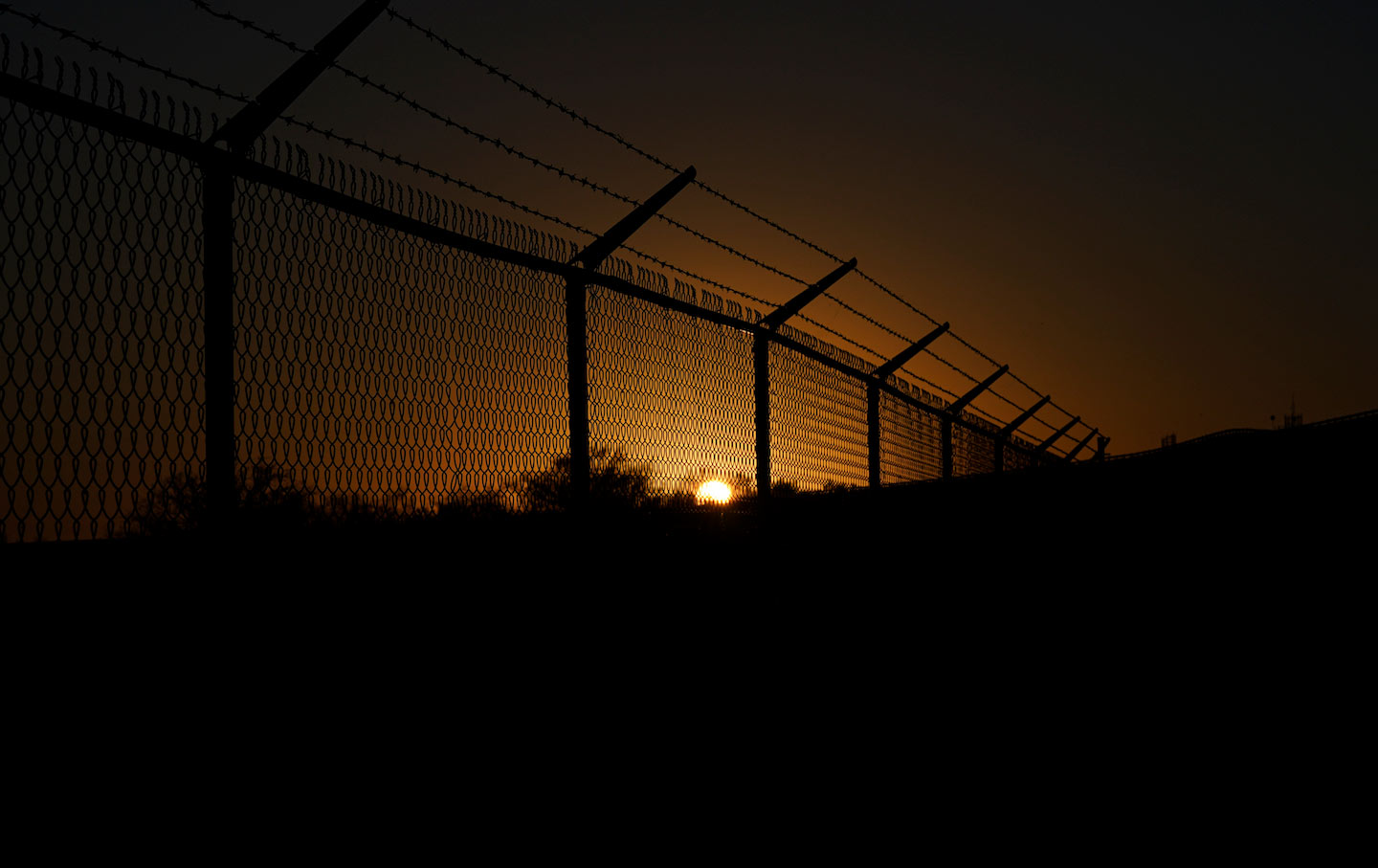
The sun sets behind a border fence separating Del Rio, Texas, and Ciudad Acuna, Mexico, Thursday, September 23, 2021.
(Fernando Llano / AP Photo)This article originally appeared at TomDispatch.com. To stay on top of important articles like these, sign up to receive the latest updates from TomDispatch.com.
Aleading preoccupation of the first Trump administration has all but slipped from view. Except when ostensible conservatives speak out against it, the major media have scarcely breathed a word on the subject. But it’s still there, 30 feet tall, aspirationally 1,952 miles long, obliterating habitats, dividing families, and sucking down public funds faster than a carrier-based air squadron.
The media’s lack of attention is understandable. All-too-real wars of choice and metaphorical wars against science, universities, and the environment have dominated our airtime and the headlines. The rise of a new medievalism in medicine and the abrogation of international trade and security agreements have also won attention. Add to all of that a federal paramilitary kidnapping people, even from what still passes for the halls of justice, while murdering the occasional protester, and one’s journalistic cup runneth over.
The meta-story of the US government’s comprehensive abandonment of its Enlightenment heritage needs telling, too. Goodbye to empiricism and the troublesome scientific discourse it produces. Goodbye as well to empiricism’s political collaterals, including the “created equal” credo of the Declaration of Independence, which the current regime finds distinctly irritating. There is simply too much to report on as the new monarchy, as if in a sped-up nature film, blossoms flowerlike, its palace under renovation, the king’s signature being prepared to grace the currency, and myriad kickback mechanisms whirring like gold-plated turbines to enrich an aristocracy of tech bros and oil emirs.
So, dear reader, it’s not just logical but inevitable that Donald Trump’s border wall, a major story during his first administration, has essentially fallen out of the news. Rest assured, though, that the world’s least pragmatic and most performative construction project continues to prosper.
Spend Now, Think Later
Modern border management relies on three tools: human patrols, remote detection backed by quick response teams, and the construction of physical obstacles. Smart gatekeepers coordinate those tools to maximize effectiveness and minimize cost. But there’s no need for thrift in Trumpworld. The One Big Beautiful Bill Act, or OBBBA, which Trump signed into law last July 4, negated all need for fiscal restraint. Among other things, it appropriated $46.55 billion for border wall construction, $7.8 billion for US Customs and Border Protection (CBP) agents and their vehicles, $6.2 billion for high-tech border surveillance, and a hefty $10 billion for anything else border-related. The total: $70.55 billion. Those funds will be available through Fiscal Year 2029. By comparison, the government will spend about $10 billion less over that same period to fund the entire Department of the Interior, which manages half a billion acres of surface land as well as the continental shelf and vast subsurface mineral deposits.
Such border largesse means that the Department of Homeland Security (DHS) can go all-out on all three tactical approaches at the US-Mexico border—patrol, surveillance, and a wall—simultaneously, without troubling to eliminate redundancies, tailor tactics to the environment, or streamline coordination. Daddy has proudly given DHS his credit card.
In a victory-lap cabinet meeting four days after enacting the OBBBA, Trump told Kristi Noem, then still his DHS secretary, “You’re loaded up on the border.” He essentially admitted that the bill’s munificence demonstrated power, not budgetary acumen, simultaneously adding, “We had zero [migrants] come in last month, so I am not sure how much of it we want to spend. You may actually think about saving a lot of money because the wall is largely built.” The president then continued with fact-free claims that the migrant population abounded with murderers and mental defectives.
Notwithstanding Trump’s comments, DHS administrators and the contractors who are their most immediate constituents show no sign of leaving money on the table. At the border, their blank-check funding meets a matching regulatory void—the most extensive waiver of laws and regulations in American history. In addition to suspending laws intended to protect the environment, wildlife, national parks, national wildlife refuges, lands sacred to Native Americans, and historic and cultural sites, the Trump administration has also waived more than 60 contracting and procurement regulations. In the name of a national emergency, which is no emergency at all—illegal border crossings (as measured by apprehensions) have indeed plunged—the president has stripped the playing field of all boundaries and opened the door to cronyism and corruption.
Under showers of money and in the absence of restraint, a single border wall is no longer viewed as adequate. Double-walling has become the norm and certain select areas now boast triple walls. With no cap on costs, whole mountaintops, rugged and unvisited, have been sheared apart to make way for the standard 30-foot-tall, steel-bollard wall, even at costs exceeding $41 million per mile, or almost $8,000 per foot. Meanwhile, the Border Patrol’s terminally bored agents (giving new meaning to bored-er) sit behind the wall in white trucks, looking at their phones and incubating their hemorrhoids.
The Non-Monetary Costs Are No Less Astronomical
It’s easy to think of the mostly arid US-Mexico border zone as empty, but biologically it’s a busy place. The grasslands of the San Rafael Valley in Arizona, for instance, are home to 17 threatened and endangered species. For years, existing vehicle barriers, bolstered by remote detection technology, have allowed jaguars, ocelots, mountain lions, mule deer, and other wildlife to move back and forth across the valley’s 30 miles of border and disperse according to their ancient ways. A network of 60 remote cameras along that stretch, monitored by the Sky Island Alliance, recorded just one possible migrant per camera every 20 months. Besides being easily patrolled, the valley is also heart-stoppingly beautiful. Nonetheless, DHS intends to double-wall all of it. In addition to bifurcating the wildlife habitat and scarring a gemlike landscape, the wall builders will extract large amounts of groundwater to make concrete for the wall’s foundation, almost certainly desiccating wetlands that are hotspots of biodiversity. And for nothing, save symbolism, bragging rights, and contractor profits.
No detail illuminates the mentality behind border enforcement better than this: in cooperation with US Customs and Border Protection, military elements at Fort Huachuca, Arizona, are now engaged in “the largest Concertina wire (C-wire) emplacement in U.S. territorial history.” “C-wire,” or “razor wire,” is designed to lacerate any flesh, human or animal, that comes in contact with it. Fort Huachuca soldiers are deploying 43,000 rolls of it, the largest single purchase ever.
Usually C-wire is used atop a wall or fence to prevent people from climbing over. Ominously, it’s now being spread on the ground, sometimes in areas where there is no wall, but also in front of the wall and between double walls—a policy of pure viciousness, not necessity. Someone should explain this deployment to the bighorn sheep of California’s Jacumba Mountains, which are now separated from their key Mexican waterhole by thickets of the nasty stuff, which will become ever more camouflaged and treacherous as grass and brush grow through it.
Buoy Oh Buoy, What a Wall!
For treachery, however, it’s hard to top CBP’s plans to “secure” 536 miles of the border in Texas by mooring a chain of cylindrical buoys, linked end to end, down the middle of the Rio Grande. Once in place, the array will look like an orange sausage, five feet in diameter, floating on the river. The anchors and mooring lines, of course, will be invisible. What could possibly go wrong?
This ill-conceived plan offers a retro-snapshot of American life before the National Environmental Policy Act (NEPA) became law in 1970, back when strip mines and other land-wrecking ventures could be launched with no evaluation of their impact, no public involvement, and no second opinions as to their necessity. The waiver of NEPA and every other environmental constraint means that no modeling of the “Buoy Wall’s” hydrodynamics (that is, its reaction to flooding), if any exists, has been made public.
The Rio Grande International Study Center in Laredo, Texas, however, commissioned its own study. The results are unequivocal. The Buoy Wall will be a debris trap during floods, as when a hurricane lodges over the region. It will redirect flows of water and raise water levels, especially in places where it’s paired with river-crowding segments of the wall. And if a section of buoys should break loose from the sandy, unstable riverbed, the likelihood of disaster will soar.
Geomorphologist Mark Tompkins, who authored the report, concludes, “Failures will cause catastrophic flooding, damage and destruction to property, and risks to the health and safety of people near the river corridor.” Thousands of people living adjacent to the river in Laredo and other communities in both Mexico and the United States will be put at risk.
Conflicts Brewed and Brewing
Walls have their place. They can be effective in urban areas. But the DHS startled more than a few onlookers with plans to build a wall among the cliffs and arid wildlands of Big Bend National Park. Even the sheriffs of West Texas, one of the reddest regions in the country, got riled up. Although the DHS may yet fall back to a more sensible “detection technology” alternative for the national park, it has failed to communicate a clear decision, while nearby private lands and Big Bend Ranch State Park remain at risk.
Even worse uncertainty may be brewing in Arizona, where the lands of the Tohono O’odham people, whose presence predates the border by many centuries, are spread on either side of the line. The tribe’s exemplary cooperation with border authorities includes tribal enforcement teams that have helped keep illegal crossings at a historic low. But the rigid minds and hungry contractors of the “CBP industrial complex” remain unsatisfied. The agency’s “smart wall map” indicates that it aims to build a double wall across the Tohono O’odham reservation, splitting apart families, clans, and long-standing webs of relationship.
And then there’s the unhappy Roman Catholic Diocese of Las Cruces, which serves Sunland Park, New Mexico. Walls have long separated El Paso and Sunland Park from the Mexican city of Ciudad Juárez. However, there is an unwalled gap at Monte Cristo Rey, a steep-sided peak long considered impractical for barrier construction. Not now, though. Blasting for the Border Wall began on Cristo Rey in March, in time to appall the thousands of Holy Week pilgrims who visit the statue of Christ the King on the mountain’s summit.
The land available to CBP, however, is not sufficient to finish the job on Cristo Rey, and the adjacent landowner, the Catholic Church, refuses to sell. CBP claims it may assert the right of eminent domain, while the church has said it will fight, although its best tool for resistance, the Religious Freedom Restoration Act, has predictably been among the many laws waived by DHS.
Orgasms for Birders
On a recent trip to the border, I visited one of the most exquisite places in the entire Southwest. To get to it, I drove 40 miles on dirt roads across broken, arroyo-carved desert. The Border Wall was almost always in sight.
Apart from the roadway itself, the commonest evidence of a human presence were signs at the approach to each arroyo: DO NOT ENTER WHEN FLOODED, which is good advice in an area where flash floods from local thunderstorms can sweep away a heavy truck. All the arroyos that the road crosses are also crossed by the Border Wall. Floods pile tons of debris against the wall and sometimes the accumulated weight is enough to push the structure down. CBP continues to experiment with designs for swinging water gates, but a durable solution remains unproven.
Popular
“swipe left below to view more authors”Swipe →Between a pair of “lay-bys”—bulldozed flats where the wall contractor has assembled fleets of eighteen-wheelers, excavators, scrapers, dumpers, pickups, bulldozers, loaders, and cement trucks—I veered down a rough track to a steel gate and let myself in. A little way beyond that, I stopped my car beside a lazy creek at the bottom of a canyon. White-barked sycamores and cottonwoods, just coming into leaf, towered overhead. Amid their shadows, the air smelled of duff and wet sand. The birds were not just singing, they were yelling. When I opened a birding app on my phone, the bird-call IDs scrolled by like movie credits.
The canyon has a perfectly good name, but I’ll call it Paradox Canyon in recognition of the contrast between the vigorous life it contains and the brutalist-walled horizon looming above it. During the first Trump administration, the nearest mountain peak was cleaved open like a watermelon, leaving the landscape not just scarred but grotesquely amputated.
The current contractor, Fisher Industries, is no stranger to disassembling and rearranging mountains. Besides installing the standard bollard wall, Fisher is pouring a concrete patrol road at the foot of the wall, portions of which, rising above Paradox Canyon, are so steep that, absent the paving, no wheeled vehicle can climb it.
The next mountain, however, is too steep even for a patrol road. The previous contractor’s employees dubbed the peak “Widow Maker,” and the zigzag scars of switchbacks and ledges by which they gained access to the path of the wall make it easy to understand why.
Fisher is the largest player in the wall-building business. Based in North Dakota, it was the contractor for “We Build the Wall,” a crowd-funded enterprise that got its promoters, including Steve Bannon, a longtime Trump ally, convicted for fraud. “We Build the Wall” funded Fisher to build 3.5 miles of wall on private land beside the Rio Grande near Mission, Texas. The Department of Justice and the International Boundary Waters Commission subsequently sued Fisher for shoddy work and violation of the boundary treaty with Mexico. The suit has since been settled, with Fisher having agreed to make immediate repairs and carry out future repairs subject to the forfeit of a $3 million bond.
The Paradox Canyon rancher whom I came to visit is philosophical about the wall. The assault on his land began at the end of Trump I and, after a Biden-era pause, has resumed at full strength. The “shock and awe” accompanying Trump’s resumption of office, he says, left no room for negotiating a more sensible path forward. He believes that the symbolism of the wall is its real power, as it channels the fears of the MAGA faithful. The wall, he says, stands for more than shutting out migrants and narcos. It stands for shutting out other complex things, possibly complexity itself. It represents Trump’s promise to his base that their worldview will be fulfilled.
Making War at Home and Abroad
My rancher friend feels that his present task is to weather the storm of wall-building and await a time when wiser heads prevail, when the rush to spend and build might yield to thoughtful redesign, when gaps for wildlife might be installed and properly monitored, and when the wall’s proponents and its enemies might find a “third path.”
Meanwhile, the excavators, scrapers, bulldozers, and haulers carry on. From concertina wire to counter-functional buoys, from mountain blasting to freewheeling billion-dollar contracts, the mindset behind the wall is the same as that which spawned the Iran war. Both are exercises in unchecked power. Both were conceived with disdain for the complexities of the real world. Both serve rhetorical as much as tangible purposes.
The war with Iran has confounded Trump’s expectation of a quick victory. Thousands of gravestones will be its monument. The Border Wall, in its own slow way, will provide another sort of monument. It won’t be the graves of those who died crossing it or flanking it by sea, for they will rarely be marked at all. And it won’t be the local extinctions of plants or animals, for they will simply vanish. It will instead be a tottering, linear, soulless version of Stonehenge—think of it as America’s Steelhenge—built on sand and made of haste, fear, and avarice.
It will memorialize Trump’s success in making America less and less great.
Become a Sustaining Donor This September
Between the reemergence of right-wing red-baiting and Donald Trump’s use of the chilling National Security Presidential Memorandum–7 to criminalize left political organizing, we’re seeing McCarthyism reborn before our eyes.
This assault on democracy cannot be ignored or wished away. Resisting it requires bravery in the face of threats and repression, a steadfast commitment to the truth, and the unwavering belief that we can—and will—overcome this darkness.
We must have an independent media that sets the record straight, unearths corruption and abuses of power, and advances a politics of justice and dignity for all if we’re to win this fight.
That’s why I’m writing to you today. This September, The Nation needs to add 100 monthly donors to sustain our progressive journalism. Your contribution makes the next investigative report, the next truth-speaking column, and the next pathbreaking essay all possible.
I hope you’ll support our work with a recurring donation today. If you donate $10 or more a month, we’ll send you a brand new “Hands Off the Free Press!” sticker to recognise your commitment to our cause. Please, donate today.
Onward,
Katrina vanden Heuvel
Editor and Publisher, The Nation
More from The Nation

Irish Goalkeeper Gavin Bazunu’s Refusal to Play Against Israel Puts Him on the Right Side of History Irish Goalkeeper Gavin Bazunu’s Refusal to Play Against Israel Puts Him on the Right Side of History
Bazunu’s decision raises the perennial question: Why is a country that is currently committing a genocide allowed to compete in the first place?
The Promises and Compromises of the University of California The Promises and Compromises of the University of California
I grew up in a neighborhood manufactured by the University of California, Irvine. It felt like a utopia for academics—until the university forsook its mission of serving the publi...

Is Platonic Co-Parenting the Future of the Family? Is Platonic Co-Parenting the Future of the Family?
Disillusioned with the nuclear family and apprehensive of tethering their reproductive futures to the bleak hellscape of modern love, young people are seeking a different way.
How Trump’s Crackdown on Speech Has Damaged the Student Press How Trump’s Crackdown on Speech Has Damaged the Student Press
I serve as editor in chief and president of The Stanford Daily. Our newsroom has keenly felt the effects of Trump’s campus crackdown, which is why we sued the federal government.

Treat Spotify Like a Public Utility Treat Spotify Like a Public Utility
Music streaming platforms have way too much control over musicians and music lovers. It’s time to rein them in.

