The Rise of the Vichy Scientists
Too many scientists are willing to collaborate with Trumpism in the mistaken assumption that obedience will save their own necks.
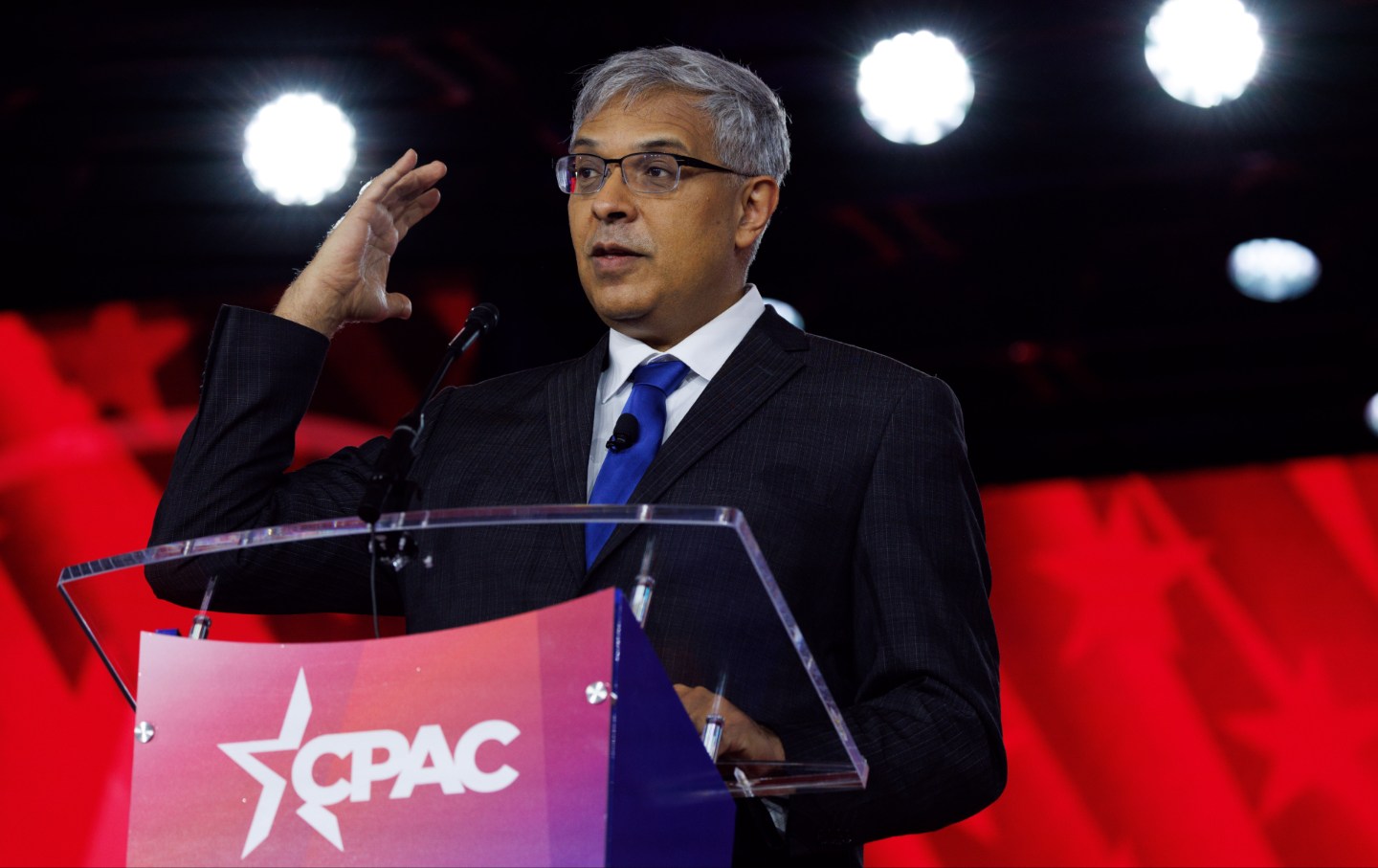
Jayanta Bhattacharya, director of the US National Institutes of Health, speaks during the Conservative Political Action Conference in Grapevine, Texas, on Saturday, March 28, 2026.
(Shelby Tauber / Bloomberg via Getty Images)American science is struggling for its life. It’s been under assault since January 2025, and nothing is getting better. We’re soon to be on a death watch. It is unbelievably stupid and insane—flushing away decades of American preeminence in innovation, and for what? No one has adequately explained why the mad men of the Trump administration are so hell-bent on this task.
But a question has lingered in my mind for months now: Why would scientific institutions be cozying up to the very people who want to pull them all down? Why do they insist on whitewashing what is happening, helping the perpetrators burnish their credentials?
Steve Vladeck, a law professor at Georgetown, wrote about the complicity of another set of scholarly actors—the members of legal academia—in a January blog post about the “dual state.” Even though it didn’t focus on the sciences, it still applies to the world I work in.
In this universe, we live in a bifurcated world: the normative state, where the systems of daily life and civic governance hew to the usual, existing order, and the “prerogative state,” which Vladeck describes as “a governmental system which exercises unlimited arbitrariness and violence unchecked by any legal guarantees.”
This idea of the dual state originated in the writings of Ernst Fraenkel, who fled the Nazis in 1938 and wrote a book in 1941 called The Dual State: A Contribution to the Theory of Dictatorship. Vladeck goes on to quote an essay by University of Minnesota law professor Oren Gross, titled “Hitler’s Willing Law Professors,” which discussed how “German academia turned with much zeal and enthusiasm to the project of justifying and legitimating the actions of the regime.… While legal scholars did not, by and large, participate directly in the crimes perpetrated by the Nazis, they facilitated those by conferring a veneer of legality and legitimacy to the actions of the regime” (my emphasis). Vladeck rejects comparisons between our current moment and Nazi Germany, but suggests that the concept of the dual state may still apply in our own time. The dual state operates with another function as well, beyond the two-track world it represents, as Pema Levy wrote in Mother Jones: “The dual state is thus two-faced twice over: it is characterized by a bifurcation in the law, but also by the facade of normalcy obscuring the fact of an authoritarian state.”
One example of this dual state in action in the world of science is a recent panel on enhancing scientific integrity at the National Academies of Science, Medicine, and Engineering.
The Academies represent the crème-de-la-crème of our nation’s scientists. On many occasions, often at the request of Congress, they issue reports and weigh in on scientific matters of great national importance. As the tagline on the front page of their website says, the Academies are: “Driving progress for the benefit of society by providing independent, objective advice to advance science, engineering, and medicine.” Discussing scientific integrity, rigor, and replicability in research is an important question for all of us.
So why in the world would the Academies invite Jay Bhattacharya, the director of the National Institute of Health, to opine about scientific integrity, when he has presided over the cancellation of thousands of grants on the basis of conservative trigger words? Why would they welcome a man who only last week pulled a critical vaccine study from publication because he didn’t like the conclusions (i.e., a “study that found that the Covid vaccine sharply cut the odds of hospitalizations and emergency visits last winter”), and terminated mRNA vaccine research at the institutes, among the other poor, unscientific decisions he makes on a regular basis? Why would they also invite Bhattacharya’s fellow Covid contrarians to the table, including one who doubled down on a flawed study suggesting that the Covid pandemic would only kill several tens of thousands of Americans (dear reader, more than a million are dead) and another with no training in any aspect of medicine, epidemiology, or public health who set herself up as an expert on how to address the pandemic (and has gotten it wrong on infectious diseases since the beginning of her career) to serve as his interlocutor?
In the end, the event obscured more than it enlightened because the Academies refused to invite anyone who could raise real criticism of Bhattacharya or speak truthfully about the fact that integrity at the NIH is currently in short supply. More importantly, Bhattacharya was allowed to make unsubstantiated claims and inaccurate comments on a wide variety of topics with little pushback, though moderator Emily Oster, to her credit, did try on one or two occasions to do so. Katy Milkman from Wharton, who co-organized the event, suggested that those criticizing the Academies for their choices should “come engage in dialogue, that’s how we improve.” Well, that didn’t quite work out. Though questions from the audience were supposed to be part of the panel, and many were submitted, he took and answered none.
Spokespeople for the Academies suggest that they were interested in a healthy debate, but by centering the event around Bhattacharya and his fellow travelers, they wound up giving a veneer of legitimacy to a man and an administration who don’t deserve it. It’s all as if to say: nothing to see here; same as it ever was; science is proceeding as it always has;, ignore what you see with your own eyes; look away from the smoldering heap that is the NIH. Of course, the motives may, on some level, be simply pecuniary; the Academies get much of their funding from the federal government, and a bit of genuflection is the price they have to pay.
However, I think something deeper is happening. In her valedictory address to the 163rd Annual Meeting of the National Academy of Science last week, outgoing Academies president Marcia McNutt gave up the pretense. She bluntly said that, on her watch, the Academies moved away from addressing issues like vaccines and climate change, which she called partisan. The Academies have been no stranger to “partisan” issues (e.g., their reports on stem cell research), until now. For such an august body to capitulate like this reflects the moral decline of our scientific institutions, where, as Oren Gross has said about the German legal academy all those years ago, “professional myopia, personal opportunism, moral weakness,” and in this case, scientific claims have “been inexorably intermingled.” The Academies are not alone, of course; universities around the country have held similar events with administration officials and made their own compromises with the White House. This is how the dual state in this context operates—science, even in its weakened state, limps along, and the contours of what is science fall under ideological control, while key institutions pretend it’s all business as usual. This, too, is the rise of Vichy science, with many willing to collaborate in the mistaken assumption that obedience and compliance will save their own necks.
Become a Sustaining Donor This September
Between the reemergence of right-wing red-baiting and Donald Trump’s use of the chilling National Security Presidential Memorandum–7 to criminalize left political organizing, we’re seeing McCarthyism reborn before our eyes.
This assault on democracy cannot be ignored or wished away. Resisting it requires bravery in the face of threats and repression, a steadfast commitment to the truth, and the unwavering belief that we can—and will—overcome this darkness.
We must have an independent media that sets the record straight, unearths corruption and abuses of power, and advances a politics of justice and dignity for all if we’re to win this fight.
That’s why I’m writing to you today. This September, The Nation needs to add 100 monthly donors to sustain our progressive journalism. Your contribution makes the next investigative report, the next truth-speaking column, and the next pathbreaking essay all possible.
I hope you’ll support our work with a recurring donation today. If you donate $10 or more a month, we’ll send you a brand new “Hands Off the Free Press!” sticker to recognise your commitment to our cause. Please, donate today.
Onward,
Katrina vanden Heuvel
Editor and Publisher, The Nation