The Fifth Circuit Seeks to Unilaterally Reimpose an Outdated Abortion Pill Protocol
What comes next is shifting terrain. The drug manufacturer has asked the Supreme Court to intervene, but the Food and Drug Administration could also step in.
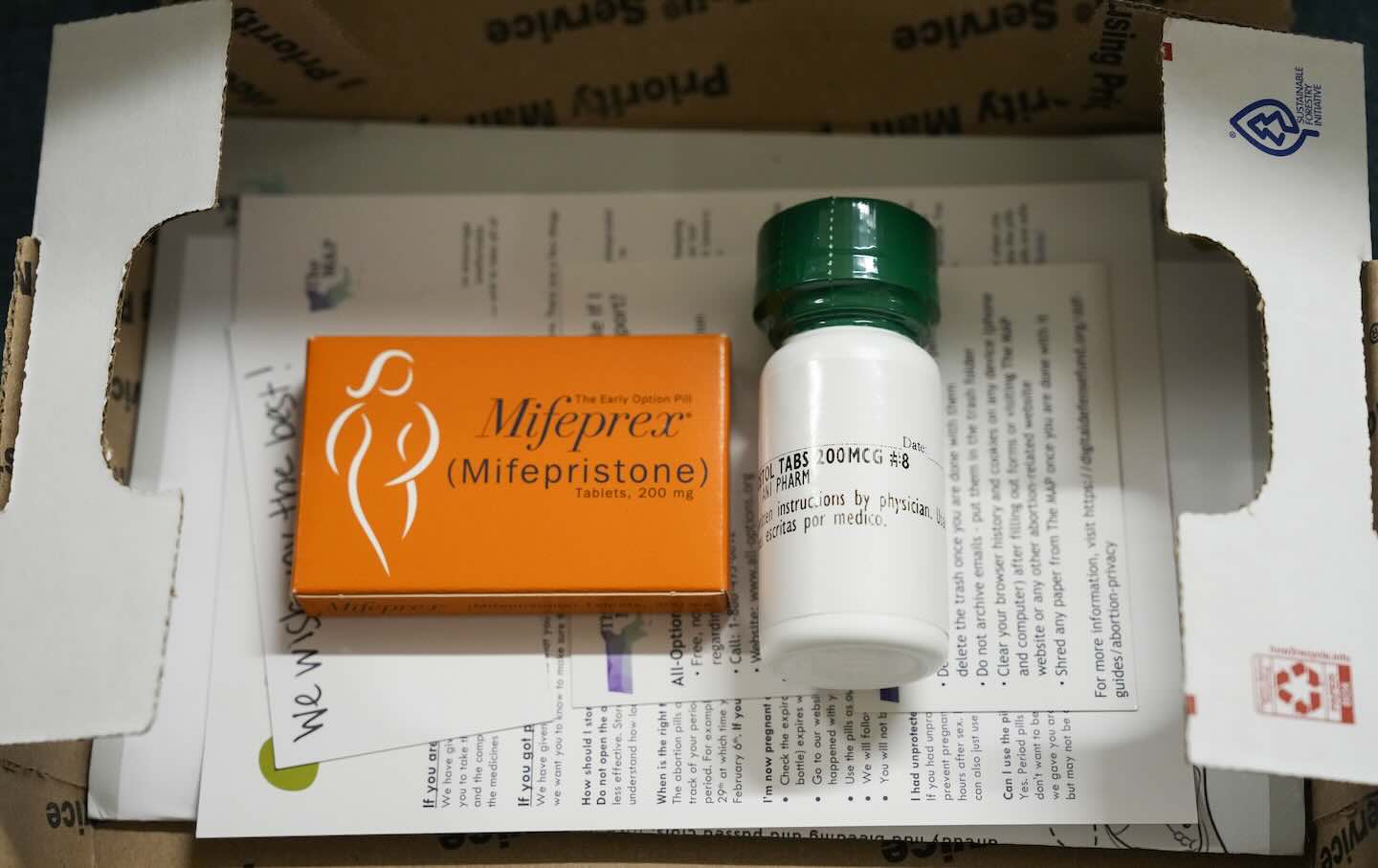
Update: On Monday morning, the US Supreme Court restored access to abortion medication via telehealth. The order, written by Justice Samuel Alito, extended a stay on the Fifth Circuit’s ruling for one week “while both sides respond and the court more fully considers the issue,” the Associated Press reports.
On Friday night, the US Court of Appeals for the Fifth Circuit issued an 18-page order that winds back the clock to 2016. The order reimposes a restriction on mifepristone, the first part of a two-drug regimen to end a pregnancy, that requires patients pick up the pill at a healthcare facility—in effect, banning the use of telehealth for medication abortion nationwide, at least temporarily.
Telehealth abortion—in which a provider, patient, and pharmacy all interact online and pills are mailed to patients—accounts for more than a quarter of all abortions and has been growing in popularity since the Covid-19 pandemic and the US Supreme Court overturned Roe v. Wade. Since the Dobbs v. Jackson Women’s Health Organization decision in 2022, patients in states with abortion bans have been receiving the medication by mail from providers in states where abortion remains legal, who operate according to their own state’s laws. But as telehealth abortion and medication abortions broadly became more widely used, anti-abortion activists have deployed a variety of tactics to threaten the legality of and access to the medication. Louisiana v. FDA, the lawsuit before the Fifth Circuit, marked the latest attempt, but certainly not the first or last, to challenge telehealth abortion.
Louisiana brought the lawsuit against the Food and Drug Administration in October of last year, arguing that the agency acted unlawfully when, practically in 2021 and officially in 2023, it lifted a restriction on mifepristone that required patients to pick up the medication at a clinic, although patients did not have to take mifepristone in a provider’s presence. The rule changed in the wake of litigation during Covid-19 and on the back of extensive research establishing the safety of telehealth for medication abortion.
Prior to Louisiana’s lawsuit, a group of anti-abortion doctors pursued the same outcome, in addition to asking the FDA to remove its 2000 approval of the drug. Those doctors, suing as the Alliance for Hippocratic Medicine, lost before the Supreme Court in 2024; a unanimous court held that they did not have standing, or could not prove an actual injury from the FDA’s rule. Anticipating the Supreme Court’s decision, other states—Missouri, Kansas, and Idaho—intervened in the case to assert their states’ standing. These states mirrored the Alliance’s legal strategy but also argued to the district court that out-of-state providers mailing abortion pills to residents of their states threatened state lawmakers’ ability to enforce their abortion bans. Texas and Florida took the same course in lodging a separate case.
Louisiana filed their own lawsuit attacking only the decision to lift the in-person requirement. The FDA requested that the district court in Louisiana hold the case until the agency “reconsidered the restrictions on mifepristone based on all the evidence.” Health and Human Services Secretary Robert F. Kennedy Jr. announced a review last fall in response to letters by Republicans pressuring the HHS for the rule’s reinstatement and following the release of a widely discredited paper, published by an anti-abortion organization, calling into question mifepristone’s safety record.
Louisiana, not to be deterred, appealed the district court’s decision to the Fifth Circuit, which issued its decision on Friday. That ruling orders that the in-person pickup rule be put back in place, meaning that patients nationwide must pick up the medication from a clinic or hospital. The Fifth Circuit brushed aside the arguments made by the FDA about its ongoing review—which, to be clear, is unnecessary given the long-standing safety track record of mifepristone. And it discounted the judgments of other federal district courts, such as one issued last October, that found the current restrictions on mifepristone, before and after the 2023 FDA decision, to be unnecessarily burdensome and unlawful.
So, in the face of an agency request, contrary federal court decisions, and a strong evidentiary record of safety and efficacy, the Fifth Circuit seeks to unilaterally reimpose a drug restriction that will affect thousands of Americans.
What comes next is shifting terrain. The drug manufacturer has asked the Supreme Court to intervene to keep the status quo while the case proceeds through the courts. The Supreme Court previously issued a stay during the original litigation, when the Fifth Circuit first sought to change FDA regulations. If the justices agree with the manufacturer, telehealth for medication abortion will continue as it has for the last five years. If not, telehealth providers will face a changing legal landscape.
For one, the Fifth Circuit suggests that its holding is immediate—in other words, the old rule applies now. But that says nothing of the pills that are presently in providers’ or distributors’ possession, acquired for the purpose of telehealth before the court’s decision. Or patients who have appointments for telehealth made before Friday’s ruling. For another, the FDA has enforcement discretion, which means that the agency could announce that it will not pursue any actions against people who need time to adjust to a new regime.
Pausing now is important, because the Fifth Circuit only seems to care about pills’ transit into states with bans, which Louisiana and other states claim impedes their ability to enforce their abortion bans. Suspend for a moment the continuing problem of standing—the claim that a state itself is injured from a rule that allows telehealth across the country—the Fifth Court paid no attention to the fact that everyone in every state would be affected by a disruption in service in weighing the costs of its order.
Moreover, the FDA deals largely with drug manufacturers and distributors, not with providers. The normal process for reversing a drug regulation requires study and evidence; though ignored by the Fifth Circuit, all the data points to mifepristone’s safety generally as well as when delivered through telehealth. Friday’s judgment short-circuits whatever process comes next, without any direction for the providers or pharmacies potentially caught in the crosshairs.
Whatever the Supreme Court decides, no one should expect pills to stop reaching patients. International abortion pill access will continue to exist. And the second part of the two-drug regimen, misoprostol, can end a pregnancy by itself and is not subject to the Fifth Circuit’s decision.
And no matter what comes next, it’s worth remembering that the Louisiana case is one strand of a multipronged attack on mifepristone. Here, the Fifth Circuit has focused on a dubious claim about states’ being able to enforce their laws. In this and other attacks, states repeat bogus allegations that telehealth for medication abortion is ripe for misuse and results in patients’ physical and mental harm. These arguments are all designed to end abortion across the country. But if we have learned anything from the Dobbs decision and every attempt to ban abortion since then, people will not stop having abortions, and that includes accessing abortion medication by mail.
Become a Sustaining Donor This September
Between the reemergence of right-wing red-baiting and Donald Trump’s use of the chilling National Security Presidential Memorandum–7 to criminalize left political organizing, we’re seeing McCarthyism reborn before our eyes.
This assault on democracy cannot be ignored or wished away. Resisting it requires bravery in the face of threats and repression, a steadfast commitment to the truth, and the unwavering belief that we can—and will—overcome this darkness.
We must have an independent media that sets the record straight, unearths corruption and abuses of power, and advances a politics of justice and dignity for all if we’re to win this fight.
That’s why I’m writing to you today. This September, The Nation needs to add 100 monthly donors to sustain our progressive journalism. Your contribution makes the next investigative report, the next truth-speaking column, and the next pathbreaking essay all possible.
I hope you’ll support our work with a recurring donation today. If you donate $10 or more a month, we’ll send you a brand new “Hands Off the Free Press!” sticker to recognise your commitment to our cause. Please, donate today.
Onward,
Katrina vanden Heuvel
Editor and Publisher, The Nation