They Were Never Going to Stop After Dobbs. We Can Minimize the Harm.
They Were Never Going to Stop After “Dobbs.” We Can Minimize the Harm.
Our collective liberation depends on our continued dedication to caring for each other through these threats and attacks on abortion access.
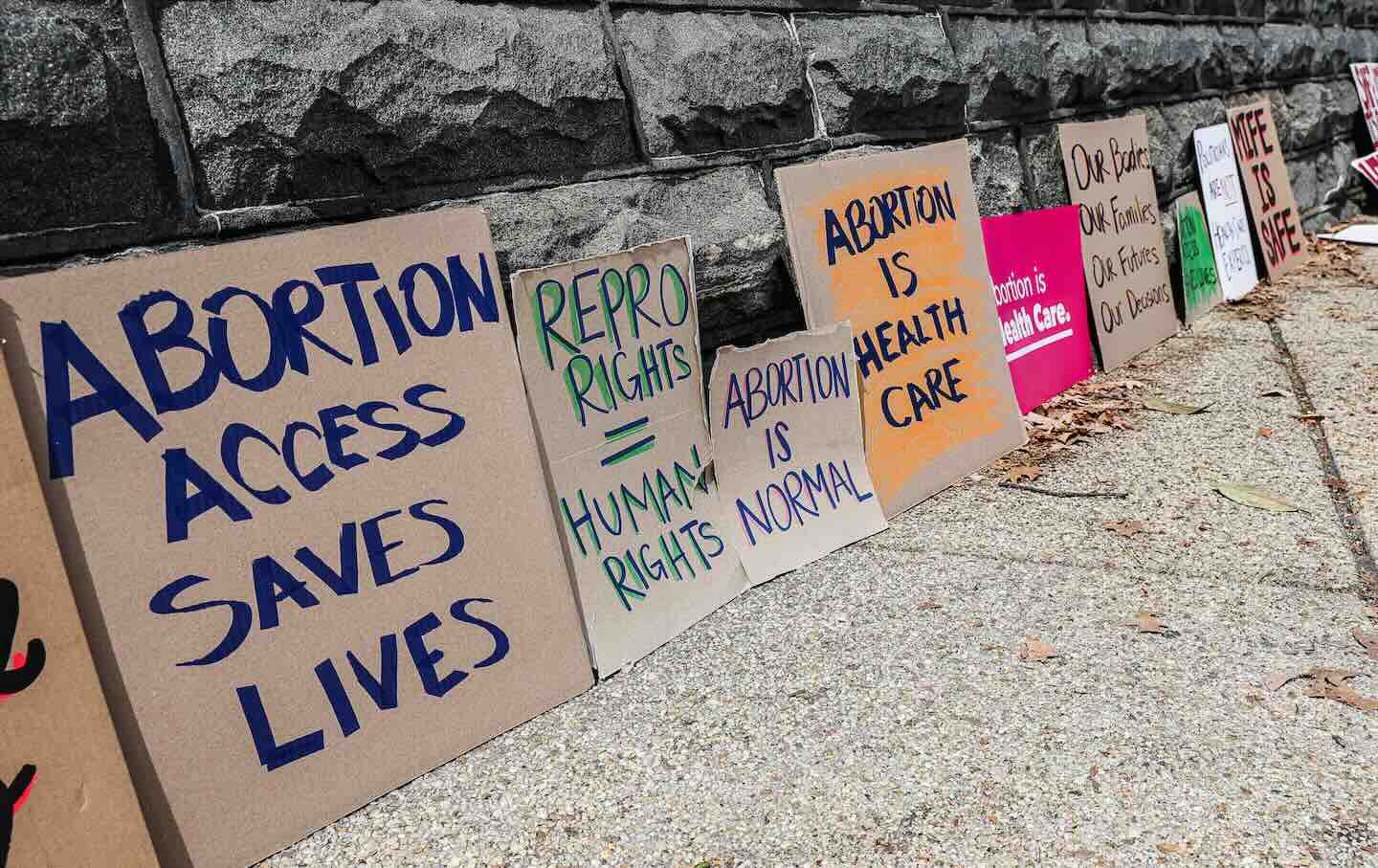
Signage left by demonstrators outside the US Supreme Court on March 26, 2024.
(Valerie Plesch / Bloomberg)Update: On Monday morning, the US Supreme Court restored access to abortion medication via telehealth. The order, written by Justice Samuel Alito, extended a stay on the Fifth Circuit’s ruling for one week “while both sides respond and the court more fully considers the issue,” the Associated Press reports.
On Friday, the US Court of Appeals for the Fifth Circuit issued a decision in Louisiana v. Food and Drug Administration, mandating that one of the two medications used in the majority of medication abortion care in the United States, mifepristone, must now be dispensed in person. This is the anti-abortion movement’s most recent attempt to push abortion care out of reach for pregnant people, and the implications are severe and nationwide.
The Fifth Circuit’s ruling affects over a quarter of people accessing telehealth abortion in the United States who receive medication abortion care by mail and pick up the pill at the pharmacy. With clinician-guided telehealth abortion care using mifepristone now disrupted, anti-abortion forces have laid bare their true intentions: to create chaos, confusion, and fear for people who are pregnant and trying to access the lifesaving healthcare they need. With an emergency appeal before the US Supreme Court seeking to restore access to abortion pills by mail, I see this attack for what it is: a political game upending and disrupting real lives.
As a board-certified, full-spectrum obstetrician and gynecologist, an abortion provider, and someone who has been caring for patients over the last 25 years, I’ve witnessed the real-life impact that anti-abortion laws and rules fueled by abortion stigma and patriarchal values like the one issued on Friday night have on patients and their families. The harm is not hypothetical. Anti-abortion extremists prey on people needing timely care and resources, hoping that when a headline is published after new rules are issued or laws are passed, pregnant people believe their only available option is to stay pregnant against their wishes and, sometimes, at the expense of their own health and well-being.
I am here to make it clear that this is simply not the case. Pregnant people across the country need to know that there are still options available to access the care they need. For example, although medication abortion care, or abortion care with pills, has been typically administered using mifepristone and misoprostol in combination, misoprostol can be used on its own as well. In fact, this regimen is used by most patients around the world, especially in places where mifepristone is unavailable or difficult to access. Both regimens are well studied and extremely safe, whether accessed in clinics, via telehealth care, or at home. We know that even if mifepristone access is currently limited to in-person dispensing, misoprostol-only regimens can continue to be accessible via mail, and telehealth clinics across the country are poised to shift to misoprostol-only regimens.
We also know that since Dobbs v. Jackson Women’s Health Organization upended legal access to abortion in the country and more and more people have continued to receive care in states with extreme abortion bans, patients have relied on community-organized resources to get abortion pills and safely self-manage their care.
Moreover, clinic-based abortion care, with or without the support of telemedicine for portions of the visit, as well as procedural abortion care for those who want or need it, is still available for patients who live in states with in-person abortion access or those who are able to travel for care with the lifesaving support of abortion funds and practical support organizations.
But the fact of the matter is, it shouldn’t take hundreds of words to describe the abortion access landscape. Because, frankly, abortion is not that complicated. Anti-abortion extremists just want it to appear that way.
While proven time and time again to be safe and effective, anti-abortion extremists remain committed in their attempts to characterize abortion and those who need it as unsafe and immoral. This is a thinly veiled attempt to control the lives of those with the capacity for pregnancy. It is a distraction.
Anti-abortion tactics are not now, nor have they ever been, about morality. They are not about the safety or well-being of women and families. People opposed to abortion rely on factually inaccurate and disturbing depictions of care because they don’t want you to know that abortion is compassionate, person-centered, and helps patients live the lives they want to live with dignity and safely.
Telehealth care and accessing medication by mail and via pharmacy has been a critical aspect of abortion access for many years. Just as we saw an uptick in telehealth for all areas of medicine during the Covid-19 pandemic, the use of telehealth services for those seeking to end their pregnancies and manage their miscarriages increased as well. Telehealth for abortion care and the dispensation of mifepristone by mail and pharmacy provided access for those who simply couldn’t make it to clinic because they lived in a rural community affected by the physician shortages, or in a state with abortion bans, needed to stay home to care for their children, had a shift at work and lacked paid leave, or simply felt more comfortable and affirmed getting their care at home rather than in a clinic. But the reason why someone seeks this care is not really relevant. As a physician, I trust patients to know what’s best for themselves and their families.
No matter what happens as we await the Supreme Court’s decision, I want to be clear that abortion providers and advocates are not shirking our commitments to our patients. We will continue to trust our patients and support them in getting the care they need. We knew anti-abortion extremists wouldn’t stop at Dobbs, and we are poised and ready to keep thinking creatively to get patients the care they need.
I urge patients to be in touch with their clinicians to work together to ensure that the many remaining access points for abortion care are made available. I urge clinicians, practical support organizations, and legal networks to be in touch with patients to ensure that the care they seek is safe and supportive and minimizes harm.
Abortion access has always been a part of our lives and has always existed in our communities, since people started getting pregnant, and it will continue to be. That will not change. Our collective liberation depends on our continued dedication to caring for each other through these threats and attacks. We will not stop. Our well-being, safety, and autonomy depend on it.
Become a Sustaining Donor This September
Between the reemergence of right-wing red-baiting and Donald Trump’s use of the chilling National Security Presidential Memorandum–7 to criminalize left political organizing, we’re seeing McCarthyism reborn before our eyes.
This assault on democracy cannot be ignored or wished away. Resisting it requires bravery in the face of threats and repression, a steadfast commitment to the truth, and the unwavering belief that we can—and will—overcome this darkness.
We must have an independent media that sets the record straight, unearths corruption and abuses of power, and advances a politics of justice and dignity for all if we’re to win this fight.
That’s why I’m writing to you today. This September, The Nation needs to add 100 monthly donors to sustain our progressive journalism. Your contribution makes the next investigative report, the next truth-speaking column, and the next pathbreaking essay all possible.
I hope you’ll support our work with a recurring donation today. If you donate $10 or more a month, we’ll send you a brand new “Hands Off the Free Press!” sticker to recognise your commitment to our cause. Please, donate today.
Onward,
Katrina vanden Heuvel
Editor and Publisher, The Nation