How Trump Got His Tacky Arch Approved
Neoclassical revivalists had to sell their souls.
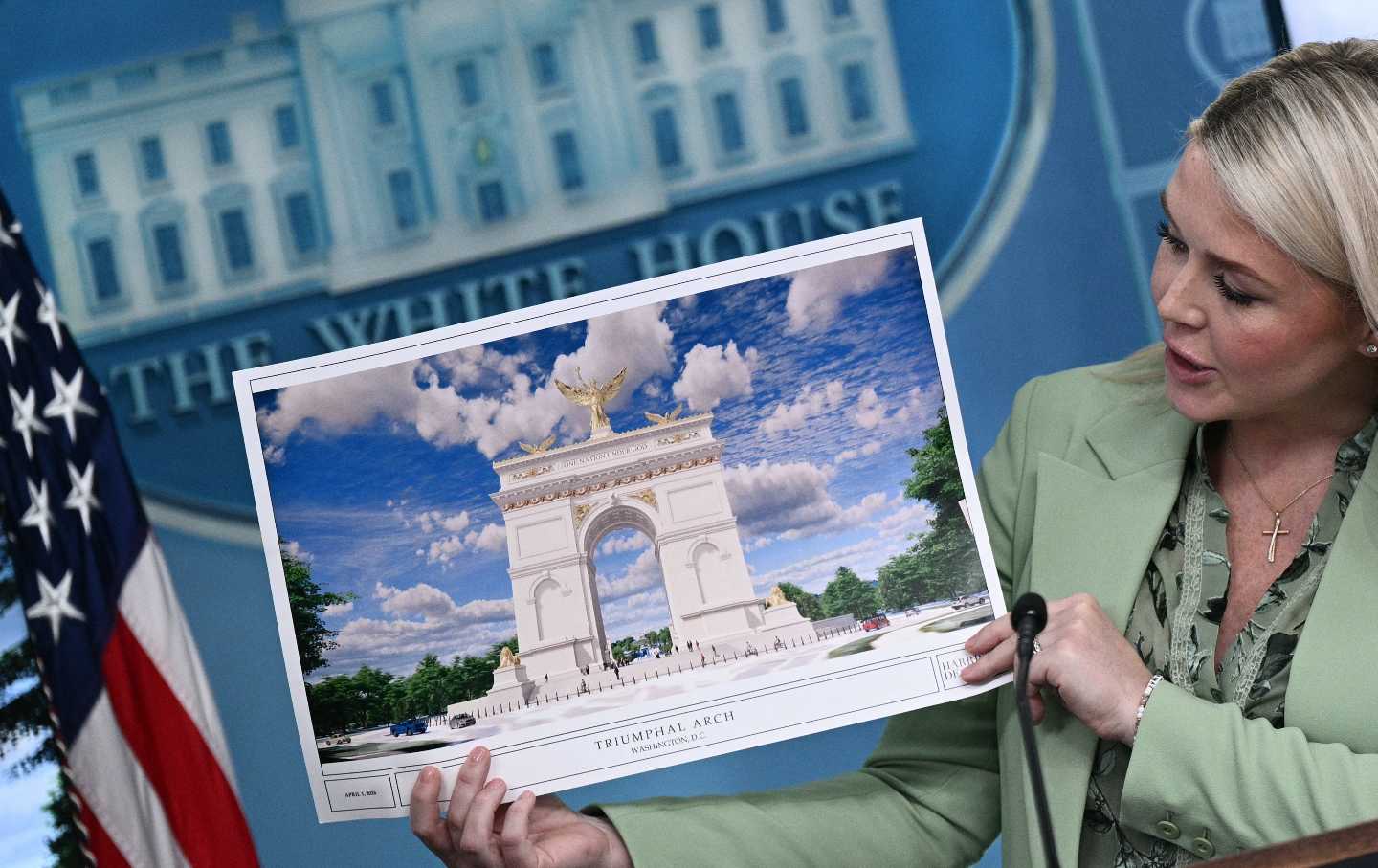
White House Press Secretary Karoline Leavitt shows an artist’s rendering of the arch.
(Brendan Smialowski / Getty)One of the less remarked upon reverberations of Trump’s disastrous rule of this country is that he has turned its architectural critics into exegetes of his sleazy plans for Washington, DC’s built environment. Instead of writing about the burgeoning (and often life-affirming) shifts in today’s architectural culture—from adaptive reuse to beautiful, functional affordable housing—we critics keep getting yanked back into the slopworld of ballrooms, arches, and faux gold leaf.
It goes without saying that the proposed 250-foot-tall triumphal arch (one foot for every year the United States has existed!) is absurd and tacky. Modeled on the Arc de Triomphe in Paris, it boasts gaudy gilded lettering and a 80-foot cake-topper statue—Trump can’t help but cheat, even on the height of his own precious arch. His McMansionized conception of what is monumental and “historic” is, much like his culinary penchant for McDonald’s itself, one of his most idiosyncratic qualities.
The motivations behind Trump’s building frenzy are not exactly mysterious. “We’re building a valuable piece of real estate right back here,” he told attendees of an Easter lunch, gesturing to construction work on his infamous ballroom. “It’s going to be amazing.” Referring to the White House as “real estate” is a bit of parapraxis, letting slip that the executive branch, in more ways than one, is indeed for sale. He is also jonesing to build a kind of knock-off One World Trade Center (but this time, of course, with a hotel) as his presidential library (perfect for a man who probably hasn’t read a book in 30 years), driving home that he is, above all, a developer at heart. His understanding of power derives from this fundamental belief that to control the land is to control the world.
As a true son of the 1980s, he believes in spectacle over quality. Arches, ballrooms, even queues for the White House, as though it were the fast-track lane at Disney World—all of these reek of what architecture critic Michael Sorkin warned us about way back when: the “theme-parkification of the American built environment.” Facing his impending 80s, Trump keeps spouting off erratically about his architectural plans. In a bizarre TruthSocial post, he bragged that the ballroom is going to have “Bomb Shelters, a State of the Art Hospital and Medical Facilities, Protective Partitioning, Top Secret Military Installations, Structures and Equipment, Protective, Missile Resistant Steel, Columns, Roofs, and Beams” (I should hope so), plus “Military Grade Venting, and Bullet, Ballistic and Blast-proof Glass.” He clearly views these building projects—these displays of undemocratic and militaristic might—as crucial to his legacy.
Those who realize what poor taste it’s all in have little recourse, given the extent of Trump’s capture of the rather complex and elaborate legislative framework that protects the historic built environment of the nation’s capital. In fact, many of them only have themselves to blame. This, more than anything else, is what interests me about the situation: architecture as a form of power. It is a case study in how ideologically invested architectural movements can secure power for themselves—and what can happen when the monkey’s paw curls.
Before Trump circumvented or infiltrated them, various DC agencies, each with its own internecine processes, governed how new buildings are erected in the heavily protected historic landscape that forms the iconic backdrop of American power. These agencies and their extensive regulations exist to prevent exactly what is happening now from happening. The hard-right-wing architectural advocacy group the National Civic Arts Society, which wants all that ugly modernism out of public spaces and nought but classical refinement in its place, reportedly played a big role in Trump’s “make federal buildings beautiful again” executive order. Their acolytes now staff the Commission of Fine Arts and the National Capital Planning Commission. Meanwhile, the Commemorative Works Act of 1986, which details a multistep process for authorizing and designing memorial works in DC (such an arch), mandates that all such work be approved by Congress. Oh, well!
The White House has its own guidelines set by the Committee for the Preservation of the White House. The director of the National Park Service chairs this committee, which is staffed by federal officials and others selected by the president (many from the Commission of Fine Arts). Facing this total capture, the nation’s usual architectural gatekeeping organizations (such as the American Institute of Architects) can only make statements condemning Trump’s follies.
At this point only the courts can step in. The National Trust for Historic Preservation has sued to stop the construction of the ballroom with some success; construction has been paused as of writing. Meanwhile, a group of Vietnam veterans is in the process of suing to stop the building of the arch out of concern that it obstructs the view to Arlington Cemetery. Never has a president been in a better position to alter the shape of the city from which he governs. Similarly, with perhaps the exception of the New Deal, never has a group of architects with an explicit ideology gotten so close to realizing their political vision.
This capture comes with a price. As Trump waits out the pause on the ballroom construction, his toadies in the Commission of Fine Arts (including his now-fired ballroom architect, James McCreary) are pretending that their actual vision and opinions on architecture matter. The New York Times reported McCreary remarking of the statues on top of the arch, “I wonder if you need those up there,” and that “[it would be] a better, more Washingtonian design” without them. Similarly, about the proposed lions at the arch’s base: “Work on the lions and find replacements for them…. As I said earlier, they’re not of this continent.”
One can easily see how McCreary, with his overtly nativist views, ended up in the position he’s in. However, the Faustian bargain the so-called neoclassical movement within architecture has made with Trump in order to secure access to basically unlimited control over what gets built in the nation’s capital comes with the caveat that they are now beholden to someone bereft of taste. Not only that, they are and will forever be pariahs in their own field. Their complicity in the wanton destruction of DC will all but kill the nigh-50-year project of reviving neoclassicism in architecture. And for all their populist bloviating about speaking to the true aesthetic preferences of the American public, 58 percent of Americans do not approve of Trump’s changes to the White House. Art of the deal indeed.
Become a Sustaining Donor This September
Between the reemergence of right-wing red-baiting and Donald Trump’s use of the chilling National Security Presidential Memorandum–7 to criminalize left political organizing, we’re seeing McCarthyism reborn before our eyes.
This assault on democracy cannot be ignored or wished away. Resisting it requires bravery in the face of threats and repression, a steadfast commitment to the truth, and the unwavering belief that we can—and will—overcome this darkness.
We must have an independent media that sets the record straight, unearths corruption and abuses of power, and advances a politics of justice and dignity for all if we’re to win this fight.
That’s why I’m writing to you today. This September, The Nation needs to add 100 monthly donors to sustain our progressive journalism. Your contribution makes the next investigative report, the next truth-speaking column, and the next pathbreaking essay all possible.
I hope you’ll support our work with a recurring donation today. If you donate $10 or more a month, we’ll send you a brand new “Hands Off the Free Press!” sticker to recognise your commitment to our cause. Please, donate today.
Onward,
Katrina vanden Heuvel
Editor and Publisher, The Nation