
The Supreme Court Just Cleared the Way for a Flood of “Reverse Discrimination” Lawsuits
The court’s ruling in favor of a woman who says she was passed over for jobs because she is straight is correct in theory—but it’s going to be terrifying in practice.

Marlean Ames, who claims she was passed over for jobs because she is a straight woman, stands outside her lawyer’s office in Akron, Ohio.
(Maddie McGarvey / for The Washington Post via Getty Images)Today, the Supreme Court made it easier for white people to claim “reverse discrimination” any time an employer hires or promotes anybody who is not a heterosexual white person. And the court did so unanimously. And the person who wrote the unanimous opinion for the court was Justice Ketanji Brown Jackson. I will now walk into the ocean.
What makes the whole situation even more galling to me is that it’s probably the correct decision. It’s right in terms of the law—even though the underlying facts in Ames v. Ohio Department of Youth Services are a case study in white fragility in the modern age.
The plaintiff in this case is Marlean Ames, a straight white woman who worked for the Ohio Department of Youth Services. Ames applied for a promotion, but didn’t get it. Instead, the promotion went to a man, and that man happened to be gay. That’s all I know about him from the court record, but I promise you that if the man happened to be a heterosexual white guy, this never would have reached the Supreme Court.
Ames claimed that hiring a gay man over her was an instance of “reverse” discrimination. She argued that the government (and remember we’re talking about the government of the state of JD Vance’s Ohio here) discriminated against her because she is straight. She filed a lawsuit under Title VII of the Civil Rights Act, which prohibits workplace discrimination.
Ames had every right to sue. Anybody, regardless of their race, gender, or sexual orientation can sue under the Civil Rights Act, because anybody can be discriminated against in certain circumstances.
Ohio, however, is still governed by a rather archaic rule regarding workplace discrimination lawsuits. It requires people who are in the “majority” group (white people generally, or straight people in this case) to show that there are “background circumstances” at their place of work that suggest a pattern of discrimination against them. It places a “heightened burden” of evidence on members of the majority when they bring discrimination suits.
I think the rule makes sense. No matter what Stephen Miller or Chris Rufo tell you, white people have not been historically discriminated against in this country, and they are not now. Neither are straight people. It’s not too much to ask people in the majority to meet a heightened evidentiary standard before claiming that, all of a sudden, everybody hates them. They still can bring a claim, and win, but they should be forced to show something more than “OMG, they hired a gay man, a gay man, can you believe it? I am a victim of the gay agenda.”
Of course, I’m not white, and I’m not homophobic. Asking straight white people to acknowledge that they’ve had every advantage this world has to offer is not something we are allowed to do in this country. Instead, we live in a world where every time a white person doesn’t get something they think they’re entitled to, we’re supposed to assume they’ve been treated unfairly.
I did not expect the Supreme Court to buck the prevailing trend in this case. I predicted that this case would come down 9–0 in favor of Ames, as it has. At oral arguments, the conservatives were predictably incensed at the notion that white people should have to meet a heightened standard because of their privilege and power in this society, while the liberals were suspiciously silent.
In her unanimous opinion for the court, Justice Jackson analyzed the case in a conservative, textualist manner. She said (correctly) that Title VII makes no mention of special burdens or heightened standards based on one’s classification as a “majority” person. Congress could have written Title VII to include a heightened burden for white folks, but it didn’t. It could have amended Title VII to include an additional burden if it felt “reverse” discrimination claims were getting out of hand, but it hasn’t.
Jackson further argued (again, correctly) that the Supreme Court’s own interpretation of Title VII rejects the notion that its standards should change based on the race, gender, or sexual orientation of the litigants. Her reasoning in Ames is similar to Justice Neil Gorsuch’s reasoning in Bostock v. Clayton County Georgia, where Gorsuch ruled, over the objection of his conservative colleagues, that Title VII’s prohibition on “sex” discrimination includes a prohibition against discrimination based on sexual orientation.
If Jackson is right and the unanimous court is right and I agree that they’re right, then why am I so salty about the opinion? Well, it’s because I know what’s coming next. Reverse discrimination claims are on the march. White people, emboldened by Trump, are acting like every time a non-white person is hired or promoted for any job, anti-white discrimination is the culprit. Flooding the courts with reverse discrimination claims is literally part of the Project 2025 playbook. Straight white guys I know and am friends with have confessed that they at least wonder if anti-white discrimination played a role when they don’t get a job or a promotion. None of the white guys I know would actually sue over it (at least, they better not), but I’m not friends with a lot of white guys.
Popular
“swipe left below to view more authors”Swipe →The 9–0 opinion in this case is like hanging an “Open for Grievances” sign on every federal courthouse. We’re going to be inundated with this stuff, and most of these people will have nothing more than the fact that they, a white person, didn’t get what they wanted.
I’m not saying the liberals on the court should have considered all that while deliberating this case. I probably wouldn’t have if I were on the court. Even though I like the Ohio rule, it’s clearly at odds with the text and modern interpretation of Title VII. It would be very Republican of me to expect the justices to abandon key and obvious legal principles just to achieve a desired cultural effect.
But, I’m not on the court, so I still get to be pissy about this one. The Ames decision was the right opinion, for the right reasons… and because of it, things will get worse.
Support independent journalism that does not fall in line
Even before February 28, the reasons for Donald Trump’s imploding approval rating were abundantly clear: untrammeled corruption and personal enrichment to the tune of billions of dollars during an affordability crisis, a foreign policy guided only by his own derelict sense of morality, and the deployment of a murderous campaign of occupation, detention, and deportation on American streets.
Now an undeclared, unauthorized, unpopular, and unconstitutional war of aggression against Iran has spread like wildfire through the region and into Europe. A new “forever war”—with an ever-increasing likelihood of American troops on the ground—may very well be upon us.
As we’ve seen over and over, this administration uses lies, misdirection, and attempts to flood the zone to justify its abuses of power at home and abroad. Just as Trump, Marco Rubio, and Pete Hegseth offer erratic and contradictory rationales for the attacks on Iran, the administration is also spreading the lie that the upcoming midterm elections are under threat from noncitizens on voter rolls. When these lies go unchecked, they become the basis for further authoritarian encroachment and war.
In these dark times, independent journalism is uniquely able to uncover the falsehoods that threaten our republic—and civilians around the world—and shine a bright light on the truth.
The Nation’s experienced team of writers, editors, and fact-checkers understands the scale of what we’re up against and the urgency with which we have to act. That’s why we’re publishing critical reporting and analysis of the war on Iran, ICE violence at home, new forms of voter suppression emerging in the courts, and much more.
But this journalism is possible only with your support.
This March, The Nation needs to raise $50,000 to ensure that we have the resources for reporting and analysis that sets the record straight and empowers people of conscience to organize. Will you donate today?
More from The Nation

The Real Reason Americans Love Guns The Real Reason Americans Love Guns
With a weak social safety net, a gun offers a false sense of personal power and security.

The Endless Hypocrisy of Bari Weiss The Endless Hypocrisy of Bari Weiss
She claims to be a free speech champion. But as her actions at CBS News keep showing, she seems to think free speech should run only in a rightward direction.
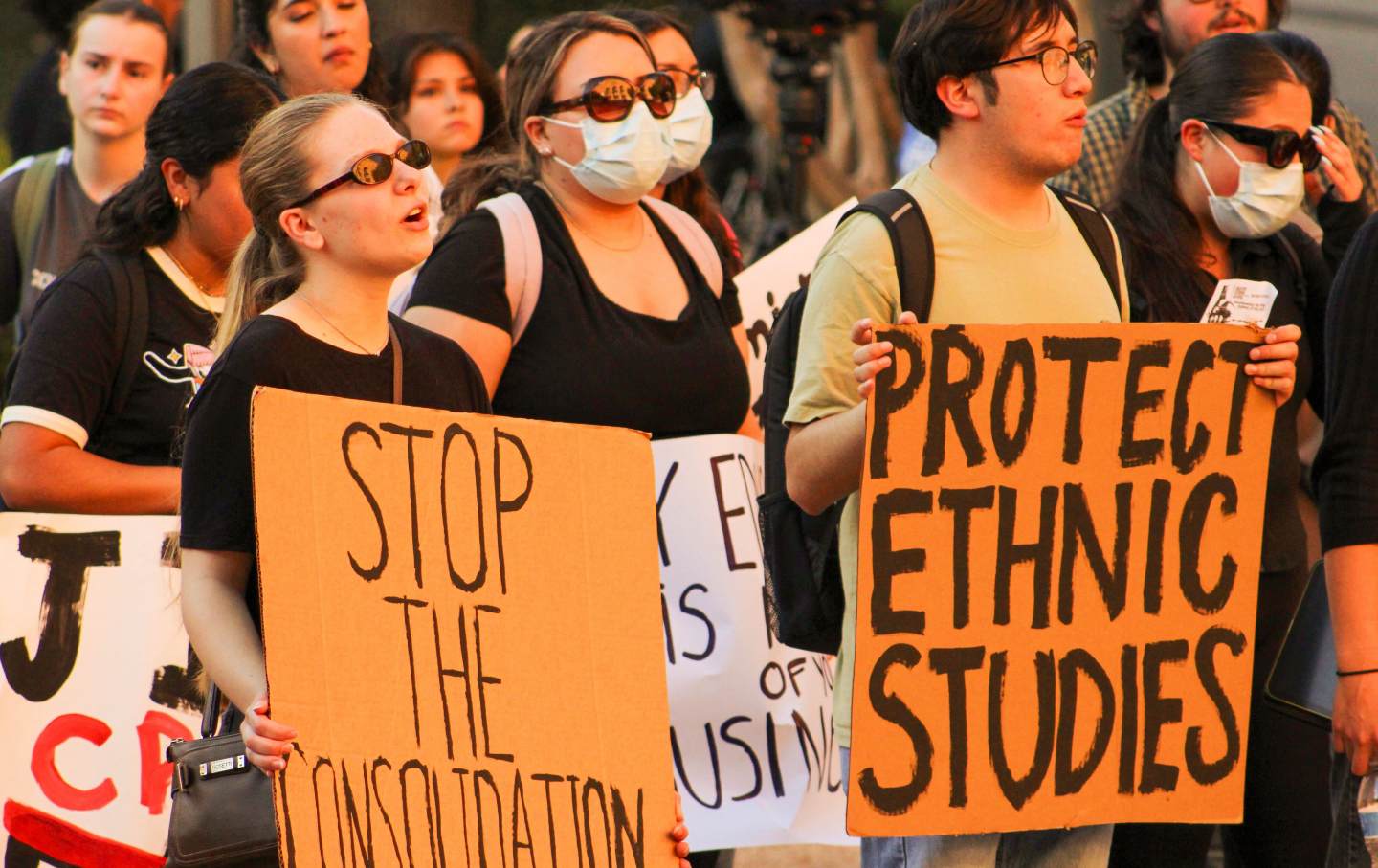
What Will Be Left After the University of Texas Destroys Itself? What Will Be Left After the University of Texas Destroys Itself?
UT-Austin has collapsed its race, ethnic, and gender studies into a single program while a new policy asks faculty to avoid “controversial” topics. But the attacks won’t end there...

The Corporate Media Is Head Over Heels for the Iran War The Corporate Media Is Head Over Heels for the Iran War
Donald Trump’s attack may be surreal, unjustified, and illegal. But that’s not stopping the press from turning the propaganda dial way up.

The Disturbing History of ICE’s “Death Cards” The Disturbing History of ICE’s “Death Cards”
The Vietnam-era practice is yet another example of ICE agents thrilling to the brutality they have been encouraged to cultivate.
The American Universities Programming Israel’s Killer Drones The American Universities Programming Israel’s Killer Drones
Industry partnerships in higher education are pushing STEM graduates into the business of weapons manufacturing and genocide profiteering.

