
Is the Sports Draft Obsolete?
With the players association’s new collective bargaining agreement, the National Women’s Soccer League became the first major league in American sports to abolish the college draft.
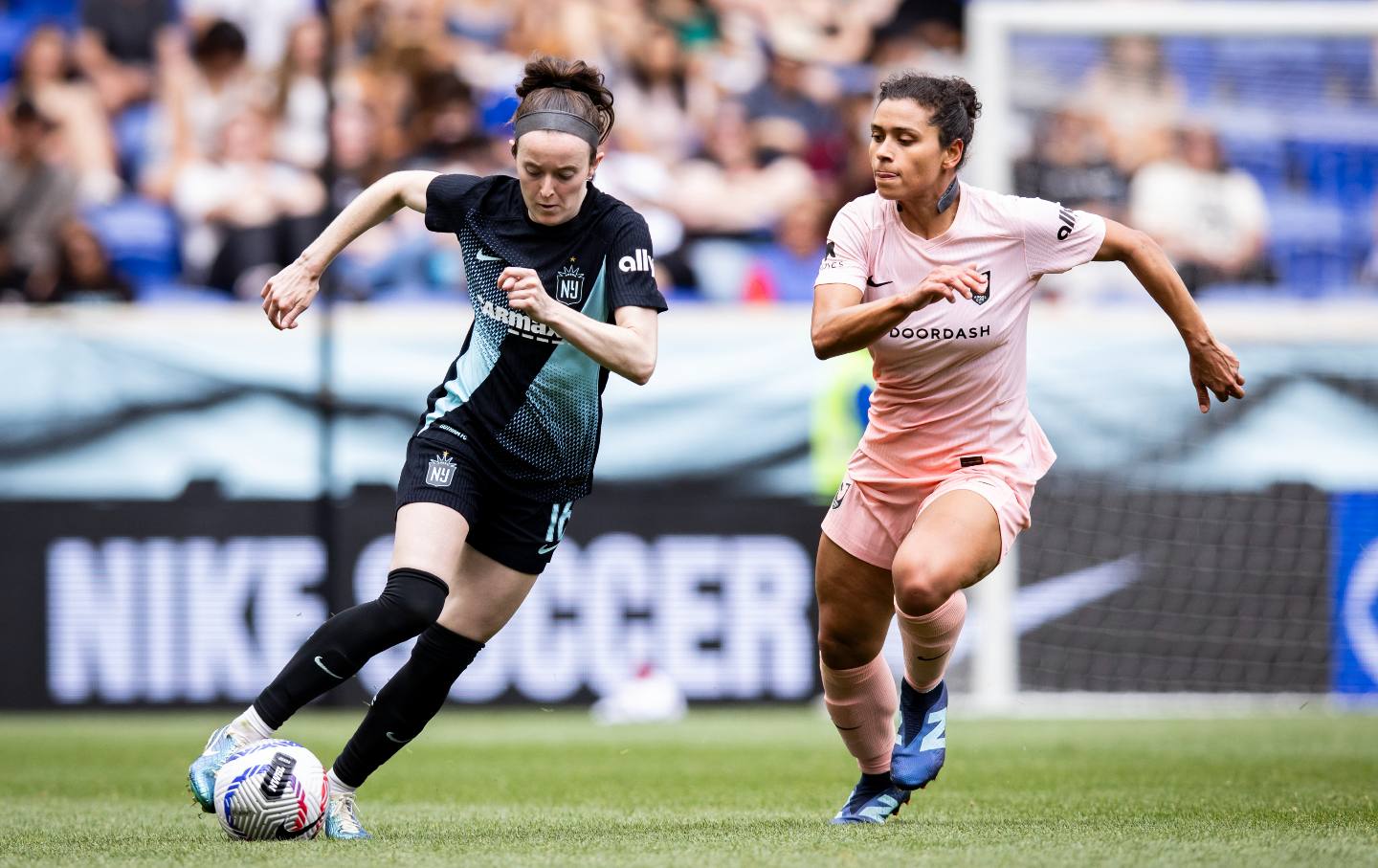
A National Womens Soccer League match at Red Bull Arena on June 8, 2024.
(Ira L. Black / Getty)
In August of last year, the National Women’s Soccer League made history by becoming the first American sports league to abolish the college and expansion draft, a monumental agreement that provides collegiate prospects with unprecedented autonomy as well as newfound challenges.
The elimination of the NWSL’s draft system was enacted by an agreement between the league and its players association on a new collective bargaining agreement, which removed the use of the draft, increased player compensation and prevented players from being traded without their consent, along with further investment in league amenities and staffing.
“The draft is an antiquated model that empowers teams to decide for players instead of players deciding for themselves,” said NWSLPA president Tori Huster in the association’s statement. “Now, Players can choose the team environment that fits their needs and maximizes their opportunities. Teams will need to step up to create environments that appeal to players.”
With no autonomy for collegiate prospects and only 14 teams to choose from in today’s NWSL, 48 of the league’s athletes met over the summer—in person and virtually—to secure the historic agreement. These negotiations began at the end of August 2023 and, after 20 bargaining sessions, turned the league into a trailblazing model for empowering professional athletes.
The college draft is deeply embedded in American sports. First implemented by the NFL in 1935 to provide parity among teams, the method has been implemented in 14 sports leagues within the United States—more than twice the number of leagues abroad that use a draft—including the NBA, WNBA, MLB, and the male counterpart of the NWSL, the MLS.
A draft is simple, but extremely limiting for the collegiate prospects who have no decision over where they will be playing their first professional seasons. Former NFL quarterback Colin Kaepernick, in his Netflix series, Colin in Black and White, compared the NFL draft process to modern slavery. Kaepernick unpacks a “power dynamic” between the front office of teams and the draft prospects. The examination of athletes’ physical characteristics and abilities results in “no dignity left intact.” These scenes mirror those of auctions where enslaved Africans had their physical bodies and abilities examined before being purchased. Dave Zirin, sports editor at The Nation, wrote about this practice in his book with former NFL defensive end Michael Bennett, Things That Make White People Uncomfortable, referring to players’ being treated as though they were pieces of meat.
Zirin supports the abolition of the draft and lamented the hypocrisy of “a sports world that’s run by billionaires who are funding a president that’s tearing apart civil society because they believe in nothing but profit, in the almighty dollar and the miracle of the so-called free market, actually restrict where people are allowed to go and work. The only thing they want out of the free market is free labor.”
“Get rid of the draft. Get rid of the salary cap,” Zirin said. “If the draft was a workable system, then you wouldn’t have the same damn teams picking first, second, and third every year.”
It is indicative of the draft’s inefficiency that only five leagues outside of North America use the process, and none of them are soccer leagues.
“It seemed something so desired but almost impossible to untangle from the existing American major professional sports environment,” said London-based women’s soccer journalist Theodore Lloyd-Hughes on the National Women’s Soccer League’s decision to end the draft. “You’re boosting the American game.… You’re saying anyone can play in this league, and they have the same rights as anywhere else.”
The USL Super League, the only other professional women’s soccer league in the United States, was created in 2021 and doesn’t have a draft. “We had to build our teams in different ways, trying to bring international players, local talent as well, but at the same time, trying to be focused on our culture of the team and the organization,” Kevin Tenjo, the sporting director of Brooklyn FC said. “I think it’s a big step moving forward to this sport.”
Lloyd-Hughes and women’s soccer journalist Amanda Westlake also laud the agreement as a crucial step toward the safety of young women joining the league. The NWSL has been rocked by multiple sexual abuse–related incidents dating back to 2013, with most notably the Yates Report bringing many of these cases to light. As a result, Westlake cited how certain players drafted or traded recently as last year—without their consent—would go abroad instead of playing somewhere they felt unsafe. “The aspect of player safety can’t be ignored, and it should be considered at every level,” Westlake said. “Especially in the past, there have been a lot of instances of coaches, abusive teams.… Who knows what could be happening right now that we’re not aware of yet?”
Popular
“swipe left below to view more authors”Swipe →The recent hiring of former Bay FC scouting director Graeme Abel last month, who resigned after allegations of abuse were exposed in which Bay FC were allegedly aware when hiring him, according to The Athletic’s Meg Linehen and Jeff Rueter, shows the work that still needs to be done.
“You have all these clubs with lots of nasty things going on and where you land is taken out of your hands,” Lloyd-Hughes said. “I think the bare minimum is just free agency, lets both clubs and players get what they both want, and that’s what we all want, right?”
After signing a two-year contract with Gotham FC in January in free agency, former UCLA Bruin Sofia Cook is a part of the new historic rookie class. Cook liked the idea of having a draft day to celebrate her accomplishment, but appreciated the independence of this year’s process. “Obviously not having a draft, you need to reach out to teams, and teams need to be willing to reach out back to you” Cook said. “So I think it was nice not having the draft, though. I think it did make me more likely to leave college to go play pro.”
Jaelin Howell, Cook’s new teammate at Gotham FC who took part in the 2022 NWSL Draft, echoes her rookie’s sentiment around how special of a day the draft can be, but expressed that “it’s great for people to choose the club they go to because you get to pick what fits you best.”
For Columbia women’s soccer alum Courtney Ruedt, the emotions regarding the draft’s abolition are mixed, acknowledging an advantage for players from more well-connected and renowned programs. “I think recognizing how small a window the NWSL teams have to recruit, the number of players who want to enter that league, it’s kind of impossible for them to say look at everybody,” Ruedt said. “So it does favor players who are coming from bigger schools, bigger programs, or even just had a very successful season.”
Alternatively, the abolition encourages teams to break away from the college prospect pool significantly, regardless of favoritism toward storied programs or not, and improve their overall recruiting methods. Citing the offseason signing of Nigerian international Celine Ottah by the Washington Spirit and the club’s recent scouting efforts in South America and Africa, Lloyd-Hughes views the removal of the draft as an opportunity to promote growth within the NWSL, rather than a domestic burden for collegiate prospects. “That’s really what we want to see in terms of getting creative with your recruitment, whether that’s in the NCAA or outside or worldwide,” Lloyd-Hughes said. “This is going to challenge, maybe some teams to invest more, work smarter and harder, and that’s not a bad thing,”
More from The Nation
Maria Bartiromo Was Fired for the Wrong Reason Maria Bartiromo Was Fired for the Wrong Reason
For Fox News, blind servility to Trump is fine until it hits the bottom line.
Sisterhood Was Gloria Steinem’s Guiding Principle Sisterhood Was Gloria Steinem’s Guiding Principle
Second-wave feminism has an undeserved reputation for being dour, man-hating, racist. Gloria was the antidote: She was witty, fun-loving, and glamorous.
Kaepernick and the Movement He Inspired Kaepernick and the Movement He Inspired
I once thought the protests of athletes after George Floyd’s murder would launch a new era of sports activism. Ten years after Kaepernick first kneeled, I revisit what I wrote.

The Misremembered ’90s of “The Backrooms” The Misremembered ’90s of “The Backrooms”
The Gen Z filmmaker presents the decade not as it was but as reproduced via nostalgic threads on Internet forums.
Saluting a Matriarch—25 Years After “Nickel and Dimed” Saluting a Matriarch—25 Years After “Nickel and Dimed”
Barbara Ehrenreich’s thesis has become even more resonant since the book’s 2001 release.
Why AOC Made Her Egg Freezing Public Why AOC Made Her Egg Freezing Public
By sharing her fertility-preservation attempts, AOC invites us to consider how to really support families.

