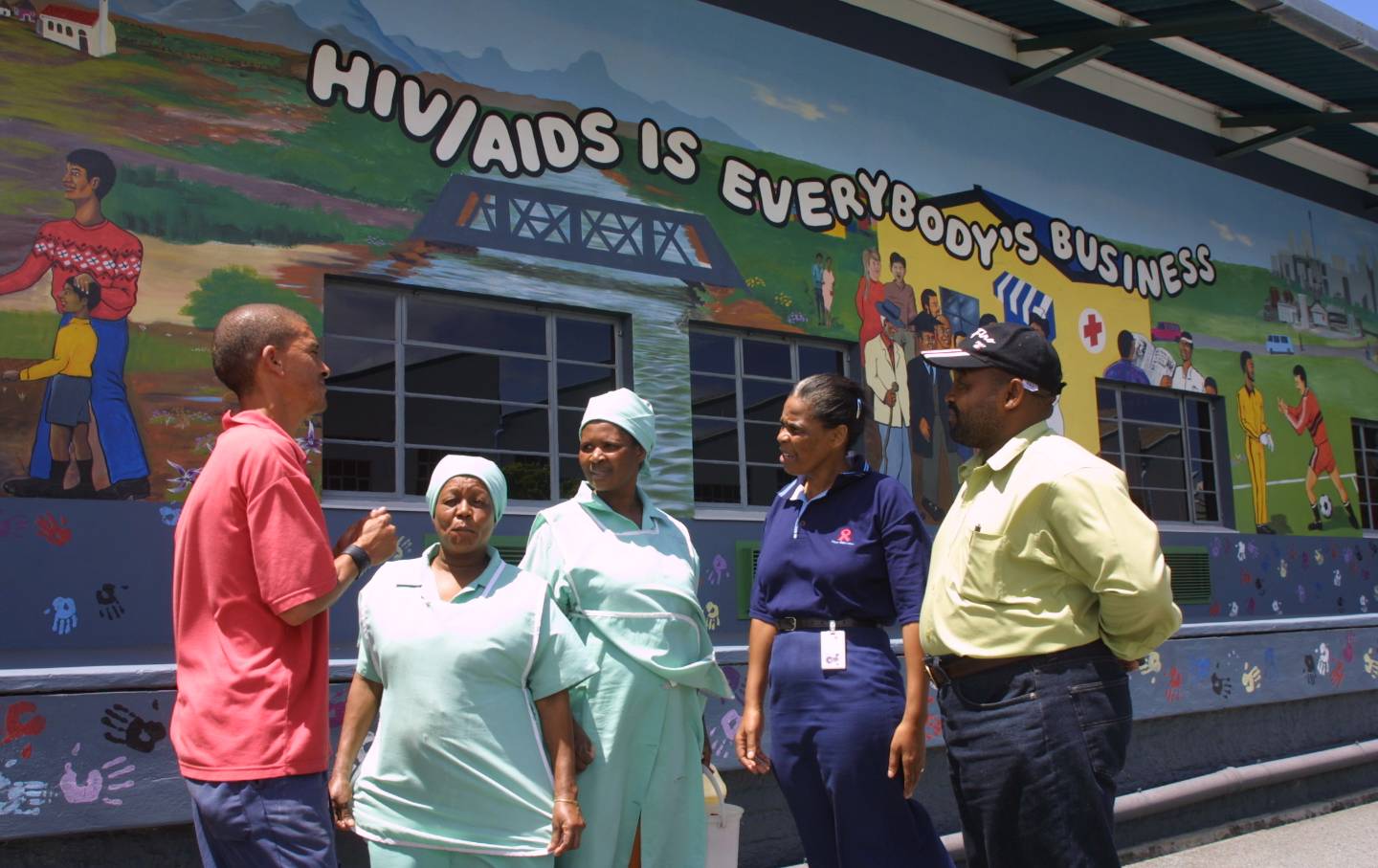
HIV educators in South Africa in 2002.
(Markus Matzel / Ullstein Bild via Getty Images)In the early 2000s, I spent time in South Africa with the Treatment Action Campaign and other organizations, working to educate communities about HIV, the immune system, and what medicines could be used to beat back the virus and deal with opportunistic infections.
These experiences were transformational for me. I learned more from my comrades in TAC about how to use scientific information to both inform and inspire than I have gathered in any formal education I had then or since.
The work TAC did wasn’t just basic health education. It was deep, often door-to-door, engagement, with time spent in clinic waiting rooms and other venues where TAC could reach people affected by AIDS. (In South Africa, a country with 6 million people living with the disease, you could make the case that nobody was spared completely from the virus.) TAC members didn’t only teach people about why, for instance, fluconazole was critical for treating fungal infections associated with AIDS. They emphasized why it was important for people to ask why their local health facility did not stock the drug, whom to talk to about this, and their rights under the South African constitution to make these demands.
This history has been on my mind recently, because of the ongoing debates within my field about how we handled the Covid pandemic. Many in public health are convinced that the biggest problem during the height of the pandemic was a lack of good communication. The answer? That those of us in public health need to learn to be better “storytellers.”
Coming from the AIDS movement, no one has to convince me that health information needs to be translated in ways that non-experts can grasp. I spent time in the mountains of Lesotho working with comrades from TAC to help rural communities understand HIV’s lifecycle and the way the immune system works, largely through acting the biology out in real time in goofy role-plays (I was a macrophage), and helping to demystify what was happening in their bodies—why understanding this information gave them power and agency over their own lives and the disease they were living with. This information became life-saving for many, helping them to advocate for themselves even in the most difficult of circumstances (e.g., a president who didn’t think HIV was the cause of AIDS).
But here in the United States, the push to communicate has often been reduced to something else—a savvy Substack, an engaging podcast, a witty social media campaign. This stuff is so, so far from the tangible, hands-on work I experienced and played a small part in in Southern Africa. Maybe people think Americans don’t need the same kind of deep commitment that South Africans did. But those people are wrong. If we want to address the real health crises in the US, better stories and storytellers are only a part of the solution. Without embedding ourselves within communities and working with them, stories from afar, as well-crafted as they can be, are inert. They are all potential energy, not kinetic in any sense.
What would it mean to communicate to residents of a holler in the mountains of West Virginia; or in a once-thriving rural community in New England, where all the jobs left long ago and many people rely on Medicaid, food assistance, and other social programs to get by; or in a city where the zip code you live in determines your life expectancy and you live in one that does not portend well for your health? I would suggest it would look more like the work of the Treatment Action Campaign and others around the world who go beyond the simple transmission of health advice to give people a sense the health of their communities is a shared purpose—and that the more information they have, the more power they possess.
Stories are part of this work, but “being there,” listening, and understanding people’s struggles are really the first step in a long process. It means sitting down at kitchen tables and talking together, building trust that only comes with commitment for the long haul. And it means talking about health in ways that matter to them, giving them a sense that a decision they make can make their lives better.
This isn’t so far-fetched. It’s a combination of a community health worker model with a bit of community organizing thrown in. While TAC in South Africa showed me how it can be done, there are models around the world to draw from, and there are 60 community health worker networks, in 38 US states, for domestic inspiration. It means building a cadre of CHWs to meet the moment—a scale-up of significant proportions. My Yale colleague Amy Kapczynski and I proposed the establishment of a community health corps in the first months of the Covid pandemic, and I think the need for something like this is greater than ever.
Yes, we should be better communicators. But if we stop there, we are playing to the smallest of audiences and should expect the smallest of impact. “Better stories” is a marketing strategy, not a recipe for true human contact and engagement. We can’t just sit at our laptops and pump out information. We have to go to the people at the other end of our efforts. If we are looking to transform public health, it’s going to be in the work we do together, side by side, and face to face. We need to learn from communities, as we craft stories together with them and envision a healthier future for all of us.