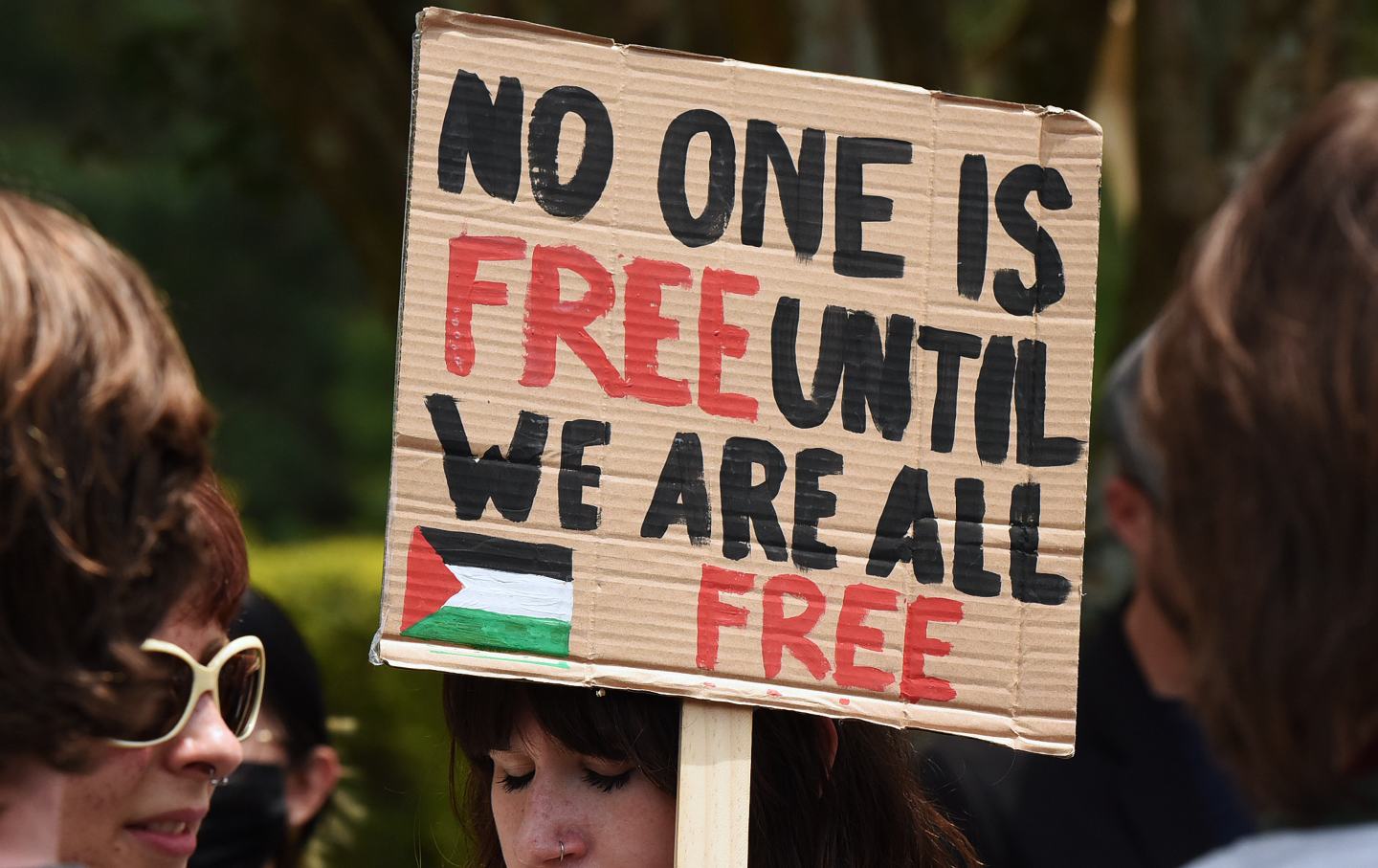
America Has Betrayed Palestinians. We Will Still Prevail.
We have returned the question of our future to ourselves. It will be guaranteed by no passport, protected by no brutal superpower.
In 1994, my father, then aged 34, sat in a courthouse in Chicago surrounded by fellow immigrants. Dressed in his best suit, his practiced English poised and ready on his tongue, he raised his hand when the judge asked for a volunteer to recite the Pledge of Allegiance. He stifled his disappointment as another volunteer was chosen, but his chagrin soon faded, overtaken by the jubilance of being confirmed as a US citizen.
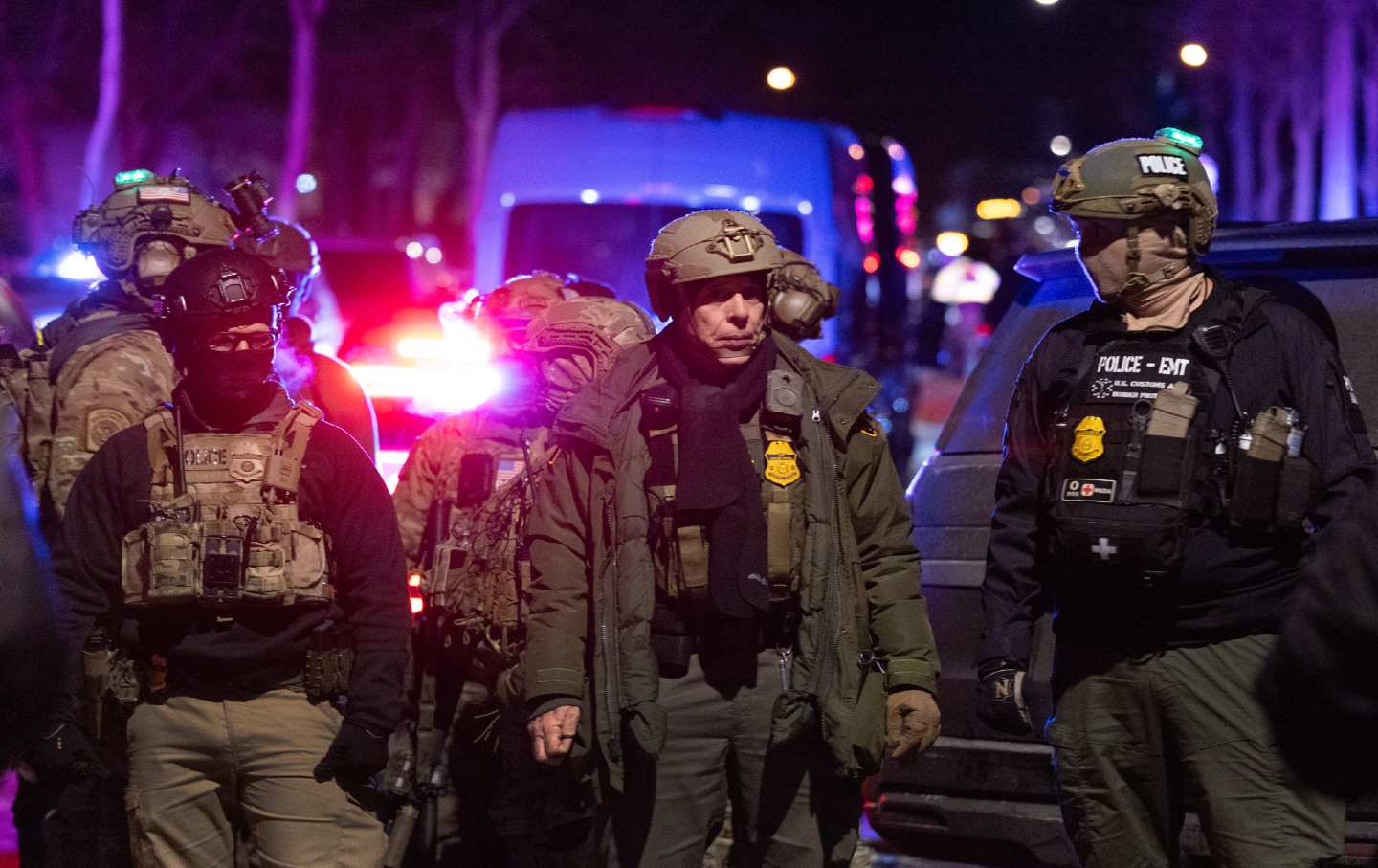
On April 14, 2025, another 34-year-old Palestinian man, Mohsen Mahdawi, was summoned to what he thought was an interview for his own naturalization process. Instead, he was ambushed by immigration officials and taken into federal custody. The grounds for his arrest: participating in protests against the Israeli genocide in Gaza.
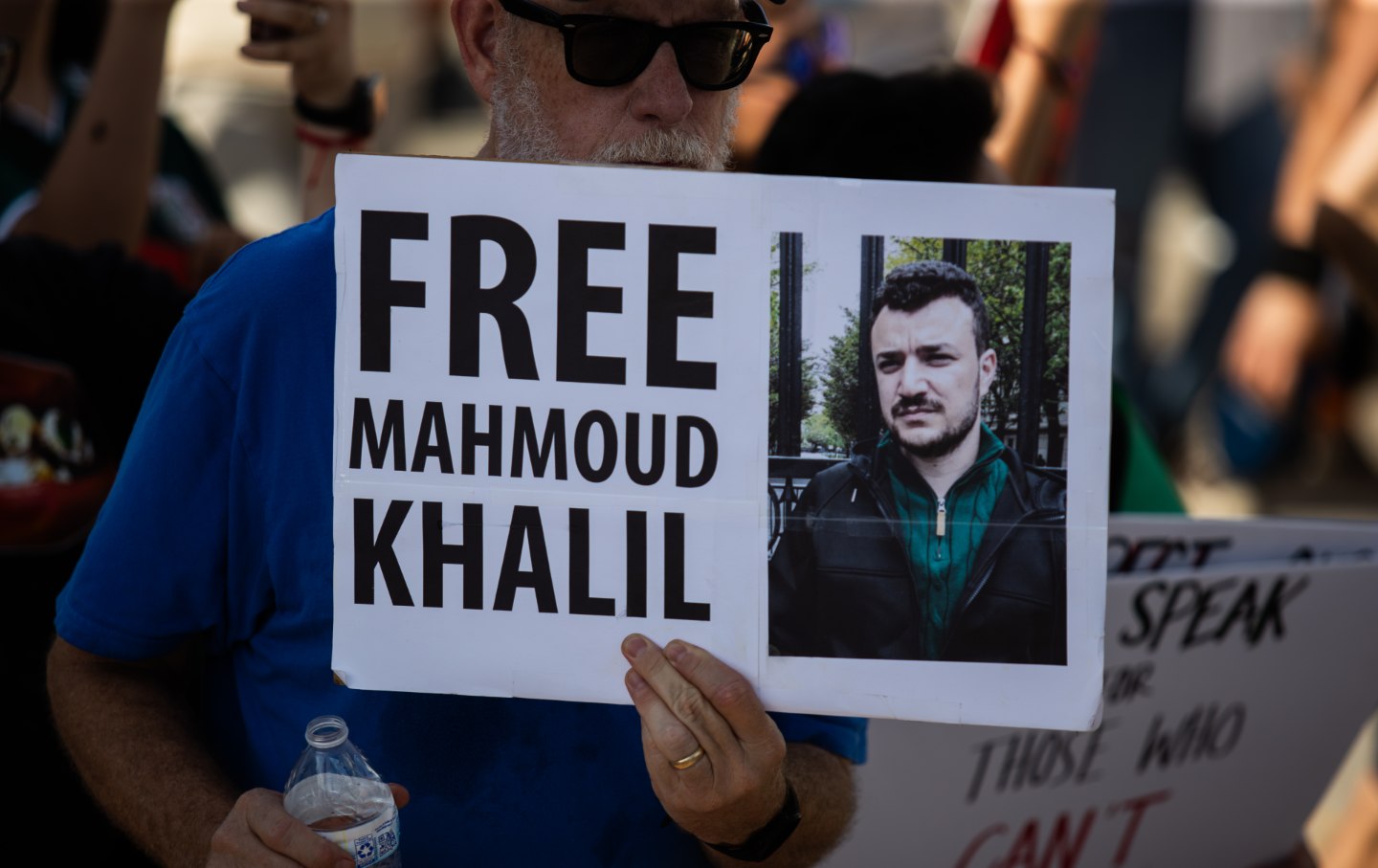
The arrest of Mahdawi, who is a green-card holder and Columbia University student, followed on the heels of similar attempts by the Trump administration to deport international students, including Mahmoud Khalil, Badar Khan Suri, and Rümeysa Öztürk, for their pro-Palestine politics. (After weeks in their respective detentions, Mahdawi, Suri, and Öztürk have since been permitted to return home while their cases are pending. Khalil’s detention in a Louisiana facility will soon enter its fourth month, while his wife, Noor Abdalla, cares for their newborn son, Deen, alone.)
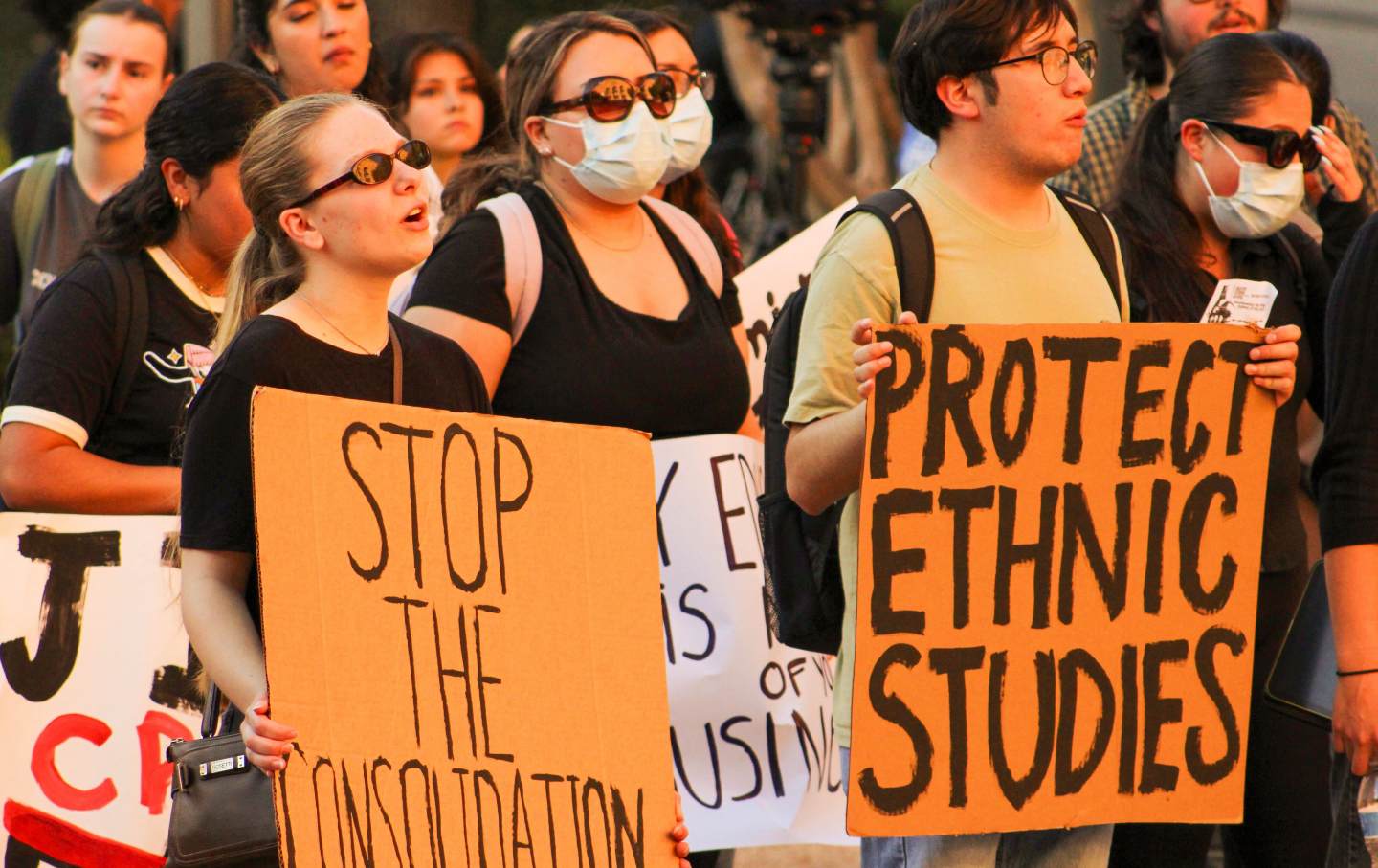
While violent crackdowns and arrests of pro-Palestine student protesters were already routine under the Biden administration, these latest disappearances have triggered an unprecedented outcry. For many, the spectacle of the targeted abductions is emblematic of a Trumpian pivot to outright fascism. In US coverage, the stories of the arrests are filtered through a domestic lens, as sympathetic Americans link these students’ cases to their personal anxieties about civil liberties.
In protests and op-eds, the crackdown on Arab, Muslim, and pro-Palestinian students have been cast as test cases for a broader threat to the First Amendment—a “new McCarthyism” which undermines American democracy itself. The hand-wringing is often self-referential—“What does this mean for the future of this country?”—“How could this happen here?” Some of the detainees have made similar arguments, admonishing the American public to live up to its own ideals and defend their freedom of speech.
My own father was seeking just such liberties when he immigrated here, hopeful that his status as a law-abiding “alien” turned citizen might offer him relief from the discrimination and surveillance he faced as a Palestinian refugee in Saudi Arabia. While he was aware of the many ways the US supported Israel’s dispossession and slaughter of his kin, his was the logic of a stateless survivor navigating a world of nation states. The US, for all the violence it wreaked outside its borders, promised safety and privilege to those inside its fold. In short, gaining entry here might protect my father and his family from what happened there.
But both then and now, this is a false binary, one which the “Palestine issue” has challenged for years, and which the cases of Mahdawi, Khalil, Suri, and Öztürk—along with other victims of brutal campus crackdowns—expose once and for all. As Saree Makdisi recently pointed out in The Nation, the current crackdowns are more than a revived McCarthyism; rather, they constitute an “entirely new” form of repression, one that privileges the political concerns of a distant nation above the rights of legal US residents, and even citizens.
(Here, we can consider both the resonance and the difference between the horrific detentions and deportations of those like Kilmar Abrego Garcia and those of the pro-Palestinian advocates. The former cases extend from a familiar American xenophobia, augmented by long-standing American manipulation in and support of tyrants in Latin America. The latter reflects the extent to which Israel’s interests have penetrated American politics to its very constitutional bones. Both are grave violences in which human bodies are treated as pawns, or worse. In each case we must resist the distraction of spectacle as we consider the deeper political realities they reveal.)
Indeed, as easy as it is to cast Mahdawi and Khalil’s cases as crude Trumpian overreach, to do so is to miss the larger context which threatens all of us. For months, legal experts and historians, invoking the likes of Césaire and Arendt, have warned of the “imperial boomerang,” the inevitability with which the violence perpetrated on the peripheries of empire will eventually swing back, unleashing on those who consider themselves safe, and separate, in the core. There is a terrible irony in the fact that Césaire’s analysis cited the Nazi Holocaust as a prime example of this phenomenon, with German atrocities against Jews and others mirroring European colonial brutality abroad.
Similarly, decades of American violence and repression in the Philippines, Vietnam, Latin America, and elsewhere have brought parallel escalations in policing, incarceration, and surveillance back home. Most recently, in the past 19 months, the US has extended bipartisan support and justification for the bombing of hospitals, the obliteration of every university in Gaza, the collective starvation of 2 million Palestinians, and the deliberate murder of journalists. How could such events be unconnected to the ICE raids in hospitals, the rapid escalation of state violence against marginalized groups, the dismantling of educational institutions, the gutting of public broadcasting, and the defunding of public health? (This is to say nothing of the over $20 billion in US aid sent to Israel since October 7, 2023, re-upped amid the gutting of domestic services.)
To be sure, resisting genocide is its own moral imperative. Yet our failure to stop the US-funded Israeli onslaught both reveals and compounds domestic authoritarianism, and a lack of such transnational analysis bears grave repercussions for us all. As Palestinian lawyer and professor Noura Erakat noted in February, “Nearly all the mainstream liberal pundits sounding the alarm about white supremacy, jingoism, xenophobia, and political violence [have] failed to connect these things to US imperial violence,” while overlooking the ways decades of anti-Arab, anti-Palestinian and Islamophobic policies have “[established] harmful precedents” that now endanger many more.
Indeed, while the boundary between foreign and domestic repression is illusory, the actual frontier of American violence is drawn on the bodies of those resisting it. Almost invariably, the movements that have defended and sought to expand civil rights and protections in the US have been led by the most vulnerable communities. In this moment, too, resistance to domestic authoritarianism and international genocide is being led by the young, the insecurely documented, the queer, the racialized, and the otherly marginalized in our midst, all of whom have faced harsh and bipartisan punishment.
Meanwhile, those with more institutional and legal protection have either watched on in cowed silence, fumbled for a nonexistent middle ground, or else co-opted particular cases as mascots for their anti-Trump messaging. In the latter case, liberals may briefly find common cause in the likes of Mahdawi when he charismatically declares his defiance of Trump. Many of the same liberals, however, have been quick to reject the larger calls for solidarity and decolonization which student protesters have insisted upon from the start.
Similarly, we must not forget the ways in which universities, and particularly elite universities, have actively repressed and endangered their pro-Palestinian students. Indeed, many of the same institutions that position themselves as defiant bastions of academic freedom have doubled down on their policies of Zionist appeasement, including collaborating with law enforcement, suspending student advocacy groups, and punishing speech deemed critical of Israel. In this, we see a microcosm of the broader American-Zionist exception, which betrays just how partial, even disposable, purportedly inalienable values may become.
In the weeks following his imprisonment, a clip of the soft-spoken Khalil circulated, in which he answers the question, “What will you do if you’re deported?” With an almost imperceptible sigh, he answers, “I will live. We will continue to live. The Palestinian people have been under occupation, ethnic cleansing, and all kinds of crimes since 1948 and have prevailed. And we will continue to prevail no matter what will happen.”
His voice was steady, anchored by a lifetime of navigating police states, immigration systems, and hostile politics. Though he, like my father, sought particular opportunities in the United States, the courageous activism of Khalil and those like him demonstrates a hope that does not ultimately lie in the much-betrayed, compromised, and compromising “American dream.” Rather, it resounds from a broader, deeper sense of both geography and history. “Being Palestinian is an experience that transcends borders,” wrote Khalil in March, noting the way his plight in US detention mirrored that of Palestinians in Israel as well as the African and Latin American detainees he slept alongside. It is a transcendence that moves in both directions. It connects Palestinians to others, and others—including those complicit in their oppression—to the Palestinian plight.
In my family, the American dream lasted a mere handful of years. Today, both my father and I move within the electric grief of nearly two years of livestreamed genocide, which has taken over two hundred of our direct kin. We have cauterized our complacency, readying ourselves for new horizons, for the day when our own safety here may expire. We have returned the question of our future to ourselves. It will be guaranteed by no passport, protected by no brutal superpower. Like Khalil, we know both that this country has betrayed us—and that we will prevail.
Support independent journalism that does not fall in line
Even before February 28, the reasons for Donald Trump’s imploding approval rating were abundantly clear: untrammeled corruption and personal enrichment to the tune of billions of dollars during an affordability crisis, a foreign policy guided only by his own derelict sense of morality, and the deployment of a murderous campaign of occupation, detention, and deportation on American streets.
Now an undeclared, unauthorized, unpopular, and unconstitutional war of aggression against Iran has spread like wildfire through the region and into Europe. A new “forever war”—with an ever-increasing likelihood of American troops on the ground—may very well be upon us.
As we’ve seen over and over, this administration uses lies, misdirection, and attempts to flood the zone to justify its abuses of power at home and abroad. Just as Trump, Marco Rubio, and Pete Hegseth offer erratic and contradictory rationales for the attacks on Iran, the administration is also spreading the lie that the upcoming midterm elections are under threat from noncitizens on voter rolls. When these lies go unchecked, they become the basis for further authoritarian encroachment and war.
In these dark times, independent journalism is uniquely able to uncover the falsehoods that threaten our republic—and civilians around the world—and shine a bright light on the truth.
The Nation’s experienced team of writers, editors, and fact-checkers understands the scale of what we’re up against and the urgency with which we have to act. That’s why we’re publishing critical reporting and analysis of the war on Iran, ICE violence at home, new forms of voter suppression emerging in the courts, and much more.
But this journalism is possible only with your support.
This March, The Nation needs to raise $50,000 to ensure that we have the resources for reporting and analysis that sets the record straight and empowers people of conscience to organize. Will you donate today?