
Pro-Palestine Activists Are Facing Horrifying Abuse Online
Speaking out for Palestine triggers a torrent of racism, misogyny, and violent sexual threats. “I was terrified that someone would do something to me,” one activist says.
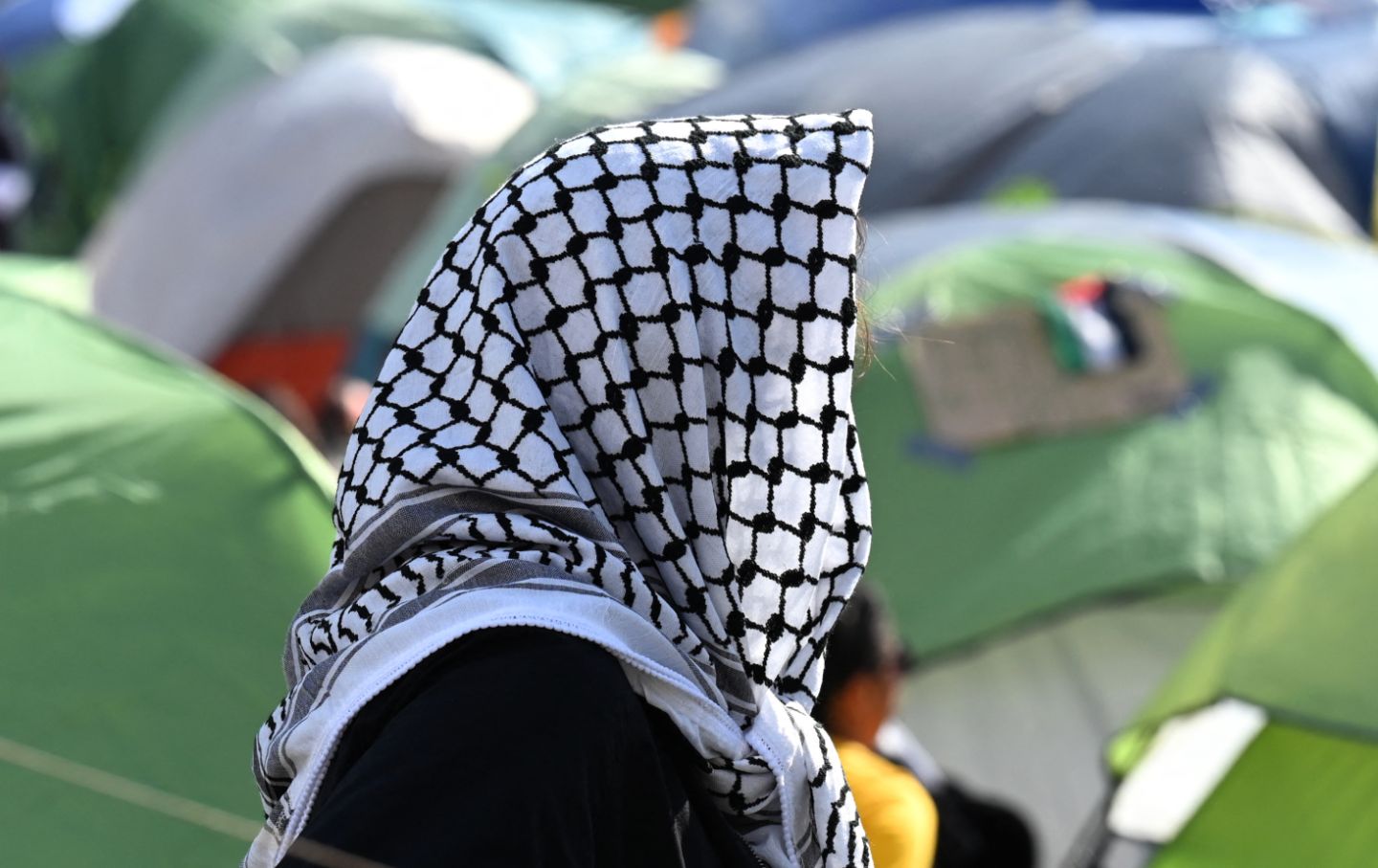
A person wearing a scarf on their head stands among tents as student demonstrators occupy the pro-Palestinian “Gaza Solidarity Encampment” on the West Lawn of Columbia University on April 24, 2024, in New York City.
(Timothy A. Clary / AFP via Getty Images)Note: This piece contains disturbing content about sexual harassment and assault.
It started, as it often does, on X. In early October 2023, Maryam Iqbal, then an 18-year-old freshman and pro-Palestinian activist at Barnard, was doxxed. Her X account was flooded with replies calling for her to be subjected to sexual violence. In the same breath, she was told that she supports the rape of Jewish women. People behind their keyboards began describing all the ways they hoped to violate her body.
“They’ll say things like ‘go to Gaza and get raped,’ and they’ll describe in very graphic detail how that would happen. But they’re clearly thinking about it themselves,” Iqbal says. “It’s clearly an expression of their thoughts and fantasies. They want to do it, but they’re like phrasing it as ‘Hamas will do this to you.’”
Iqbal is far from alone in experiencing this kind of hatred. Over and over again, pro-Palestinian activists have found themselves on the receiving end of violent, sexually explicit, racist harassment online. The bile is not limited to student activists or to Muslim or BIPOC women—for instance, Ruth, an attorney and vocal anti-Zionist Jew, says that she has received many misogynistic and antisemitic messages, including people calling her a “Kapo c**t” and a “self-gassing Jew”—she says that these messages are incredibly disturbing, and sadly not the worst that folks get.
Nor did this trend begin in October 2023. In 2021, Leila (a pseudonym), a Palestinian journalist, published an op-ed urging her university in the UK to divest from Israel. “Soon after it was released, I received a message from an anonymous account that wasn’t following me of a picture taken from my profile with another woman’s naked body superimposed on top. It looked incredibly realistic, and it was an obvious threat,” Leila says. “After I gathered myself, I took to the police to see what I could do; I was dismissed immediately [because] the nude ‘wasn’t real,’ even though anyone who looked at it would think it was my body.”
She was 21 years old at the time.
But things got exponentially worse once Israel’s genocide commenced—leaving the victims of this hatred traumatized, angry, and doubting that their attackers will ever face serious consequences.
After she was arrested for her participation in the first student encampment at Columbia University, Iqbal was suspended, thrown out of university housing, and given only 15 minutes to pack up her things before the administration left her homeless. When she described her experience online, the New York Post took a screenshot of the video with a headline that had an implicit sexual undertone that made Iqbal uncomfortable.
“Barnard student moans about being kicked out of dorm after she was arrested,” the front page read. The picture the Post used was of Iqbal as a minor. “My parents had to read that and ask me about it,” she says. “That was so much worse than me reading the headline on my own because we already don’t talk about that kind of thing in our culture. And now they’re forced to see me being sexualized by Zionists.”
“I would get inundated with rape threats in those days, like hundreds and hundreds in my DMs, on my Twitter, on LinkedIn, like every single social media platform,” she says. “I was so caught up in the momentum of the encampment that I didn’t even want to process any of it. And I would just delete every single thing that I got.”
It’s particularly hard for Iqbal to talk about this subject because every threat she received also involved alluding that the Palestinian people she was fighting for would be the ones to inflict harm upon her—something she rejects. “It’s hard because it feels like even by talking about it, you’re amplifying this dehumanizing narrative.”
People began to recognize and follow Iqbal around campus. “I was terrified that someone would do something to me. And I ended up having to leave the state during the encampment because I was scared something would happen to me.”
Due to her one-semester suspension, Iqbal found herself in Jordan, finally realizing the extent to which she was dehumanized online and how explicit the threats were against her.
“Because I was away from all of it, and I was interacting with normal people who treated me like a normal person, reading those things from Columbia affiliates would be jarring even if it wasn’t as bad as during the encampment,” she explains. “I was put in a different environment where, for the first time, I was not experiencing those things and not seeing it as normal. I came into Barnard as an 18-year-old; this was me starting my adulthood.”
However, the most disturbing development came when Iqbal returned to campus in the spring of 2025 to resume her studies. “What really impacted me was when it was Columbia affiliates doing it on this app called SideChat, which is like anonymous Columbia Twitter,” she says.
SideChat is entirely anonymous, but the only way to create an account is by using a verified Columbia e-mail, which means that every user is connected to the university. It was a powerful tool in rallying the student body during the encampments, but has also been criticized in recent years for spreading hateful rhetoric.
“There were people threatening to make OnlyFans deepfakes of me. And the thing is, Zionists in the city have already done that to other female activists,” she said.
But when Iqbal took evidence of the sexual harassment to the Office of Nondiscrimination at Barnard, they were dismissive. “One of them said, ‘Not to sound like a conspiracy theorist, but it’s probably one of your friends posting these things.’”
At the time, an advocate for Iqbal sent an e-mail to the administration, submitting a formal Title IX report.
Attached to the e-mail were documented threats that Maryam received on X, including a reply from May 1, 2024, “May they rape you until your pelvis breaks while cutting your breasts out, stab your vagina, slit your throat, burn you alive or parade you naked at the back of a truck.”
“Countless others have left tweets and Instagram comments under her posts calling for her to be gang-raped, mutilated, deported, and/or killed. This has been happening for months on public forums with the university’s full knowledge.”
Shraddha Joshi was a senior at Harvard in October 2023 when she became one of several pro-Palestine students whose picture was emblazoned on the side of trucks that drove around campus, labeling her as an antisemite.
Joshi received sexual threats from Zionists and Hindu nationalists alike due to her Indian origin. At the time, she had a blog with her e-mail address on it. “So I ended up getting a ton of messages to my e-mail that were extremely sexually explicit and often used that angle of sexual harassment to talk about how, as someone of Indian origin, I’m an immoral traitor to my community.”
Other e-mail threats included the hope that Joshi would kill herself so that the anonymous sender could fantasize about violating her corpse. “Isn’t that what you’re into? Please commit suicide and record it; we’re all begging you,” the message read.
Popular
“swipe left below to view more authors”Swipe →The majority of the comments, according to Joshi, had Islamophobic and casteist undertones.
“A lot of it was also like using the language of ‘Love Jihad,’ which is this Islamophobic conspiracy theory of Hindu women marrying Muslim men,” Joshi explains. “So a lot of the comments that I would get on X, especially, were saying that I was under the influence of a Muslim man. And they would use the word Abdul, which is their proxy for this Islamophobic trope.” In Arabic, the prefix “Abdul” is used for names like “Abdullah” or “Abdulrahman,” meaning servant of God. However, in Hindu nationalist circles, people use it as a slur for Muslim men, referring to them as enslaved people.
“Are MUZLIMS banging them all at Harvard Hostels?” one reply on X read. “Wait till their Abdul is running a hacksaw on their throats,” another read.
Joshi still remembers the most explicit threat she received at the time. “It said that my body should end up mutilated in [the anonymous user’s] fridge. It was referencing a particular event that had happened in India a few years ago. And they’re saying that that should happen to me,” she recalls. “There was this very Islamophobic angle around all of it.”
Like Iqbal, Joshi felt desensitized to the threatening language at the time, but it began to catch up to her once she left campus for Thanksgiving break. “I think in those moments, it kind of starts to sink in, or it gets to you that these are disgusting things that people are saying about you and your body.”
“There are these very pressing issues that are happening in Palestine. And so then, it also feels weird because you’re weirdly absorbed with these micro-level threats that you’re experiencing. But then there’s this extreme macro level violence that you’re like organizing against and or like trying to sort of speak out against,” she explains. “So it has been weirdly disorienting. And like, at this point, as I said, it feels a bit normalized, but it shouldn’t be.”
Joshi and her fellow organizers at Harvard tried to file complaints to the university, but the administration offered no substantial support. Reporting the tweets on X was not only impossible due to the sheer volume of threats but also exhausting, as so few of them were taken down.
“There’s this weird masculine obsession with women’s bodies and particularly the women and queer people who are vocally involved with these causes,” Joshi says. “I think people who are sitting behind their screens find that they have an edge of control when they come after someone from a gender minority background or like a woman who is already so vulnerable. I think it’s something deeply sinister. And there’s also a strange fascination or obsession with people’s bodies and especially for people who are from more vulnerable backgrounds who speak out.”
“It doesn’t matter that it’s online or intangible; it leaves physical imprints on your psyche,” says Leila. But she also acknowledges that even though what is happening to her and others online is a “complete and total infringement of one’s personhood,” it does not compare to the sexual and gender based violence that Palestinians are facing in Israeli captivity. Until that violence is confronted and victims see justice, it’s clear we will continue to see the reverberations of that harassment online.
Support independent journalism that does not fall in line
Even before February 28, the reasons for Donald Trump’s imploding approval rating were abundantly clear: untrammeled corruption and personal enrichment to the tune of billions of dollars during an affordability crisis, a foreign policy guided only by his own derelict sense of morality, and the deployment of a murderous campaign of occupation, detention, and deportation on American streets.
Now an undeclared, unauthorized, unpopular, and unconstitutional war of aggression against Iran has spread like wildfire through the region and into Europe. A new “forever war”—with an ever-increasing likelihood of American troops on the ground—may very well be upon us.
As we’ve seen over and over, this administration uses lies, misdirection, and attempts to flood the zone to justify its abuses of power at home and abroad. Just as Trump, Marco Rubio, and Pete Hegseth offer erratic and contradictory rationales for the attacks on Iran, the administration is also spreading the lie that the upcoming midterm elections are under threat from noncitizens on voter rolls. When these lies go unchecked, they become the basis for further authoritarian encroachment and war.
In these dark times, independent journalism is uniquely able to uncover the falsehoods that threaten our republic—and civilians around the world—and shine a bright light on the truth.
The Nation’s experienced team of writers, editors, and fact-checkers understands the scale of what we’re up against and the urgency with which we have to act. That’s why we’re publishing critical reporting and analysis of the war on Iran, ICE violence at home, new forms of voter suppression emerging in the courts, and much more.
But this journalism is possible only with your support.
This March, The Nation needs to raise $50,000 to ensure that we have the resources for reporting and analysis that sets the record straight and empowers people of conscience to organize. Will you donate today?
More from The Nation
The Real Reason Americans Love Guns The Real Reason Americans Love Guns
With a weak social safety net, a gun offers a false sense of personal power and security.

The Endless Hypocrisy of Bari Weiss The Endless Hypocrisy of Bari Weiss
She claims to be a free speech champion. But as her actions at CBS News keep showing, she seems to think free speech should run only in a rightward direction.
What Will Be Left After the University of Texas Destroys Itself? What Will Be Left After the University of Texas Destroys Itself?
UT-Austin has collapsed its race, ethnic, and gender studies into a single program while a new policy asks faculty to avoid “controversial” topics. But the attacks won’t end there...
The Corporate Media Is Head Over Heels for the Iran War The Corporate Media Is Head Over Heels for the Iran War
Donald Trump’s attack may be surreal, unjustified, and illegal. But that’s not stopping the press from turning the propaganda dial way up.
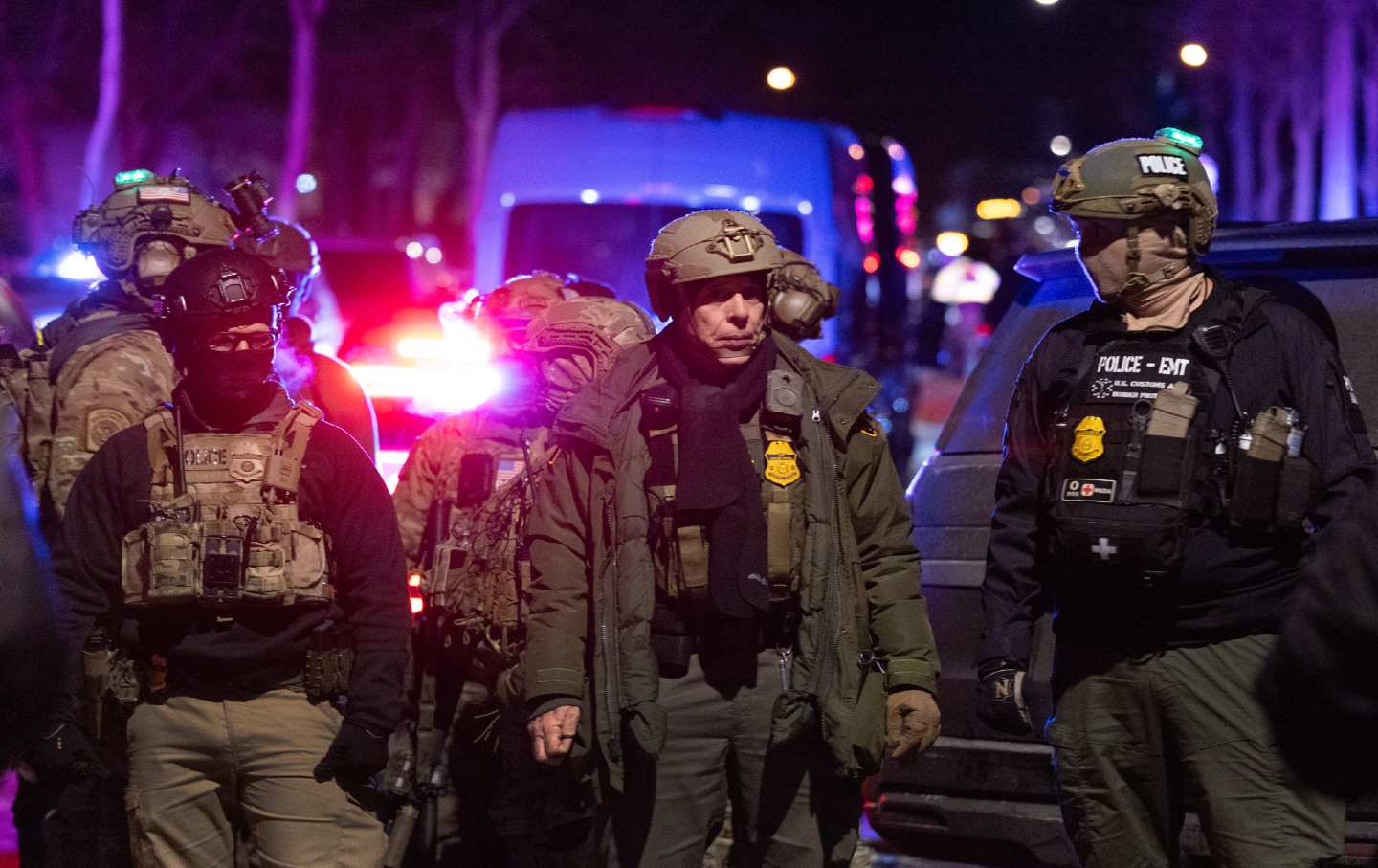
The Disturbing History of ICE’s “Death Cards” The Disturbing History of ICE’s “Death Cards”
The Vietnam-era practice is yet another example of ICE agents thrilling to the brutality they have been encouraged to cultivate.

The Red State–Blue State Healthcare Divide Is Dangerous for Everyone The Red State–Blue State Healthcare Divide Is Dangerous for Everyone
Whether or not you have access to independent, scientifically sound public health guidance may depend on how your state voted for governor.

