When Her Neighbors Began Dying, the World Looked Away
A new podcast takes us back to the early days of the HIV/AIDS crisis, when a mystery virus began spreading among New York’s Black and brown communities.
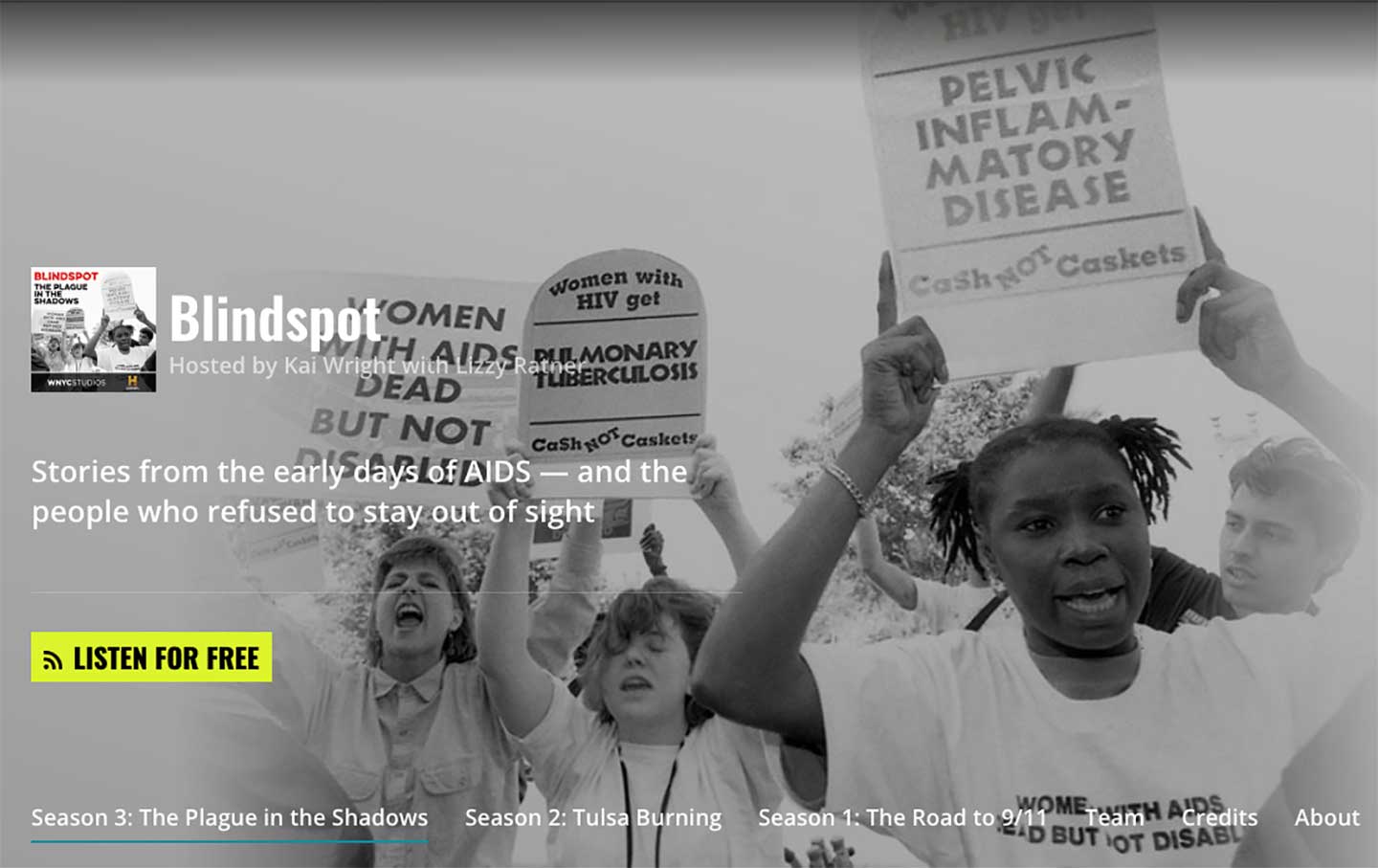
In the mid-1980s, the people of Valerie Reyes-Jimenez’s Lower Manhattan neighborhood began to disappear. First one, then another, then tens—then 75 from one single block. “One day they were there,” she said, “and the next day they were gone.”
In the decades before these disappearances, Reyes-Jimenez’s neighborhood had been a tight-knit Puerto Rican community—a vibrant place where friends and family were always close at hand. But in the 1970s, as the local economy crumbled, a different one grew in its place—an economy centered around the city’s largest open-air heroin market—and, with that heroin, came this other thing, this illness, that began to steal people away.
“We said that people had The Monster, because they had that look,” Reyes-Jimenez said. “They had the sucked-in cheeks.… They were really thin.”
Outside Reyes-Jimenez’s neighborhood, doctors had a different name for what was going on: They called it HIV, the virus that causes AIDS. By this point, the illness that was destroying people’s immune systems was widely recognized as the biggest contagious threat facing the United States, but its effect on communities like Reyes-Jimenez’s—Black and Puerto Rican, poor, often in the grips of drug crises—remained largely invisible. It was a blind spot that would shape the course of the epidemic for years to come.
Why didn’t more people see this side of HIV and AIDS? And what might have been different if they had?
These are some of the questions at the heart of Blindspot: The Plague in the Shadows, a podcast I helped make alongside a dream team of journalists from WNYC, including Kai Wright, my former Nation colleague and the sublime host of Notes from America. Our collective hope was to understand how, decades before Covid-19, a virus had torn through some of this country’s most vulnerable communities while the wider world looked away.
What we found both devastated and inspired us. As we time-warped back to the 1980s, our reporting took us from a pediatric ward in Harlem to a maximum security women’s prison in upstate New York to a needle exchange in a South Bronx church to the city’s own potter’s field. And it revealed how, unseen but desperately feared, a single, tiny virus could take advantage of some of the worst bigotries, biases, and, yes, blindspots in our society. As Kai says in the first episode, “AIDS was not just a medical crisis; it was and it remains a social disease, one that exploits the inequities that already define so much of American life.”
And yet: Amid the grief and enduring pain, we also found something else—truly heroic human beings who had no intention of bowing to any of society’s bigotries and biases. These were activists and nurses, doctors and elected officials, daughters, sons, a nun, a priest, and a woman who literally helped change the definition of AIDS. They were people dying of HIV. When the world averted its eyes, they demanded the world look; they demanded to be seen.
It’s now been more than 40 years since HIV/AIDS burst into public consciousness, scorching lives, neighborhoods, and whole communities. Some 40 million people have died around the world, and it’s still killing people today. But in the US, much of the country has moved past the illness; we have forgotten it—or, in too many cases, never gotten to know—an illness that redefined everything from love and intimacy to health, sexuality, solidarity, and activism.
With Blindspot: The Plague in the Shadows, we revisit the early days of this pandemic, and we ask: What might have happened if more people had chosen to see the plague in the shadows—if they chose to see it even now? And what lessons can we learn from it today?
* * *
Listen to an excerpt of the new podcast series Blindspot: The Plague in the Shadows, which revisits the early years of the HIV epidemic in New York City and how the virus tore through some of our most vulnerable communities while the wider world looked away. A co-production of The HISTORY® Channel and WNYC Studios.
You can listen to more of Blindspot: The Plague in the Shadows here.
Advertising Inquiries: https://redcircle.com/brands
Privacy & Opt-Out: https://redcircle.com/privacy
Blindspot: The Plague in the Shadows is a coproduction of the History Channel and WNYC Studios, with The Nation. Its first two episodes are “Mourning in America” and “If I Didn’t Have HIV, I Wouldn’t Have Met You.” You can find them at wnycstudios.org/podcasts/blindspot or wherever you get your podcasts.
Support independent journalism that does not fall in line
Even before February 28, the reasons for Donald Trump’s imploding approval rating were abundantly clear: untrammeled corruption and personal enrichment to the tune of billions of dollars during an affordability crisis, a foreign policy guided only by his own derelict sense of morality, and the deployment of a murderous campaign of occupation, detention, and deportation on American streets.
Now an undeclared, unauthorized, unpopular, and unconstitutional war of aggression against Iran has spread like wildfire through the region and into Europe. A new “forever war”—with an ever-increasing likelihood of American troops on the ground—may very well be upon us.
As we’ve seen over and over, this administration uses lies, misdirection, and attempts to flood the zone to justify its abuses of power at home and abroad. Just as Trump, Marco Rubio, and Pete Hegseth offer erratic and contradictory rationales for the attacks on Iran, the administration is also spreading the lie that the upcoming midterm elections are under threat from noncitizens on voter rolls. When these lies go unchecked, they become the basis for further authoritarian encroachment and war.
In these dark times, independent journalism is uniquely able to uncover the falsehoods that threaten our republic—and civilians around the world—and shine a bright light on the truth.
The Nation’s experienced team of writers, editors, and fact-checkers understands the scale of what we’re up against and the urgency with which we have to act. That’s why we’re publishing critical reporting and analysis of the war on Iran, ICE violence at home, new forms of voter suppression emerging in the courts, and much more.
But this journalism is possible only with your support.
This March, The Nation needs to raise $50,000 to ensure that we have the resources for reporting and analysis that sets the record straight and empowers people of conscience to organize. Will you donate today?