In “We’re Not Going Back!” Dems Find an Antidote to the Politics of Nostalgia
Underneath the cliché that “we’re all in this together” lie harder truths that will need to be faced if Harris and Walz want to rally the nation for real change.
The failed campaign to save Nicola Sacco and Bartolomeo Vanzetti—the Italian immigrants and anarchists who were executed in 1927 for a bank robbery and murder they didn’t commit—prompted John Dos Passos to lament, in his novel The Big Money, that “our nation has been beaten by strangers who have bought the laws and fenced off the meadows and cut down the woods for pulp and turned our pleasant cities into slums and sweated the wealth out of our people and when they want to they hire the executioner to throw the switch.” In his impotence and rage, Dos Passos came to recognize a deep political truth: We are not all in this together.
Not in the America of the radical-hunting Palmer Raids, or in the “return to normalcy” promised by Warren G. Harding, or in the nation that celebrated the Immigration Act of 1924, which sought to restore a white, Anglo-Saxon Protestant vision of the country as it was supposedly being menaced by Catholic and Jewish immigrants from Southern and Eastern Europe. Nostalgia has always been a powerful force in our politics; Dos Passos himself heard its siren call. But he also tried to break free of its spell with his cry of “All right we are two nations.”
The politics of nostalgia are anything but simple. The Republican convention in Milwaukee was a veritable festival of nostalgia for a time when America was on top of the world—and white men were on top in America. Yet in selecting JD Vance as his running mate, appealing to the simpler virtues whose loss provides Vance’s book Hillbilly Elegy with its wistful tone, Donald Trump also lifted up a man whose own mixed-race family rebukes the blood-and-soil nationalism he advocates on the stump.
Nor are Democrats immune to the lure of an idealized past. I suspect that for many of us, the greatest generation is not the one that defeated fascism in World War II but the men and women who took on racism at home and the Vietnam War and imperialism abroad. But like the fight against fascism, their work remains unfinished. Until we cease to be the oligarchy Dos Passos described—where the economy’s winners make the rules and the losers, enraged and desperate, fight over the crumbs—America will never be truly great.
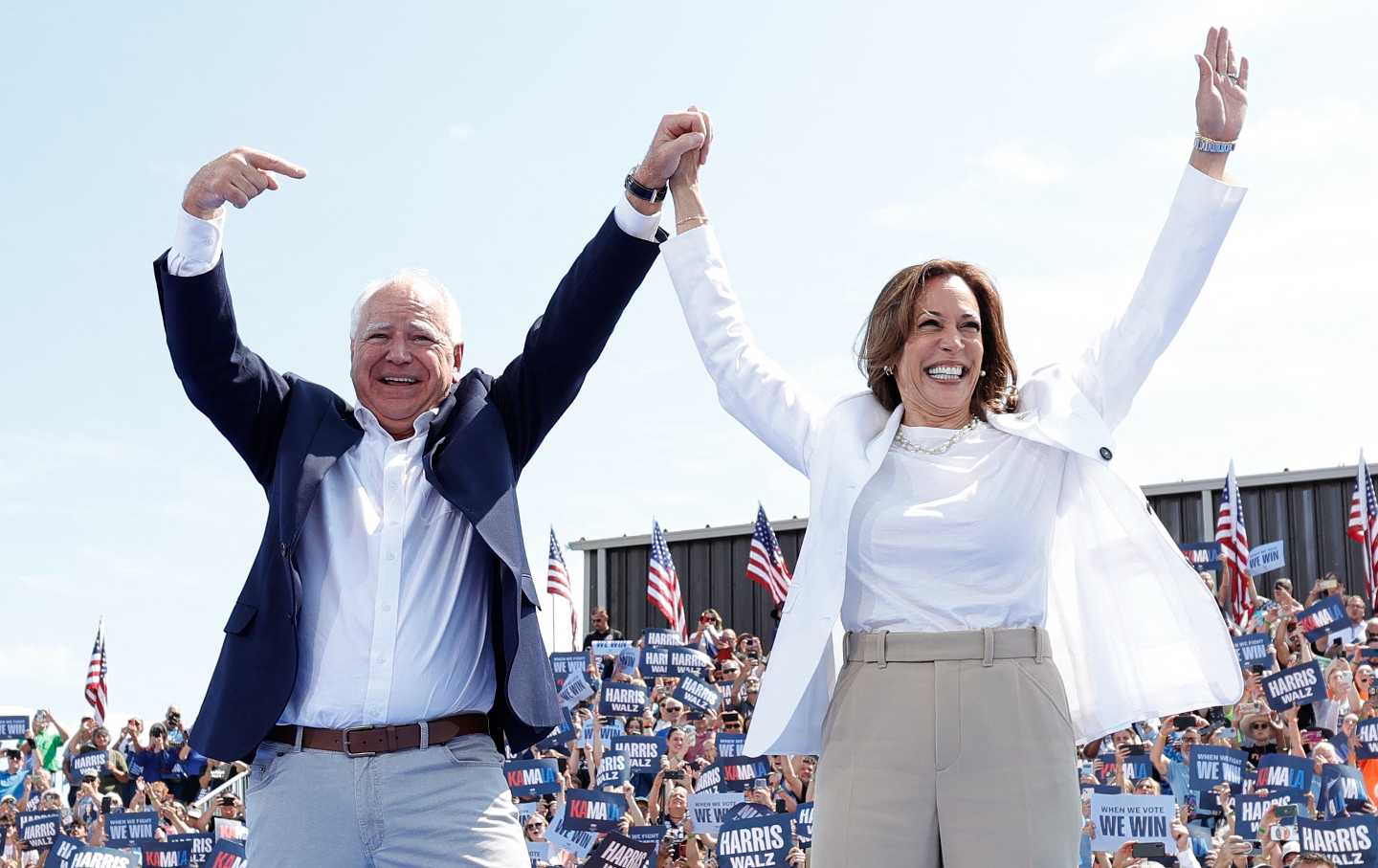
Yet as I watched Kamala Harris and Tim Walz introduce their ticket to the country in Philadelphia in early August, I found myself wondering what made this moment suddenly seem so hopeful. Compared with the two old men it looked like we were going to have to choose between, both of them seemed youthful and full of energy. And in the repeatedly shouted declaration “We’re not going back!,” their campaign was able to powerfully distill—and dispel—the reactionary threat posed by Trump and Project 2025.
But I also found myself recalling a line from a poem by Langston Hughes:
Hold fast to dreams
For when dreams go
Life is a barren field
Frozen with snow.
Eventually, I recognized that some of what I (and likely others in that massive crowd) was feeling was nostalgia. Specifically, nostalgia for 2008 and 2012, when the campaign of Barack Obama seemed to offer the hope that, at long last, America would redeem its promises. Hope is a powerful drug. But so is hope abandoned, hope denied, dreams endlessly deferred—which, as Hughes also reminds us, are liable to explode. Can we ever become one nation? There’s only one way to find out.
To help you manage the suspense, this month we’ve assembled a bumper crop of literary gems for our Fall Books issue: Edna Bonhomme on the Southern laureate Natasha Trethewey, Hannah Gold on the interior dramas of Garth Greenwell, Lovia Gyarkye on Danzy Senna’s comedy of manners, Benjamin Kunkel on economic growth, Nicolás Medina Mora on Rachel Kushner’s political thriller, Samuel Moyn on the surprising politics of equality, and Bijan Stephen on Questlove’s personal history of hip-hop.
Plus, Amy Littlefield on abortion on the ballot in Florida; Elie Mystal on the scariest Republicans of all (they’re not running for president); Katie Rose Quandt on probation without end; Eleni Schirmer on negotiating with Jane McAlevey; and Barry Yourgrau on early anti-Zionism.
Hang on! It’s going to be a bumpy couple of months.
D.D. Guttenplan
Editor
Support independent journalism that does not fall in line
Even before February 28, the reasons for Donald Trump’s imploding approval rating were abundantly clear: untrammeled corruption and personal enrichment to the tune of billions of dollars during an affordability crisis, a foreign policy guided only by his own derelict sense of morality, and the deployment of a murderous campaign of occupation, detention, and deportation on American streets.
Now an undeclared, unauthorized, unpopular, and unconstitutional war of aggression against Iran has spread like wildfire through the region and into Europe. A new “forever war”—with an ever-increasing likelihood of American troops on the ground—may very well be upon us.
As we’ve seen over and over, this administration uses lies, misdirection, and attempts to flood the zone to justify its abuses of power at home and abroad. Just as Trump, Marco Rubio, and Pete Hegseth offer erratic and contradictory rationales for the attacks on Iran, the administration is also spreading the lie that the upcoming midterm elections are under threat from noncitizens on voter rolls. When these lies go unchecked, they become the basis for further authoritarian encroachment and war.
In these dark times, independent journalism is uniquely able to uncover the falsehoods that threaten our republic—and civilians around the world—and shine a bright light on the truth.
The Nation’s experienced team of writers, editors, and fact-checkers understands the scale of what we’re up against and the urgency with which we have to act. That’s why we’re publishing critical reporting and analysis of the war on Iran, ICE violence at home, new forms of voter suppression emerging in the courts, and much more.
But this journalism is possible only with your support.
This March, The Nation needs to raise $50,000 to ensure that we have the resources for reporting and analysis that sets the record straight and empowers people of conscience to organize. Will you donate today?