The Stagecraft Behind the New Orleans Immigration Raids
In a text exchange, Border Patrol Commander Gregory Bovino calls his operation a “massive disturbance” in the making.
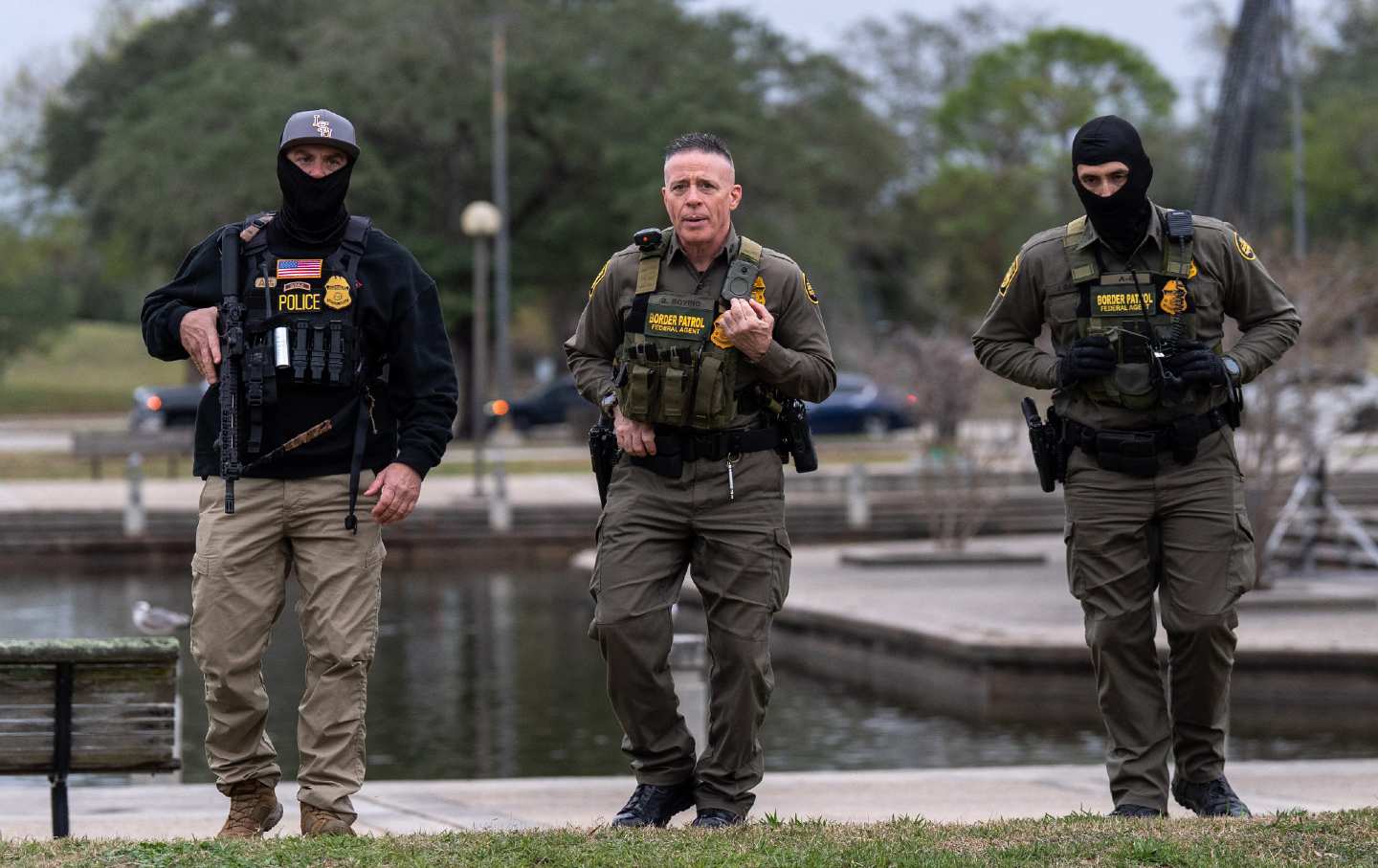
Border Patrol Commander Gregory Bovino (center) and a pair of agents leave a local park during Operation Catahoula Crunch
(Adam Gray / AFP via Getty Images)“Operation Catahoula Crunch is making New Orleans safer by finding and arresting illegal aliens who have been endangering this community,” Border Patrol Commander Gregory Bovino posted on X shortly after his roving corps of immigration enforcers arrived in the city. In a similar PR offensive, the Department of Homeland Security recently launched the “Worst of the Worst” website, which features some of the arrests that the federal agents implementing the Trump White House’s mass deportation policy have carried out across the country. (The legal resolution of these arrests, like the 13 cases dropped in court after Bovino’s Operation Midway Blitz campaign in Chicago, are not featured.)
And despite the online efforts to portray the Trump raids as heroic peacekeeping exercises, Commander Bovino’s New Orleans team seemed to be operating by a different set of rules, to judge by its conduct this past Saturday. A caravan of Louisiana state troopers escorted three rental cars full of federal agents, including Bovino himself, to an apartment complex in Kenner, Louisiana. A secondary caravan, made up mostly of journalists and protesters, followed close behind. State police blocked off a road in the complex, driving both groups out of their vehicles and into the street, where Bovino and his agents could move in on them. The federal agents slowly drove down the road, stopping for minutes at a time. The small group of protesters grew, bolstered by neighbors who lived in the apartments.
Safe inside an SUV, surrounded by agents with weapons, Bovino texted away on his phone from the parking lot of an apartment complex. The messages, recorded by journalist Ford Fischer, offer some insight—into both Bovino’s mind and the state of the Louisiana operation.
“Kind of cool we are a massive wrecking crew. The idiots can’t do anything to us…. I can’t understand why DHS is hiding us when we are handing them strategy on a silver platter,” Bovino wrote to a contact listed as “Diz.” Minutes later, Bovino followed up with a summary of their on-the-ground strategy that afternoon: “Massive disturbance at apartment complex in Kenner. We are running tags and such.”
The “disturbance” was hardly massive. The protesters were yelling at the agents as they sat in their vehicles with the windows up, but they didn’t offer any physical resistance. After running the tags of the cars down the length of the road, Border Patrol agents got out and knocked on a door. The sound of whistles pierced the air, and one loud protester yelled out for his neighbors not to open their doors: “They cannot come in if you do not give them verbal, allowed permission.”
The stunt seemed to be a way to agitate the neighborhood more than anything else. And the photos showing Bovino’s messages cast the operation’s alleged legal aims into further doubt. Just for starters, why would a targeted enforcement operation rely on running tags in the parking lot of an apartment complex located in the town with the highest Hispanic population in the state of Louisiana? This seemed to be a “Kavanaugh stop”—the practice of racially profiling residents recently sanctioned by the US Supreme Court—running on steroids.
Bovino’s reference to the DHS’s “hiding” his team raises further questions. It certainly seems at odds with his constant media appearances, and his photo-ops in the snack aisles of gas stations
Perhaps Bovino was simply venting because the New Orleans raids aren’t producing the kind of strong-arm spectacle that he’s staged in Chicago and elsewhere. According to the Associated Press, his team has carried out just 38 arrests over the first four days of Operation Catahoula Crunch. And of the 38 people detained, only nine had criminal records—a percentage that’s generally in line with the national numbers for the immigration raids, which show that more than 70 percent of the people arrested had no criminal convictions.
Bovino’s texting partner, at least, seemed to be mindful of the team’s lackluster show of force. “You need to do interviews. Fox and friends wants you. We will come up for a talking point on the low numbers,” Diz texted Bovino.
Still, when he doesn’t feel like he’s being hidden, Commander Bovino remains stoutly on message. “The Big Easy is the Big Hard for illegal aliens,” Bovino bragged this week on X.