Luigi Mangione Is America Whether We Like It or Not
While very few Americans would sincerely advocate killing insurance executives, tens of millions have likely joked that they want to. There’s a clear reason why.
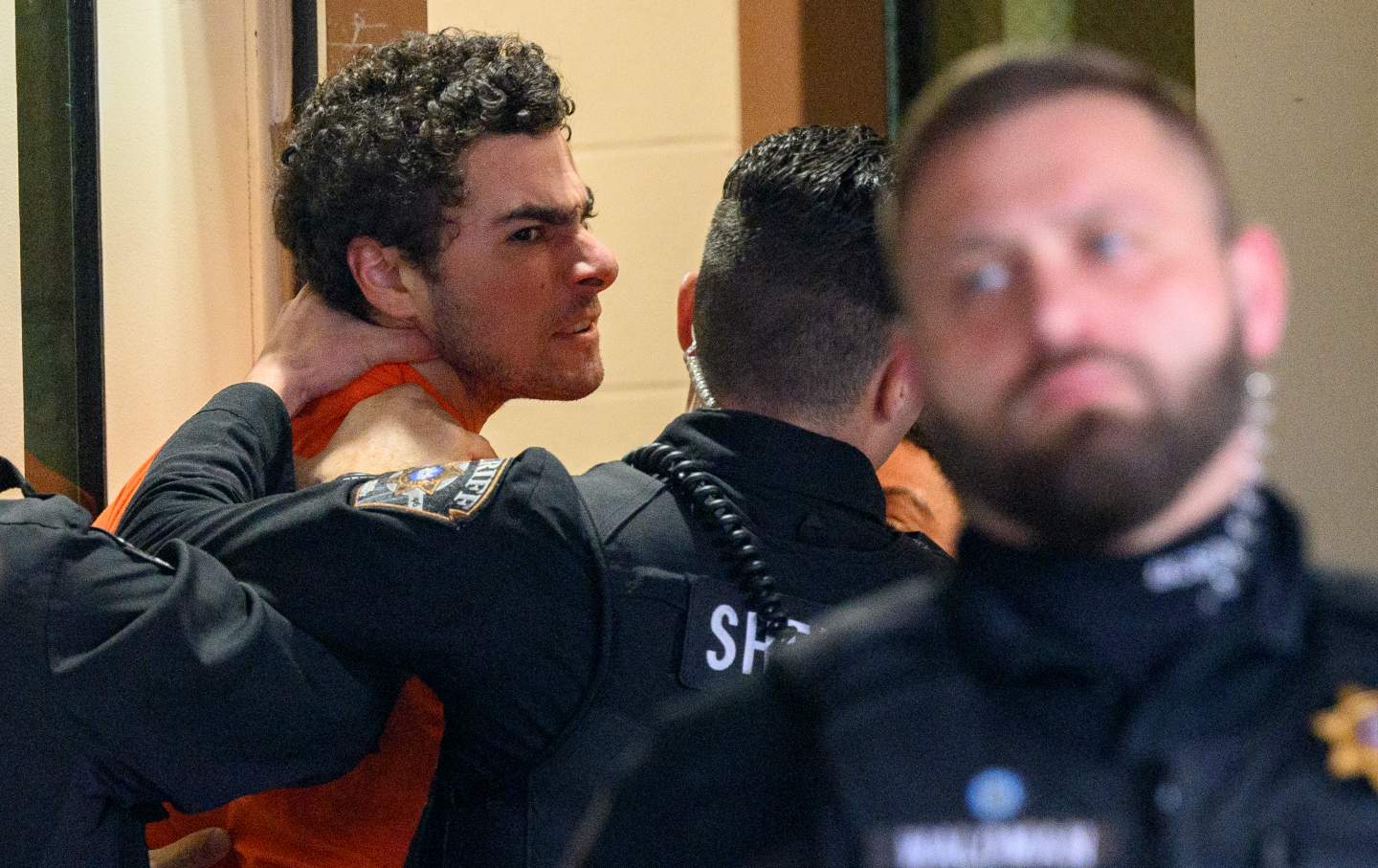
Suspected shooter Luigi Mangione is led into the Blair County Courthouse for an extradition hearing.
(Jeff Swensen / Getty Images)
Now that 26-year-old Luigi Mangione has been apprehended and charged with the murder of UnitedHealthcare CEO Brian Thompson, public reactions ranging from schadenfreude to giddiness have hardly died down. The Altoona, Pennsylvania, McDonald’s has been flooded with angry reviews, in apparent retaliation against the manager who allegedly called in the tip that led to Mangione’s arrest. “Free Luigi Mangione” merch is reportedly selling like hotcakes on Amazon. Mangione’s lawyer in Pennsylvania admitted on CNN that supporters have already reached out with offers to fund his defense; a sign reading “deny, defend, depose”—the message allegedly scrawled on bullet casings found at the murder scene, in an apparent riff on “delay, deny, defend,” a shorthand for insurer claims denial strategy—is on display above a Baltimore highway. Such takes are hardly relegated to the political left: Even decidedly non-leftist podcaster Joe Rogan sounded sympathetic to anti-insurer animus, asserting on his popular podcast that “the business of [health] insurance is fucking gross.”
He’s right. The fact that a masked mystery man turned undeniably hunky suspect has emerged as a sort of folk antihero has all to do with the depth of societal revulsion held for everything his target is understood to represent: the inexcusably callous structure of American healthcare financing, and all the suffering and humiliation it entails.
Private health insurers are not, of course, the sole bad actor in our legendarily monstrous healthcare sector, but they do impose the irredeemable organizational structure that determines how the rest of it operates. Entrenching private health insurance coverage as a precondition for the majority of Americans to access care left some 26 million people uninsured in 2023. Nearly one-fourth of working-age adults qualify as “underinsured,” while 48 percent report skipping care due to cost. Insurers are a mix of unable and unwilling to negotiate provider prices, allowing the latter to inflate. And the administrative quagmire required to sustain the system on both sides, arguing endlessly over who should pay what, when, and how, eats up over a trillion dollars a year, which the Congressional Budget Office found could be cut by $528 billion under a single-payer system even while fully covering tens of millions of extra people.
But abstract systemic critiques aren’t why UHC’s Facebook post about Brian Thompson’s death—“We are deeply saddened and shocked at the passing of our dear friend and colleague”—was met with 90,000 laughing emojis. That resentment stems from how these processes play out in people’s actual lives. Hundreds of billions of dollars in administrative bloat pays for an awful lot of concrete disputes whose stakes couldn’t be higher for patients, over whether or not someone can undergo needed surgery, or whether they’ll bottom out bank accounts to fill prescriptions. Claim denial happens maddeningly often, with 16 percent of all claims rejected by insurers and 32 percent rejected by UHC in particular. Surveys suggest around 20 percent of insured people have claims denied in a given year, and nearly half have some problem with their insurance.
From the patient’s perspective, the reasoning behind all this can feel damn near inscrutable, or worse. For all the resources that insurers put into administration, they still force us into doing plenty of it for them, on an involuntary basis, for free. In a country with no shortage of ghastly industries, health insurers are practically unique in how often they force individual users to beg them directly to fulfill their basic function for something every single human requires. While very few Americans would sincerely advocate killing insurance executives, tens of millions have likely joked that they want to.
And yet, until last Wednesday, the public rarely saw insurance companies face a single consequence for anything. For all the indignity they impose, for all the out-of-pocket costs and care denial, you can’t opt out of dealing with them. These companies continue to be rewarded with staggering profits, allowing them to shell out eight figures for CEOs to innovate still more ways to suck up money that should instead be spent on actual health care. That pits patients and health insurers against each other in a zero-sum game: these companies profit by making the healthcare system slightly worse for anyone unlucky enough to need it.
So, what does the public get in exchange for all of this misery? In a word, nothing. The appalling amount of resources and energy we put into maintaining the existence of health insurance is wasted on an industry with no social value whatsoever. You could eliminate every one of these corporations tomorrow and build a system without them that works better, for less money, and with less hassle. Other countries already have systems like this. Medicare for All is the only proposal on the table capable of delivering universal, continuous coverage for everyone, while also securing the efficiency and savings only possible through the elimination of private insurance.
None of that means that murder is justified or useful. But anger can be. Some politicians, from Bernie Sanders, to Elizabeth Warren, to Alexandria Ocasio-Cortez, have begun to make public statements ascribing the reaction to Brian Thompson’s murder to widespread fury over the health insurance industry. The next step is to harness it, and to build something new.