Kamala Harris Is Thinking About the Care Economy. Here’s Where She Should Start.
The vice president has begun to shape a vision of how we care for each other. It’s up to us to expand her horizons.
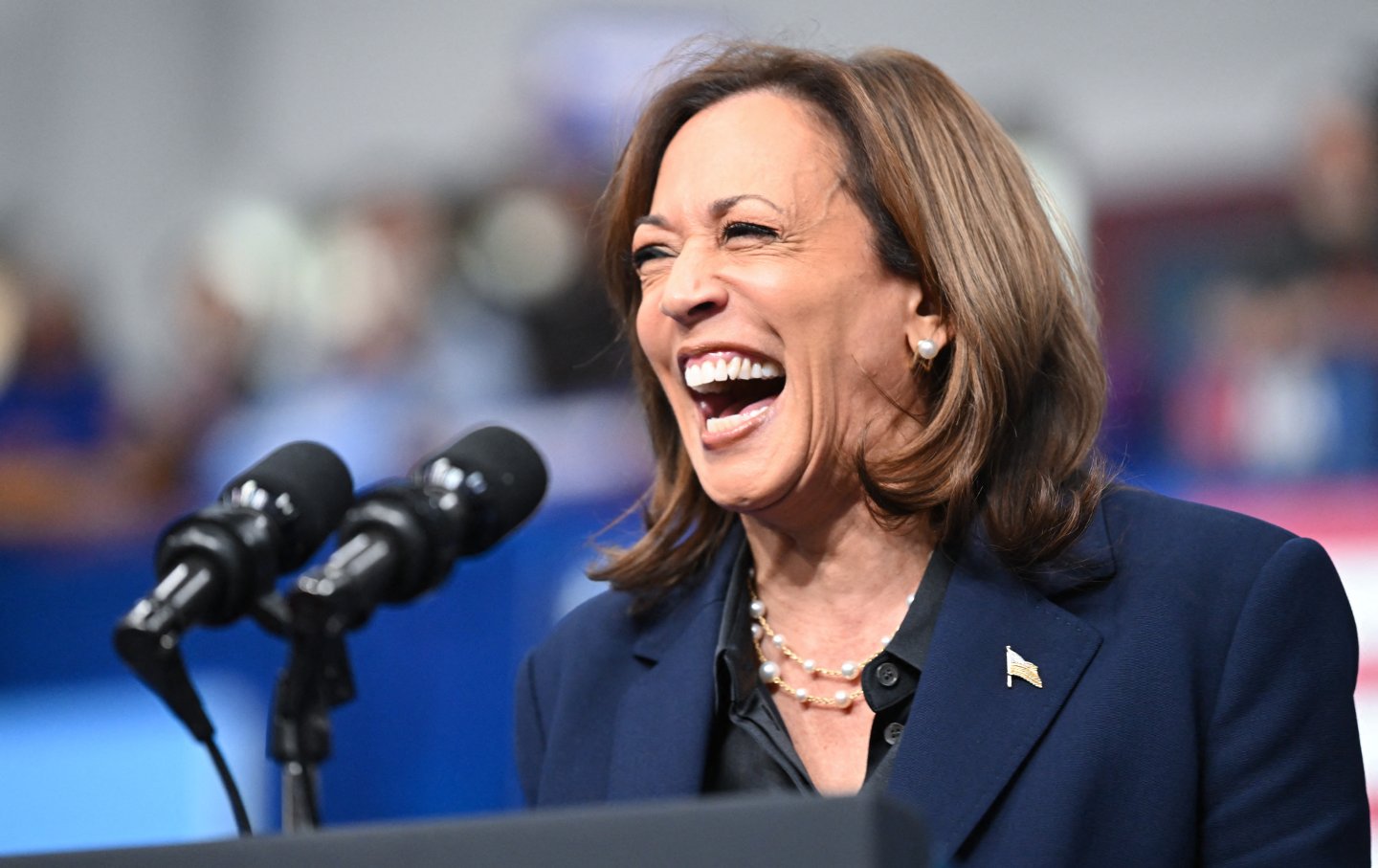
Kamala Harris speaks at the University of Wisconsin-La Crosse during a campaign event in La Crosse, Wisconsin, on October 17, 2024.
(Craig Lassig / AFP via Getty Images)Recently, The New York Times reported that Vice President Kamala Harris and Melinda French-Gates were considering a joint event about the “care economy.” My heart leaped. To hear the vice president make a new, specific call for an expanded home care benefit in Medicare a few days later was just icing on the cake.
In early 2020, my Yale colleague Amy Kapczynski and I wrote a series of articles for the Boston Review on how our country’s neglect of the politics of care was leading us into catastrophe—something that was clear even in the first few months of the Covid pandemic. Simply put, we pointed out that being able to take care of ourselves and those we love, whether our kin, our closest friends and colleagues, our neighborhoods, or our communities, was essential to riding out a once-in-a-century pandemic. We did not have an infrastructure of care in the US that was able to “catch people when they fall,” and Americans, in the millions, fell hard in the following years.
Back then, Amy and I proposed a massive “public health corps” as a short-term fix to help people navigate their way through Covid and ensure that their day-to-day needs were taken care of, while putting people to work in communities reeling from the pandemic. The idea was that, after the pandemic had ebbed, this locally based corps could be repurposed to build up the health of the nation from the ground up, with care as a centerpiece of that endeavor.
But the “care crisis” was already visible and being talked about for years before Covid. You could see it in our broken systems of child and elder care, paid family and sick leave, and other policies. You could also see it in the way our economic system—where productivity is king—is meant to extract and exploit, leaving us little time to care for ourselves and others; creates caste systems of care where poor, usually Black and brown, women end up shouldering the burden of care for those higher up on the socioeconomic ladder; and shunts generations of both the sick and the poor into the criminal justice system, through the public hospital system and back again in a merry-go-round of punitive and inadequate services that generate handsome profits for a few but never address the essential needs for care.
So to hear two of the most powerful people in our country talk about care is exciting. And don’t get me wrong, I’m not naïve. It will be an uphill battle to win the policy changes that we need to make care easier and accessible to all. The right will say we can’t afford it, even as the Boston Consulting Group suggests it will cost us trillions (i.e., the US will lose about $290 billion a year in GDP in 2030 and beyond) if we ignore the care crisis in front of us.
Confronting more fundamental problems in our social and economic system will take decades. But as Jessica Green at the University of Toronto has said about global warming, we’re talking about an existential issue here. This is about life and death—and care for our people is directly linked to care for our planet.
We haven’t heard what Kamala Harris or Melinda French-Gates think about this larger frame—the political philosophy of care—but they can’t have missed these larger discussions that have been happening about how we mobilize in the interests of others and build systems of governance so that people can flourish.
And while the talk of “care” may not seem like a priority for the right, they are circling this space too. The conservative movement has taken note of the strain on American families and proposed its own robust agenda for addressing the care crisis through “families first” and proposals to make America more “family-friendly,” with more than a little bit of the model for their ideas coming from Viktor Orbán’s Hungary.
So we have a choice: to cede the conversation on care to the right and their narrow, exclusionary vision of families first (where my childless dog-daddy LGBT household need not apply) or we can help shape the nascent vision of care emerging from Vice President Harris and French-Gates and the dozens of advocates who have been pushing the care agenda ahead for many years.
And care can center both short-term policy pushes—like childcare, elder care, and paid sick leave—and long-term thinking about how we “build back better” and create an economy that works for all of us, rather than grinding us down day by day. As Amy and I maintained four years ago, care is essential to our survival, not just from pandemics, but from the enormous pressures modern life puts on our ability to flourish in this world.
Support independent journalism that does not fall in line
Even before February 28, the reasons for Donald Trump’s imploding approval rating were abundantly clear: untrammeled corruption and personal enrichment to the tune of billions of dollars during an affordability crisis, a foreign policy guided only by his own derelict sense of morality, and the deployment of a murderous campaign of occupation, detention, and deportation on American streets.
Now an undeclared, unauthorized, unpopular, and unconstitutional war of aggression against Iran has spread like wildfire through the region and into Europe. A new “forever war”—with an ever-increasing likelihood of American troops on the ground—may very well be upon us.
As we’ve seen over and over, this administration uses lies, misdirection, and attempts to flood the zone to justify its abuses of power at home and abroad. Just as Trump, Marco Rubio, and Pete Hegseth offer erratic and contradictory rationales for the attacks on Iran, the administration is also spreading the lie that the upcoming midterm elections are under threat from noncitizens on voter rolls. When these lies go unchecked, they become the basis for further authoritarian encroachment and war.
In these dark times, independent journalism is uniquely able to uncover the falsehoods that threaten our republic—and civilians around the world—and shine a bright light on the truth.
The Nation’s experienced team of writers, editors, and fact-checkers understands the scale of what we’re up against and the urgency with which we have to act. That’s why we’re publishing critical reporting and analysis of the war on Iran, ICE violence at home, new forms of voter suppression emerging in the courts, and much more.
But this journalism is possible only with your support.
This March, The Nation needs to raise $50,000 to ensure that we have the resources for reporting and analysis that sets the record straight and empowers people of conscience to organize. Will you donate today?