How Inequality Was Redefined as “Poverty”—Letting Capitalism Off the Hook
In the 1960s, policy shifted from calling for the redistribution of wealth to enforcing an ideology of personal responsibility.
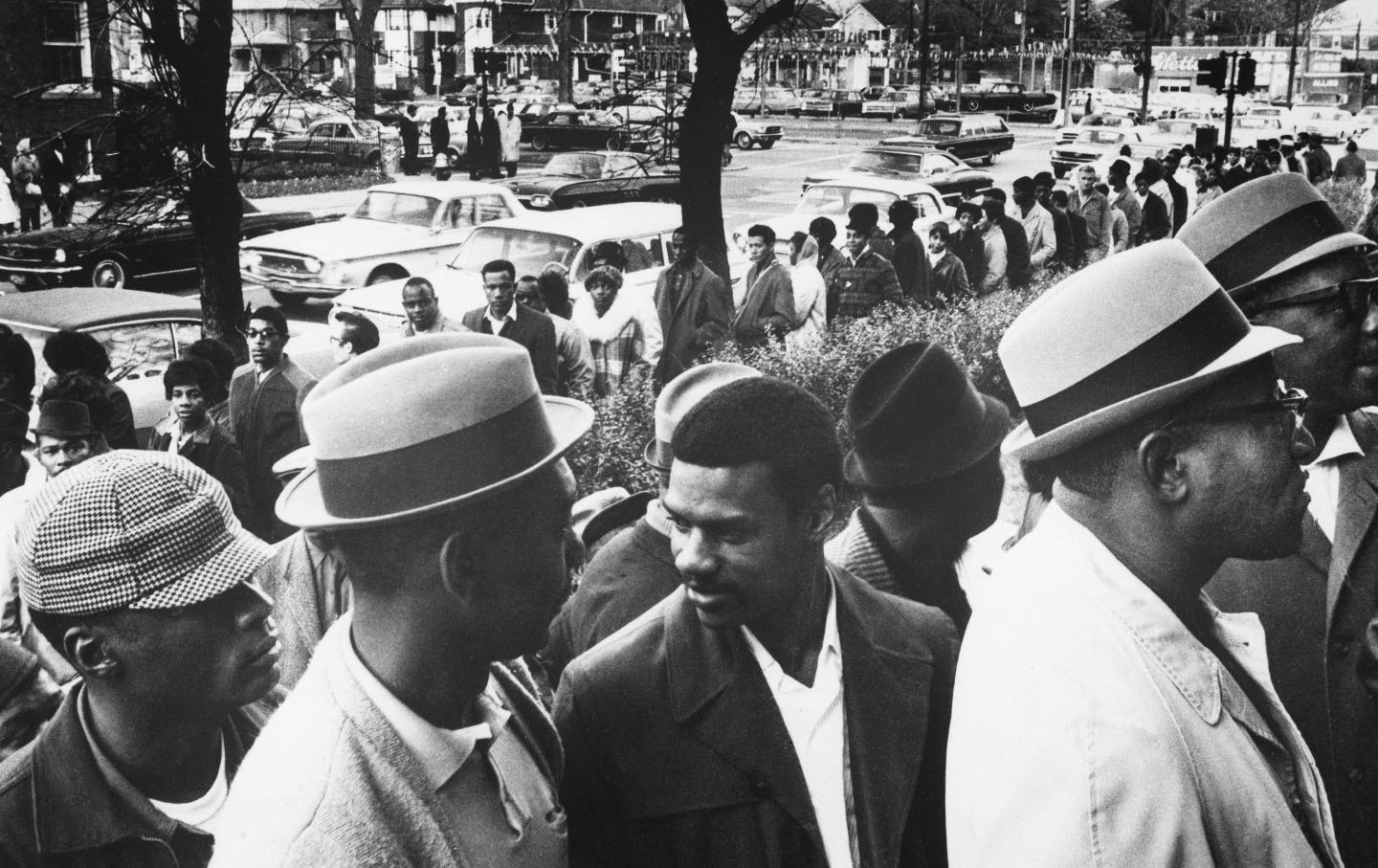
“The critical edge of 1963 was blunted in the legislation of 1964, as the causes of both poverty and black unemployment were separated from the workings of the economy,” writes the historian Judith Stein in her book Running Steel, Running America: Race, Economic Policy, and the Decline of Liberalism, on the aftermath of the events at the peak of the civil rights movement. “Discussions of unemployment, underemployment, and low wages were replaced by discourses on inadequate motivation, education, and culture, factors limiting a person’s ability to take advantage of opportunity…. Manpower policies would focus on the bottom end of the labor market.”
The discovery of poverty as a national problem in the late 1950s and early ’60s redefined economic inequality from a description of relative material circumstances to a cultural issue deriving from the inadequacies of individuals or groups. Debate within and around the John F. Kennedy and Lyndon B. Johnson administrations on how to understand and thus respond to “poverty” overlapped with the debate about structural unemployment. Figures like Labor Secretary W. Willard Wirtz, labor and civil rights leaders like Walter Reuther, A. Philip Randolph, and Bayard Rustin, and labor economists like Charles Killingsworth continued to argue that poverty stemmed primarily from the economy’s inability to generate sufficient gainful employment. In their view, the most effective anti-poverty strategy would involve the kind of substantial federal intervention that would tighten labor markets—including public investment, serious job training, and direct job creation.
The other view, which won out, insisted that poverty was a residual problem in the United States, distinct from the issue of unemployment. That view was advanced by administration economic advisers and other proponents of growth politics or “commercial Keynesianism,” the postwar liberal alternatives to redistributive social wage policies and active government involvement in managing the economy. It held that most unemployment could be eliminated through tax cuts intended to stimulate aggregate demand, which in turn would generate jobs through increased private investment. That view also reflected the contention that chronic unemployment and poverty resulted from deficits of skills or motivation, attitudinal problems, or in the case of Black Americans in particular, the effects of racial discrimination, and were unlikely to be ameliorated by a rising tide of economic growth. Anti-poverty efforts, therefore, should target the affected groups for special remedial interventions—character-building rather than redistribution.
The Ford Foundation, which had been involved in defining and responding to a postwar “urban crisis” since the mid-’50s and had an early toehold in the Kennedy administration, provided a conveniently fuzzy narrative. In line with the anthropologist Oscar Lewis’s original formulation of “the culture of poverty,” the foundation’s programs and reports identified the immediate source of persistent poverty as an underdeveloped sense of personal and group efficacy stemming from economic and social marginalization. That interpretation reinforced the subordination of economic privation to supposed personal characteristics. It also proposed a remedy, grassroots mobilization for community action, that substituted the cultivation of civic participation for redistribution, which would become a common trope of liberal egalitarian reform. Because it was action-oriented and focused on engagement at the “grassroots,” that approach could seem more authentic than the straightforwardly bureaucratic social-democratic proposals—particularly in light of an emerging New Left sensibility that prized direct action.
Two linked circumstances buttressed the perception that the community action approach was politically insurgent. It harmonized with the civil rights agenda of liberal Democrats, to the extent that Community Action and other such agencies created autonomous opportunity structures and programmatic resources that facilitated the upward mobility of Black and Hispanic political elites, enabling their incorporation into local governing coalitions on an ethnic interest-group model.
At the same time, insofar as the anti-poverty programs operated without local government oversight, entrenched officials often reacted to them with skepticism. They feared, correctly, that the federally funded social service agencies would establish rival institutional power bases that could support challenges to governing regimes. Black and brown pressure for greater representation in urban politics intensified during the postwar decades, partly as an expression of the increasing militancy of the struggle for racial justice. In that context, local officials’ attempts to rein in or control anti-poverty programs and activists could be seen by liberal reformers as, and often enough were, attempts by racially benighted local officials to suppress the legitimate aspirations of minorities.
Most important, separating poverty from political economy fit the Kennedy and Johnson administrations’ commitment to forswearing significant new domestic spending, which had been a condition of business and congressional conservatives’ support for the proposed tax cut intended to stimulate aggregate demand. The community action approach was much less costly than the interventionist alternative, and it satisfied the strictures against government involvement in resource allocation, production, prices, and wages that had been imposed in the postwar defeat of social-democratic or left-Keynesian tendencies in domestic politics. Defining poverty as a cultural rather than an economic problem comported with the Cold War propaganda that extolled an American way of life in which the promise of endless growth had supposedly overcome class tensions by providing access to a steadily improving standard of living for all who were not hampered by idiosyncratic limitations.
Recasting economic inequality as “poverty” reflected and extended postwar liberalism’s separation of inequality from capitalist political economy. The debate over how to understand poverty’s sources and remediate it marked another defeat for already moribund social democracy in the US. And the commitment to addressing economic inequality on the cheap led to a badly underfunded War on Poverty, which would underwrite subsequent contentions that it had been a “failed social program.” Moreover, the tax cut did not solve the unemployment problem, as rates declined only in response to increased public spending on the Vietnam War. As Judith Stein noted sardonically, “It was Ho Chi Minh, not Keynes, who brought [unemployment] down to 4 percent.”
Support independent journalism that does not fall in line
Even before February 28, the reasons for Donald Trump’s imploding approval rating were abundantly clear: untrammeled corruption and personal enrichment to the tune of billions of dollars during an affordability crisis, a foreign policy guided only by his own derelict sense of morality, and the deployment of a murderous campaign of occupation, detention, and deportation on American streets.
Now an undeclared, unauthorized, unpopular, and unconstitutional war of aggression against Iran has spread like wildfire through the region and into Europe. A new “forever war”—with an ever-increasing likelihood of American troops on the ground—may very well be upon us.
As we’ve seen over and over, this administration uses lies, misdirection, and attempts to flood the zone to justify its abuses of power at home and abroad. Just as Trump, Marco Rubio, and Pete Hegseth offer erratic and contradictory rationales for the attacks on Iran, the administration is also spreading the lie that the upcoming midterm elections are under threat from noncitizens on voter rolls. When these lies go unchecked, they become the basis for further authoritarian encroachment and war.
In these dark times, independent journalism is uniquely able to uncover the falsehoods that threaten our republic—and civilians around the world—and shine a bright light on the truth.
The Nation’s experienced team of writers, editors, and fact-checkers understands the scale of what we’re up against and the urgency with which we have to act. That’s why we’re publishing critical reporting and analysis of the war on Iran, ICE violence at home, new forms of voter suppression emerging in the courts, and much more.
But this journalism is possible only with your support.
This March, The Nation needs to raise $50,000 to ensure that we have the resources for reporting and analysis that sets the record straight and empowers people of conscience to organize. Will you donate today?