Why Are Armed Troops in NYC Subways?
Kathy Hochul made a grave miscalculation by further militarizing a city she doesn’t live in or understand.
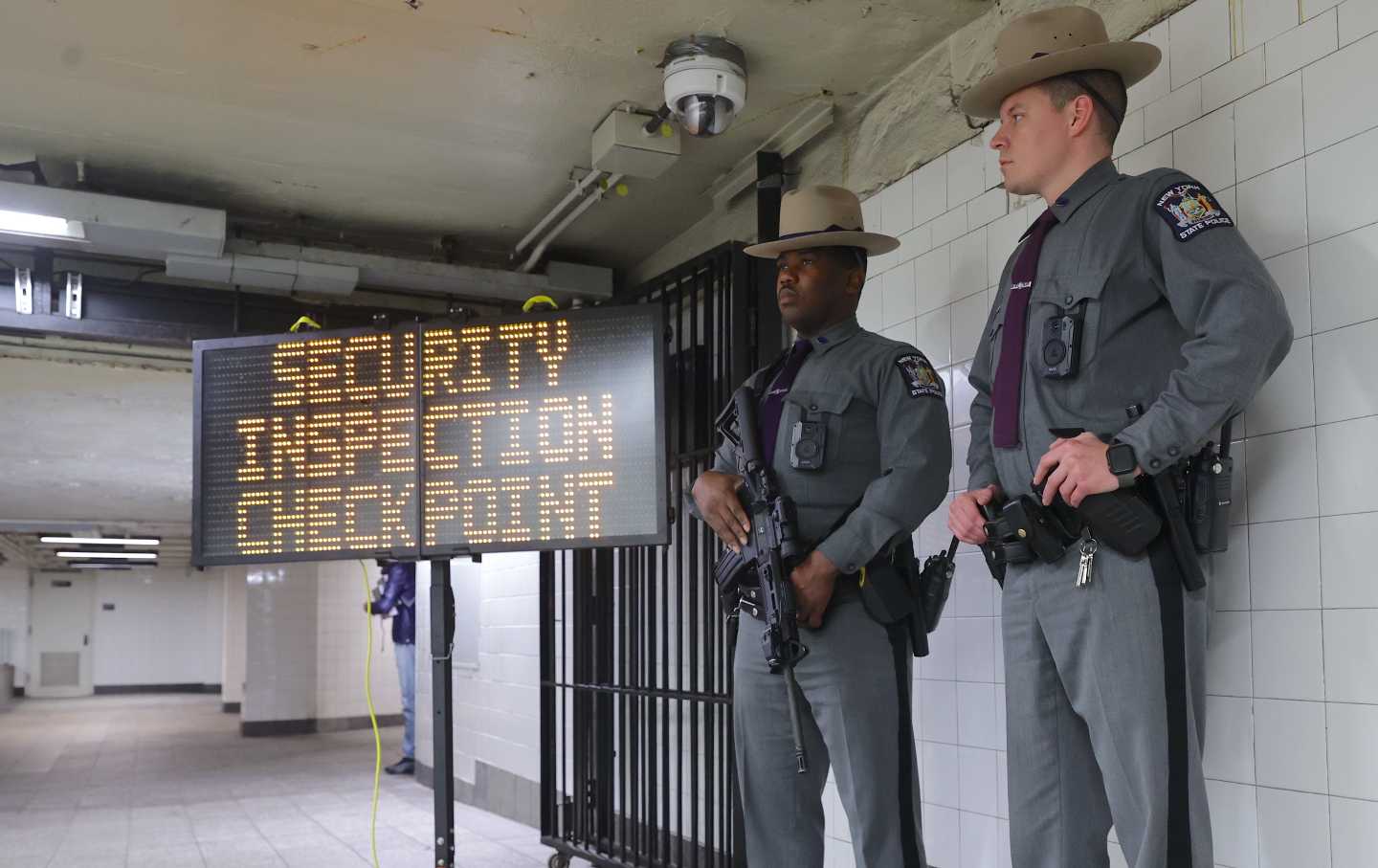
New York City is no stranger to security theater. Ever since 9/11, ultra-militarized police and actual military personnel have periodically roamed city streets, and various politicians—Republican and Democratic alike—have announced new mobilizations for various perceived threats. A decade ago, when ISIS was on the rise in the Middle East, Andrew Cuomo and Chris Christie, then the governors of New York and New Jersey respectively, momentarily terrified the populace by announcing how prepared they were for a very nonspecific terrorist threat. The substance of their media push amounted to little: more dogs, troopers, and the National Guard patrolling bridges and tunnels. Once the dust had settled, it became clear that Cuomo and Christie were mostly burnishing their brands ahead of potential presidential runs. Christie ran twice and never came close, while Cuomo never got the chance, after resigning in disgrace.
If the two men were ambitious blowhards, they at least had an excuse for bellowing about the ISIS threat that never materialized in the tristate area: Middle Eastern terrorists had hijacked airplanes and knocked down the Twin Towers, and the attacks traumatized a generation of New Yorkers and New Jerseyans. Christie and Cuomo were responding to something, if inflating a new threat to appear tougher to the national media.
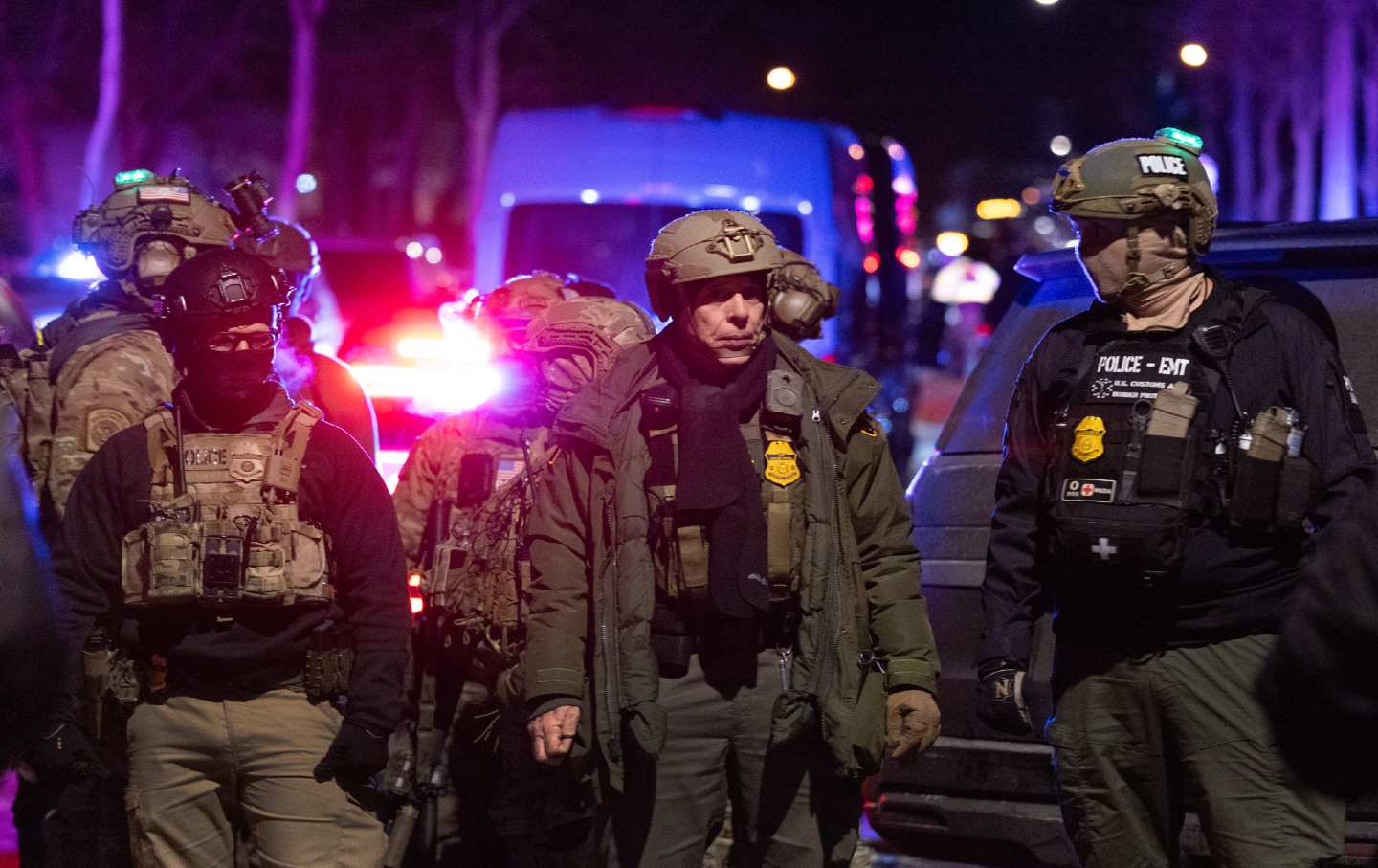
Contrast all of that with Kathy Hochul, Cuomo’s successor, deploying 750 National Guard troops to the New York subway system. Hochul lacks Cuomo’s political sociopathy, his thirst for vendettas and power games. She has governed the state differently. But she is, on matters of law and order, very much a centrist or even conservative, and throughout her tenure she has strained to weaken as many of New York’s criminal justice reforms as possible. After a Trump Republican, Lee Zeldin, almost beat her in 2022 by fanning fears around crime, Hochul has made it her mission to show voters that no Republican will outflank her again. (She also has the support of the Transport Workers Union, which wants an indefinite military presence because subway conductors have been attacked recently.)
The trouble is that the National Guard deployment is wholly unnecessary, even absurd. Crime in the subway ticked up at the start of the year and tailed off over the last month. Even the NYPD isn’t convinced that it’s a serious problem the city’s already large, very well-funded police force can’t solve. New York is grappling with ongoing homelessness and mental health crises—too many people, without any place to go, sleep on the platforms and in the cars—but crime itself, particularly violent crime, is not historically high. A New York Times analysis in 2022 found there was about one violent crime for every 1 million rides in the subway, and that number has fallen off since then.
What Hochul has done is fuel a wholly inaccurate narrative of New York’s decline, potentially creating a doom loop for her state’s most important economic engine. By US standards, New York City is a very safe place to live in and visit: The murder rate declined in 2023, and, while overall homicides were higher than in 2019, the last year before the pandemic, there were fewer people killed in 2023 than in 2011 and 2012—when Michael Bloomberg was mayor and the city, in the popular imagination, was believed to be more pristine.
Mayor Eric Adams, like Hochul, has inflated the myth of New York bloodshed and chaos. Early in his tenure, he said, against all available evidence, that he had never seen crime worse in the city—despite serving as a transit police officer in the early 1990s, when as many as 2,000 people a year were killed. Braying for law and order, he has only grown more unpopular. Between Hochul and Adams, right-wing Republicans couldn’t have dreamed up better Democrats to make the case for them that a diverse, Democrat-run city, now besieged by migrants, can no longer function.
This, of course, isn’t true. Despite Adams’s ceaseless warnings, the migrant influx has not destroyed the city. The municipal budget will have higher tax revenue than originally forecasted. Tourism is returning to pre-pandemic levels; bars and restaurants are packed; and subway cars are filling again with commuters and revelers. Downtown and Midtown Manhattan are still struggling with the rise of remote work—there are corridors that will never see the same foot traffic again—and there remains a glut of underused office space. But there’s little threatening New York now that isn’t impacting any other large city in America. The lingering effects of Covid are real. Shoplifting, for example, is a newer scourge battering small businesses and pharmacies.
All of these challenges, though, are manageable. New York needs deeply affordable housing to get the indigent sheltered. The state needs more psychiatric beds and facilities to help those battling addiction and mental illness. The federal government must invest far more in helping migrants, sending cash to New York and other localities while making it easier for their people to get work and start paying taxes. Notably, none of these long-term issues will be solved by National Guard troops carrying guns, randomly checking bags, and spooking locals and tourists alike.
Hochul is panicking. She is panicking because she doesn’t want to lose an election, in two more years, to another Republican. She is also miscalculating—a Buffalo native and Albany resident, she’s never had a real feel for New York City and what its residents actually crave. They want executives who will boost the city, reassure them, and project a mix of toughness and resolve. They aren’t against law enforcement, but they don’t think military troops are needed to surveil their commutes. If New York were in the fallout from another cataclysmic terrorist attack, this sort of unsettling infringement of civil liberties would be tolerated. But not now. Not when riding the subway is still, on most days, ordinary and forgettable. Here’s a straightforward prediction: Hochul will pull back the troops, sooner rather than later. And she’ll regret, quietly at least, the damage she did to her state and America’s largest city.