Covid, Year Four
Liberals are in denial. Conservatives are trying to destroy public health. And the virus is still raging.
After Four Years of Covid, We’ve Still Got Our Heads In the Sand
Liberals are in denial. Conservatives are trying to destroy public health. And the virus is still raging.
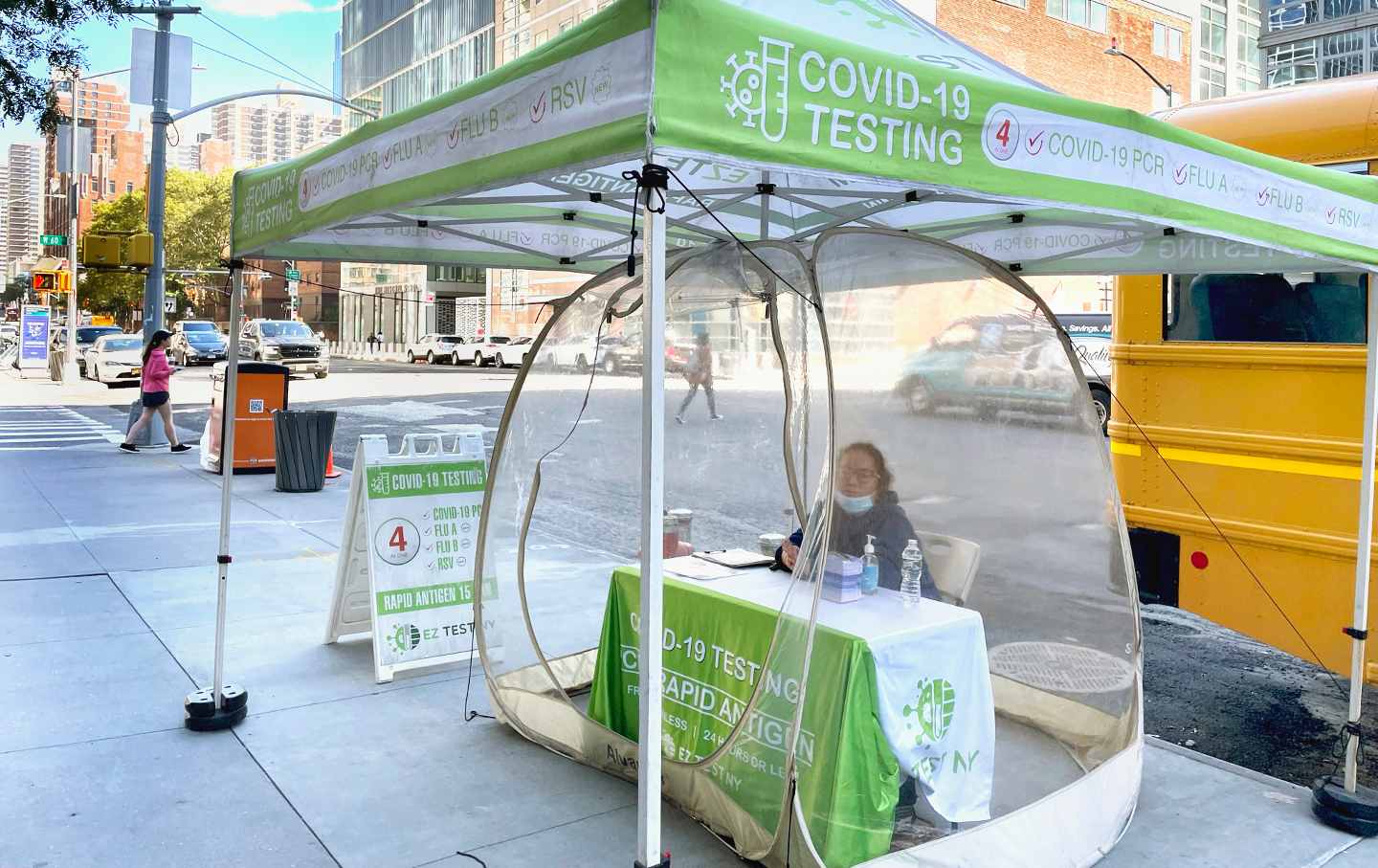
Four years of Covid-19. A total of 1.165 million deaths in the United States. As of December, we were averaging about 1,500 deaths a week from Covid. These numbers may seem abstract to many, but I remember a scientific paper from early in the pandemic that estimated “for every Covid-19 death, approximately nine surviving Americans will lose a grandparent, parent, sibling, spouse, or child”—which means 60,000 Americans were left grieving for the holidays.
Public health is about trade-offs between risks and benefits, just like personal health. Think about your own life: We all weigh the pleasure of that second glass of wine or extra slice of cake against the calories we know that pleasure will bring. And I’m not judging here, as I make these same decisions daily. (Give me that chocolate chip cookie.)
Yet I am not quite sure we’ve ever had an explicit discussion about the collective trade-offs we’ve made when it comes to Covid. As the physician and scientist Eric Topol said in the Los Angeles Times earlier this month, “SARS-CoV-2 has once again proved to be highly resilient, capable of reinventing itself to infect us. Yet we continue to make-believe that the pandemic is over, that infections have been transformed to common cold status by prior exposure(s), and that life has returned to normal. Sadly, none of this is true.”
We’ve told ourselves, or been told by our leaders, that the pandemic is over. And governments have reinforced that idea by jettisoning most mitigation measures, failing to deliver even on ones that would not require individual choice—such as improving ventilation and filtration in our buildings. We’ve also largely stopped tracking the spread of the virus and reporting detailed Covid data.
This is a way to let ourselves off the hook. It lets us think we’ve gotten something for nothing; that we’ve made no societal trade-offs at all. But, as Topol pointed out, this is a lie. The deaths, the burden on our hospitals, the difficulties that families face when someone is sick at home, and the specter of long Covid for some—those are the trade-offs, the things we have all been conditioned to accept as the price of our return to “normality.”
Some will say: Well, this isn’t 2020. Deaths and hospitalizations are down, even if infections are surging to their second-highest level since the pandemic began, with some estimates suggesting that one out of three Americans (or around 112 million people) could be infected by mid-February. But the comparator shouldn’t be the darkest days of the pandemic thus far. It should be what came before. Each year, we’re adding thousands of preventable deaths to the baseline of what we experienced as a nation in 2019 and calling it quits. This is the trade-off we’ve made. And as a recent report in The Washington Post reminds us, our baseline was far from rosy: We have some of the worst life expectancy among rich nations around the world, but we don’t seem to care much about that either.
If “don’t worry, be happy,” is the left-of-center default now, on the right, it’s mayhem. Many are familiar with Florida Governor Ron DeSantis’s attacks on public health and his surgeon general’s anti-vaccine quackery, but around the nation, Republican legislatures in nearly 30 states have also enacted laws that weaken public health authorities. Less well-known are the attacks on public health from a conservative judiciary. As the legal scholar Wendy Parmet has written, this is making us less safe and leaving us less prepared for new public health threats as they emerge. Meanwhile, emboldened by their support on the right, anti-vaccine activists are targeting standard childhood immunizations as an affront to religious liberty and winning in states like Mississippi. There are also conservative legal challenges to mandates for polio and measles, mumps, and rubella shots in several states, in hopes that the Supreme Court will eventually strike down childhood vaccine mandates across the board.
Finally, there is the sad revisionism of leaders such as former National Institutes of Health director Francis Collins, who suggested that concerns about the social and economic impacts of lockdowns were underplayed in 2020—a totally false rewriting of history. (Collins earned a rebuke from Jeremy Konyndyk, the former head of the USAID Covid task force, for undermining “‘public health’ by blaming it for all COVID-related grievances and airbrushing what Trump and other pols actually did,” thus obscuring the actual and difficult trade-offs being made during the early days of the pandemic.)
Meanwhile, as Collins was being lauded on the right, an 83-year-old former civil servant, Anthony Fauci, who led the nation’s infectious disease response for nearly 40 years, was being grilled for hours by a hostile House committee for his Covid sins. Talk about feeding your colleagues to the lions to save your own skin. Thanks, Francis, for your service.
So here we are in 2024. Liberals and progressives in a la-la land of denial. Conservatives in a feeding frenzy, ready to tear apart American public health for their own political purposes. And the virus nowhere near under control. This is the state of the pandemic in year four.
Correction: This piece initially said that one in three Americans is equal to 140 million people It has been updated with the correct figure.