
Cornell Drops Its Discrimination Case Against a Pro-Palestine Professor After Public Outcry
After around 160 faculty members signed a resolution condemning the university, Cornell closed a disciplinary case against Dr. Eric Cheyfitz on the condition that he retires.

Students outside Goldwin Smith Hall at the Cornell University campus.
(Bing Guan / Getty)
Cornell University has agreed to end disciplinary proceedings against Dr. Eric Cheyfitz—an 84-year-old professor of American studies who was battling a discrimination case that sparked concerns over academic freedom—in exchange for his retirement after a paid leave through June 2026, according to a copy of the deal reviewed by The Nation.
The agreement puts to rest months of investigations—carried out by different university bodies with conflicting findings—into whether Cheyfitz told a graduate student last semester to drop a class he was teaching about Gaza because the student is Israeli. Cheyfitz, who is Jewish and whose daughter and grandchildren live in Israel, denied the allegation.
The deal came a little over a week after The Nation reported in September that Cornell had canceled Cheyfitz’s classes this semester, and just days after around 160 faculty members at Cornell signed a Faculty Senate resolution, which has yet to be considered, condemning the university for threatening academic freedom and violating principles of due process in its handling of the case.
To Cheyfitz—an outspoken advocate for Palestinians who has taught at Cornell for more than two decades—the agreement is a “major victory,” especially when compared to the punishment the provost had earlier recommended: a two-semester unpaid suspension. Cheyfitz said his retirement was “obviously compelled,” but he added that he had planned to step down in the near future anyway and will not dial back his activism. “They wanted me out of the picture,” Cheyfitz said. “I’m not gagged. I will continue to talk about this case.”
At a Faculty Senate meeting last week, provost Kavita Bala rejected claims that the university violated Cheyfitz’s academic freedom. “I believe deeply in academic freedom,” Bala said. “But that freedom does not extend to denying a student access to an educational opportunity based on their nationality or their viewpoint.”
An excerpt of the agreement, signed on October 7 by Cheyfitz and College of Arts and Sciences dean Peter John Loewen, reads, “Cornell will announce that Professor Cheyfitz has decided to retire, stating: ‘Professor Cheyfitz has decided to retire and this matter is concluded.’”
Cheyfitz acknowledged that he had asked the graduate student to quit the course in a conversation in late January but denied it had anything to do with the student’s Israeli identity. The graduate student recorded that exchange and used it as evidence in a discrimination complaint. Cheyfitz said he had not been told that he was being recorded.
The graduate student, Oren Renard, a PhD candidate in computer science whose identity was confirmed by other students in the class, once served in Unit 8200, the Israeli military’s equivalent to America’s National Security Agency, according to an archived copy of his LinkedIn profile. (He has since removed the references to the unit from his profile.) Luna Droubi, Cheyfitz’s lawyer, said that Cheyfitz was acting to protect others in the class who had come to him with concerns that Renard appeared to be surreptitiously recording them during discussions, possibly to “gather their names and comments” and intimidate them. Cheyfitz also claimed that Renard often came to class unprepared and argumentative.
It is unclear exactly what Cheyfitz told Renard. Renard, who has not been charged by the university with wrongdoing, did not answer an e-mailed list of questions for this story, including a request to share the audio. Droubi argued that any reference to Israel during the exchange was made in the context of political views, not identity.
In an October 11 letter to the editor published in The Cornell Daily Sun, nine of Renard’s peers in the course wrote that many of them had “approached Professor Cheyfitz with fears that we were being recorded with the intention of doxxing us later” and that “it was immediately clear that [Renard] had come to disrupt.”
University spokesperson Rebecca Valli confirmed that the case is resolved. “Professor Cheyfitz has chosen to retire and leave university employment, thus ending Cornell’s disciplinary process,” Valli wrote in a statement. Cornell’s civil rights office, she added, “issued a finding of discrimination by Professor Cheyfitz based on evidence of a Title VI violation and applying the required federal standard. The finding that Professor Cheyfitz violated Cornell policy and federal law remains in place.”
According to the terms of Cheyfitz’s deal, he will be eligible to apply for emeritus status and can still refer to himself as Ernest I. White Professor of American Studies and Humane Letters, but waived his right to sue the university over its handling of the case or “pursue any grievances or complaints using any of Cornell’s internal processes.”
Cheyfitz’s paid leave will last until the end of June 2026 at his current salary, at which point he will retire with full benefits. He can participate in campus activities but will have to vacate his office by the end of November.
Pressure mounted from faculty members in support of Cheyfitz in the run-up to the deal, and the resolution condemning the university for canceling Cheyfitz’s classes and pushing ahead with the discrimination charge is still pending in the Faculty Senate. “[T]he cancellation of Professor Cheyfitz’s classes amounts to punishment without process,” the Faculty Senate resolution reads in part, adding that “the University’s actions represent a serious attack on academic freedom.”
According to Cheyfitz, Cornell’s civil rights office had found him “responsible” for the discrimination charge in April. Cheyfitz said Loewen, the dean, recommended that he be suspended for two semesters without pay. But the case and Loewen’s recommendation that Cheyfitz be disciplined were tossed out unanimously on appeal in June by the Faculty Senate’s Committee on Academic Freedom and Professional Status of the Faculty—a six-person panel tasked with investigating matters of academic freedom.
However, Droubi said Loewen overruled the panel and went against the university’s own rules—which state that he “must accept” the committee’s conclusions—when he forwarded the case to Bala, the provost, who in turn launched her own investigation concluding that Cheyfitz had violated federal antidiscrimination laws and professional expectations. Bala reportedly wrote in a letter to Cheyfitz in August that a two-semester unpaid suspension was “fully warranted.” That same month, about a week before the start of the semester, Cheyfitz said, the university canceled his classes.
At last week’s Faculty Senate meeting, Bala argued that the Faculty Senate panel’s findings needed to be set aside because the panel used a higher evidentiary standard, “clear and convincing evidence,” than the federally mandated one used by Cornell’s civil rights office: “a preponderance of the evidence.” (Cornell policy states that the Faculty Senate panel should operate with the higher standard.)
Popular
“swipe left below to view more authors”Swipe →“As a university, we would be violating federal antidiscrimination law if we accepted their finding based on that threshold,” Bala said at the meeting. Bala did not respond to requests for comment, and Loewen said that he was unable to comment on a personnel issue.
In an October 5 letter to the editor published in The Cornell Daily Sun, the Cornell chapter of the American Association of University Professors questioned why Bala would go against Cornell policy by ignoring the Faculty Senate panel’s findings. “The only conclusion we can draw is that she was unhappy with the outcome,” the group wrote. “This is the height of arbitrariness and it sets a dangerous precedent for faculty members under Cornell’s current administration.”
Droubi called it a mistake for Cornell to have revived the case against Cheyfitz in the first place. But ultimately, she said, the university “did the right thing” in choosing to settle. “I think the pressure of the community and the outpouring of outrage for what happened to [Cheyfitz] contributed immensely,” Droubi said.
Cheyfitz might no longer teach classes at Cornell, but he said that because of fresh attention brought by the case, he has already fielded invitations for speaking engagements at other universities. “I got invited by the students at University of Virginia Law School to come and talk about the case,” Cheyfitz said.
“This is not going away. I mean, I’m a good example,” Cheyfitz added. “The way this case has been handled is a good example of throwing due process, academic freedom, and faculty governance under the bus.”
More from The Nation
What Will Be Left After the University of Texas Destroys Itself? What Will Be Left After the University of Texas Destroys Itself?
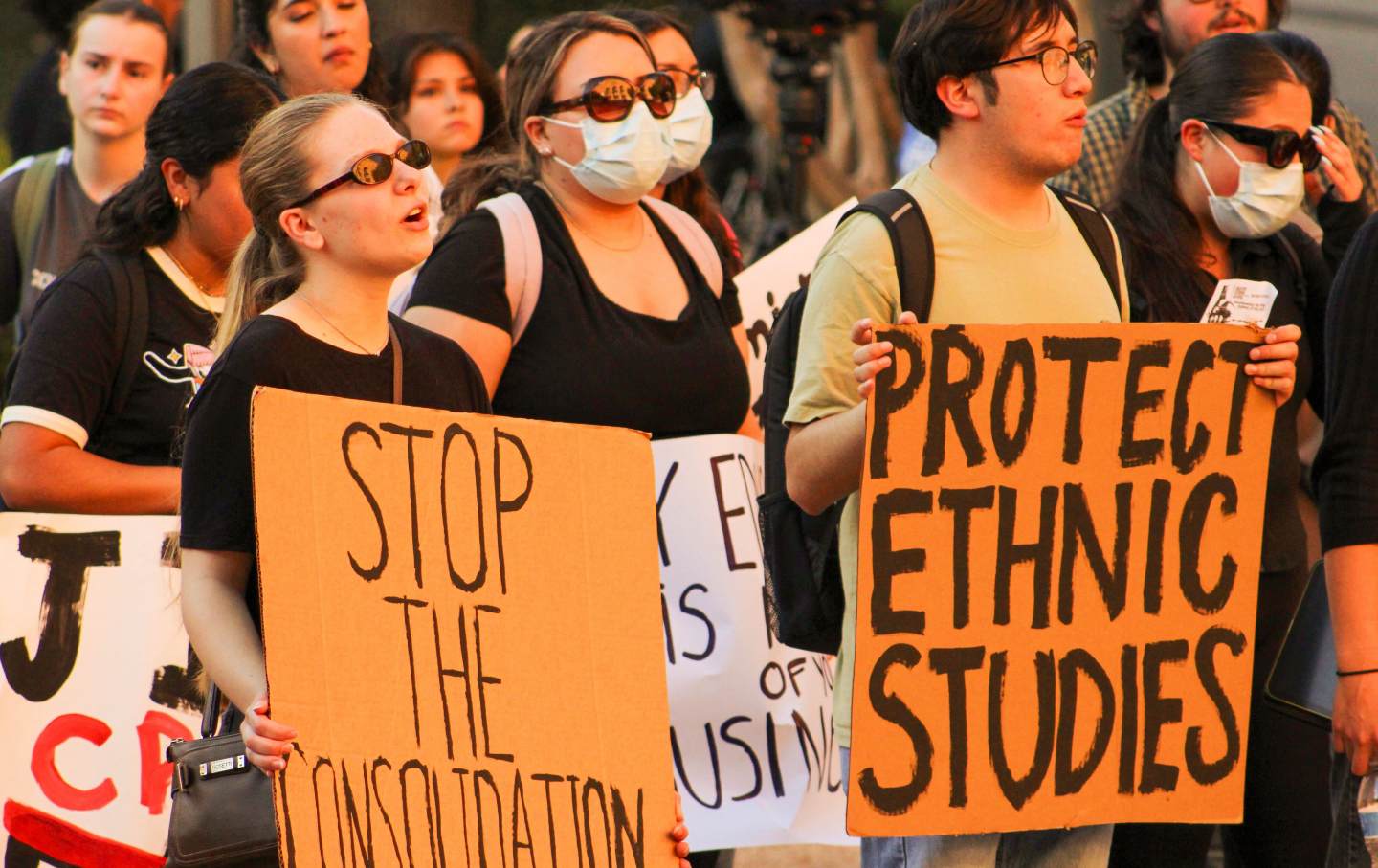
UT-Austin has collapsed its race, ethnic, and gender studies into a single program while a new policy asks faculty to avoid “controversial” topics. But the attacks won’t end there...
The Corporate Media Is Head Over Heels for the Iran War The Corporate Media Is Head Over Heels for the Iran War
Donald Trump’s attack may be surreal, unjustified, and illegal. But that’s not stopping the press from turning the propaganda dial way up.

The Disturbing History of ICE’s “Death Cards” The Disturbing History of ICE’s “Death Cards”
The Vietnam-era practice is yet another example of ICE agents thrilling to the brutality they have been encouraged to cultivate.

The Red State–Blue State Healthcare Divide Is Dangerous for Everyone The Red State–Blue State Healthcare Divide Is Dangerous for Everyone
Whether or not you have access to independent, scientifically sound public health guidance may depend on how your state voted for governor.
The American Universities Programming Israel’s Killer Drones The American Universities Programming Israel’s Killer Drones
Industry partnerships in higher education are pushing STEM graduates into the business of weapons manufacturing and genocide profiteering.

In the Trump Era, Celebrating Black History Month Feels Radical Again In the Trump Era, Celebrating Black History Month Feels Radical Again
After putting on their very best performances of solidarity every Black History Month, this year corporate marketers have seemed at a loss for words.

