
On the Waterfront
The remaking of Bush Terminal.
The Transformation of the New York Waterfront
From the Navy Yard and Industry City to the recent remaking of Bush Terminal, developers are attempting to remake Brooklyn’s coastline.
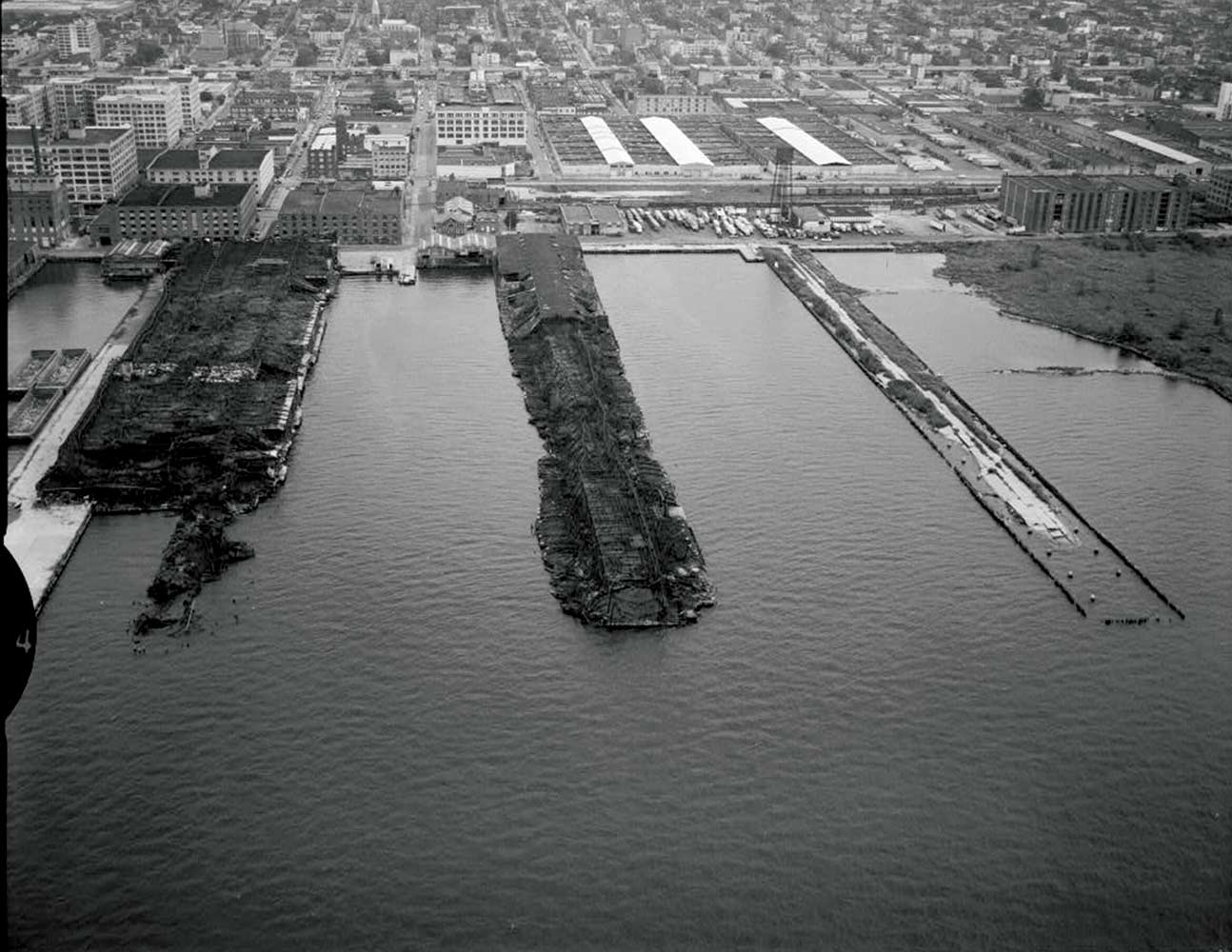
Driving the Gowanus Expressway in the 1980s, I’d often gaze in wonder at the string of massive industrial buildings that lined the South Brooklyn waterfront. Epic in scale, they appeared to be the relics of a lost world. At the time, I didn’t know a thing about them. I had no idea that they represented 10 million square feet of late-19th- and early-20th-century industrial ambition, or even that they had names: the Brooklyn Army Terminal, Industry City, and Bush Terminal.
Honestly, I didn’t give them much thought, because so much of New York City in the 1980s was like that: abandoned, disused, up for grabs. It didn’t seem particularly noteworthy that an entire working waterfront had become estranged from the real estate industry’s concept of value. Back then, I had no idea that Bush Terminal, as the complex had originally been called, had once been a visionary project. Built by a man named Irving Bush, it began operations in the late 19th century and was what we might refer to today as an intermodal shipping complex. Goods would arrive by water and leave by rail. Bananas, coffee, and cotton were unloaded from boats via doors on the warehouses’ water side—picture the flaps of an Advent calendar—and later loaded on trains from a similar set of doors on the land side. According to Waverly Neer of the New York City Economic Development Corporation, Bush Terminal “became an economic workhorse, not just for New York City but of the world. At its height, it spanned several city blocks and avenues and employed over 35,000 Brooklynites.” After World War II, trucks began to take over the distribution of goods and this transportation marvel of the early 20th century lost its purpose. “The site was effectively locked off from the public and from businesses for almost 40 years,” Neer says. “The city assumed control of it in the ’80s.”
There were still, however, commercial tenants in the facility at that point. Topps, famous for its baseball cards but also known for other novelty products like Wacky Packages and the Garbage Pail Kids, remained there until the mid-’90s. In fact, back when I assumed those buildings were moribund, some friends and acquaintances still worked in them. Topps provided a steady income to cartoonists and illustrators I knew, like Art Spiegelman and Mark Newgarden. Still, Bush Terminal wasn’t exactly bustling. “The only other business in that building that I was ever aware of,” Newgarden recalled, “was the Uneeda Doll Company.” It was “hard to miss—doll heads would sometimes be strewn across the cobblestone streets outside the entrance.” As for the rest of the terminal and the surrounding area, it was a “semi–ghost town.”
By the early 21st century, however, grand schemes had begun to develop around these hulking old relics of industries past. In many parts of the world, including New York City, efforts were underway by entrepreneurial real estate companies and municipalities to “reclaim” the derelict industrial zones and waterfronts by turning them into parks, workplaces, and entertainment venues.
An early New York City example was the Brooklyn Navy Yard. From 1801 until 1966, when the federal government finally parted with it, the site had been home to a major shipbuilding facility in war after war. After the feds shut down the Navy Yard, it became another one of those mysterious places: 300 acres of prime New York City real estate, somnolent and largely inaccessible to the public. But then the city took it over and, over time, it began to fill with private industry. By the early 2000s, it had been repositioned as a “sustainable industrial park.” Along came the so-called maker class, young entrepreneurs who understood the economic potential of digital fabrication tools. One of its rooftops even became the site of the very stylish Brooklyn Grange urban farm.
Among the people who led this effort was Andrew Kimball, the president and CEO of the Brooklyn Navy Yard Development Corporation. In 2013, Kimball turned his attention to Industry City, a 6-million-square-foot hunk of underused space (also part of Irving Bush’s legacy) that had been purchased by the real estate management company Jamestown Partners. By that time, Industry City had attracted artists and designers with its affordable studio spaces. But under new ownership and management, it became somewhat less affordable and was rebranded, like many former industrial places, as a destination. It now has a Japanese market and food hall, nighttime dance parties, various fancy shops, and festivals. On weekends, young parents can be seen enjoying summertime drinks in its courtyards while their kids play in a massive sandbox.
So it made perfect sense when the city, under Mayor Bill de Blasio, announced a plan to transform Bush Terminal, the 36-acre expanse south of Industry City, into a center for light industry in general and the garment industry in particular. The goal, as The New York Times wrote of the city’s plan, was to “create a new, modern garment district” that would presumably supplant the traditional Garment District in Manhattan—one that offered “large industrial buildings, affordable rents and easy access to transit lines.”
That was back in 2017, and since then a painstaking makeover of Bush Terminal has been underway, with a historically considerate renovation of two old warehouse buildings by nArchitects, the Brooklyn-based partnership of Mimi Hoang and Eric Bunge. The firm’s website describes the project this way: “The revitalization of the two former warehouses includes tenant spaces and business support for companies working in design, pattern-making, cutting and sewing, and sample-making. Appropriate to its context of Sunset Park, with its long history as a home to working-class and immigrant communities, the [project] supports opportunities for skilled laborers that are at risk of disappearing from the city.” When the first of these buildings was completed earlier this year, I was eager to see the results.
On a scorching August day, I visited Building A, now completely renovated, well air-conditioned, gorgeous, and largely unoccupied. The result was a very 21st-century combination of rough, industrial structural members and art-gallery aesthetics, such as the gleaming, high-quality concrete floors. There are original columns, according to Hoang, from trees hewed in the early 1800s. To deal with sea-level rise and storm surges now, however, there are also “10-to-12-inch-thick reinforced concrete walls with a waterproof membrane in between the existing brick and the concrete,” principal architect Amanda Morgan added. But, alas, still no garmentos to be seen. As Morgan explained: “Covid hit, and rents came down. So a lot of people were able to stay in place.” As a result, the New York City Economic Development Corporation rebranded the project: “Now it’s called MADE Bush Terminal…. That’s an acronym, which stands for ‘Manufacturers, Artisans, Designers, and Entrepreneurs.’”
Covid was one reason. But the absence of garment businesses is also partly because the plans for Bush Terminal were not viewed favorably among at least some of the manufacturers in the Garment District. As Katie Sue Nicklos, the CEO of Wing & Weft Gloves, the last custom glove shop in the United States, notes: “The Garment District is an ecosystem. Our work depends on being able to walk a few blocks to a trim supplier, a specialty leather shop, or a tailor who can turn something around same-day. We also need to be close to our Broadway and fashion clientele for these quick timelines. Moving to Bush Terminal would have dismantled that network. The cost and time lost in transporting goods and people between Brooklyn and our current vendors and clients in Midtown would have been devastating.”
Other recent events may have diminished Bush Terminal’s appeal to the rag trade. This past August, the City Council signed off on a rezoning plan for Midtown South, by which it meant the Garment District, that changes the neighborhood’s primary use from manufacturing to residential and allows the creation of 9,500 much-needed units of housing, a third of which would be permanently affordable. But along with the rezoning, representatives of the garment industry, working with city officials, crafted a compromise that preserves 20 percent of the area for commercial and manufacturing use. Even as the Bush Terminal planners were hoping to attract garment manufacturing to their development, the City Council was sending its own message to the district’s established manufacturers: Please don’t go.
The small industrial preserve in Midtown consists of roughly 39 buildings where residential conversion won’t be allowed. In addition, the city is providing a $122 million package of programs to help nonprofits purchase space for “fashion and garment uses,” among other things, and to sponsor a branding campaign called “Midtown Made,” which will promote the idea that the garment industry is a central part of the life of the city, as well as a push to get New York fashion designers to manufacture their creations close to home.
Meanwhile, as a sector of older industrial Manhattan is preserved, changes at Bush Terminal are moving ahead apace, albeit under slightly different terms: Along with the broader ambitions for the terminal comes some high-level architectural panache. There will be a new park on Pier 6 by the landscape design firm Scape, a new soundstage for Steiner Studios designed by Dattner, and a pair of ancient warehouses, remodeled and refreshed, housing a variety of light industrial firms. Building A is also slated to have a music venue on the ground floor, making Bush Terminal a destination like neighboring Industry City, though it will also have space allotted to community groups and neighborhood schools such as Sunset Park High School.
Popular
“swipe left below to view more authors”Swipe →Certain architectural elements were designed with the garment industry in mind. But mostly this is industrial space that could be useful to anyone. Like many large-scale projects in a city full of contradictions and competing interests, Bush Terminal began as one thing, was planned to be revived as another, and now will likely be a different thing altogether. This, in a way, is the ongoing story of New York City. On the day of my visit, there was only one tenant, a furniture maker named Joshua Hume. He showed off his newly installed air-filtration system and passed around photos of his space’s sunset views of New York Harbor. He was very happy to be there.
More from The Nation
Is Union Power Growing in Mamdani’s New York? Is Union Power Growing in Mamdani’s New York?
Following the Mamdani administration’s talks with the CUNY faculty union, three professors have returned to class after losing their jobs for their pro-Palestine activism.
How Stephen Miller Became the Power Behind the Throne How Stephen Miller Became the Power Behind the Throne
Miller was not elected. Nor are he or his policies popular. Yet he continues to hold uncommon sway in the administration.
What Peter Thiel Saw in Jeffrey Epstein What Peter Thiel Saw in Jeffrey Epstein
In the extensive correspondence between the Silicon Valley venture capitalist and the late pedophile, both men expressed a deep aversion to democracy.
How Capitalism Transformed the Natural World How Capitalism Transformed the Natural World
In her new book, Alyssa Battistoni explores how nature came to be treated as a supposedly cost-free supplement of capital accumulation.

The Truth About Interracial Intimacy The Truth About Interracial Intimacy
In a new memoir, author Dorothy Roberts explores why interracial attraction can’t be disentangled from the larger forces of race, gender, and power that govern our world.
Bad Bunny’s Stunning Redefinition of “America” Bad Bunny’s Stunning Redefinition of “America”
His joyous, internationalist, worker-centered vision was a declaration of war against Trumpism.

