Birthright Citizenship Lives to Die Another Day
The Supreme Court’s decision upholding birthright citizenship is a victory that may contain the seeds of a future defeat.
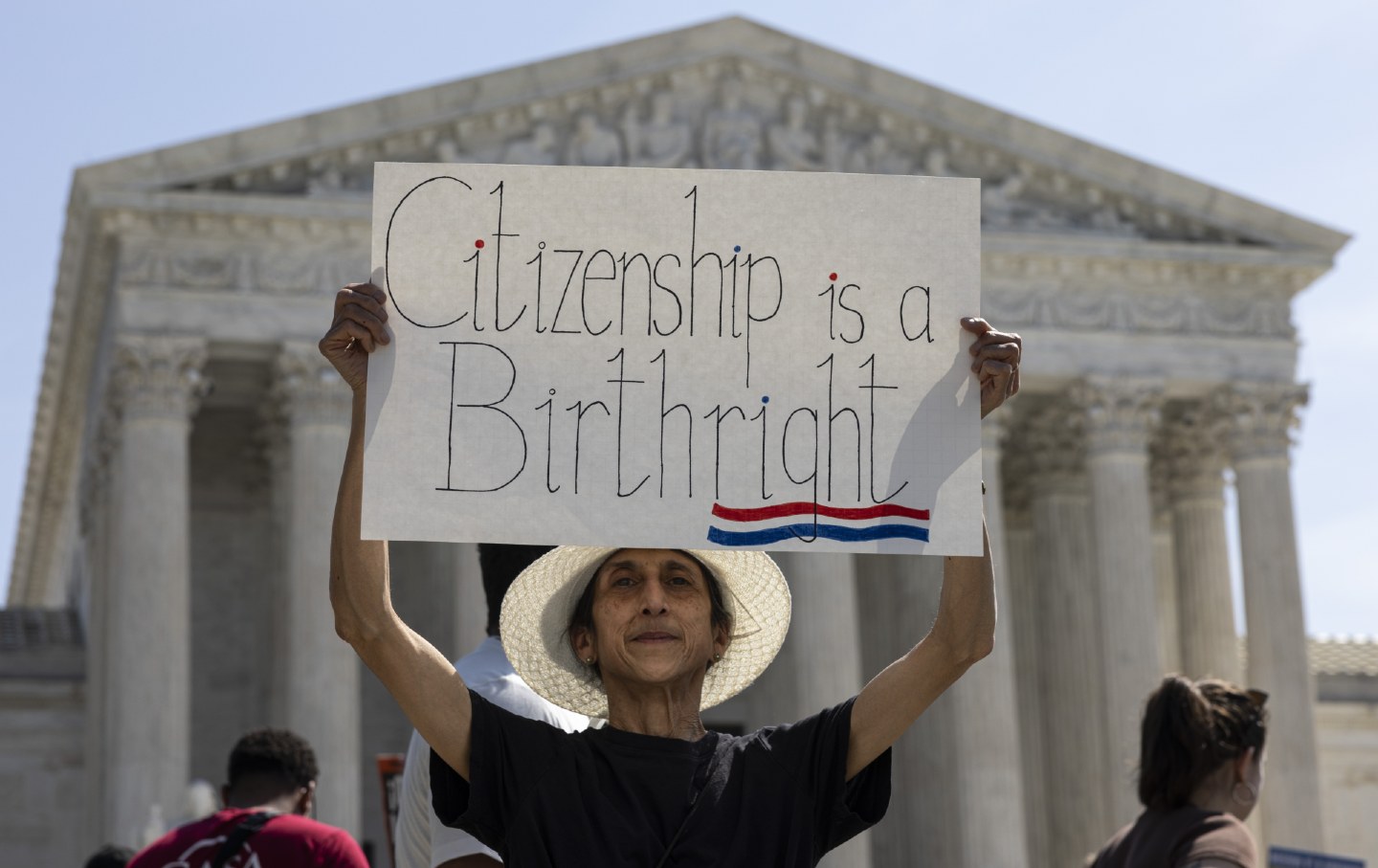
Supporters of birthright citizenship rally outside the US Supreme Court on April 1, 2026.
(Mehmet Eser / Anadolu via Getty Images)The battle over birthright citizenship is over. The war against birthright citizenship is just beginning.
That is the essential lesson of today’s Supreme Court ruling in Trump v. Barbara, the case involving Donald Trump’s Executive Order No. 14160, which denied citizenship to children born to temporary immigrants and children whose parents are in the country without authorization.
The ruling is a victory, to the extent that upholding a bedrock principle hard-coded into the Constitution for more than 150 years is what passes for a “win” these days. But the ruling was far closer than it should have been. There were a number of dissents, and when you read those dissents, the ruling looks less like the final word and more like the prologue to what will be a long and ugly attempt to write xenophobia and bigotry back into the Constitution.
The case hinged on two objections to Trump’s executive order: that it violated federal statute and that it violated the Citizenship Clause of the 14th Amendment.
On the statutory claim, Trump lost 6–3. Chief Justice John Roberts wrote for the majority, and his 30-page opinion (in a ruling that clocked in at 194 pages) was almost perfunctory. At the risk of oversimplifying it, Roberts said that birthright citizenship (as enshrined both in federal law and the Constitution) means what we’ve always thought it meant: that all children born here are citizens here. He was joined by justices Sonia Sotomayor, Elena Kagan, Ketanji Brown Jackson, and Amy Coney Barret. He was also joined, in part, by alleged attempted rapist Brett Kavanaugh.
Kavanaugh only joined Roberts’s interpretation of federal law. On the more important constitutional question—whether the Citizenship Clause of the 14th Amendment demands that all persons born in the United States are citizens—Kavanaugh split off, making the vote 5–t4. In a concurrence, he said that the Citizenship Clause does not apply to children whose parents are living here in violation of US law. His view was echoed by dissents from justices Clarence Thomas, Samuel Alito, and Neil Gorsuch.
The fact that the foundational principle of American citizenship, something said clearly and plainly in the Constitution, survived by only the slimmest of majorities over the strenuous objections of two-thirds of the Republican supermajority should not be cause for celebration. It is a cause for deep concern. Trump tried to change the definition of citizenship by executive fiat in clear opposition to the text of the 14th Amendment, and he almost got away with it. This time. And we know there will almost certainly be a next time; the Supreme Court loves to give Trump multiple bites at the apple whenever he is trying to graft bigotry onto the Constitution.
As has happened in the past, the dissents laid out the road map for how Trump or future bigots might get around the Citizenship Clause. Trump tried to take out both children of people with temporary status (like people on work visas) and children of people without proper status (like people who have overstayed travel visas or crossed the border in secret), and that appears to have been his mistake. The dissenters have different arguments for why the children of people who have temporary status should be denied rights than for why children whose parents are out of status (or never had status) should be denied those rights. It’s possible, even likely, that if Trump attacks these two groups separately, he’ll squeak his way to five votes on one or both fronts.
Clarence Thomas’s wild dissent is the one that most directly took on the issue of the children of people here temporarily. The thrust of his argument is that temporary visitors are not properly “domiciled” in the United States, and thus their children cannot be citizens. What does “domiciled” mean? Well, according to noted dictionary-enthusiast Thomas, it doesn’t mean what Merriam-Webster says it means. Instead, Thomas claims that people are “domiciled” where they’re from, not where they live. Thomas says that such immigrants still “owe allegiance” to their home countries. Indeed, no matter how long a noncitizen lives in the United States, Thomas says, they are always domiciled somewhere else.
Thomas’s interpretation makes no logical sense, and most people will be able to see how obtuse his argument is if they just consider their own lives. Most likely, you do not live in the same house you grew up in. Many of you don’t live in the same state you grew up in. And some of you might only be living where you are on a temporary basis—maybe, you know, you rent. Maybe you’re only there for a job and plan to leave the moment a better employment opportunity comes along. Maybe you’re like me and consider your entire miserable habitation “temporary” until the glorious day you have enough money and few enough children to move to Hawaii.
Are you not “domiciled” where you live? Of course you are domiciled where you live, work, and raise your family. And the same must be true of immigrants. A person from, say, Mexico, living in Arizona pursuant to a valid work visa must be domiciled in Arizona and can’t possibly be understood to be domiciled anywhere else.
Trump could not convince Roberts and Barrett to adopt Thomas’s stunted and logically unworkable view of domicile, but future administrations might. If future federal legislation defines domicile incredibly narrowly—you’re only domiciled in the US if you own property here, for instance—it could be used to restrict the scope of birthright citizenship, and Thomas’s dissent will have prepared the way.
As for the children of people who are undocumented, the dissenters had to come up with a different way to deny them rights. The “domiciled” issue doesn’t work here. That’s because there are many people who came to the US without proper authorization but have every intention to stay. These are not people who are “just visiting”; they are people who have built their whole lives here—and, more important, their children know no other country than this one. What to do with them?
Thomas and Alito, of course, argue that we should kick these children out. Their parents came here without documentation and, well, sucks to suck. But Kavanaugh’s concurrence provides the more likely roadmap to attack them—because he agrees with Thomas that such children should not have a constitutional right to citizenship. Kavanaugh, with access to the special Ouija board that allows Republicans to commune with people who have been dead for hundreds of years, claims that the authors of the 14th Amendment never intended for the children of undocumented people to be granted citizenship. He says that those authors “could not have fully anticipated” the current era’s “significant illegal immigration”—and that the influx of immigrants without proper authorization has so significantly changed the legal landscape since 1868 (when the 14th Amendment was ratified) and 1898 (when the Supreme Court last upheld the promise of birthright citizenship) that a new exception to the 14th Amendment must be recognized. That exception should exclude from citizenship the children of undocumented immigrants.
Kavanaugh’s contention that people of earlier generations did not understand the dangers of granting citizenship to the children of certain immigrants is easily one of the dumbest things written by a Supreme Court justice, and I just read Clarence Thomas’s dissent in this case. The 1870s was a period of massive immigration to the United States, mainly of northern European white people fleeing famine. The 1890s, when the last birthright case was decided, was smack-dab in the middle of the “great arrival,” the period when America was buffeted by a wave of immigrants from eastern and especially southern Europe (including, eventually, Sam Alito’s forebears). Indeed, the xenophobes of that time were so concerned about immigration that they passed various laws excluding certain people from the country (like the Chinese Exclusion Act of 1882). The generation of people who ratified birthright citizenship and upheld it at the Supreme Court were well aware of immigration, and many of them disliked it (at least as it pertained to non-white people). They had every opportunity to create a special exception to deny citizenship to the children of people who weren’t authorized to come here—and yet they didn’t.
Still, that misreading of history doesn’t stop Kavanaugh from offering a solution to an invented problem: Kavanaugh says that all Trump has to do is change the federal law granting birthright citizenship, and the 14th Amendment’s protection of birthright citizenship magically disappears. He writes: “An exception for those born in the United States to foreign parents unlawfully or temporarily in the country is consistent…with the Fourteenth Amendment.”
Roberts and Amy Coney Barrett (who did not write) rejected Kavanaugh’s view. But resting an entire conception of human rights on the narrow shoulders of one or two Republican justices is a mistake this country has made before.
From where I sit, birthright citizenship is now poised to replace abortion as the litmus test for future Republican judicial appointments, with Barbara replacing Roe as the case Republicans insist must be overturned.
For a generation, the drive to overturn Roe v. Wade was the calling card of every Republican Senate or presidential candidate who told their voters they must be elected so they could appoint and confirm Republican justices. But the Republicans have won on abortion. They are the dog that caught the car. In the years since Dobbs v. Jackson Women’s Health, Republicans have been kind of flailing around, searching for their next Supreme Court wedge issue. The most likely issue for them to pivot to was thought to be LGBTQ+ rights, but it doesn’t quite work for Republicans because they’re already winning. They already have all the justices they need to smash LGBTQ+ rights (and, indeed, in a different decision today, the Republican justices continued their crusade to erase trans people from legal existence).
Popular
“swipe left below to view more authors”Swipe →Unlike on LGBTQ+ issues, the Republicans lost on birthright. But they can tell their people that they’re only “one vote away.” They can tell them they just need one more mouthbreathing xenophobic justice who will allow them functionally revoke the first part of the 14th Amendment.
Democrats, meanwhile, are likely to treat this bare win in Barbara just like they treated Roe: as a settled victory that requires no more legislation or defense. They are likely to throw Barbara back in the face of court reformers—as if a 5-4 ruling that the 14th Amendment means what it says is some kind of enduring victory—and media pundits are likely to use Barbara as an example of the court “standing up to Trump,” even though the dissents literally told Trump what to do next to accomplish his unconstitutional goals.
We can already see this playing out. Earlier today, Senate minority leader Chuck Schumer was claiming victory, declaring in a statement: “No matter how much President Trump tries to steal citizenship from people…the Supreme Court confirmed today that those born in America are American.” My brother, read the dissents please. They don’t say “no matter how much Trump tries,” they say “Trump should try again.”
Republicans will use Barbara as a rallying cry, Democrats will use it as an excuse to do nothing.
It took Republicans 49 years to overturn Roe. If Democrats refuse to treat court reform as the number-one priority, Barbara won’t last nearly as long. This is not the last time birthright citizenship will rest on a knife’s edge, and next time it might well fall under the axe.
As long as Republicans are allowed to control the Supreme Court, every human right enjoyed by any American is temporary. That is the moral of Trump v. Barbara.
Become a Sustaining Donor This September
Between the reemergence of right-wing red-baiting and Donald Trump’s use of the chilling National Security Presidential Memorandum–7 to criminalize left political organizing, we’re seeing McCarthyism reborn before our eyes.
This assault on democracy cannot be ignored or wished away. Resisting it requires bravery in the face of threats and repression, a steadfast commitment to the truth, and the unwavering belief that we can—and will—overcome this darkness.
We must have an independent media that sets the record straight, unearths corruption and abuses of power, and advances a politics of justice and dignity for all if we’re to win this fight.
That’s why I’m writing to you today. This September, The Nation needs to add 100 monthly donors to sustain our progressive journalism. Your contribution makes the next investigative report, the next truth-speaking column, and the next pathbreaking essay all possible.
I hope you’ll support our work with a recurring donation today. If you donate $10 or more a month, we’ll send you a brand new “Hands Off the Free Press!” sticker to recognise your commitment to our cause. Please, donate today.
Onward,
Katrina vanden Heuvel
Editor and Publisher, The Nation