
The American Jewish Consensus Is Fracturing—and That’s a Blessing
While the Jewish establishment bemoans divisions around Israel, younger Jews are demonstrating that the real crisis is that so many support a state engaging in mass murder.
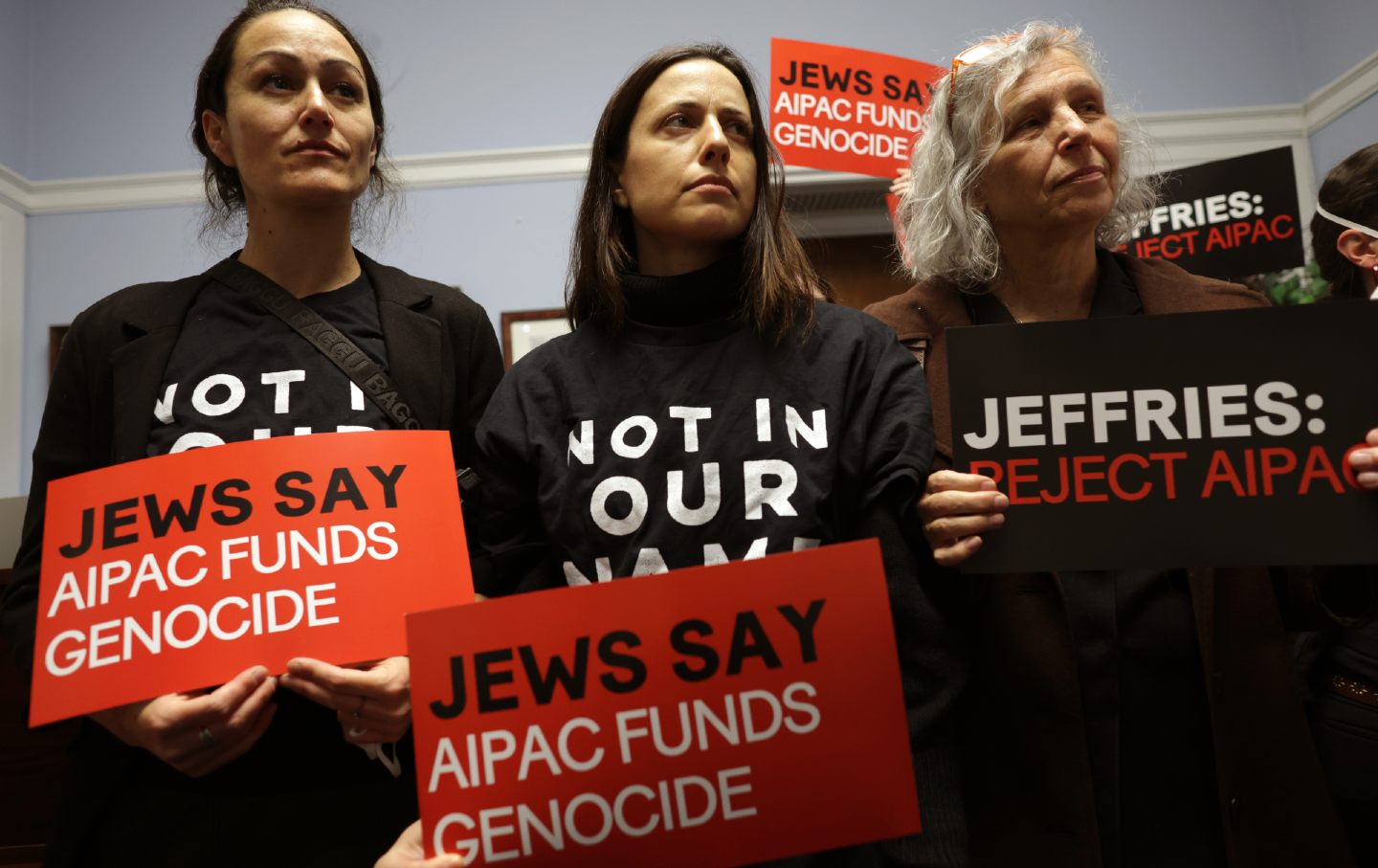
Activists with Jewish Voice for Peace hold signs during a protest at the office of House minority leader Representative Hakeem Jeffries (D-NY) on March 12, 2024.
(Alex Wong / Getty Images)
As a rabbi, I’ve devoted my life to tending to the well-being of the American Jewish community. That community is now collapsing in on itself in a moment of true rupture—and that, I believe, is not only necessary but a blessing.
Usually, Jewish homes are full of extended family at this time of year. It’s the season of the High Holy Days, Rosh Hashanah and Yom Kippur, and for Jews of all backgrounds this means getting together and, often, going to synagogue. On these holidays, many Jews who otherwise forgo religious services break out the prayer shawl they wore at their b’nai mitzvahs and pray. They fast. They atone.
But many people won’t be attending services at their family’s synagogue this year because it has a large “We Stand With Israel” poster out front or an Israeli flag on the podium next to the rabbi. They won’t be intoning a prayer for Israel—with no mention of Palestinians—alongside the rest of the congregation. Instead, these Jews, many of them young, will be turning to alternative services that are explicitly non-Zionist or creating their own ways to observe the High Holidays. What is typically a time of unity in Jewish communities will this year be a time of separation.
For many in the establishment Jewish community, this is a source of deep anxiety. In May, as a human-made famine was taking hold in Gaza, and as students were protesting across US campuses, Rabbi Jill Jacobs wrote in The Forward: “A panic has developed within much of the Jewish community as more and more Jews—mostly, but not entirely young people—have declared themselves to be anti-Zionists or non-Zionists.”
I share Rabbi Jacobs’s sentiment that there is indeed a moral crisis at the heart of mainstream Jewish life. (I also appreciate that she argues against formally excommunicating non- and anti-Zionist Jews, even as we have long been unwelcome in supposedly progressive spaces.)
However, I believe our panic should not be over the waning support for Zionism among Jewish young people. Instead, the crisis is that the Jewish state that was founded in the shadow of the Holocaust has been found guilty of its own plausible genocide. Our Jewish community should break apart when so many of our leaders and institutions go along with or even champion Israel as it maims, tortures, starves, and kills Palestinians, including tens of thousands of children.
Since the beginning of Zionism, 130 or so years ago, there have been Jews who have rejected it—on theological, political, and cultural grounds. The Reform movement of Judaism, today the largest denomination of Judaism in the United States, was adamantly anti-Zionist until the 1970s, eschewing the idea that Jews constitute a nation, asserting instead that we are rather a religious community. The Jewish Labor Bund, a Jewish social democratic movement founded in the same era as Zionism, preferred to link arms with the working class in their home countries to struggle for labor and social justice. Some ultra-Orthodox Jews to this day reject the idea that humans can bring Jewish sovereignty to the Land of Israel by force; only God can do that in messianic times.
Over the past 76 years, since Israel’s bloody birth, the Jewish organizational establishment has cultivated an illusion of a Jewish Zionist consensus. After the Six-Day War in 1967, that effort only intensified, as legacy Jewish institutions in North America pivoted dramatically from promoting Jewish civic and social standing for minorities and new immigrants to pro-Israel advocacy.
Yet today American Jews are further from each other than they’ve ever been before, with the greatest chasm falling along generational lines. A recent Pew study found that younger Jews have less-favorable attitudes toward Israelis and more-favorable views of the Palestinian people. Fifty-five percent of Jews under 35 have an unfavorable view of the Israeli government. Jews ages 50 to 64 are the only age group in which a majority express a favorable opinion of the Israeli government (64 percent). By comparison, just 45 percent of Jews ages 18 to 34 have a favorable view of the Israeli government.
In another study, when presented with a definition of Zionism that asserts the belief in “privileging Jewish rights over non-Jewish rights in Israel,” a full 69 percent of Jewish American respondents said that they were probably or definitely not Zionist.
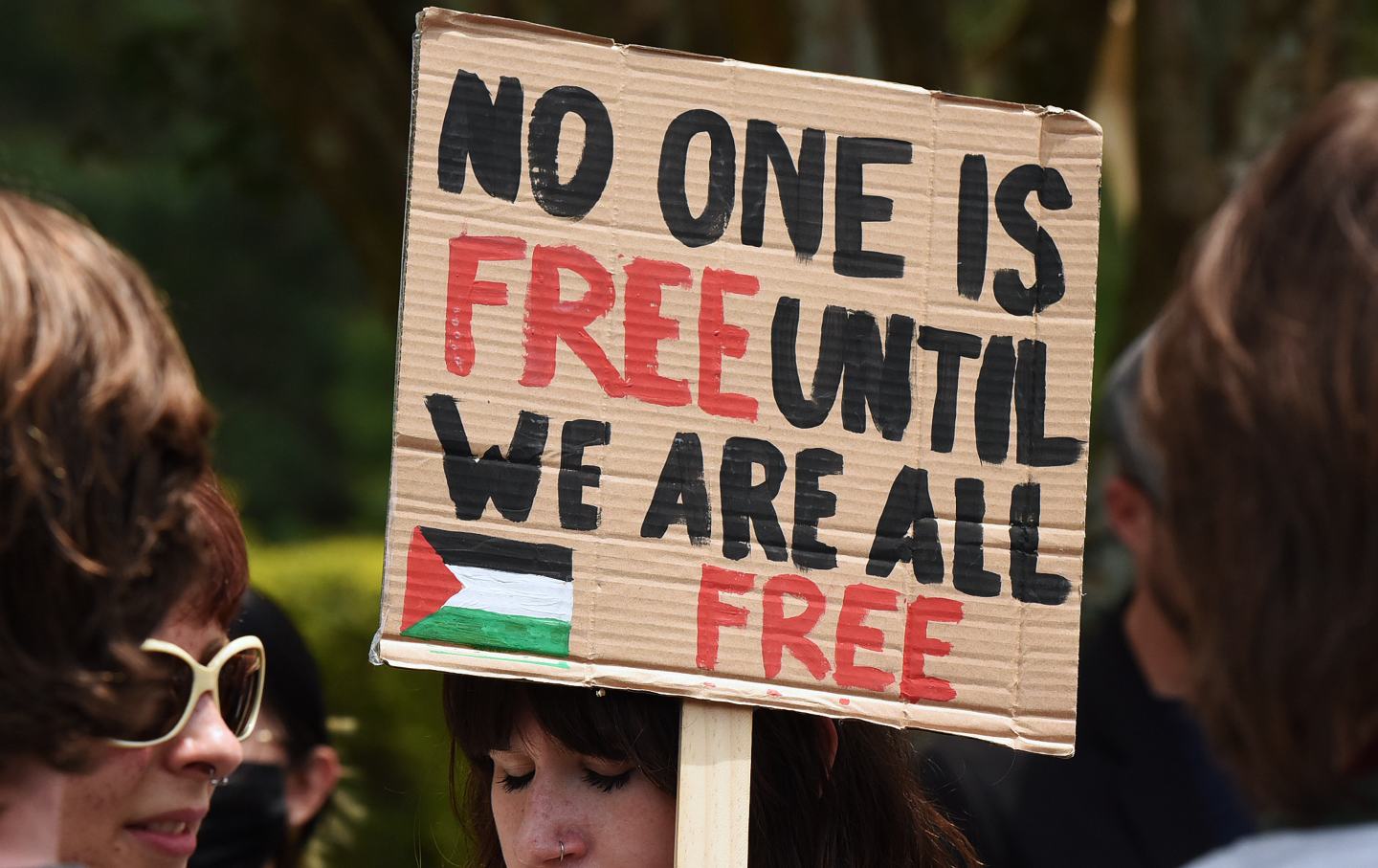
Crucially, these beliefs are beginning to go beyond the realm of thought and take the form of action. In recent years, Jews between the ages of 18 and 49 have begun stewarding organizations that embody interdependence and solidarity with Palestinians. More and more synagogues with young leadership are rejecting the near-universal ostracism of non- and anti-zionist Jews. And more and more organizations, helmed and populated by young Jews, are flipping on its head the logic that the legacy of the Holocaust requires allegiance to Israel rather than solidarity with Palestinians. For them, as they chant at protests, “‘Never again’ is now.”
These groups are growing not only in number but also in support. Jewish Voice for Peace, which is the only Jewish American organization that has signed on to the Palestinian call for Boycott, Divestment, and Sanctions against Israel, and If Not Now, a millennial-led organization founded to challenge the Jewish communal establishment, have been mobilizing feverishly since October 7 for a ceasefire and an arms embargo. Meanwhile, Judaism On Our Own Terms, a network of Jewish college campus groups organizing outside of the legacy organization Hillel, has been expanding across campuses. (Hillel prohibits their hundreds of affiliates from hosting groups or speakers that “support boycott of, divestment from, or sanctions against the State of Israel” and has gone so far as to threaten legal action with affiliates that ignore these guidelines.)
These new organizations and networks, liturgies, and identities are doing essential work, yet forming them comes at a cost to familial and communal comfort. Leftist, non-Zionist, and anti-Zionist Jews are often deemed traitors, self-haters, fake Jews, or worse, by the mainstream. I am not immune from those accusations as a rabbi. Some go so far as to claim that we should no longer be considered part of Klal Yisrael, the Jewish people.
Still, communal rejection is the cost many activists over the generations have had to pay to win change for future generations. Many young white people, including white Jews, in the civil rights movement broke with their families to join the Student Nonviolent Coordinating Committee. It was pressure from college campuses in the 1980s that is credited with changing the tide of US support for apartheid South Africa. The student encampments of this past spring showed us that young people are willing to sacrifice to stop their institutions’ complicity in the mass slaughter of Palestinians.
Popular
“swipe left below to view more authors”Swipe →On Rosh Hashanah and Yom Kippur, Jewish prayers demand that we face directly our responsibility for our actions and the precariousness of all human-made institutions. This year, these ancient words will be put to the test. Will they soften our hearts and strengthen our resolve? Will they fortify us to put our relationships and livelihoods on the line if we must? Will they embolden us to dismantle our institutions to rebuild them in God’s image? Will we finally be willing to upend all we thought we knew, to break into a million pieces, if it means all people may be safe, healthy, and free?
It’s the rising generation that best understands the moral demands of this moment, and we must follow their lead.
More from The Nation

The Real Reason Americans Love Guns The Real Reason Americans Love Guns
With a weak social safety net, a gun offers a false sense of personal power and security.

The Endless Hypocrisy of Bari Weiss The Endless Hypocrisy of Bari Weiss
She claims to be a free speech champion. But as her actions at CBS News keep showing, she seems to think free speech should run only in a rightward direction.
What Will Be Left After the University of Texas Destroys Itself? What Will Be Left After the University of Texas Destroys Itself?
UT-Austin has collapsed its race, ethnic, and gender studies into a single program while a new policy asks faculty to avoid “controversial” topics. But the attacks won’t end there...
The Corporate Media Is Head Over Heels for the Iran War The Corporate Media Is Head Over Heels for the Iran War
Donald Trump’s attack may be surreal, unjustified, and illegal. But that’s not stopping the press from turning the propaganda dial way up.
The Disturbing History of ICE’s “Death Cards” The Disturbing History of ICE’s “Death Cards”
The Vietnam-era practice is yet another example of ICE agents thrilling to the brutality they have been encouraged to cultivate.
The American Universities Programming Israel’s Killer Drones The American Universities Programming Israel’s Killer Drones
Industry partnerships in higher education are pushing STEM graduates into the business of weapons manufacturing and genocide profiteering.

