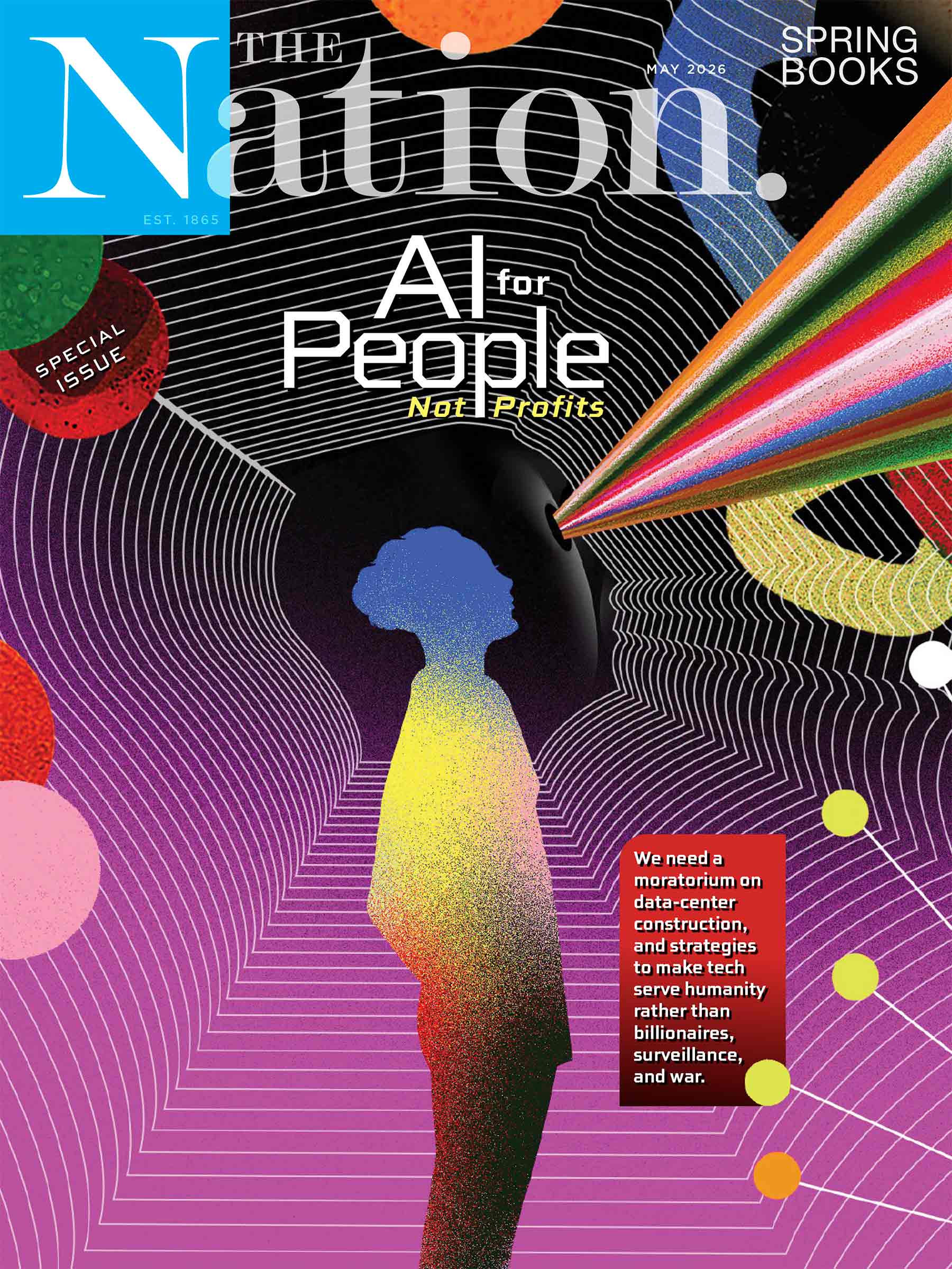
The Nation Is Siding With Humanity
“The Nation” Is Siding With Humanity
As unregulated, profit-driven AI threatens our economy, climate, and safety, we can’t let tech-bro profiteers define our future.

Artificial intelligence is already generating technological change that, on its own and in combination with advanced robotics, will design and define much of our future. But who will design and define AI—tech-bro billionaires whose primary mission is to become trillionaires, or citizens and elected representatives who seek to harness technology in the interest of humanity? Donald Trump has made his choice, signaling at a Pittsburgh “energy and innovation summit” last summer that he would willingly sacrifice the public interest and let the tech industry call the shots. “Regulation be damned” was the message from the president; let the chips fall where they may. Trump formalized his subservience in December, when he issued an executive order that The New York Times reported “grants broad authority to the attorney general to sue states and overturn laws that do not support the ‘United States’ global A.I. dominance,’ putting dozens of A.I. safety and consumer protection laws at risk. If states keep their laws in place,” the report continued, “Mr. Trump directed federal regulators to withhold funds for broadband and other projects.”
In March, Trump baked his agenda into a “National AI Legislative Framework” that emphasizes deregulation and federal preemption of the states. “Preemption is the real story,” Zephyr Teachout, the scholar of monopoly power, wrote on X. “We do not need a national framework for AI. Of any kind. We need state and federal laws but we will be crushed if we block local power to protect kids, workers, consumers, journalism, everything. Congress should do its job, not stop states from doing theirs with common law, liability, antitrust, and more.”
So far, however, Congress has tended to sideline itself, while the president and his administration rush to embrace the financial overlords during this transformative moment. That embrace is so shameless, so transparent, that messages and images emanating from the White House seem like dystopian cinema. “The future of AI is ‘personified,’” first lady Melania Trump declared at a March 25 White House event where she appeared with robots and asked Americans to “imagine a humanoid educator named Plato” replacing teachers.
“Call me a radical, but no!” responded Senator Bernie Sanders, the Vermont independent who has emerged—along with a growing number of the scientific pioneers of artificial intelligence—as a thoughtful AI skeptic. “We should not be replacing teachers in America with robots. We should attract the best and brightest in our country to become teachers and pay them the decent wages that they deserve.”
Sanders is right, of course. But, as has too often been the case when it comes to industrial and technological revolutions, their influence on society, and the resulting policy disputes, being right in the early stages of a transformation can be a lonely mission.
The good news is that the people get it. A February Economist/YouGov survey found that 63 percent of Americans think jobs will be lost in an AI transition that Anthropic CEO Dario Amodei has acknowledged “isn’t a substitute for specific human jobs but rather a general labor substitute for humans.” Nearly three-quarters of those surveyed who expressed an opinion on the question said they believed AI will hurt the economy.
That’s backed up by polls in states where the issues have been framed by fights over the development of AI data centers. A December letter from more than 230 environmental groups, including Food & Water Watch, Greenpeace, and Friends of the Earth, argued, “The rapid, largely unregulated rise of data centers to fuel the AI and crypto frenzy is disrupting communities across the country and threatening Americans’ economic, environmental, climate, and water security.” Voters see what’s happening in states like Wisconsin, where a Marquette Law School Poll in March found that 69 percent of those surveyed agreed that “the costs of the data centers outweigh the benefits.” That’s the same percentage that said AI is developing too fast.
Smart Democrats and a few Republicans are seizing on these concerns. But there are not enough of them. “Sadly,” Sanders says, “Congress has done virtually nothing.” This disconnect has added urgency to a moment of enormous importance for people whose jobs are threatened, whose children’s brains are already marinating in AI slop, and whose privacy is being invaded by an ever-tightening surveillance state and an industry that’s determined to barter off personal data to the highest bidder.
To be sure, AI has huge potential to benefit humanity: by assisting responsible scientific innovation, helping medical researchers identify new strategies for diagnosing and treating disease, and (in ethical hands) increasing cybersecurity and other protections. But that potential will turn to peril if Trump and his allies—in both political parties—simply serve an industry that is already pouring hundreds of millions of dollars into manipulating the results of the 2026 elections. The urgency of the moment inspires this issue of The Nation, which affirms that skepticism about AI is well-founded and necessary. The articles in our special section examine the concentration of wealth and power in the hands of tech billionaires, along with concerns about job losses and surveillance, questions about military and police uses of new technologies, and smart strategies for regulating and governing AI.
At a point when everyone must take a side, The Nation is siding with humanity. We want the best that AI has to offer for the people. But we know that won’t happen if the citizens are locked out of the decision-making process, as Trump and his allies seek to do with their preemption scheme.
That scheme threatens to upend a burgeoning popular revolt that has already emerged at the grassroots, as communities all over the country reject the construction of behemoth data centers that are designed to meet the astronomical energy demands of the AI and cryptocurrency industries.
This is where Sanders proposes to intervene. In late March, with Representative Alexandria Ocasio-Cortez (D-NY), he proposed legislation to establish a national moratorium on the construction of data centers.
But this is about much more than data centers. “Bottom line: We cannot sit back and allow a handful of billionaire Big Tech oligarchs to make decisions that will reshape our economy, our democracy, and the future of humanity,” the senator says, arguing that a federal moratorium—along with state and local interventions and the growing movement for international regulatory treaties—can slow down the self-serving rush of AI fabulists and profiteers.
Popular
“swipe left below to view more authors”Swipe →“Congress has a moral obligation,” AOC says, “to stand with the American people and stop the expansion of these data centers until we have a framework to adequately address the existential harm AI poses to our society. We must choose humanity over profit.”
Yes, we must!
More from The Nation

Letters From the May 2026 Issue Letters From the May 2026 Issue
Voting for vets… The meaning of evangelical… Billionaire ball clubs…

Why Fascists Fear Free Speech Why Fascists Fear Free Speech
The White House is following an old authoritarian playbook to suppress dissent.

Selma Still Matters Selma Still Matters
What was born there was a new definition of who gets to be an American. And that legacy is under threat.
What Happens When “Your Honor” Is a Robot? What Happens When “Your Honor” Is a Robot?
The age of artificial judges is fast approaching. What will that mean for justice?

What We Need to Ask Ourselves About AI What We Need to Ask Ourselves About AI
Seven questions to resolve before we let this fast-moving technology run rampant.

San Diego’s AI Battlefield Heats Up San Diego’s AI Battlefield Heats Up
The city is at the forefront of the fight against using big tech to surveill residents. But AI poses new threats.

