
AI Will Never Be Your Friend
The Friend necklace promises constant companionship and understanding. But this isn’t friendship—it’s a soulless, cynical way to prey on our loneliness and fear.
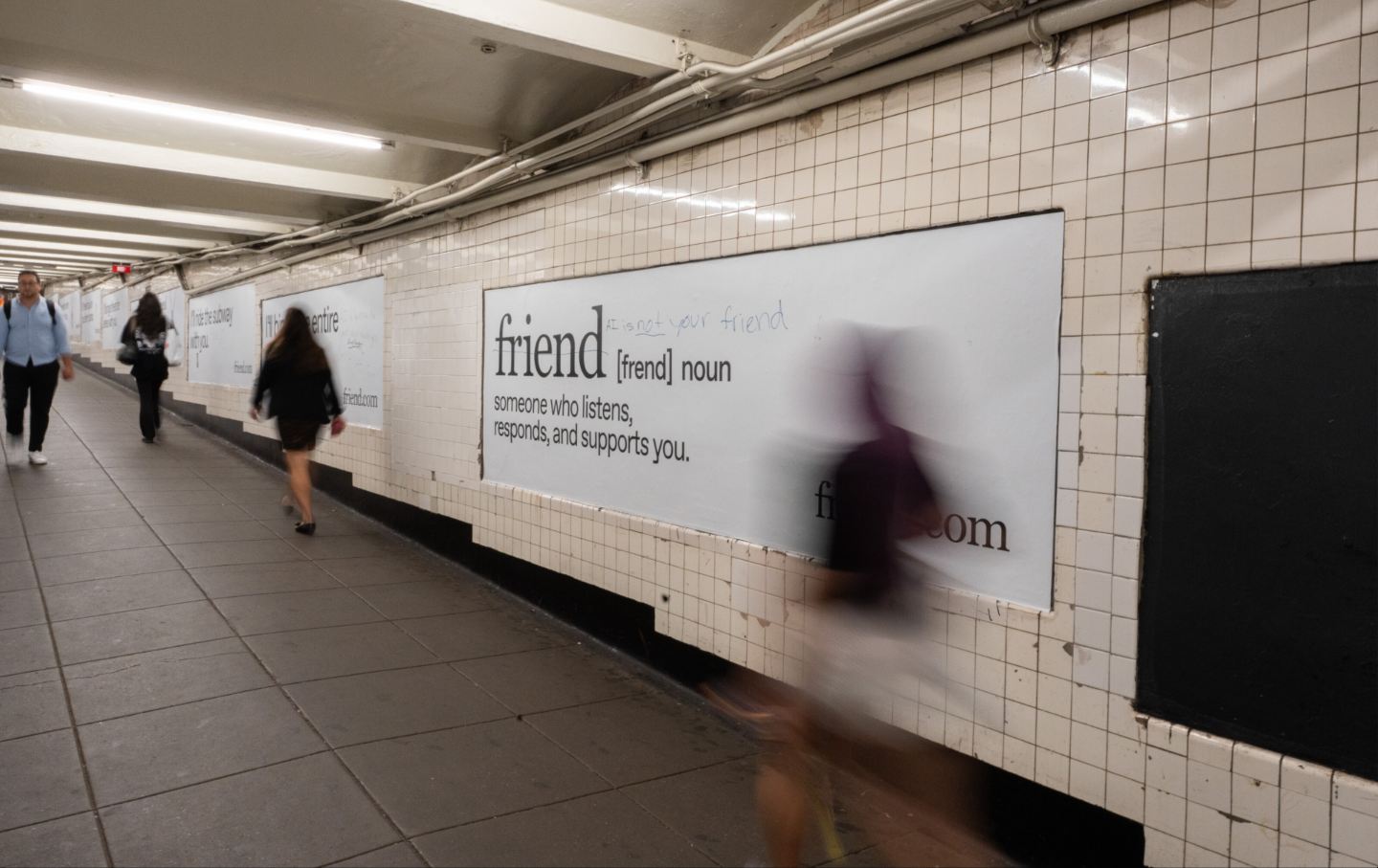
An advertising campaign for the “Friend” artificial intelligence device is seen inside the West 4th street subway station in Manhattan, on Monday, September 29, 2025.
(Cristina Matuozzi / Sipa USA via AP)It’s nearly impossible to use the New York City subway system these days without encountering ads for a new AI start-up called Friend. They’re plastered everywhere, with messages like “I’ll ride on the subway with you” and “[friend] noun. Someone who listens, responds, and supports you.”
Friend CEO Avi Schiffmann boasted on X that this was “the largest NYC subway campaign ever,” and Adweek reported that the campaign cost $1 million, “running entirely in print, with more than 11,000 car cards, over 1,000 platform posters, and 130 urban panels.”
But what, exactly, is Friend?
It’s a small, round, white object that is supposed to be hung from the neck. Wherever you go, it goes too, listening to and gathering data from everything you say and do in order to “know” you as much as possible. Then, when you “talk” to Friend, it should deliver the most personal and helpful answers through its companion app. And you get all of that for $129.
It wasn’t that long ago that people were (rightfully) paranoid about the prospect of their technological devices spying on them—a feeling captured in the 1983 hit by Rockwell “Somebody’s Watching Me.” Now, we’re asked to welcome this surveillance into our lives. The marketing of the Friend device continues this messaging pivot.
It’s not denied that these technologies are always recording and gathering information and data—on the contrary, that’s the whole point. The complete erosion of individual and collective privacy, we’re told, is actually good. These devices can keep us and our communities safe. They can help us. They can be the truest friend, the most loyal companion, the biggest cure for loneliness we’ve ever had—as long as we give over our whole lives to them. Schiffmann has repeatedly compared the experience to talking to God.
New Yorkers wasted no time rejecting the messaging. Some began defacing the ads; one person, responding to an ad where the concept of friend is defined, crossed out the word “friend” and replaced it with a declaration that reads, “AI would not care if you lived or died.”
Naturally, Schiffmann, like any CEO who thinks all publicity is good publicity, tried to spin things his way. He claimed that the ads are actually part of one big social experiment or radical art project: “I know people in New York hate AI, and things like AI companionship and wearables, probably more than anywhere else in the country.… So I bought more ads than anyone has ever done with a lot of white space so that they would socially comment on the topic.”
Sure. It’s very hard to believe that the CEO of an AI company would spend so long creating a product to sell to the public and spend a million dollars on the largest subway ad campaign in the history of the biggest city in America for the sake of attracting hate and rejection. But then again, I’m not a young tech and marketing genius. Schiffmann, who won a Webby award for a Covid tracking app that he made at 17, seems to have the utmost confidence that his plan will work, if not now, then later in the future. Even much later: He told Fortune earlier this month, “My plans are measured in centuries.”
Friend might be the most visible, but it’s not the only attempt at an AI companion app out there. Dot, which was founded by Sam Whitmore and former Apple designer Jason Yuan, and which has since gone offline, was a similar attempt at building an AI app that acts as a replacement for human intimacy. There’s also Character.AI, Soul Machine, and Replika (yes, these names are all real). And AI platforms like Grok and ChatGPT, which weren’t originally positioned as companion apps, have been reprogrammed towards that goal.
The market for digital relationships is booming because of an attempt to exploit people’s struggles in the contemporary world. In a nutshell, people are lonelier than ever. There’s enough evidence to suggest that loneliness has increased in the last few decades. It’s not entirely surprising that, at a time when people are struggling to live, from working and simply being able to afford a place to live, more people are feeling isolated and lonely. And the more marginal a group is, at least in this country, the more likely they are to be lonely or have loneliness structured into their lives:
[A] Cigna/Morning Consult poll found that 75 percent of Hispanic adults and 68 percent of Black adults were considered lonely, compared to 58 percent of the general adult population. Fewer Black, Hispanic, and Asian adults reported having a strong social support system compared to white adults, per the 2023 KFF Racism, Discrimination and Health Survey. The survey also found that LGBT adults were about twice as likely to feel lonely compared to non-LGBT adults.
Living alone and parenthood are also risk factors, as are physical and mental disabilities. In other words, these AI companies have untold numbers of potential targets to prey on. So it’s not a shock that a recent survey showed that “some 72 percent of teens said they’ve experimented with artificial buddies. Of those, over 50 percent say they have a regular relationship with the chatbots.”
These AI companion apps may seem different from the digital reality products like the Meta Quest, but the ethos remains the same—the world out there is terrible, things are hard and you have no friends and community, why don’t you come here where you can find all of those things, and because we’ve gathered so much information about you, this world will be tailored particularly to make you happy. It’s an enticing proposition that has lured a lot of people in, sometimes with the horrible consequences you’d expect when someone’s thoughts and delusions are positively reinforced by an app that makes them feel that they’re the most important person in the world.
Loneliness feels painful, mentally and physically. It makes one feel alone and unwanted, monstrous and broken. As Olivia Laing writes in The Lonely City: Adventures in the Art of Being Alone:
It feels like being hungry: like being hungry when everyone else around you is readying for a feast. It feels shameful and alarming, and over time these feelings radiate outwards, making the lonely person increasingly isolated, increasingly estranged. It hurts, in the way that feelings do, and it also has physical consequences that take place invisibly, inside the closed compartments of the body. It advances, is what I’m trying to say, cold as ice and clear as glass, enclosing and engulfing.
It makes sense that people dealing with that kind of physical and mental pain, people who are precarious and feel trapped in their condition, with little to no hope for the future and for the world around them, would want to run into the seemingly comforting arms of tech companies promising a paradise where, finally, someone, or something, will listen to and validate them. As Liu Zhenyun, translated by Mao Dun, writes in One Sentence Is Ten Thousand Sentences / A Word is Worth Ten Thousand Words—a novel that deals with profound loneliness:
Throughout a lifetime, one doesn’t expect much, only someone to talk to. Some people begin unable to understand each other, but years later are able to; others begin with the ability, but lose it by and by. Some people spend this whole life unable to communicate. Finding someone to talk to is a blessing, be they a lover, friend, or family.
But are these AI companions the best solution to the loneliness of the modern world? Of course not. Are they a lover, friend, or family? Of course not.
Popular
“swipe left below to view more authors”Swipe →A true solution would take a restructuring of the systems and conditions that create and amplify the loneliness of different people. It would take things like wealth redistribution, lower rent, doing away with the stigmatization of different gender identities, support for parents and children, promotion of the arts and spaces where young people can congregate without the surveillance of the police and their parents, a push towards a reengagement with the physical world and out of the digital worlds that can trap and radicalize young people. A true solution would essentially take a lot of things that are in contradiction to the goal of these tech companies. So instead of an effort to lessen loneliness in the world, what we get are digital mirrors akin to the pool that leads Narcissus to his doom.
It’s a tired cliché at this point that humans are social creatures, but even the definition of “friend” in the Friend advertisements acknowledges the very critical and important element of friendship—and the importance of having someone else in your life.
But what makes a true friend is not only that they are full of life and warmth, but that they have their own mind, wants, desires, dreams, struggles, and happinesses. They have a responsibility to us as contracted in the bond of friendship, which includes listening and helping us when we need help, but that responsibility is shared, and we also hopefully can listen and help them when they are in need. A friend requires us to be a friend as much as we require them to be one. Friendship is not just about being heard and seen, but also about seeing and hearing someone else. Friendship is not and cannot be a mirror. Other people are other worlds.
A place like New York City can be extraordinarily lonely not because there’s something particularly special about it but because there are so many people here, of so many different backgrounds, that when you feel isolated, when you feel unseen, it can feel more acute because you’re aware of all the different people, communities, and worlds out there where other people are finding friends, family, and romance. It feels as if you have failed in being a person, since there’s no one in such a big place who wants to share in your life with you. One of the big promises of New York City is that regardless of the kind of person you are, you can find your people here. And when that doesn’t happen, it feels like the consequence of a personal and spiritual defect.
The rejection of the Friend companion app by New Yorkers is important as a reminder that we should always look at these apps as an attempt at world-building. We have to engage with them first and foremost by asking if they’re compatible with the world that we want to live in.
Loneliness is painful, but only because we want to be with other people, not because we want to be disappeared further from the rest of the world. As Jean-Luc Nancy writes in Being Singular Plural: “Being cannot be anything but being-with-one-another, circulating in the with and as the with of this singularly plural coexistence.”
The only world where loneliness is lessened is a world where humans are given a chance to be closer to other humans, not one in which they become a host for a digital parasite hanging around their neck, draining their life in service of profit for a tech company. It is not a world where we give ourselves and every part of our life over to people like Schiffmann, but one in which life is made less precarious so that we can be more vulnerable with others. A world where we can search for and hopefully find the people with whom we can share a walk, a dinner, and a conversation.
To accept the world that these AI companion apps dangle in front of us is to accept that the bastardized images of ourselves reflected back to us are more worthwhile than the true friendship of other humans. This idea is one that we must consistently reject, that we have to deface on the subway, during our travels to see and find our real friends.
More from The Nation

What Will Be Left After the University of Texas Destroys Itself? What Will Be Left After the University of Texas Destroys Itself?
UT-Austin has collapsed its race, ethnic, and gender studies into a single program while a new policy asks faculty to avoid “controversial” topics. But the attacks won’t end there...

The Corporate Media Is Head Over Heels for the Iran War The Corporate Media Is Head Over Heels for the Iran War
Donald Trump’s attack may be surreal, unjustified, and illegal. But that’s not stopping the press from turning the propaganda dial way up.

The Disturbing History of ICE’s “Death Cards” The Disturbing History of ICE’s “Death Cards”
The Vietnam-era practice is yet another example of ICE agents thrilling to the brutality they have been encouraged to cultivate.

The American Universities Programming Israel’s Killer Drones The American Universities Programming Israel’s Killer Drones
Industry partnerships in higher education are pushing STEM graduates into the business of weapons manufacturing and genocide profiteering.

The Red State–Blue State Healthcare Divide Is Dangerous for Everyone The Red State–Blue State Healthcare Divide Is Dangerous for Everyone
Whether or not you have access to independent, scientifically sound public health guidance may depend on how your state voted for governor.

In the Trump Era, Celebrating Black History Month Feels Radical Again In the Trump Era, Celebrating Black History Month Feels Radical Again
After putting on their very best performances of solidarity every Black History Month, this year corporate marketers have seemed at a loss for words.

