
Young Mayor in a Hurry
Zohran Mamdani has pledged to govern at the same pace New Yorkers live—but city politics are largely designed to thwart that ambition.
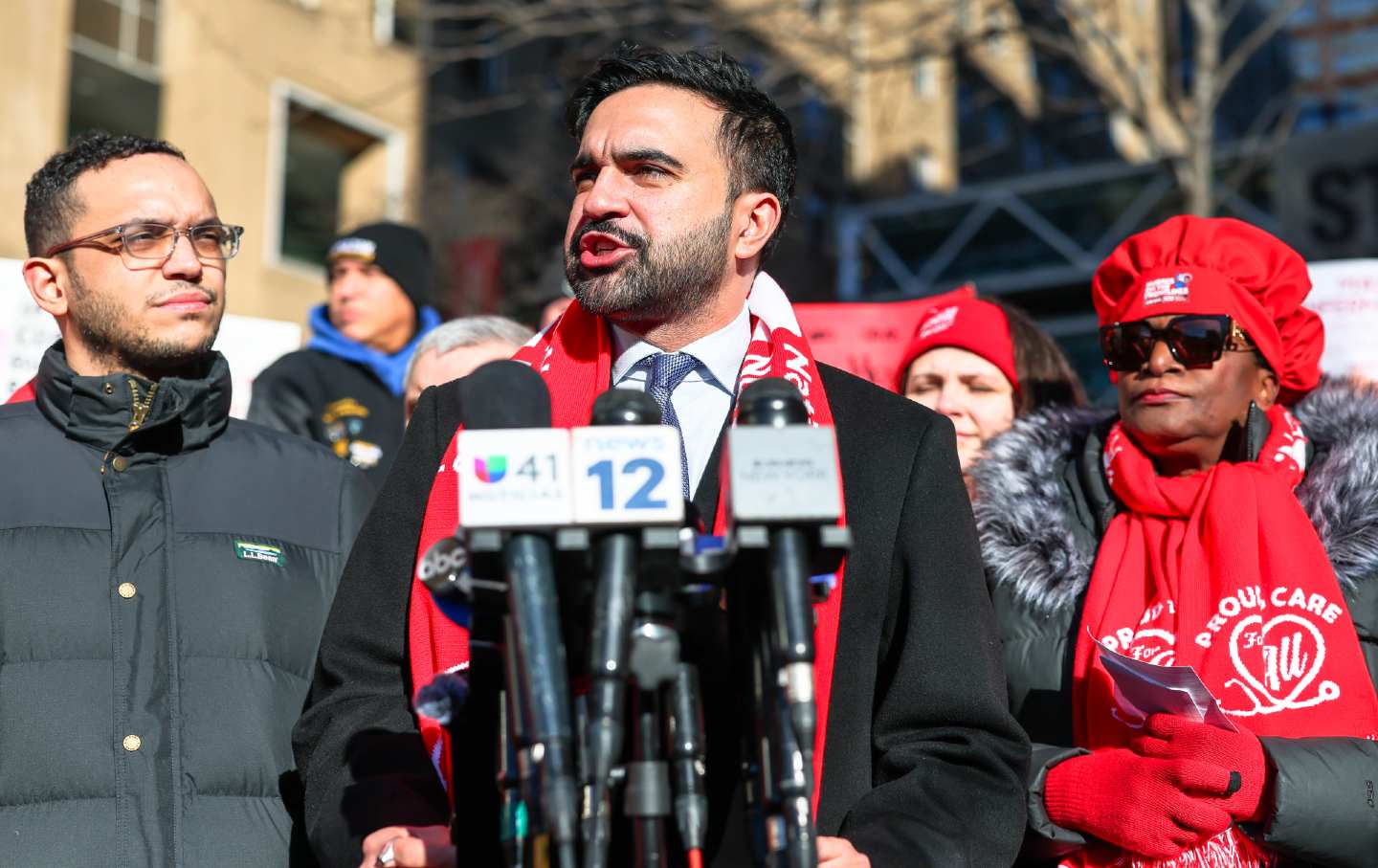
New York Mayor Zohran Mamdani speaks before striking nurses at New York-Presbyterian/Columbia University Irving Medical Center.
(Michael M. Santiago / Getty Images)
On Tuesday morning, after joining his friend Bernie Sanders to deliver a few encouraging words of support to striking nurses shivering at the start of their 10th day on the picket line at Mount Sinai West, New York Mayor Zohran Mamdani raced downtown to Hudson Square. There, at the Manhattan headquarters of the Walt Disney Company, the panel from ABC’s The View gave him a reception that would have thawed even the most frost-bitten of hearts.
“We can say it now,” Whoopi Goldberg began her introduction, her face beaming. “He is the mayor of New York City.” But the enthusiasm wasn’t coming only from Goldberg, who’d given candidate Mamdani a sympathetic hearing on the show back in October. When cohost Ayssa Farah Griffin, the show’s token Republican, asked the now-predictable question about controversial past social media posts by some of the new administration’s appointees, Mamdani’s response—that anyone who wanted to know what he stood for need only consult his own voluminous statements, and that New Yorkers were more concerned with whether his team could deliver in the future than with what someone might have tweeted years in the past—had the entire panel nodding in assent.
Likewise, panelist Sarah Haines (who back in the fall had delivered an equally predictable disciplinary caution to Mamdani for calling Israel “an Apartheid State”) sought to stir up more controversy by charging his office with having “hedged or delayed strong condemnation of pro-Hamas demonstrations.”
“How do you answer to Jewish New Yorkers who still don’t feel protected under your administration?” Haines asked. But she, too, appeared more than satisfied when he declared that the rubric he wanted to be judged by wasn’t simply “are we keeping Jewish New Yorkers safe?” but “are we celebrating and cherishing them? Because that’s what it means to feel like you belong in a city.”
“We’ve always wanted to build a city government that moves as fast as New Yorkers do, ” Mamdani told Goldberg. “Day one, we put bad landlords on notice; day six, we fixed a bump on the Williamsburg Bridge; day eight, we announced more than a billion dollars in funding for universal childcare.”
In a city where the response times to a crime-in-progress call to 911 have jumped from 11 minutes in 2020 to over 15 minutes in 2024, making good on the pledge to make government move faster is going to be a tall order. But it’s also true, as the mayor remarked several times during his lovefest on The View, that statistics tell only part of the story.
One of the reasons so many talented and intelligent men—so far, regrettably, they have all been men—fail at being mayor of New York is that the title is really three jobs rolled into one. The mayor’s most visible role is as the city’s public face, and as communicator in chief of a set of values. Here, Mamdani is indeed already off to a racing start—sometimes literally, with a public schedule that has taken him from one end of the city to the other (sometimes in the same day) to address everything from the desirability of installing bidets in Gracie Mansion and “the hidden fees that plague New Yorker’s lives” when booking holidays, to the depredations of greedy landlords and the transformation of working New Yorkers’ lives enabled by the provision of free universal childcare.
As the mayor’s triumphant return to The View made clear, he really is a generational talent as a communicator—of not just the politics of democratic socialism but also the values embodied by his message of dignity, opportunity, and inclusion. But then Andrew Cuomo was pretty good in front of the cameras as well—at least for a time.
Actual governing, however, is a lot harder than it looks. Just ask Bill de Blasio—another young firebrand who started off with honeymoon press coverage in January but by February of his first term was already smarting from headlines like “How Did Bill de Blasio Screw Up Today?” Not all of de Blasio’s fall from grace was his own fault: Then-Governor Cuomo supplied several crucial assists. But the appearance of arrogance—partly a result of his habitual lateness, and partly due to mishaps such as the mayoral SUV’s getting caught on camera running a stop sign just days after announcing his “Vision Zero” traffic safety plan—didn’t help. Nor did the perception—widespread throughout his administration—that the mayor cared more about media coverage than the machinery of government.
Running this city well means staying on top of the delivery of the services New Yorkers depend on. In addition to ensuring the smooth running of such mainstays of city life as the police and fire departments, mass transit, or the public schools and city hospitals, it also includes distinctly unglamorous civic functions like collecting the garbage and plowing the streets. John Lindsay, once feted as the “mayor of Fun City,” never fully recovered from the political damage left by his administration’s failure to clear the streets in Queens after the February 1969 “Lindsay Blizzard.” On the other hand, Kathryn Garcia’s record of quiet competence as de Blasio’s sanitation commissioner brought her within shouting distance of Gracie Mansion.
But if any mayor needs to keep one eye on the weather—especially during major snowstorms like the one forecast for this weekend—watching the budget is even more important. That’s not just on account of all the popular, vote-winning policies a healthy budget can buy—a key factor in affording the extremely uncharismatic Michael Bloomberg a third term to polish his legacy). It’s also because, like the weather, so much of what determines New York city’s financial health (or frailty) is beyond a mayor’s control.
Given Albany’s iron grip over the city’s finances—a consequence of the city’s historical failure to secure home rule, despite being the economic engine supporting the whole state—a hostile governor can easily make the mayor’s life difficult. To his credit, Mamdani seems to understand this. The mayor has reiterated his view that the city will have to raise taxes on the rich—most recently in response to Comptroller Mark Levine’s announcement that the city faces a gaping budget deficit over the next two years. But rather than provoking a showdown in Albany, he and Governor Kathy Hochul have been cultivating a mutual admiration society. Their joint announcement of funding for universal childcare—a big step toward delivering one of the mayor’s signature programs, just one week into his first term—was the first fruit of that relationship. Equally important, however, was the mayor’s unruffled response to the governor’s State of the State address, where she ruled out any tax increase in the coming year—a no-brainer for any politician running for reelection this year.
Popular
“swipe left below to view more authors”Swipe →In politics, as in life, timing matters a lot. Although the headlines blared a $12 billion hole in the city’s finances, only a little over $2 billion of that shortfall is projected for this year. Given the city’s expense budget of roughly $118 billion, that’s a long way from a fiscal crisis.
Once the mayor releases his preliminary budget, we’ll have a better idea of what trade-offs he is prepared to make—and what new priorities he’s willing to go to the mat for. But even that document is just a set of preliminary positions, subject to horse-trading with the governor and the city council and pressure from advocates, interest groups and the public.
So, while the mayor does his best to give the impression of a young man in a hurry, you might as well get comfortable and enjoy the view. Change is definitely coming, but it isn’t going to happen overnight.
Support independent journalism that does not fall in line
Even before February 28, the reasons for Donald Trump’s imploding approval rating were abundantly clear: untrammeled corruption and personal enrichment to the tune of billions of dollars during an affordability crisis, a foreign policy guided only by his own derelict sense of morality, and the deployment of a murderous campaign of occupation, detention, and deportation on American streets.
Now an undeclared, unauthorized, unpopular, and unconstitutional war of aggression against Iran has spread like wildfire through the region and into Europe. A new “forever war”—with an ever-increasing likelihood of American troops on the ground—may very well be upon us.
As we’ve seen over and over, this administration uses lies, misdirection, and attempts to flood the zone to justify its abuses of power at home and abroad. Just as Trump, Marco Rubio, and Pete Hegseth offer erratic and contradictory rationales for the attacks on Iran, the administration is also spreading the lie that the upcoming midterm elections are under threat from noncitizens on voter rolls. When these lies go unchecked, they become the basis for further authoritarian encroachment and war.
In these dark times, independent journalism is uniquely able to uncover the falsehoods that threaten our republic—and civilians around the world—and shine a bright light on the truth.
The Nation’s experienced team of writers, editors, and fact-checkers understands the scale of what we’re up against and the urgency with which we have to act. That’s why we’re publishing critical reporting and analysis of the war on Iran, ICE violence at home, new forms of voter suppression emerging in the courts, and much more.
But this journalism is possible only with your support.
This March, The Nation needs to raise $50,000 to ensure that we have the resources for reporting and analysis that sets the record straight and empowers people of conscience to organize. Will you donate today?
More from The Nation
Trump’s War Is Destroying the Global Economy Trump’s War Is Destroying the Global Economy
Spiraling financial chaos might be the only thing that can force the president to pull back from this conflict.
Make America Great Again Make America Great Again
Who are the immigrants?
OppArt / Anonymous and Peter Kuper
How the Abortion Rights Activists Found Their Radical Imagination How the Abortion Rights Activists Found Their Radical Imagination
A long-shot campaign to restore public funding for abortion turned into the movement’s biggest success in a generation.
An Argument Against Voting for the “Electable” Guy An Argument Against Voting for the “Electable” Guy
In this week’s Elie v. US, The Nation’s justice correspondent shares his thoughts on the Texas primaries. Plus, a terrible Supreme Court decision and a bad play by Major League Ba...

A Conflict Without Reason Has Become a Dangerous Holy War A Conflict Without Reason Has Become a Dangerous Holy War
Lacking a clear rationale for the attack on Iran, Trumpists are increasingly talking like crusaders.

