
“Homestyle Fare”: The Supreme Court’s Weird, Ahistorical, Platonic Bribery Jurisprudence
The Supreme Court’s ruling in Snyder is baffling—so long as we ignore a desire by the justices to minimize the extent of their own corrupt conduct.
On Wednesday, the Supreme Court came down with a 6-3 decision concluding that one of the most important federal bribery laws—ominously numbered Section 666 of the United States Code—does not mean what it says it does.
The statute has two purposes. First, it is designed to protect the integrity of federal funds, by preventing federal money from being used in state and local corruption schemes. Second, it allows the federal government to prosecute state corruption which would otherwise go unpunished—all too often, local prosecutors are either afraid of powerful state politicians, or under-resourced, or both. Section 666 bars any actor with a state or local agency that takes federal funds over a certain amount from “corruptly” soliciting, accepting, or agreeing to accept payments “intending to be influenced or rewarded,” as well as target any person who “corruptly gives, offers, or agrees to give anything of value to any person, with intent to influence or reward,” to an agent within a state or local agency receiving federal funds.
At issue was whether §666 prohibits after-the fact payments for government work, as well as before-the-fact payments for yet-to-be-conducted government work. In Snyder, that division was treated as the bribery/gratuities distinction—a bribe being a before-the fact payment, with a gratuity coming after the desired activity has been performed.
In Snyder v. United States, the court, in a decision written by Justice Brett Kavanaugh, concluded that “gratuities” or after the fact payments—what some might call a “tip”—are not covered by the statute. Kavanaugh’s opinion was based on two cornerstones. First, he built the decision on the premise that there is a clear conceptual and moral difference between bribes and gratuities, and “unlike gratuities, bribes can corrupt the official act—meaning that the official takes the act for private gain, not for the public good.” Unlike bribes, gratuities merely “raise ethical and appearance concerns.” Second, Kavanaugh worries repeatedly about the “trivial” violation and the “unwary’ innocent official. He justifies his decision on federalism grounds, rightly pointing out that the federal law is in some cases stricter than state law. However, the argument was superficial—just a few paragraphs long, not a serious federalism discussion—and sounded more in the key of sympathy for the unlucky public official who accepts gift cards in the course of routinized local corruption.
Justice Ketanji Brown Jackson dissented with brevity and ferocity, noting that the bulk of the majority opinion was about policy and ignored the plain text of the statute. As she wrote, this is a reading that “only this Court could love.” She read it as a policy brief, not a worthy statutory interpretation, and chastised the majority for overreach: “woulds, coulds, and shoulds of this nature must be addressed across the street with Congress, not in the pages of the U. S. Reports.” The text of the statute, as you’ll recall, prohibits accepting or giving gifts to “reward” official behavior. Traditional statutory interpretation would treat “reward” as, well… “reward”—something given for an act previously performed.
Jackson’s dissent was especially welcome, because for nearly 40 years the Supreme Court has been exceptionally hostile to federal anti-corruption laws. Since Justice John Paul Stevens retired, that hostility has been without dissent—until now.
The court’s aversion to federal anti-corruption laws began in a 1987 case, McNally v. United States, in which Justice Byron White interpreted a mail fraud statute to apply only to schemes to defraud others of “money or property,” despite the fact that there was no statutory history supporting this reading. Justice Stevens (with Sandra Day O’Connor) dissented, as did the US Congress, which immediately acted to overturn the law with a targeted statute.
No matter. The next time the law was challenged, the Supreme Court, in a decision by Justice Ruth Bader Ginsburg, found a new way to limit fraud to instances of defrauding people of “property.” The effect of this reading, in Cleveland, was to make the subsequent 30 years of fraud jurisprudence center on impossible philosophical questions about “what is property?”—a puzzle that has burdened theorists for thousands of years. In other words, they made elite fraud hard to prove and hard to understand at the same time.
In the years following, the Supreme Court narrowed other federal anti-corruption laws, most notably in Justice Ginsburg’s decision in the big Enron case, Skilling v. United States, in which the court held that the federal “honest services” provision only covered “bribes and kickbacks” although the statutory history didn’t point to that, and although “bribes” and “kickbacks” themselves have no clear meaning. Skilling, notably, came down the same year as Citizens United, so while the latter case has gotten far more attention, the pairing of the two is significant: The court in Citizens United suggested that bribery enforcement was the best way to protect against corruption, just as it was making bribery enforcement much harder.
The court also held—unanimously, in a 2016 decision by Justice Roberts—that Bob McDonald, governor of Virginia, did nothing wrong when he took a Rolex watch, thousands of dollars of clothes, and other gifts in return for making several introductions and arranging meetings for Star Scientific, a company trying to push its nutritional supplement, because he wasn’t trading the watch and clothes for an “official action.”
In the last three Supreme Court terms alone they have handed down three big unanimous cases, in which the Court continued to gnaw away at the sinews of federal anti-corruption law:
- In Kelly, 2020, Justice Elena Kagan wrote for a unanimous court throwing out convictions related to the scandal known as “Bridgegate.”
- In Percoco, 2023, Justice Samuel Alito wrote for a unanimous court that the jury instructions asserting that someone not in government could be liable under government corruption laws if they nevertheless “dominated and controlled any governmental business” were insufficiently clear about what conduct would be illegal.
- In Ciminelli, 2023, Justice Clarence Thomas wrote for a unanimous court that bid-rigging doesn’t fall under the federal wire fraud statute because information isn’t “property.”
Today’s opinion kept marching in the same direction—narrowing, narrowing, narrowing the definition of bribery—and using the same logic that was used in each of those cases: a fear of federal law so broad that law-abiding gentle folk might get caught up in it. Or, as Justice Kavanaugh said:
Some gratuities can be problematic. Others are commonplace and might be innocuous. A family gives a holiday tip to the mail carrier. Parents send an end-of-year gift basket to their child’s public school teacher. A college dean gives a college sweatshirt to a city council member who comes to speak at an event. A state legislator’s neighbor drops off a bottle of wine to congratulate her for her work on a new law.
Popular
“swipe left below to view more authors”Swipe →Most judges, under a strict legal code, simply refuse bottles of wine—frankly, it’s not that hard—even without a “corruptly” limitation. But more importantly, that’s precisely the legislative role, not the judicial one: to decide what should and should not be covered by the statute, and in the case of Section 666 of the United States Code the statute’s use of “reward” could not be clearer.
So what is going on here? I think there’s two main explanations. The first is that the justices have a vision of the platonic form of the perfect bribery law, and laws that fail to conform to their vision keep getting struck down, either through statutory or constitutional logic. It just doesn’t feel right to them, and as a group, they are uniquely inexperienced outside of the academy and judiciary with the difficulties of prosecuting corruption, or the realities of the subtle ways in which gifts interact with power.
In Snyder, this shows up in Justice Kavanaugh’s citation-free section where he lays out what he sees as the clear conceptual difference, and moral difference, between “bribes” and “gratuities.” The notion that there’s a strict conceptual line between the two doesn’t find any support in case law or statutes. Bribery laws traditionally included both—and did not even always require intent to influence. Gratuities are sometimes distinguished from bribes based on whether there is intent, not on the timing. There is no platonic form of either statute, only generations of lawmakers attempting, in different ways, to protect against corruption—and yet the court, in this case and all of the other recent ones, overrides statutory interpretation on the basis of some as-yet-unrealized ideal.
The second is that the criminalized behavior cuts too close to the bone. Their own colleagues on the Supreme Court have taken wine bottles—and free trips to Alaska, and fancy steaks, and items worth far more than a sweatshirt. If they acknowledge the legitimacy of the federal law here, wouldn’t they also have to admit that their own behavior falls within the corruption arena?
Last spring, Justice Alito wrote a Wall Street Journal op-ed defending accepting an Alaskan fishing trip. His defense was that the lodge was a “comfortable but rustic facility.” The meals, “were homestyle fare.” And while he’s not sure whether there was wine, if there was, “it was certainly not wine that costs $1,000.”
If gifts are a corruption problem—which thousands of years of bribery tradition tells us they are—then what the justices have been doing is far more serious than “ethics and appearance.” What they are doing—which may explain why they keep defending it—is itself corrupt.
Support independent journalism that does not fall in line
Even before February 28, the reasons for Donald Trump’s imploding approval rating were abundantly clear: untrammeled corruption and personal enrichment to the tune of billions of dollars during an affordability crisis, a foreign policy guided only by his own derelict sense of morality, and the deployment of a murderous campaign of occupation, detention, and deportation on American streets.
Now an undeclared, unauthorized, unpopular, and unconstitutional war of aggression against Iran has spread like wildfire through the region and into Europe. A new “forever war”—with an ever-increasing likelihood of American troops on the ground—may very well be upon us.
As we’ve seen over and over, this administration uses lies, misdirection, and attempts to flood the zone to justify its abuses of power at home and abroad. Just as Trump, Marco Rubio, and Pete Hegseth offer erratic and contradictory rationales for the attacks on Iran, the administration is also spreading the lie that the upcoming midterm elections are under threat from noncitizens on voter rolls. When these lies go unchecked, they become the basis for further authoritarian encroachment and war.
In these dark times, independent journalism is uniquely able to uncover the falsehoods that threaten our republic—and civilians around the world—and shine a bright light on the truth.
The Nation’s experienced team of writers, editors, and fact-checkers understands the scale of what we’re up against and the urgency with which we have to act. That’s why we’re publishing critical reporting and analysis of the war on Iran, ICE violence at home, new forms of voter suppression emerging in the courts, and much more.
But this journalism is possible only with your support.
This March, The Nation needs to raise $50,000 to ensure that we have the resources for reporting and analysis that sets the record straight and empowers people of conscience to organize. Will you donate today?
More from The Nation
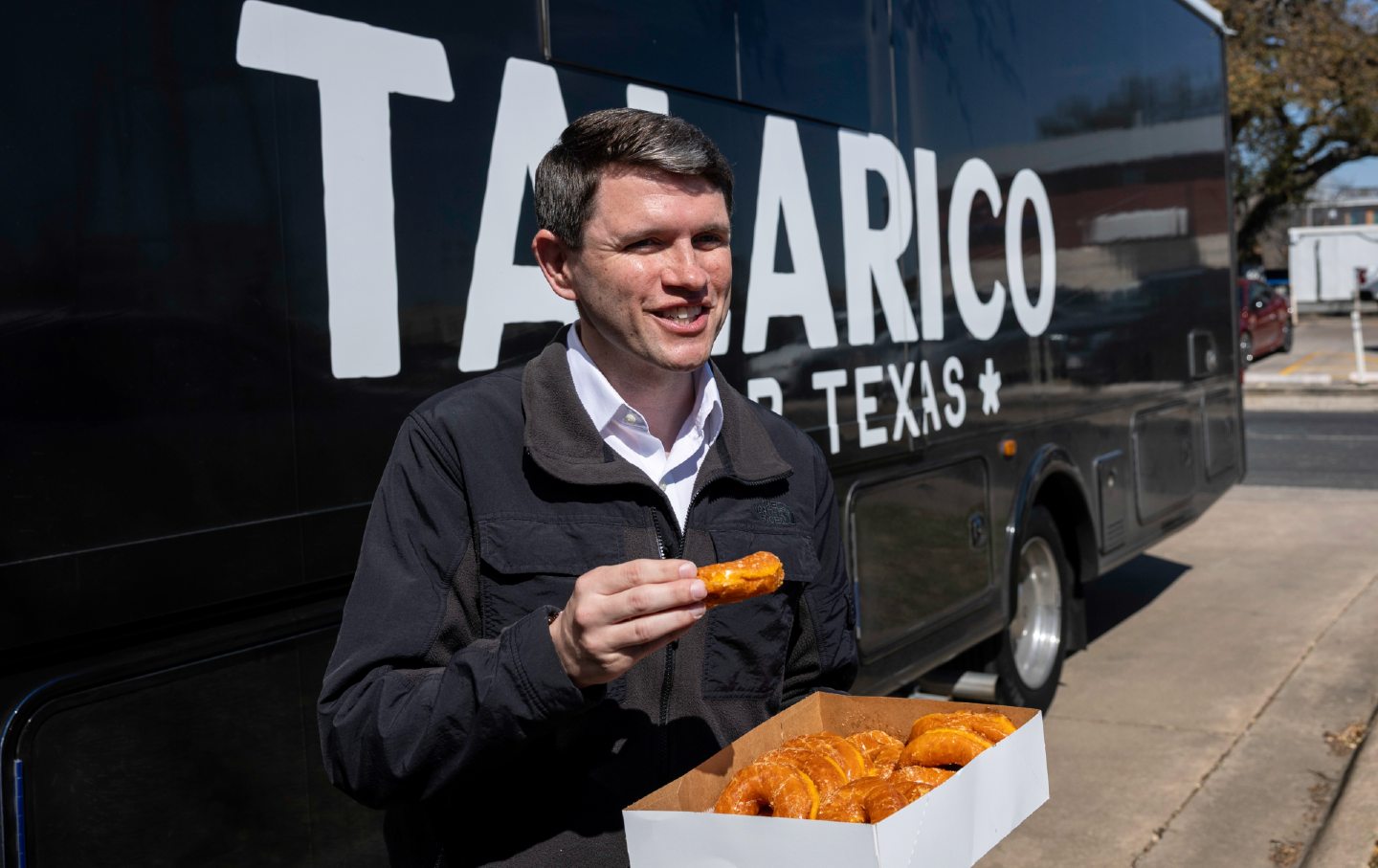
An Argument Against Voting for the “Electable” Guy An Argument Against Voting for the “Electable” Guy
In this week’s Elie v. US, The Nation’s justice correspondent shares his thoughts on the Texas primaries. Plus, a terrible Supreme Court decision and a bad play by Major League Ba...
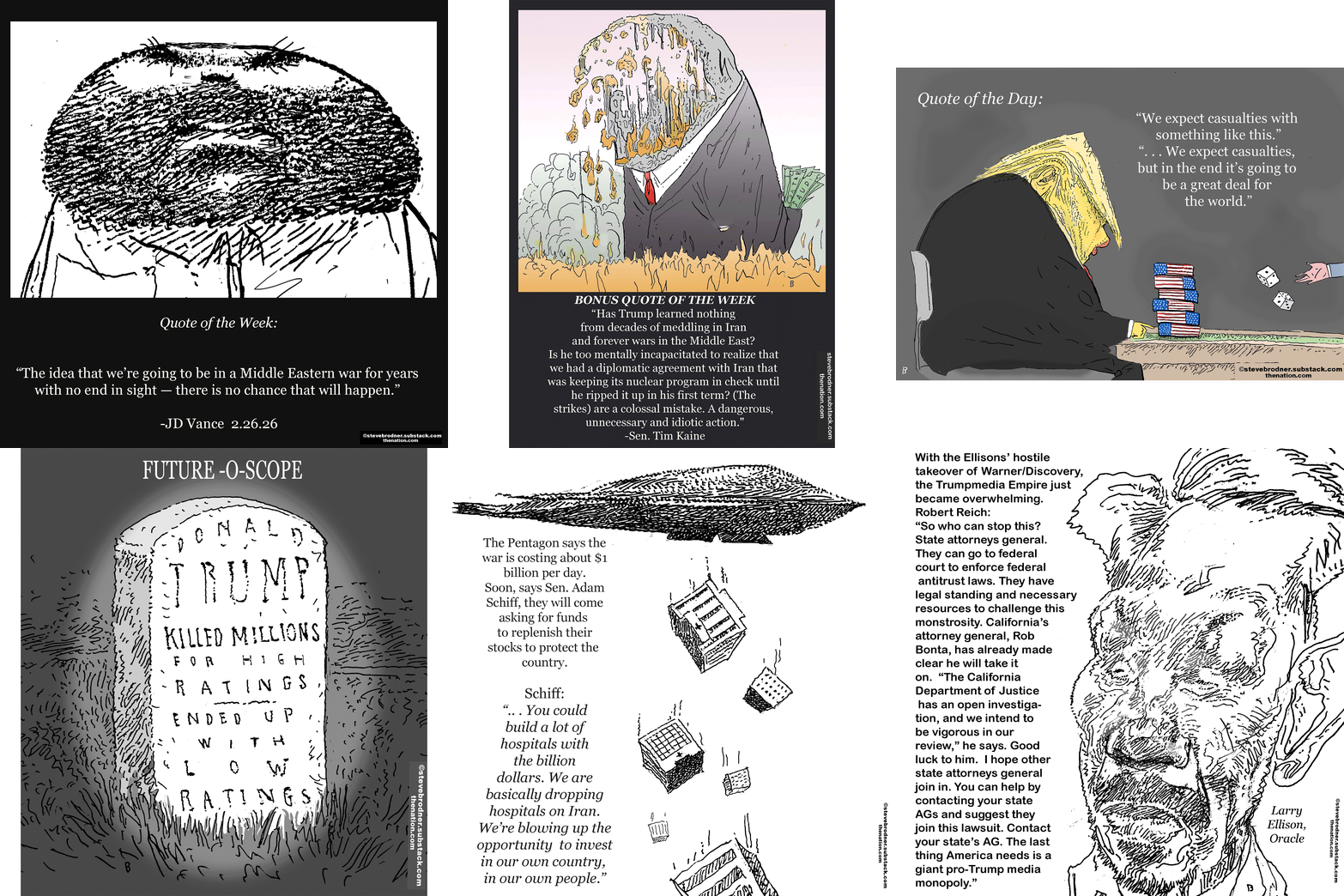

A Conflict Without Reason Has Become a Dangerous Holy War A Conflict Without Reason Has Become a Dangerous Holy War
Lacking a clear rationale for the attack on Iran, Trumpists are increasingly talking like crusaders.
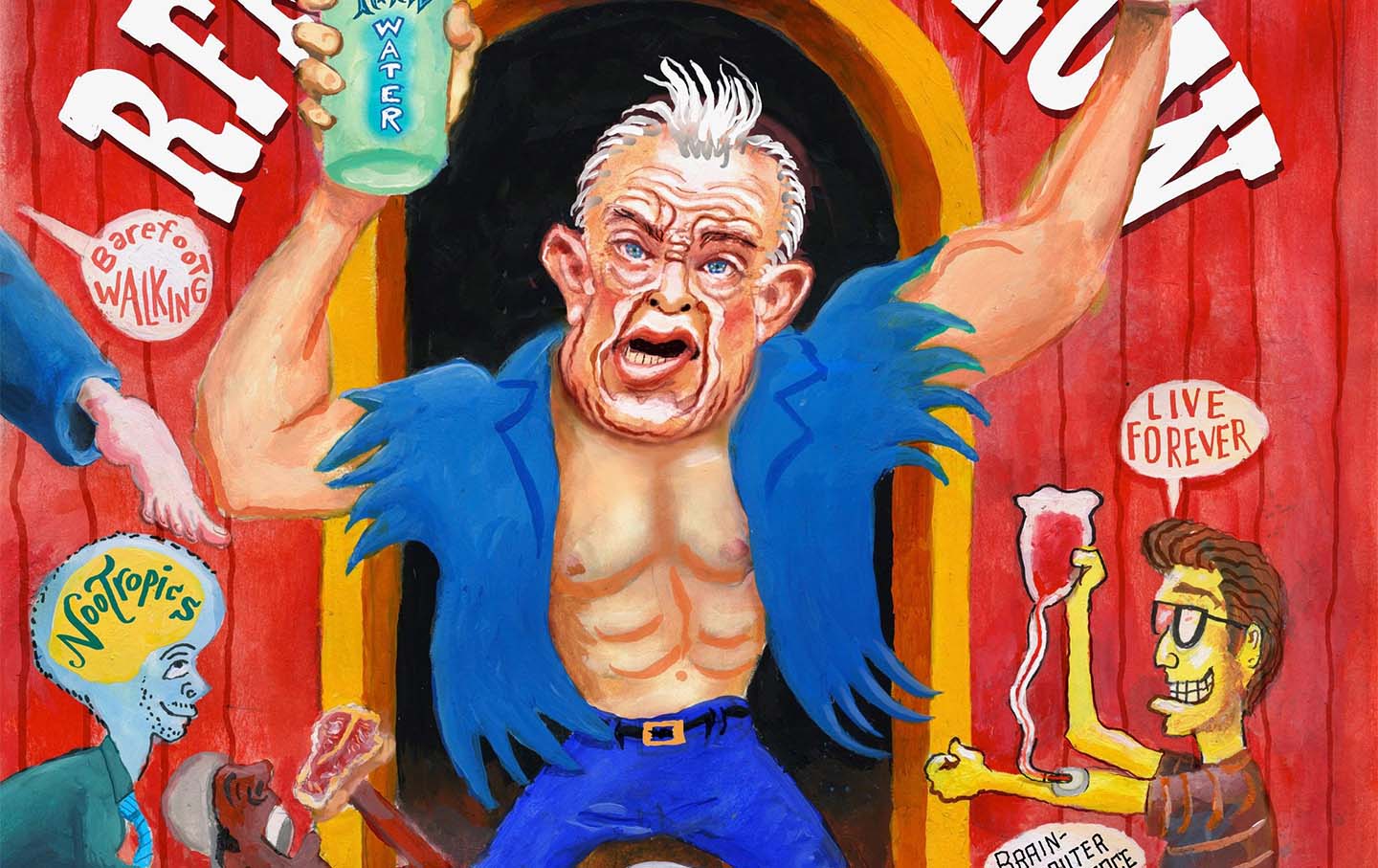
RFK Jr.: America’s Snake Oil Salesman RFK Jr.: America’s Snake Oil Salesman
Raw truth: MAHA is NUTS.

The Unfathomable Toll of the Syrian Civil War The Unfathomable Toll of the Syrian Civil War
How to make sense of the 13-year conflict?
Celebrate Kristi Noem’s Firing. But Keep Protesting ICE. Celebrate Kristi Noem’s Firing. But Keep Protesting ICE.
Finally, someone in the administration is paying for their cruelty and incompetence.

