House Republicans Tie Themselves Into Knots Over Federal Surveillance
The vote to reauthorize section 702 of the Foreign Intelligence Surveillance Act rose and fell and rose again on the whims of one Donald J. Trump.
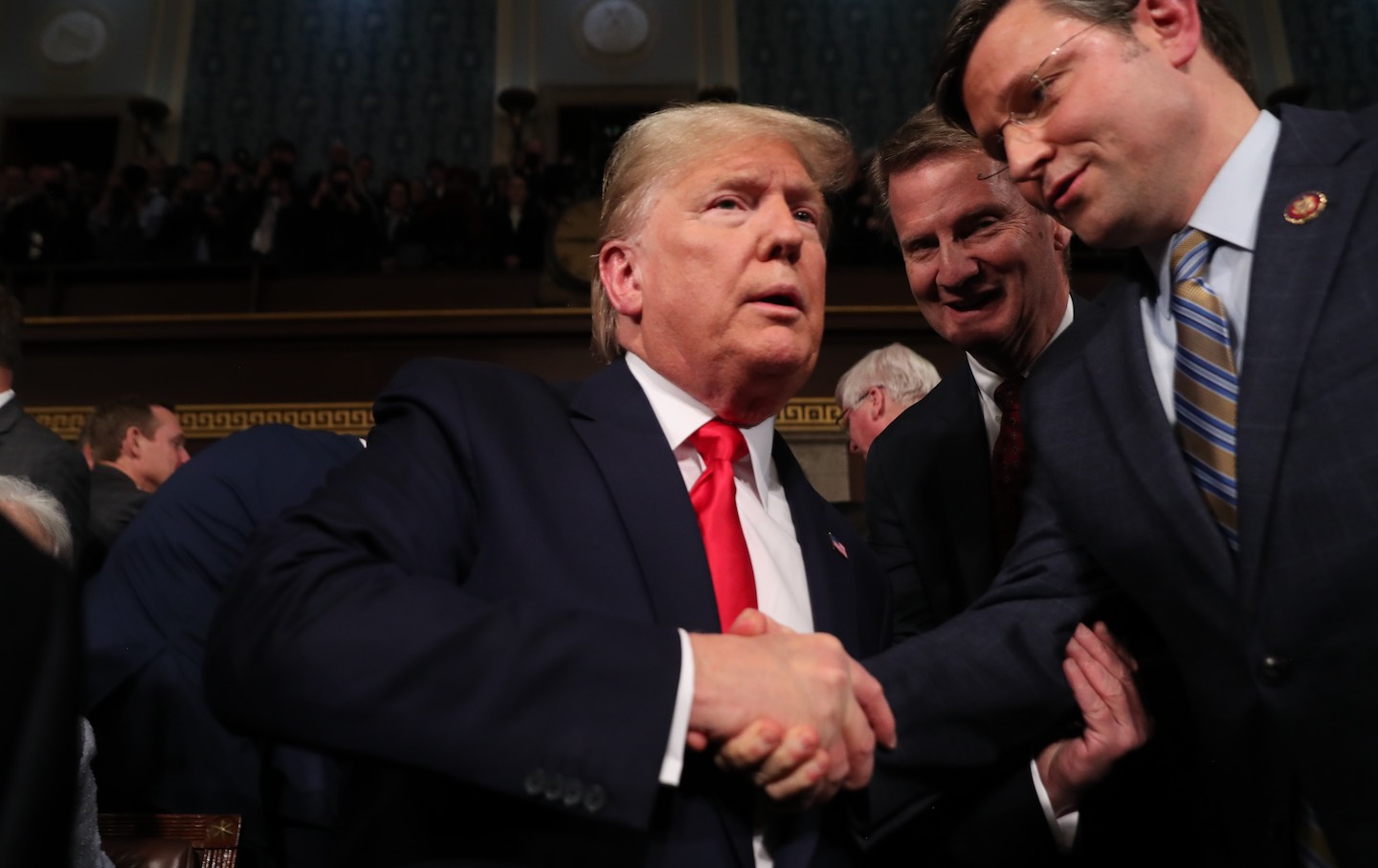
A mere 18 months into its tenure, the 118th Congress has somehow roused itself to do something more than reluctantly avert government shutdowns and ritually immolate its leaders for clearing even that low bar. These days, the bare minimum of legislative activity passes for good news on Capitol Hill. The bad news is that the House of Representatives has now voted to reauthorize Section 702 of the Foreign Intelligence Surveillance Act (FISA)—a blunt and antidemocratic instrument of the American surveillance state that has granted license to intelligence agencies to conduct stateside warrantless wiretaps on any hapless soul, on the flimsiest imaginable national security pretexts.
Section 702 was ratified back in 2008, as a rearguard bid to lend legal cover to a slew of well-documented abuses during the heyday of the George W. Bush administration’s Global War on Terror. The Bush White House endorsed wide-ranging surveillance on citizens and foreign nationals alike in the predictably bootless effort to target terrorist plots via overbroad sweeps of digital communications.
But virtually none of that ugly history of FISA abuse has figured into the House’s battle over the law’s reauthorization. Instead, the main source of the measure’s initial procedural death sentence and its rapid resurrection is the same force that drives all thinking and maneuvering in today’s Republican Party: the petulant worldview of Donald J. Trump. As House Speaker Mike Johnson sought to move the reauthorization vote through the Rules Committee, claiming that Section 702 was critical to national security, the 45th president took to his Truth Social account with this blunt directive: “KILL FISA, IT WAS ILLEGALLY USED AGAINST ME AND MANY OTHERS. THEY SPIED ON MY CAMPAIGN!!!”
Never mind that the surveillance Trump was referencing here—the wiretapping of former 2016 campaign hand Carter Page—was actually carried out by the FBI under a warrant from the standing FISA court, and not through the harum-scarum system instituted under Section 702. Never mind as well that during Trump’s own presidency, when he tried floating the same outraged protest over Section 702’s reauthorization in 2018, he fell back in line to support the vote at then–House Speaker Paul Ryan’s behest—no doubt because greater executive power of any kind is catnip to authoritarian leaders in the Trump mold. No, Mar-a-Lago’s Great and Powerful Oz had spoken, and so 19 MAGA lawmakers promptly aligned with House Democrats to prevent the bill from moving out of the Rules Committee. Under a suspension vote without Rules Committee support, reauthorization would require a two-thirds majority, meaning it was dead in the water.
But that was Wednesday. In the meantime, Johnson scheduled a pilgrimage to Mar-a-Lago to shore up his frail hold on the speakership by touting his and Trump’s shared devotion to the bogus election-deniers’ crusade for “election integrity.” As an initial peace offering, Johnson put together a revised FISA reauthorization deal, scheduled to sunset in two years, rather than five. For the 11th-hour MAGA dissenters, this would again put a longer reauthorization vote under the tenure of what they fondly hope will be a second Trump administration; they promptly switched their votes back, and the measure won approval from the Rules Committee, and moved quickly to a floor vote Friday, where it passed 273-147. The Senate will vote on the bill next week, ahead of Section 702’s scheduled expiration on April 19. Johnson has thus heeded Ryan’s example, realizing belatedly that the way to settle the longer-term status of Section 702 is to dangle it before Trump as a beguiling plaything for a presidential candidate who’s made it his mandate to visit “revenge” and “retribution” on his ever-expanding list of domestic enemies.
Ironically, Trump’s intervention here, like his earlier successful bid to tank a dismal Senate deal to introduce hard-line border security crackdowns, has inadvertently created an opening for better policy outcomes. Libertarian-minded MAGA lawmakers remain skeptical of the national security case for warrantless wiretapping, and have joined forces with civil libertarians on the Democratic side of the aisle to put forward an amendment to the bill that would render warrantless wiretapping more the exception than the rule in government surveillance. The amendment forbids “warrantless searches of U.S. person communications in the FISA 702 database, with exceptions for imminent threats to life or bodily harm, consent searches, or known cybersecurity threat signatures.”
The roster of sponsors for the amendment is quite a roll call of strange bedfellows: Progressive Caucus Chair Pramila Jayapal of Washington, former Freedom Caucus chair Andy Biggs of Arizona, House Judiciary Chair Jim Jordan of Ohio, ranking House Judiciary member Jerry Nadler of New York, Ohio Representative Warren Davidson of the Republican Study Conference and Freedom Caucus, and California Democratic Representative Zoe Lofgren, ranking member of the House Science, Space, and Technology Committee. However, the amendment didn’t survive the floor vote on Friday, which left privacy advocates with nothing more than a promise from Johnson that he’d proceed next week with a vote on a separate measure that would prevent government agencies from purchasing the personal data of citizens.
That’s not much, admittedly, but any incremental progress is welcome when it comes to reining in the excesses of the military-industrial surveillance state—particularly since Big Tech and defense companies lobby so aggressively to extend them. While the Beltway fetish of sage partisanship is a long-spent force, this provisional cross-ideological show of support for FISA reform is at least a reminder that lawmakers might still forge new alliances to prevent personal data from fueling unhinged executive agendas, either in Florida resort compounds or in the Virginia lairs of the National Security Agency.