Republican Border Theatrics Go Into Overdrive
Senate negotiations over immigration policy have become a proxy for warmongering foreign policy rhetoric.
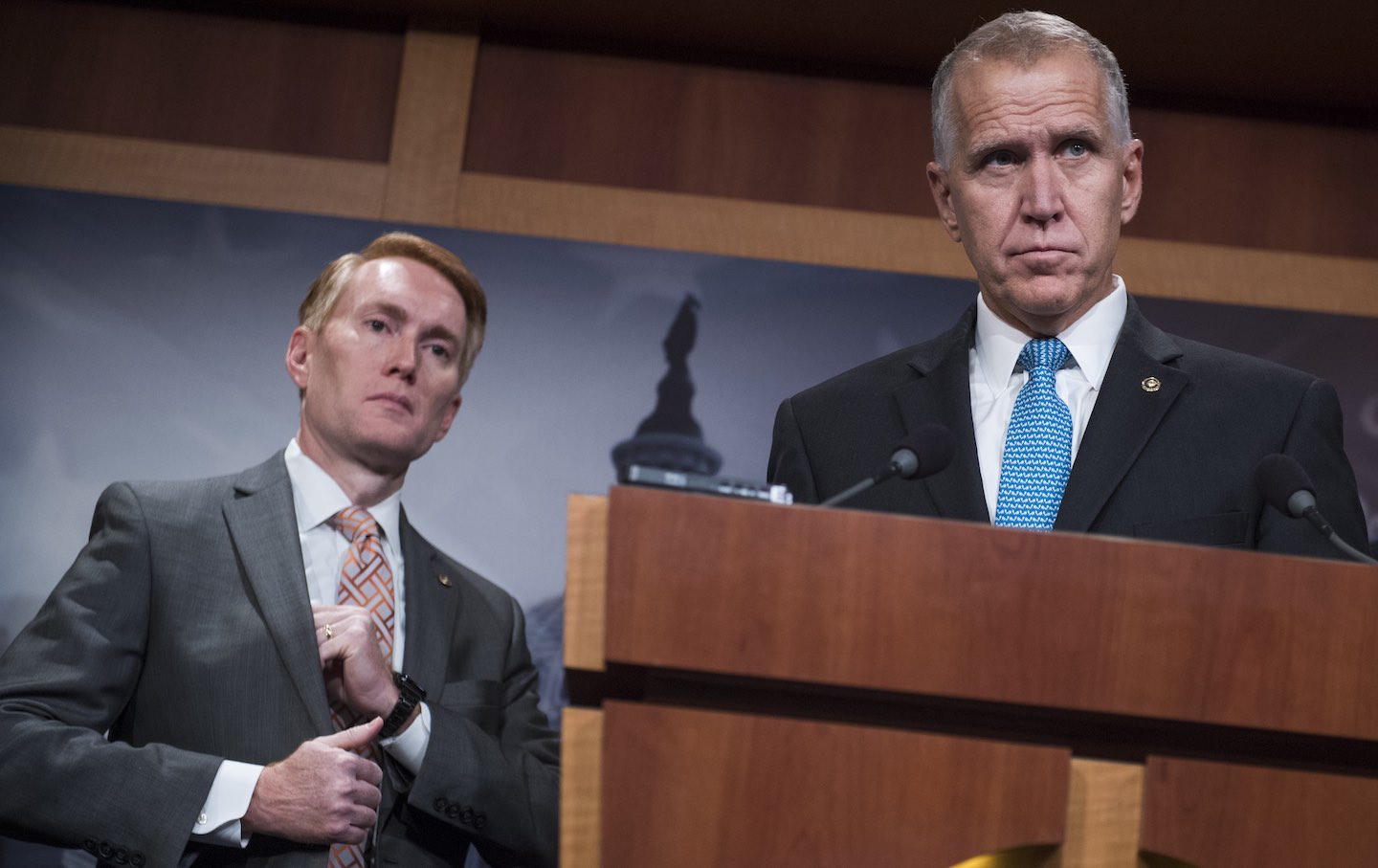
Two months out from yet another potential government shutdown, without a viable spending bill anywhere on the legislative schedule, congressional Republicans are doing what they do best: posturing to move ahead with a content-challenged right-wing package on border policy. Senate negotiations over immigration issues have focused on the MAGA right’s vision of border enforcement: hamstringing actual measures to reduce the volume of undocumented immigrants at the country’s southern border, while ignoring the plight of US-born children of undocumented parents.
Senate Republicans, led by chief negotiators Thom Tillis of North Carolina and James Lankford of Oklahoma, want to effectively throttle the “parole” program that lets a monthly quota of 30,000 immigrants from crisis-ravaged countries such as Ukraine and Afghanistan into the country on two-year work visas. They are also demanding a crackdown on immigrants’ qualifying for political asylum—another measure that would clearly increase, rather than stanch, the flow of immigrants entering the country without documentation: If you deny legitimate channels of entry to immigrants fleeing political oppression, they’ll turn in desperation to unsanctioned ones. “It’s like saying too many people are dying of cancer, so we shouldn’t do any more chemotherapy,” says Boston-based immigration attorney Matt Cameron. “This was put in place because [Republicans] were demanding that we have a process for taking people. So now the people who always say we have to follow the rules and have an orderly process, they’re the same people who are now saying we can’t have these orderly procedures.”
The specifics of the asylum overhaul are especially harsh, Cameron notes. “The major asylum change Republicans are pushing for seems to be raising the ‘credible fear’ screening interview standard from a ‘significant possibility’ that an asylum claim could prevail to a ‘more likely than not’ standard. This would result in many more expedited removals with many fewer people having the chance to present full claims to immigration judges.”
The Republican proposal also greatly expands judicial discretion in asylum cases, on what are clearly ideologically driven grounds. “This bill also broadens the definition of a ‘frivolous’ asylum application from one that’s fundamentally based on misrepresentations to anything the court views as intended to delay proceedings,” Cameron says. “The definition was written as broadly as possible on purpose. Giving judges the authority to decide that a good-faith asylum claim is so weak as to be a delaying tactic could be far too much power in many cases.”
This set of proposals underline a central operating principle: It’s never been GOP strategy to implement substantive immigration reform. The party is instead exploiting the image of border crossings as a dire crisis in “national security” to allow candidates to continue demagoguing the issue for electoral gain. That logic is, indeed, how these immigration talks got dragged onto center stage in debates over the supplemental spending package that the Biden administration is seeking for Ukraine, Israel, and Taiwan: In order to address threats to national security abroad, the GOP line goes, the country needs to adopt harsher “border security” measures at home.
The distressing first-order effect of this rhetoric is to treat a question of domestic politics—the terms under which people from other countries enter into this one, and the policies for eventual naturalization and citizenship—as a military issue, requiring chiefly military solutions. Beyond that, however, the border crisis ritually invoked in right-wing stump appeals is a flat-out mirage. For starters, the alleged criminal mayhem wrought by undocumented immigrants is a complete Republican myth; this demographic actually commits crimes at a significantly lower rate than native born Americans do; in the exhaustively hyped sphere of violent crime, that rate is indeed half of the domestic US rate. In addition, the fentanyl epidemic—the right-wing immigration campfire terror-story du jour—is anything but the just-so tale of cartel apparatchiks swarming in from Mexico and China that has become standard MAGA lore. While bad actors do manipulate the immigration system to their advantage, the fentanyl plague is rooted in the mundane traffic of consumer goods sanctioned by major US corporate interests. (This is, of course, to say nothing of the demand-side issues that almost never get aired in drug-war scare-mongering.) The legislative accelerant in question here is a customs-import provision known as the “Amazon loophole,” which has permitted fentanyl precursors to swamp American markets alongside a slew of Bezos-branded consumer products from China.
Immigration-scare rhetoric was a pivotal factor in the MAGA movement’s rise to power, and former president Donald Trump is again running on demands for draconian border crackdowns that invertebrate congressional leaders are racing to mimic. As a Senate Democratic aide told The Washington Post’s Greg Sargent, Republican lawmakers are acting as though Trump and his ghoulish border consigliere Stephen Miller are “looking over their shoulders.” One clear sign of that malign and bootless influence is a GOP demand in border talks that Democrats must commit to reducing illegal border crossings by more than 50 percent—a wholly arbitrary and fanciful threshold, particularly given that four years of Trump administration policies produced no appreciable decline in illegal entries. Still, the political reckoning on the right remains the same. “They’re just obsessed with doing whatever they can to bring back these failed Trump policies that the courts have struck down,” Cameron says.
The latest round of GOP border theatrics comes as the party continues to suffer the ongoing political fallout from bringing a long-running culture-war mobilization to effective fruition, instituting a regime of coerced child-bearing under the 2022 Dobbs v. Jackson Women’s Health Organization ruling. What’s more, the GOP’s latest up-and-coming culture war sensation—the McCarthyite inquisition against critical race theory and assorted other bacilluses of subversion lurking in public school curricula—has proved a serious liability at the polls.
Rest assured, then, that congressional Republicans gearing up for the next election cycle understand all too plainly that MAGA campaign appeals have no use for policy measures that might tamp down the perception of hordes of Real America–imperiling sociopaths barreling through the US southern border. For ready confirmation of this perverse political incentive, look no further than the last Republican presidential debate, which saw candidates trying to one-up each other with proposals to bomb Mexico sooner, faster, and harder in retaliation for the fentanyl crisis. This ludicrous posturing would be comical if the stakes didn’t involve so much human suffering. “I just wish there was more context for why immigrants are actually coming here. The conventional narrative is just that these people are coming out of a vacuum, but I see this every day—it’s generational now; it’s people driven out of their homes and massacred,” Cameron says. “And yet we’re talking as though they’re just turning up at the border to get better opportunities. There’s no moral accountability here, or even the understanding that would generate moral accountability.”
The other source of ready confirmation here is the extent to which congressional Democrats had already capitulated to the GOP immigration wish list. Fearing right-leaning backlashes of their own next November, particularly for red-state Senate incumbents like John Tester and Sherrod Brown, Democrats are already signaling support for the new asylum restrictions. Democrats also readily relinquished an early proposal from Connecticut Senator Chris Murphy to revive a naturalization program for the Dreamers, even though that plan has long commanded overwhelming cross-partisan popular support. Yet the GOP has taken it upon itself to push for the suspension of parole entry, with Tillis pronouncing that without “parole language” the measure wouldn’t pass muster as “border security,” and thus would throw Ukraine funding into doubt. And that’s what passes for sober statesmanship on the right—other leading right-wing institutions, such as the Heritage Foundation’s political action committee, have disowned the Senate talks altogether, plumping instead for the House’s far more punitive, and politically doomed, immigration bill, HR 2. In other words, the range of right-wing legislative options on border policy run the gamut from the counterproductive to the symbolically vicious—and, more to the point, it scarcely matters to Republican strategists what will ultimately become of them.