Raphael Warnock Lights Up the Convention With a Preacher’s Fire
The Georgia senator showed why the Black church remains the cornerstone of the Democratic Party.
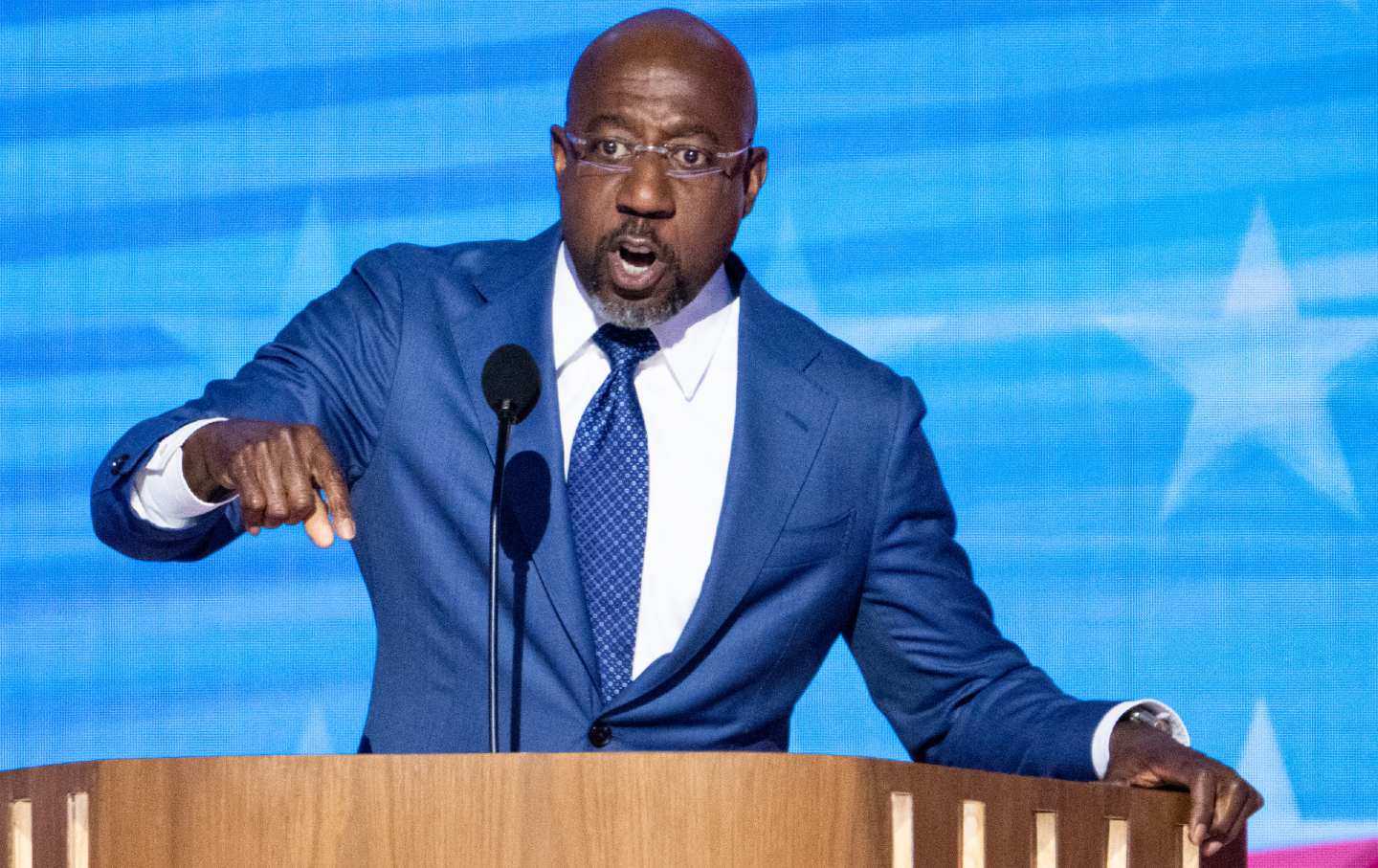
Senator Raphael Warnock speaks during the 2024 Democratic National Convention at the United Center in Chicago on August 19, 2024.
(Bill Clark / CQ-Roll Call, Inc via Getty Images)
At a political convention, speeches are performances where style and delivery are as important as substance. Like improvised jazz, they rely on a preexisting material (an existing stock of arguments and talking points that are shared by the party) but come to life based on the panache and intensity of the performer.
In his speech on Monday night, Georgia Senator Raphael Warnock relied on the same set list as almost all the other speakers: the foulness of Trump’s January 6 insurrection, Covid-19 as a collective trauma that was overcome through solidarity, the Democrats as an inclusive party of the future that rejects “going back” to the reactionary past advocated by the GOP, the urgency of protecting reproductive freedom, the promise to fight to keep drug prices down.
More on the 2024 Democratic National Convention:
But if the tropes were familiar, what Warnock did with them stood out. He didn’t invent a new style but rather revived the tradition of the progressive Black preacher that has been rarely heard in national politics since the heyday of Jesse Jackson (who, as it happens, was honored that night). It’s a venerable tradition, made globally famous by Martin Luther King Jr., that stretches back to slavery. Under the brutal regime of the enslavers, Black Americans were forbidden most forms of organization except the formation of their own churches, where they could hear sermons on how the Israelites under bondage weren’t forgotten by God, who sent them a leader that took them to freedom.
It was this message of redemption and healing that Warnock repeatedly evoked, not just by using the language of the faith but by his very cadence and lilt, which were those of the pulpit not the political arena. It’s hardly a surprise that Warnock spoke as an avatar of the Black church. He has been senior pastor of Atlanta’s Ebenezer Baptist Church since 2005. In keeping with his tradition, his faith and his politics have been one.
The message of secular redemption could be heard when Warnock said, “A vote is a prayer for the world we desire for ourselves and our children. Our prayers are stronger when we pray together. Together we flipped the Senate, held the House, and sent Joe Biden and Kamala Harris to the White House.”
Near the end of the speech, Warnock made a grand peroration:
“I’m inspired tonight by the memory of my late father, a preacher and a junk man. Monday through Friday he lifted old broken cars and put them on the back of an old rig. But on Sunday morning, the man who lifted broken cars lifted broken people and told them they were God’s somebody. My dad discovered strength in the broken places, a power made perfect in weakness. So I am convinced tonight that we can lift the broken even as we climb. I’m convinced tonight that we can heal sick bodies, we can heal the wounds that divide us, we can heal a plant in peril, we can heal the land.”
This ending brought the audience to its feet. The progressive Black religious tradition has made history in the past and is likely to continue to grow in power, especially as the Democratic Party expands in Georgia and North Carolina. In Warnock, this tradition has a powerful vessel, ready to sound forth the trumpet that shall never call retreat.
Support independent journalism that does not fall in line
Even before February 28, the reasons for Donald Trump’s imploding approval rating were abundantly clear: untrammeled corruption and personal enrichment to the tune of billions of dollars during an affordability crisis, a foreign policy guided only by his own derelict sense of morality, and the deployment of a murderous campaign of occupation, detention, and deportation on American streets.
Now an undeclared, unauthorized, unpopular, and unconstitutional war of aggression against Iran has spread like wildfire through the region and into Europe. A new “forever war”—with an ever-increasing likelihood of American troops on the ground—may very well be upon us.
As we’ve seen over and over, this administration uses lies, misdirection, and attempts to flood the zone to justify its abuses of power at home and abroad. Just as Trump, Marco Rubio, and Pete Hegseth offer erratic and contradictory rationales for the attacks on Iran, the administration is also spreading the lie that the upcoming midterm elections are under threat from noncitizens on voter rolls. When these lies go unchecked, they become the basis for further authoritarian encroachment and war.
In these dark times, independent journalism is uniquely able to uncover the falsehoods that threaten our republic—and civilians around the world—and shine a bright light on the truth.
The Nation’s experienced team of writers, editors, and fact-checkers understands the scale of what we’re up against and the urgency with which we have to act. That’s why we’re publishing critical reporting and analysis of the war on Iran, ICE violence at home, new forms of voter suppression emerging in the courts, and much more.
But this journalism is possible only with your support.
This March, The Nation needs to raise $50,000 to ensure that we have the resources for reporting and analysis that sets the record straight and empowers people of conscience to organize. Will you donate today?