
Why Mamdani Should Oppose Kathy Hochul’s Protest Ban
The proposed restriction on protests outside houses of worship is rooted in anti-Palestinian bias and would give Israeli apartheid a free pass. Mamdani should reject it.
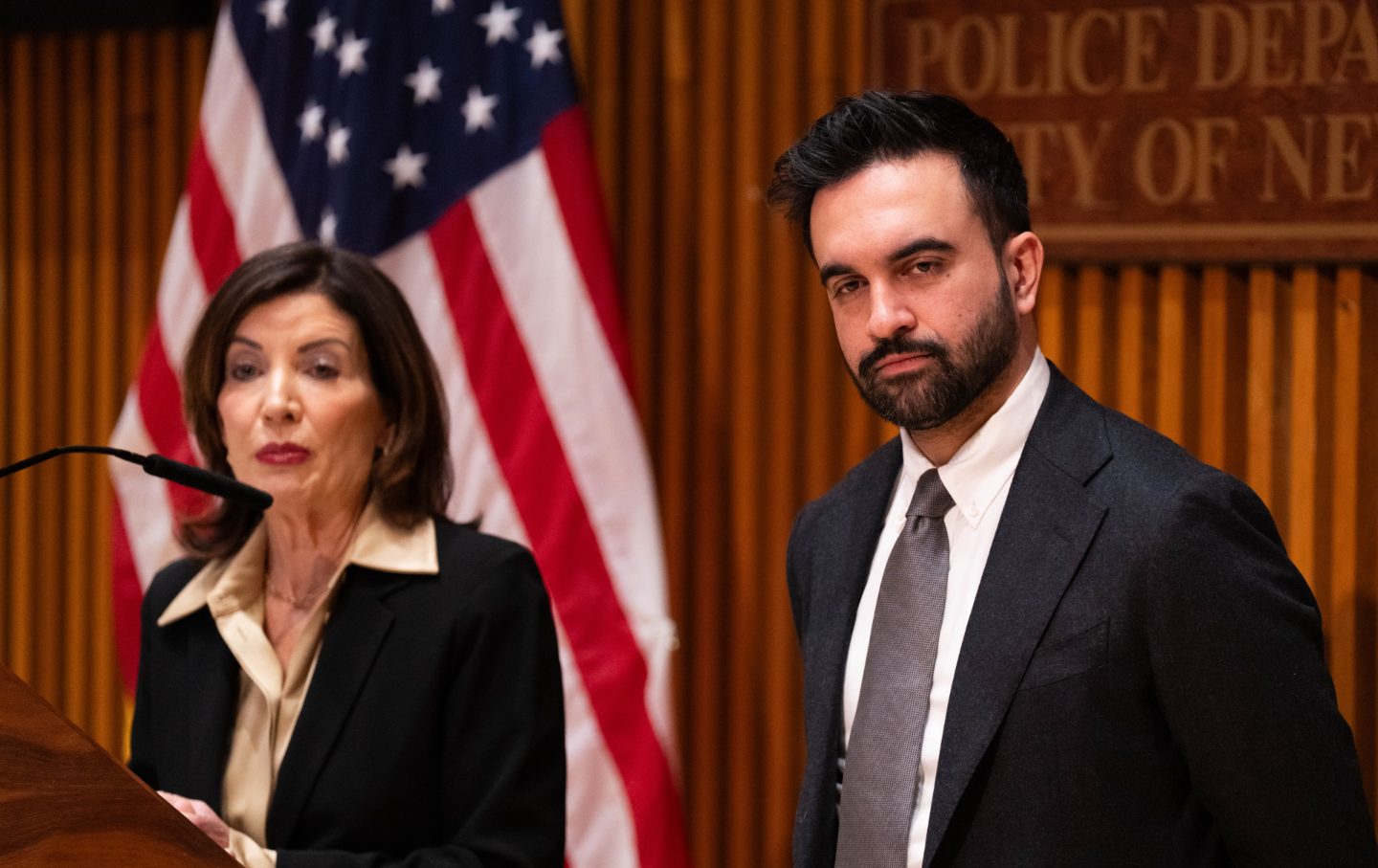
Kathy Hochul and Zohran Mamdani at 1 Police Plaza in New York City, on Tuesday, January 6, 2026.
(Adam Gray / Bloomberg via Getty Images)In the first week of January, Israeli authorities issued a tender to construct over 3,400 new illegal settlements in the “E1 corridor” of the West Bank, a parcel of land that connects the ring of settlements surrounding occupied East Jerusalem with the major settlement city of Ma’ale Adumim. Capitalizing on the inaction of the international community, which failed to apply meaningful pressure on Israel to halt its genocidal war in Gaza, the Israeli state has fast-tracked its efforts to carve up the West Bank through land grabs, home demolitions, and the mass expulsion of Palestinians. The purpose of the E1 project has always been clear; as Finance Minister Bezalel Smotrich said last August, it is intended to “bury the idea of a Palestinian state.”
Thousands of miles away, protesters gathered in the New York neighborhood of Kew Gardens, Queens, to demonstrate against an event advertising land sales in the occupied Palestinian territories. The event was hosted at the Young Israel synagogue of Kew Gardens Hills, in keeping with a broader pattern of settler recruitment fairs and real estate events hosted at synagogues and Jewish communal institutions across New York and New Jersey. The promotional materials of Tivuch Shelly, the Israeli real estate agency participating in the event, highlighted listings in Ma’ale Adumim—the city at the heart of the E1 project.
A viral video from the demonstration, which depicted protesters chanting in support of the Palestinian political faction Hamas, quickly commanded the headlines. Newly elected New York mayor Zohran Mamdani condemned the chants, stating that they “have no place in our city.” Governor Kathy Hochul, Attorney General Letitia James, and Congresswoman Alexandria Ocasio-Cortez also registered their outrage at the protesters’ language. None saw fit to address the rhetoric used by pro-Israel counterprotesters, who chanted “death to Palestine,” showered death and rape threats on their opponents, and brandished flags of the extremist right-wing Kach movement.
It’s not surprising that the pro-Palestinian activists found themselves placed under greater scrutiny than their pro-Israel counterparts. Almost every slogan that Palestinian rights groups use—including “globalize the intifada,” “from the river to the sea,” and even “free Palestine”—gets fed into the same media outrage cycle, providing a useful distraction from engaging with the concrete, rigorously articulated demands of the movement: cutting funding to Israel, imposing an arms embargo, and stopping the sale of unlawfully appropriated Palestinian land. As the past two years have demonstrated, the moderation of protest rhetoric has little bearing on establishment politicians’ bipartisan desire to quash the Palestine movement by whatever means necessary.
Now New York state and city officials are moving to criminalize protests near religious institutions. On January 13, Hochul proposed legislation that would ban protests within 25 feet of houses of worship, citing the Kew Gardens demonstration as justification. The New York City Council introduced a similar bill on Friday that would create “safety zones” outside of religious sites and schools.
Everyone should be free to practice their faith in safety, and such proposals may seem like common sense to some. But the protesters who gathered outside of Young Israel—many of whom were Jewish—were not motivated by the intention to prevent religious worship. They instead took to the streets to challenge the illegal, colonial theft of Palestinian land happening in their own backyards.
If passed, Hochul’s ban would enable pro-Israel agencies to recruit Americans into Israel’s settlement enterprise or sell properties on confiscated Palestinian land, without fear of disruption from people of conscience. No wonder, then, that civil rights groups condemned the move, stating that land sales, regardless of their location, constitute a “central component of the dispossession of Palestinians.”
By framing criticism of Israel as indistinguishable from racially motivated bias and antisemitism, supporters of Zionism like Hochul seek to weaponize civil rights law to suppress political dissent. And by conflating support for war crimes with the exercise of faith—despite growing divides among Jewish Americans over Israel—Zionist groups are seeking to further institutionalize the “Palestine exception” to local, state, and federal restrictions on Americans’ ability to participate in colonial violence abroad.
While incidents such as the Kew Gardens protest are used to position Palestine activists as fringe extremists, opposition to US funding and military aid to Israel has become mainstream. Israel’s crimes against humanity in Gaza have alienated large swaths of the American public, spurring campaigns against local arms manufacturers, settlement-supporting nonprofits, and the government officials responsible for propping up US logistical, financial, and military support for Israel.
The consequences of enabling Israel’s atrocities have become clear in the past two years. Emboldened by the genocidal rhetoric of government ministers like Bezalel Smotrich and Itamar Ben-Gvir, violence against Palestinians in the West Bank has skyrocketed. Since October 7, 2023, over 1,100 Palestinians in the West Bank have been killed in Israeli attacks, with an additional 20,000 arrested. Settler groups, often in collusion with military forces, terrorize Palestinian communities with assaults, arson, destruction of livestock and olive groves, and summary executions. The price of complicity with Israel’s apartheid regime is the “systematic asphyxiation” of the West Bank.
In the wake of mass displacement and land seizures, Israel-affiliated nonprofits and real estate agencies in New York swoop in to auction off spots in settlements to the highest bidders at events such as the one that took place in Kew Gardens. This international, state-backed project of colonization warrants much greater scrutiny, media attention, and legal action. But the Democratic establishment in New York has largely failed to reflect the massive shift in the attitude of its base towards Israel. In doing so, they have ceded ground to right-wing forces seeking to roll back fundamental protections for political organizing and dissent against US foreign and domestic policies.
Mamdani has walked a more delicate path than Hochul. In the aftermath of an earlier protest outside of the Park East Synagogue last November, a spokesperson for the then-mayor-elect stated that “every New Yorker should be free to enter a house of worship without intimidation, and that these sacred spaces should not be used to promote activities in violation of international law.” These two positions are both uncontroversial on their face. But they do not account for instances where a house of worship insists on promoting illegal activities for the benefit of what Mamdani himself has called a genocidal apartheid state. Whose rights should prevail in that instance? Mamdani hasn’t said.
Mamdani’s willingness to buck the shibboleths of the Democratic establishment, challenge corporate power, and uphold basic principles of international solidarity bolstered his appeal among New Yorkers of all stripes. His stunning electoral victory proved that expressing support for Palestinians and condemning Israel’s genocide in Gaza no longer constitutes political kryptonite.
As a member of the New York State Assembly, Mamdani previously sponsored the “Not On Our Dime” bill, which aimed to revoke the charitable status of organizations that sponsored violence against Palestinians. At the time, Mamdani pointed out that the New York attorney general had the power to investigate New York–based organizations for enabling settlements, but “there [was] no application of existing law” because of the politically charged nature of challenging Israeli impunity. As mayor, Mamdani has the opportunity to leverage his relationship with Albany, and the powers vested in his position, to ensure that organizations profiting from dispossession of Palestinians no longer elude accountability. In his first week in office, the new mayor took the promising step of revoking a series of executive orders signed by former Mayor Eric Adams that sought to prohibit political boycotts in support of Palestinian rights and redefine the legal definition of antisemitism to include criticism of Israel.
Now, his administration faces pressure from political forces seeking to undermine a bottom-up movement for economic justice by manufacturing endless cycles of media outrage. It is the duty of the broad, progressive coalition that swept him into power to provide a countervailing force.
Popular
“swipe left below to view more authors”Swipe →Mamdani’s election marked the beginning, not the end, of a long struggle to hold him accountable to his stated aims and prevent a rightward drift in strategy. The mayor must reject cynical efforts to clamp down on political dissent, summon his well-established public communication skills, and replace fearmongering with principled action against violations of international law.
We collectively bear the responsibility to provide a much-needed sense of perspective, prioritizing the real effects that New York policies have on everyday working people—and on the Palestinians struggling under the boot heel of Israeli domination half a world away.
Support independent journalism that does not fall in line
Even before February 28, the reasons for Donald Trump’s imploding approval rating were abundantly clear: untrammeled corruption and personal enrichment to the tune of billions of dollars during an affordability crisis, a foreign policy guided only by his own derelict sense of morality, and the deployment of a murderous campaign of occupation, detention, and deportation on American streets.
Now an undeclared, unauthorized, unpopular, and unconstitutional war of aggression against Iran has spread like wildfire through the region and into Europe. A new “forever war”—with an ever-increasing likelihood of American troops on the ground—may very well be upon us.
As we’ve seen over and over, this administration uses lies, misdirection, and attempts to flood the zone to justify its abuses of power at home and abroad. Just as Trump, Marco Rubio, and Pete Hegseth offer erratic and contradictory rationales for the attacks on Iran, the administration is also spreading the lie that the upcoming midterm elections are under threat from noncitizens on voter rolls. When these lies go unchecked, they become the basis for further authoritarian encroachment and war.
In these dark times, independent journalism is uniquely able to uncover the falsehoods that threaten our republic—and civilians around the world—and shine a bright light on the truth.
The Nation’s experienced team of writers, editors, and fact-checkers understands the scale of what we’re up against and the urgency with which we have to act. That’s why we’re publishing critical reporting and analysis of the war on Iran, ICE violence at home, new forms of voter suppression emerging in the courts, and much more.
But this journalism is possible only with your support.
This March, The Nation needs to raise $50,000 to ensure that we have the resources for reporting and analysis that sets the record straight and empowers people of conscience to organize. Will you donate today?
More from The Nation
Trump’s War Is Destroying the Global Economy Trump’s War Is Destroying the Global Economy
Spiraling financial chaos might be the only thing that can force the president to pull back from this conflict.
Make America Great Again Make America Great Again
Who are the immigrants?
OppArt / Anonymous and Peter Kuper
How the Abortion Rights Activists Found Their Radical Imagination How the Abortion Rights Activists Found Their Radical Imagination
A long-shot campaign to restore public funding for abortion turned into the movement’s biggest success in a generation.

An Argument Against Voting for the “Electable” Guy An Argument Against Voting for the “Electable” Guy
In this week’s Elie v. US, The Nation’s justice correspondent shares his thoughts on the Texas primaries. Plus, a terrible Supreme Court decision and a bad play by Major League Ba...
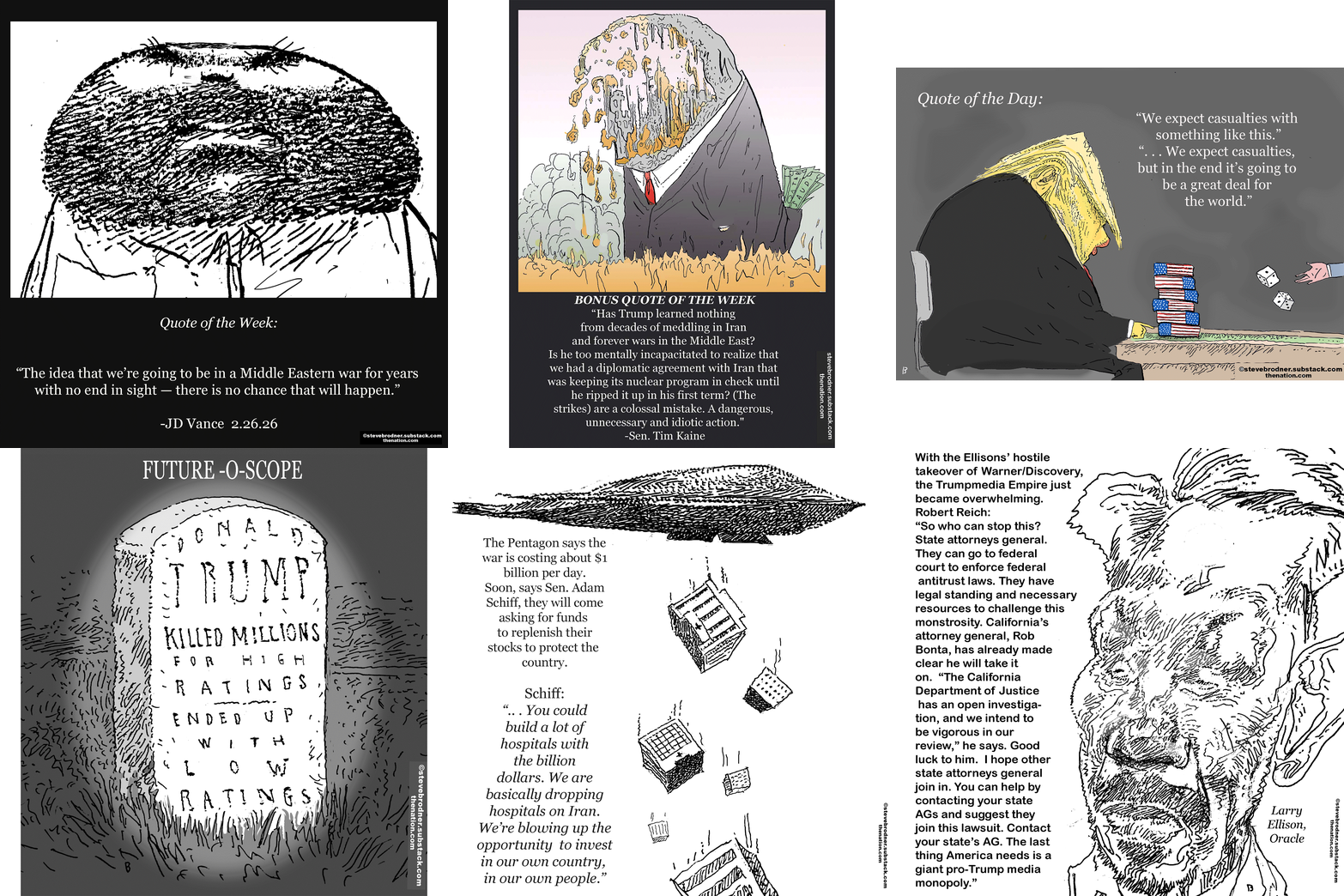

A Conflict Without Reason Has Become a Dangerous Holy War A Conflict Without Reason Has Become a Dangerous Holy War
Lacking a clear rationale for the attack on Iran, Trumpists are increasingly talking like crusaders.

