
No, Kamala Harris Staffers Did Not Run a “Flawless” Campaign
Democratic strategists are still patting themselves on the back for a catastrophic defeat.
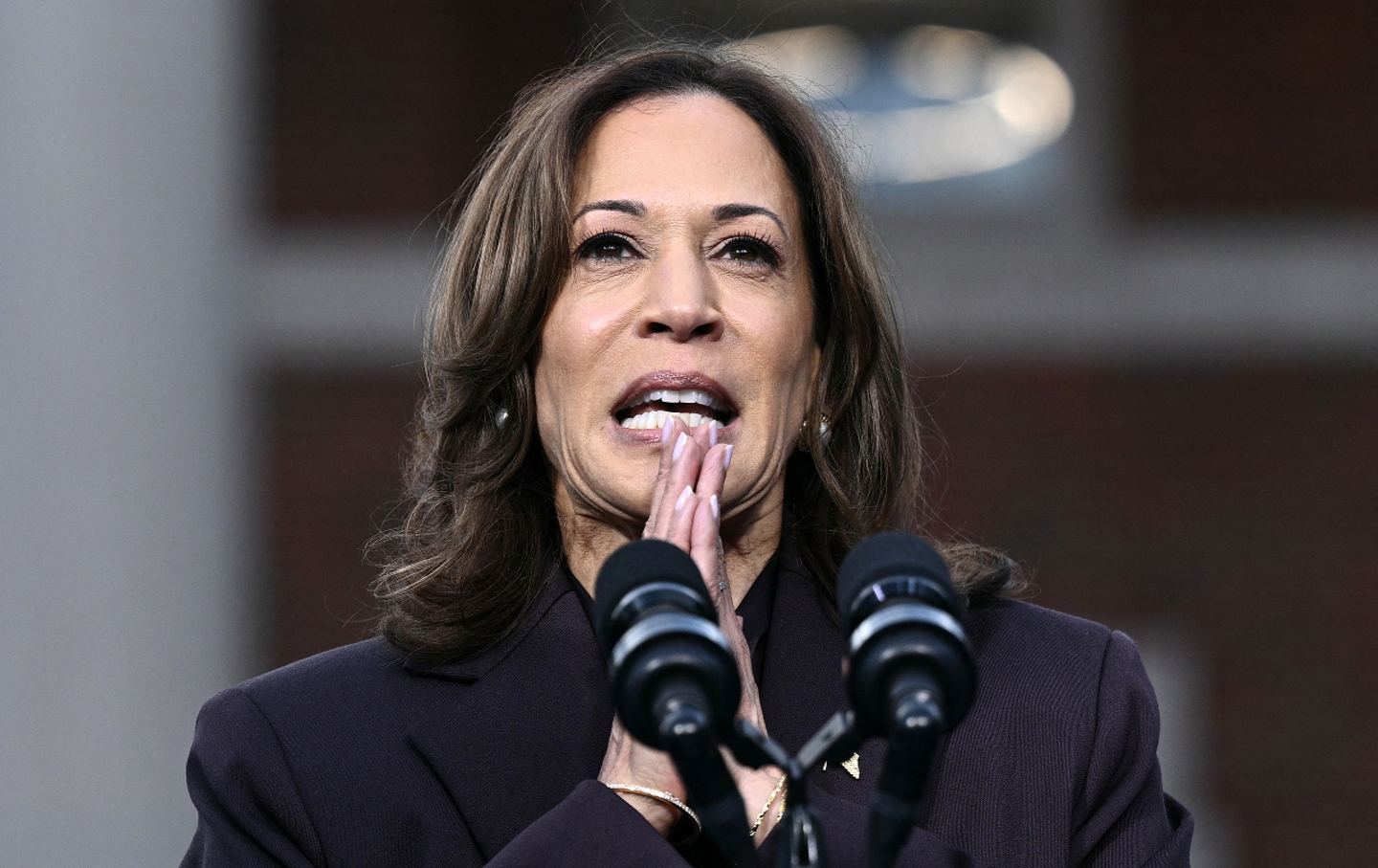
Being angry all the time is not good for your mental health, but the world provides provocations to rage that overpower any effort at equanimity. For anyone who followed the presidential election of 2024 and regards the victory of Donald Trump as an enormous tragedy for the United States and the world, the great foe of serenity is listening to interviews with Democratic Party strategists. This is a group that has displayed a mind-boggling unwillingness to accept any accountability for losing—for the second time in eight years—to Trump, a hoodlum and con man who is widely hated.
Last Thursday, Sheila Nix, Vice President Kamala Harris’s chief of staff, participated in a bipartisan conference of staffers from this year’s presidential campaign, where she made a stunning claim. “I would posit she ran a pretty flawless campaign, and she did all the steps that [were] required to be successful,” Nix said. “And I think—obviously, we did not win, but I do think we hit all the marks.”
Chris LaCivita, Trump’s campaign manager, had the obvious retort. “Flawless campaigns don’t lose,” LaCivita told The New York Times. “You can run a great campaign—you can run a good campaign—and still lose. But you can’t run a flawless campaign and lose.”
Nix is not the only Harris staffer currently patting herself on the back for doing a terrific job. The same notes of self-satisfaction and complacency dominate a remarkable episode of the Pod Save America podcast that ran in late November featuring four senior advisers for the Harris campaign: Jen O’Malley Dillion, Quentin Fulks, Stephanie Cutter, and David Plouffe.
As Washington Post columnist Perry Bacon Jr. acutely noted, these four strategists “kept saying they weren’t making excuses or blaming others—while doing both.”
Bacon went on to observe:
What the four never did is directly admit any major mistakes they made. “We should have really pushed Harris to distance herself from President Biden”; “Maybe we spent too much time in Arizona” (Harris lost there by 6 percentage points); “We should have had a Palestinian speaker at the Democratic National Convention.” There were no blunt statements like that.
Instead, the staffers repeatedly defended their work by noting that Harris lost by less in the seven swing states she campaigned in compared with the rest of the country.
The refrain that Harris overperformed in the swing states has often been made as a defense of the campaign. But it turns out not to be true. As Vox writer Eric Levitz, building on the observation of strategist David Shor, notes, “Dems’ swing-state over-performance mostly reflects how exceptionally badly the party did in NY, TX, FL, and CA.” In other words, Harris’s performance in the swing states was in line with her performance in the rest of the country—leaving aside the solid-blue states where there was a massive erosion of support for the Democratic candidate. This is a particularly revealing admission from Shor, since he was a senior adviser to an outside group that did much advertising in the swing states.
One could make many other critiques of the Harris campaign: her strategy of hugging Liz Cheney and other far-right Republicans; her use of wealthy surrogates such as Mark Cuban, which undercut her economic message; her closeness to Wall Street donors, who (along with Cuban) made her water down any economic populism.
The original sin of the 2024 election was Joe Biden’s selfish decision to run again, which meant that when he finally gave up the ghost over the summer, Democrats had to scramble to replace him with Kamala Harris.
Many Harris strategists also worked for Joe Biden—and they remain singularly reluctant to hold their former boss to account or to explain their own complicity in Biden’s disastrous egoism.
As CNN notes about the Pod Save America interview, “None of the campaign brass called out Biden by name, but they repeatedly referred to political ‘headwinds’ and touted how much Harris needed to claw back just to make the race competitive.”
Quentin Fulks told Pod Save America, “We were honestly in, in crisis management mode of keeping President Biden in the race.… Trump’s favorability numbers were creeping up as Plouffe said, and we had to do something about that as well. And so it was a lot of walking and chewing gum at the same time, but there really was no sort of contingency planning to turn the race over to her right after that debate or at any point until President Biden definitively said he wasn’t going to continue on.”
The fact that there was no contingency planning even after Joe Biden’s horrendous debate performance against Donald Trump in June is shocking. Yet it is confirmed by Time magazine, which reports: “Biden let his top hands know on July 21 that he’d be dropping out of the race. O’Malley Dillon said she and campaign manager Julie Chavez Rodriguez both cried that day, and insisted there had been zero planning for that moment. ‘Not one ounce,’ O’Malley Dillon said.”
These Biden loyalists took over Harris’s campaign and continued to show the same lack of judgement.
Stephanie Cutter told Pod Save America that “the convention demonstrated a lot of enthusiasm for Kamala Harris, a lot of freshness, future oriented, bringing a variety of coalitions together. We had independents, Republicans, Democrats, business leaders, sports figures, everybody coming together around a new way forward and finally turning the page.” It is incredibly revealing that Cutter thinks a winning Democratic coalition consists of “independents, Republicans, Democrats, business leaders, sports figures” rather than being a multiracial coalition of union members, the broader working class, young people, civil rights activists, feminists environmentalists, and anti-war activists. Hers is a profoundly depoliticized view of the Democratic Party as a vehicle of the bipartisan establishment rather than a coalition fighting to change America. This depoliticized ideology permeated the Harris campaign—and doomed it to failure.
Cutter gives an equally revelatory answer to “the Biden question” (why didn’t Harris distinguish herself from Joe Biden, since that was what voters told pollsters they wanted to see?). According to Cutter:
[O]n the Biden question, we of course got that, everywhere we went. And we knew what the data was. We knew we had to show her as her own person and point to the future and not try to rehash the past. But she also felt that she was part of the administration. And unless we said something like, “Well, I would have handled the border completely differently.” We were never going to satisfy anybody. So we did talk about things like: she’s a different generation, most of her career is from outside of Washington, not inside Washington. So she knows a lot of the best ideas are from across the country. Her career has been about reaching across the aisle, finding common sense ways to get things done. It’s not been based in ideological politics. All of these things we were trying to tell a story and give the impression that she was different without pointing to a specific issue.
Popular
“swipe left below to view more authors”Swipe →That last sentence is telling: “we were trying to tell a story and give the impression that she was different without pointing to a specific issue.” In other words, the goal was a vacuous campaign that would involve no concrete commitment to real politics. Everything was about branding, not policy. But the story Cutter and her colleagues wanted to sell wasn’t one that the American people fell for. The public wanted genuine politics, which Harris failed to deliver.
The Democratic Party needs a fundamental shake-up if it is to recover from the failure of 2024. The party needs to come to terms with the fact the loss to Trump was not an accident that befell the party—but the result of bad decisions made by Joe Biden and his staff, which left Harris in an almost impossible position. But Harris proceeded to make this bad situation even worse by hiring Biden’s staffers and following their advice to run a no-content campaign.
The Democrats will never improve unless the leaders responsible for this catastrophe are held accountable.
More from The Nation
Can James Carville Please Just Be Quietly Wrong Somewhere Else? Can James Carville Please Just Be Quietly Wrong Somewhere Else?
The omnipresent consultant-cum-tantrum-thrower has long outlived whatever relevance he once had, but cable producers, podcast hosts, and Democratic campaigns haven’t got the memo....
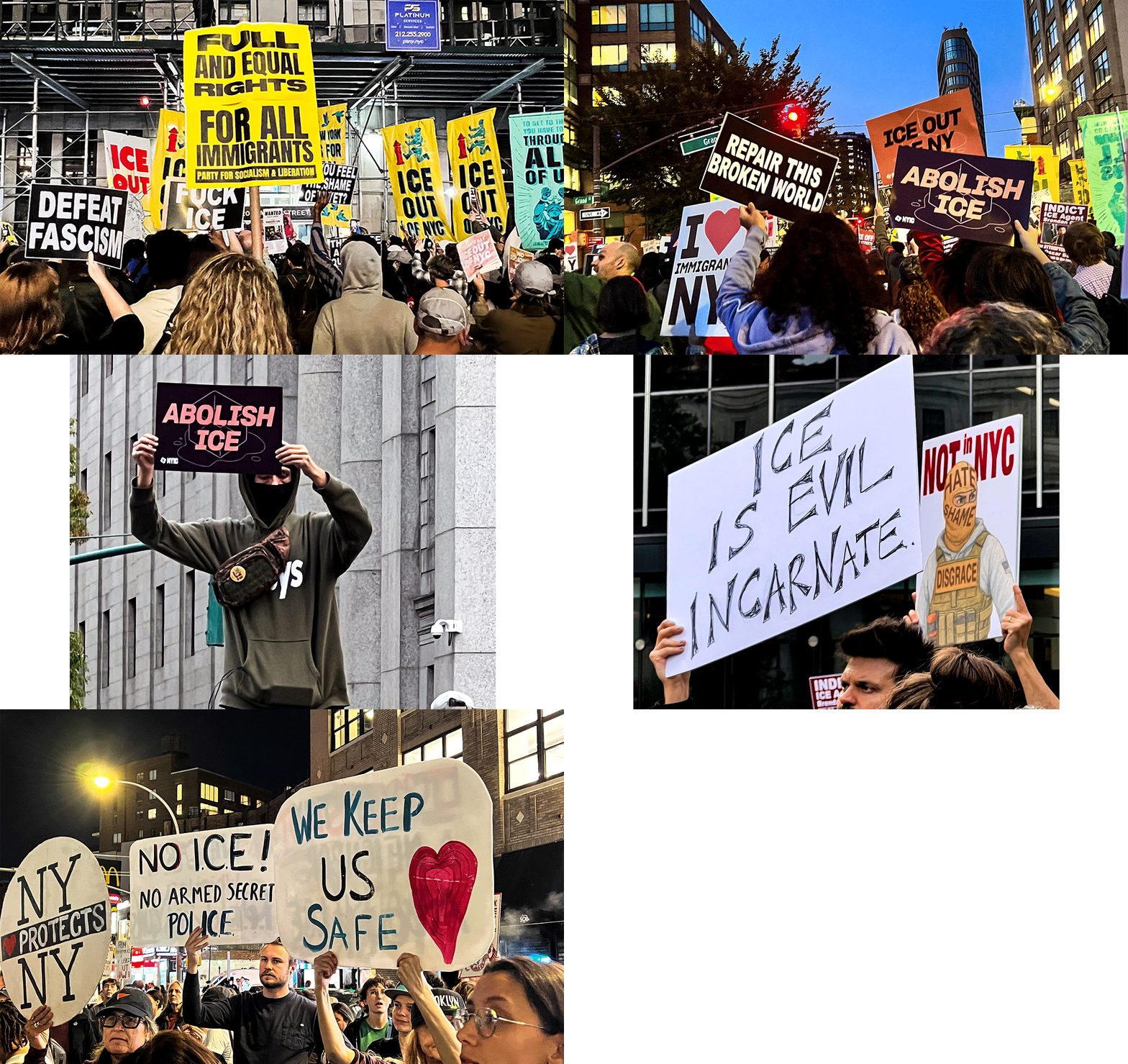
Abolish ICE Abolish ICE
Demonstrators take to the streets in protest against an ICE shooting in New York City. Foley Square, October 2026.
Mamdani Is Facing Heat Over the NYPD. Here’s What He Should Do. Mamdani Is Facing Heat Over the NYPD. Here’s What He Should Do.
The mayor is being given a series of false choices over his public-safety agenda. But there is another way forward.
Why Calling Anti-Trans Hate a “Distraction” Is So Troubling Why Calling Anti-Trans Hate a “Distraction” Is So Troubling
It’s a familiar line in the midterms: Anti-trans attacks are a “distraction” from “kitchen-table” issues. That sends a chilling message about whose rights are worth fighting for.
So What Is Socialism, Anyway? So What Is Socialism, Anyway?
In a world dominated by neoliberal market fundamentalism, “socialism” is what will make a more moderate, regulated form of capitalism work for most people.
Will the GOP’s Big Money Save Jon Husted in Ohio? Will the GOP’s Big Money Save Jon Husted in Ohio?
Former senator Sherrod Brown is leading in most polls, but a tidal wave of spending may prop up the struggling incumbent.

