How to Vote for a Cease-Fire
A guide to voting “Uncommitted.”
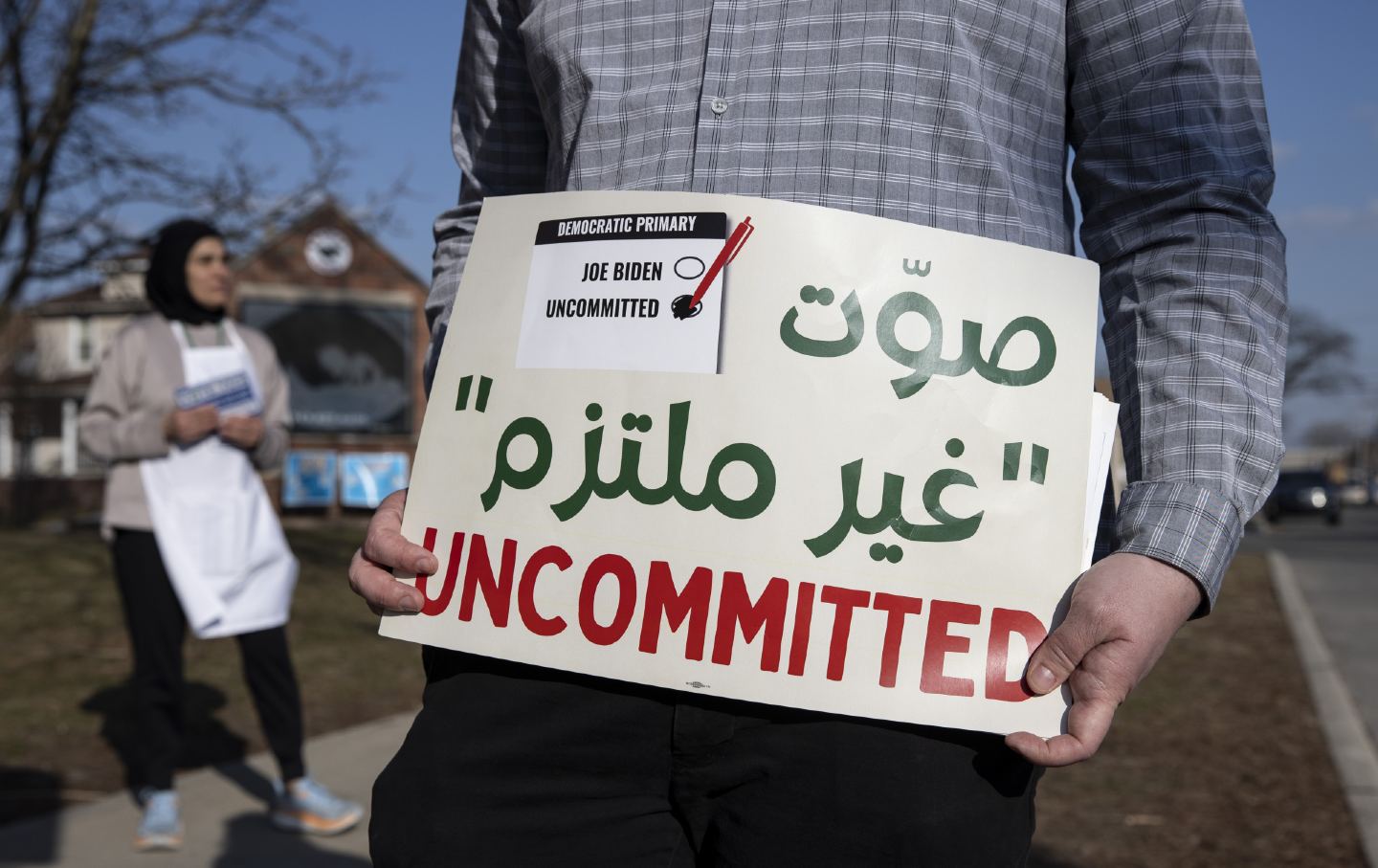
The presidential rematch is now official. Since the Georgia, Washington and Mississippi primaries on March 13, both President Joe Biden and former president Donald Trump have accumulated outright majorities of each of their party’s total delegates, ensuring that they will both be on our ballots in November (barring unforeseen events, which given the ages of both men can’t entirely be ruled out). But presidential primaries continue to occur—and are by no means irrelevant for those seeking to register their discontent with Biden’s Gaza policy. We’ve seen the impact that a robust “Uncommited” vote in just the first half of these races has already had on the administration’s words and deeds, moving the White House from a full-body hug of Netanyahu to talk of a cease-fire and the need for a Palestinian state. It’s our task to make sure that momentum is sustained—to send a message, end a war, and save a presidency from itself. Here’s how those who live in upcoming primary states can do so.
April 2: Connecticut, Rhode Island, Wisconsin, New York
This set of upcoming contests will be some of the last Democratic primaries to be held in, well, a set. Going forward, most will be held on their own days—which has resulted in decreased coverage over the past few weeks. This makes these contests particularly crucial, which is a good thing, as they collectively present very potent opportunities for the uncommitted movement. All except New York will have an uncommited option on the ballots outright, and there are reasons to expect it to do well in each of these states. This is especially the case in Wisconsin. But things could be choppier in the Acela corridor states, which historically have been more right-leaning in Democratic primaries—however there’s always room for a surprise.
Vote uncommitted if you’re Connecticut, Rhode Island, and Wisconsin (where it’s called “unrestricted delegation”). If you’re in New York State, vote blank—it will be counted.
April 6: Alaska
Only a few days after Wisconsin and the Acela corridor comes Alaska, where uncommitted will also be on the ballot. It stands to do well with the state’s historically progressive Democratic primary electorate. Vote for it if you’re there—just keep in mind that it’s called “undeclared” on the ballot.
April 13: Wyoming (Caucus, Called “Undeclared”)
A week after Alaska will be Wyoming, another sparsely-populated western state with progressive tendencies in past primaries. Like Alaska, it will be referred to as “undeclared” on the ballot.
April 23: Pennsylvania
Voting by itself later in April will be the Keystone State, where neither “uncommitted” nor the pro-cease-fire Marianne Williamson will be available options. Given that blank ballots are historically not counted in the state, this presents something of a bind to those in the state wishing to cast protest votes. Right now, there is an organization called UncommittedPa calling on people to write-in “uncommitted” on their ballots. Whether or not these votes will be counted is not clear, but local reporting has indicated that the group is contacting election officials to ask them to allocate the ballots.
April 28: Puerto Rico
“Uncommitted” will not be an option in the overseas territory of Puerto Rico. Since the island has counted blank ballots in past primaries, that is the best option available.
May 7: Indiana
While Indiana has not officially canceled its primary, Biden is the only name on the ballot, and write-ins are not available. The state has not counted blank ballots in the past, and there are currently no in-state protest efforts that have endorsed that method, or any other, in the state.
May 14: Maryland, Nebraska, West Virginia
In Maryland, another Acela corridor state, voters will be able to vote “uncommitted.” Nebraskans and West Virginians will not have that option, nor will they have the Williamson on their ballots. There are currently no organized protest vote campaigns organized in either state, and it is not clear if either will count blank ballots. Voting for Dean Phillips or another non-Biden candidate may be worth it in these states unless it becomes clear that they do count blank ballots in their totals.
May 21: Kentucky, Oregon
Kentucky voters will have an “uncommitted” option on their ballots. Oregon voters do not, but the state has historically counted all write-ins cast in its elections. These votes are usually piled together as a single group, so whoever or whatever you write-in won’t matter, although simply writing in “uncommitted” might be the clearest way to connect your vote to the rest of the movement. Currently, there are not any organized protest voting efforts in the state endorsing one manner of write-in over another.
May 23: Idaho (Caucus)
Voters who show up for Idaho’s caucus will be given an “uncommitted” option.
Popular
“swipe left below to view more authors”Swipe →June 4: Montana, New Jersey, New Mexico, District of Columbia, South Dakota
Montana, New Jersey and New Mexico voters will be able to vote uncommitted in their June primaries, although the option will be referred to as “no preference” in Montana. Washington, D.C., voters will not have such an option, but write-ins will be counted in a manner similar to Oregon’s. South Dakota will not have an “uncommitted” option and has not historically counted blank ballots, but does include the pro-cease-fire Williamson among its listed candidates.
June 8: Virgin Islands, Guam
Voters in the Virgin Islands will be able to vote “uncommitted.” Candidate availability in Guam is still not decided as of the time of writing for this article.
Support independent journalism that does not fall in line
Even before February 28, the reasons for Donald Trump’s imploding approval rating were abundantly clear: untrammeled corruption and personal enrichment to the tune of billions of dollars during an affordability crisis, a foreign policy guided only by his own derelict sense of morality, and the deployment of a murderous campaign of occupation, detention, and deportation on American streets.
Now an undeclared, unauthorized, unpopular, and unconstitutional war of aggression against Iran has spread like wildfire through the region and into Europe. A new “forever war”—with an ever-increasing likelihood of American troops on the ground—may very well be upon us.
As we’ve seen over and over, this administration uses lies, misdirection, and attempts to flood the zone to justify its abuses of power at home and abroad. Just as Trump, Marco Rubio, and Pete Hegseth offer erratic and contradictory rationales for the attacks on Iran, the administration is also spreading the lie that the upcoming midterm elections are under threat from noncitizens on voter rolls. When these lies go unchecked, they become the basis for further authoritarian encroachment and war.
In these dark times, independent journalism is uniquely able to uncover the falsehoods that threaten our republic—and civilians around the world—and shine a bright light on the truth.
The Nation’s experienced team of writers, editors, and fact-checkers understands the scale of what we’re up against and the urgency with which we have to act. That’s why we’re publishing critical reporting and analysis of the war on Iran, ICE violence at home, new forms of voter suppression emerging in the courts, and much more.
But this journalism is possible only with your support.
This March, The Nation needs to raise $50,000 to ensure that we have the resources for reporting and analysis that sets the record straight and empowers people of conscience to organize. Will you donate today?