Faiz Shakir’s Late Entry Shakes Up the Race for DNC Chair
The strategist who managed Bernie Sanders’s presidential race says the party needs vision and conviction “to restore a deeply damaged Democratic brand.”
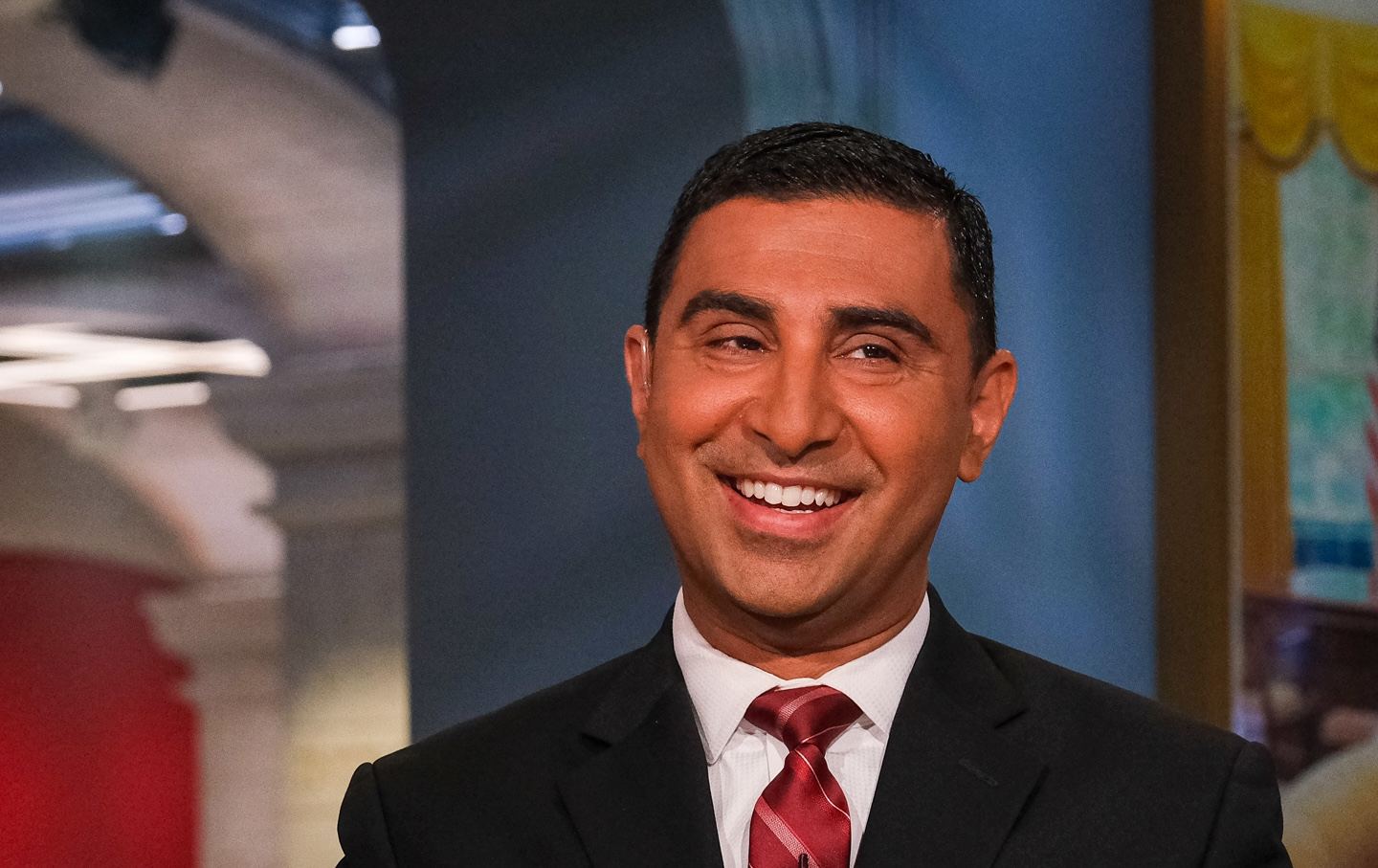
Faiz Shakir appearing on Meet the Press in 2023.
(William B. Plowman / NBC via Getty Images)Before this week, the hotly contested race for chair of the Democratic National Committee looked as if it had settled into a reasonably well-defined matchup between a pair of experienced front-runners—Wisconsin Democratic Party chair Ben Wikler and Minnesota Democratic-Farmer-Labor Party chair Ken Martin—and a half-dozen minor contenders, including former Maryland governor and 2016 presidential candidate Martin O’Malley and 2020 and 2024 presidential candidate Marianne Williamson.
But, with just two weeks to go before the February 1 vote, the contest took a major turn Wednesday, with the late-stage entry of one of the biggest names in progressive political organizing, Faiz Shakir, a senior adviser to Vermont Senator Bernie Sanders who managed Sanders’s 2020 presidential bid after serving as political director of the American Civil Liberties Union, editor in chief of the influential ThinkProgress website, and a key aide to both Nancy Pelosi, the former Democratic speaker of the House, and Harry Reid, the former Democratic Senate majority leader.
Shakir said he entered the competition—which will install a key leader for the party as it reels from the loss of the White House and Congress in the 2024 election—because he was frustrated with the “lack of vision and conviction for what to do to restore a deeply damaged Democratic brand.” In a letter to DNC members, he wrote, “As I have listened to our candidates, I sense a constrained, status-quo style of thinking. We cannot expect working-class audiences to see us any differently if we are not offering anything new or substantive to attract their support.”
In an interview with the Associated Press, Shakir went further, saying of the race, “It feels very fluid to me, based out of a lack of energy and a sense of aimless drift that people are feeling. Democrats are in the wilderness, right? There’s no real leader.”
The other candidates, most of whom have talked about renewing the party’s appeal to traditional Democratic voters who moved toward Donald Trump and the GOP in the 2024 election, will surely disagree with Shakir’s assessment of their bids. Wikler, in particular, has placed a heavy emphasis on appealing to union members and the broader working class, arguing,”On every platform, voters need to hear that Democrats are on the side of working people and Republicans are on the side of the billionaires trying to rig our economy for themselves.”
But Shakir has a history of urging Democrats to make their party more aggressively progressive and populist. The founder of the More Perfect Media project, which has earned high marks for its messaging to disenchanted working-class voters of all races and backgrounds, he has strong ties to many of the nation’s leading labor leaders and progressive activists. Now, as a candidate for party chair, he is making a blunt argument that the DNC must develop “its own powerful media outlet, doing compelling original content in different video, text and graphic formats” and create “an organizing army which lends support to striking and organizing union and non-union workers” in order to renew itself. Shakir also brings to the competition a stark critique of the much-maligned Democratic strategy of having 2024 party nominee Kamala Harris campaign alongside former Republican US representative Liz Cheney and billionaire Mark Cuban.
Shakir acknowledged to The New York Times Wednesday that his entry comes “late in the game.” Many observers believe that Martin, the current president of the Association of State Democratic Committees and a sitting vice chair of the DNC, has opened a lead with the 448 DNC members. He has also attracted support from influential United Food and Commercial Workers union leaders who sit on the DNC. In a sign of his perceived strength, one of the most engaging candidates for chair, New York state Senator James Skoufis, announced on Thursday that he was quitting the race to back Martin.
At the same time, Wikler has been attracting high-profile endorsements from liberal Democratic senators such as Chris Murphy of Connecticut and Tammy Baldwin of Wisconsin, and Democratic “stars” such as Michigan state Senator Mallory McMorrow, former Georgia gubernatorial candidate Stacey Abrams, and North Carolina Democratic Party chair Anderson Clayton—along with powerful party figures such as Senate Democratic leader Chuck Schumer. The Wisconsinite has also been endorsed by activist groups such as MoveOn and the Progressive Change Campaign Committee.
But even if he may be coming from behind, Shakir’s candidacy should ensure that the chair’s race will be more sharply focused on ending the DNC’s deference to economic elites—a bedrock concern for Shakir, who has worked as a senior adviser for the anti-monopoly agitators at the American Economic Liberty Project. The prospect of that bolder debate about the direction Democrats will take excites some of the most dynamic figures in the party. Sanders has not made an endorsement in the race yet. But Sara Nelson, the president of the Association of Flight Attendants union and a popular figure among progressive Democrats and labor activists, announced, “I am proud to endorse Faiz Shakir as Chair of the Democratic National Committee. Faiz not only has the right working class credibility, vision, and insight for this moment, but he also has the vast experience needed to operate and rebuild the DNC.”
“The party is at a critical moment, and we need to embrace changing status quo. Faiz’s vision and conviction is clear: use the authority and resources of the DNC to build power for working people—the promise of America,” added Nelson, who argued that Shakir “is the leader the party needs at this moment.”
Become a Sustaining Donor This September
Between the reemergence of right-wing red-baiting and Donald Trump’s use of the chilling National Security Presidential Memorandum–7 to criminalize left political organizing, we’re seeing McCarthyism reborn before our eyes.
This assault on democracy cannot be ignored or wished away. Resisting it requires bravery in the face of threats and repression, a steadfast commitment to the truth, and the unwavering belief that we can—and will—overcome this darkness.
We must have an independent media that sets the record straight, unearths corruption and abuses of power, and advances a politics of justice and dignity for all if we’re to win this fight.
That’s why I’m writing to you today. This September, The Nation needs to add 100 monthly donors to sustain our progressive journalism. Your contribution makes the next investigative report, the next truth-speaking column, and the next pathbreaking essay all possible.
I hope you’ll support our work with a recurring donation today. If you donate $10 or more a month, we’ll send you a brand new “Hands Off the Free Press!” sticker to recognise your commitment to our cause. Please, donate today.
Onward,
Katrina vanden Heuvel
Editor and Publisher, The Nation