The Speech That Brought the Class War to the DNC
John Russell told Democrats that they must “create a political home for working Americans fighting for control over their government, their workplaces, and their planet.”
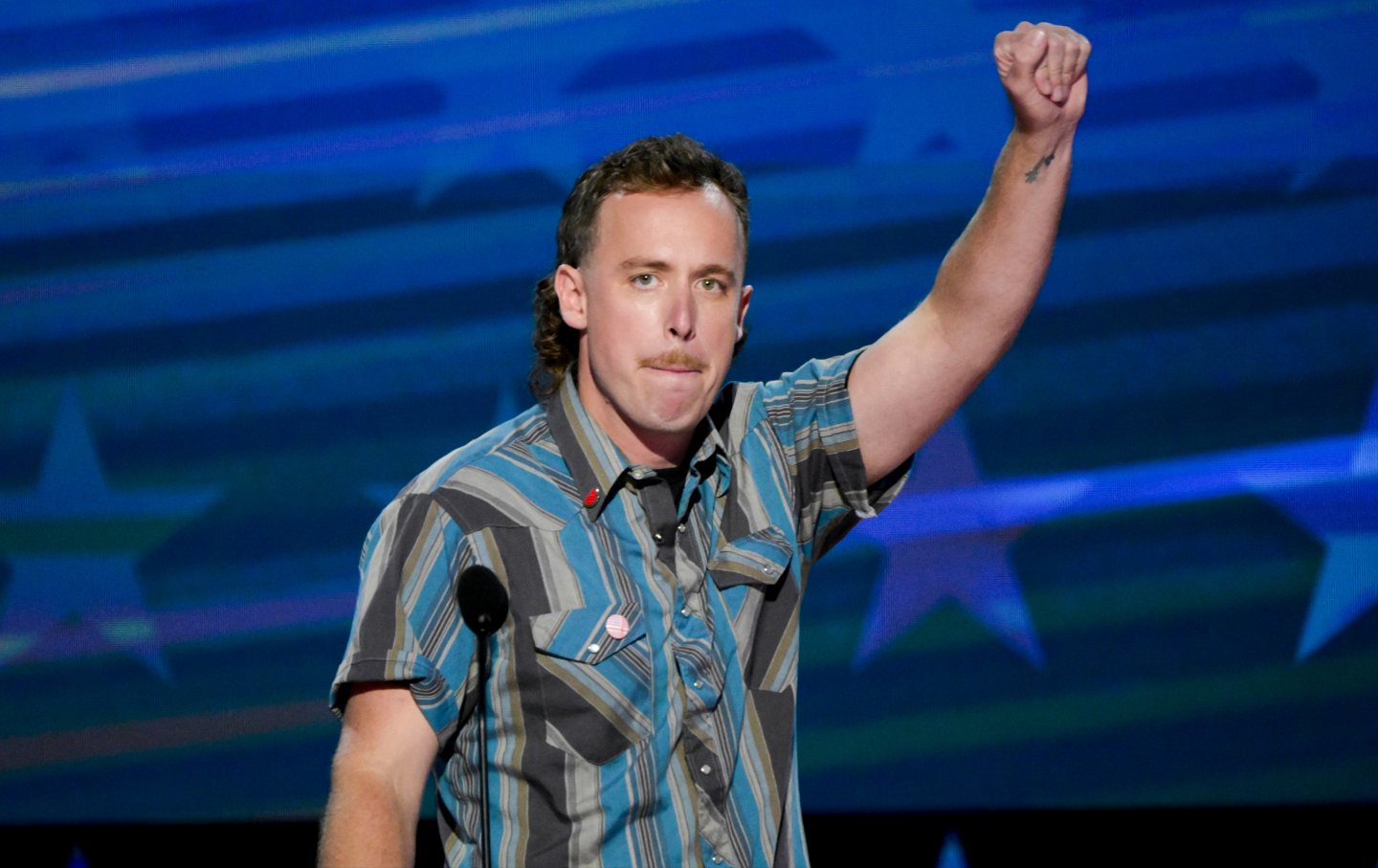
John Russell during the Democratic National Convention at the United Center in Chicago on Thursday, August 22, 2024.
(David Paul Morris / Bloomberg via Getty Images)Last week’s Democratic National Convention featured a fair share of compelling speeches—including important addresses from figures as distinct as US Representative Alexandria Ocasio-Cortez, US Senator Bernie Sanders, and United Auto Workers Union President Shawn Fain, all of whom spoke about the vital need for a politics that raises up workers and their unions rather than billionaires and their profiteering. But the speech that I keep coming back to was a two-and-a-half-minute address on the final night of the convention by Appalachian populist John Russell, who called on the party “to create a political home for the mass of working Americans fighting for control over their government, their workplaces, and their planet.”
Russell’s speech was an outlier. It did not dwell on the candidacies of Democratic presidential nominee Kamala Harris and vice-presidential nominee Tim Walz. It did not even namecheck the Democratic Party, which had convened in Chicago on the eve of a fall campaign that will pit Harris and Walz against a Republican ticket led by alleged billionaire Donald Trump and Yale-educated former venture capitalist JD Vance. Instead, Russell tapped into a deeper, more enduring political vein—the long history of class struggle in the United States.
“I come from Appalachia,” declared Russell, a former farmer and congressional candidate who now writes, as a self-described “dirtbag journalist,” about “class politics for rednecks and hippies” in his popular Substack newsletter, The Holler. “We kept the lights on in this country for generations. But the wealth made by our broken backs and our black lungs never did trickle down. And Washington listened to rich men demanding that we stick with dirty energy at any cost.”
Russell also works as a reporter with the More Perfect Union project, which recently received two Emmy Award nominations for its reporting on issues of concern to America’s multiracial and multiethnic working class, and which produced a video on how infrastructure projects benefit workers and the environment that was shown Thursday night. After the video finished, Russell strode to the same podium from which former, current, and possibly future presidents had addressed the delegates.
“Across the country, working-class people are looking for a political home, after years of both parties putting profit above people,” Russell proclaimed, as cheers rose from the arena, which packed to the rafters in anticipation of Harris’s acceptance speech. “Now Trump, a billionaire, says that he’ll take on the elites. But then he promises handouts to Big Oil and he punches down at anyone with the guts to be different. But populism that insists we are too different to get along is just divide-and-conquer by a different name.”
Russell was not satisfied, as many of the other speakers were, to simply decry the cruel cynicism of the Trump-Vance ticket. Instead, he proposed an alternative to the GOP’s fake populism, which is being peddled this year by a child of privilege from New York and a millionaire senator whose fortune was made in the tech vineyards of California before he earned prominence as the author of a book that trashed struggling low-income families in Appalachia.
“There’s another sort of populism, with roots in this party, that we—in West Virginia—know well. They called us ‘rednecks’ back in the 1920s, because striking workers from all different races wore red bandanas around their necks as they fought and died for respect and a living wage,” Russell said, with a nod to members of the West Virginia delegation, who understood the history of the workers who struggled to organize the United Mine Workers of America union in the face of violent oppression by mine owners and their paid thugs, as well as the corrupt sheriffs of southern West Virginia. Today, the West Virginia Mine Wars Museum, in Matewan, recalls the red bandanas worn by miners who joined “the militant labor union movement in the central Appalachian coalfields over a century ago: rooted in the dress of the +10,000 multiethnic striking coal miners who joined the armed march that erupted into open conflict on Blair Mountain in August of 1921.”
The “Battle of Blair Mountain” has been described in a Smithsonian magazine essay as “the largest labor uprising in American history,” and its economic, cultural, and political influence reverberates to this day. Earlier this year, Christopher Williamson, the assistant secretary of labor for the Mine Safety and Health Administration, recalled the “many miners—Black and white—who died on Blair Mountain trying to organize and support other miners,” and wrote of how “white and Black miners stood side-by-side at Blair Mountain in their fight to unionize the southern West Virginia coalfields.”
In that battle, explain the curators of the museum (which is located in the former United Mine Workers of America Local 1440 hall in Matewan), “coal miners tied commonly-available red bandanas around their necks, a critical battlefield signifier that showed who was on their side. These workers fought a guerrilla war in the mountains against a well-armed vigilante army led by a regional ruling class in the pocket of the coal industry. Those fighters wore white armbands, and they called the miners who had picked up rifles to fight for their basic human rights ‘rednecks’ because of their red bandanas.” Today, the museum sells hand-printed red bandanas “as a symbol of identity reclamation for Appalachians, and as a powerful gesture of global solidarity with workers everywhere.”
John Russell, who has made a point over the years of drawing attention to the story of the red bandanas and of miners who risked their lives to build the UMWA, concluded his convention speech by linking the often-neglected history of working-class struggle with the contemporary pursuit of economic justice. “Their fight yesterday is our fight right now. It is our choice to build on this progress and to create a political home for the mass of working Americans fighting for control over their government, their workplaces, and their planet,” he told the convention. “And it is our moment to live up to. Let’s get after it.”
With that, a roar went up from the crowd of delegates, alternates and guests—from not just the West Virginians but also the Ohioans, the Pennsylvanians, the Wisconsinites, and union members and working-class delegates from across the country—because Russell, in barely two-and-a-half minutes, had shown Democrats how to counter Trump’s fake populism with a populism that speaks to our history and our future.
Grassroots Democrats get it, even if party leaders rarely do. But, this year, if Democrats want to win big—like Franklin Roosevelt did in 1936, when he announced that he welcomed the hatred of those who engaged in “business and financial monopoly, speculation, [and] reckless banking”—they will listen less to the predictable cadre of consultants, pollsters, and donors, and more to working-class advocates like Russell, who speak the justified and ancient language of solidarity.
Become a Sustaining Donor This September
Between the reemergence of right-wing red-baiting and Donald Trump’s use of the chilling National Security Presidential Memorandum–7 to criminalize left political organizing, we’re seeing McCarthyism reborn before our eyes.
This assault on democracy cannot be ignored or wished away. Resisting it requires bravery in the face of threats and repression, a steadfast commitment to the truth, and the unwavering belief that we can—and will—overcome this darkness.
We must have an independent media that sets the record straight, unearths corruption and abuses of power, and advances a politics of justice and dignity for all if we’re to win this fight.
That’s why I’m writing to you today. This September, The Nation needs to add 100 monthly donors to sustain our progressive journalism. Your contribution makes the next investigative report, the next truth-speaking column, and the next pathbreaking essay all possible.
I hope you’ll support our work with a recurring donation today. If you donate $10 or more a month, we’ll send you a brand new “Hands Off the Free Press!” sticker to recognise your commitment to our cause. Please, donate today.
Onward,
Katrina vanden Heuvel
Editor and Publisher, The Nation