
The Queer Progressives Helping to Pull Louisiana to the Left
The Pelican State might have a dearth of left-leaning political figures in office, but that doesn’t stop Davante Lewis and Mel Manuel from fighting for LGBTQ advocacy and economic justice.
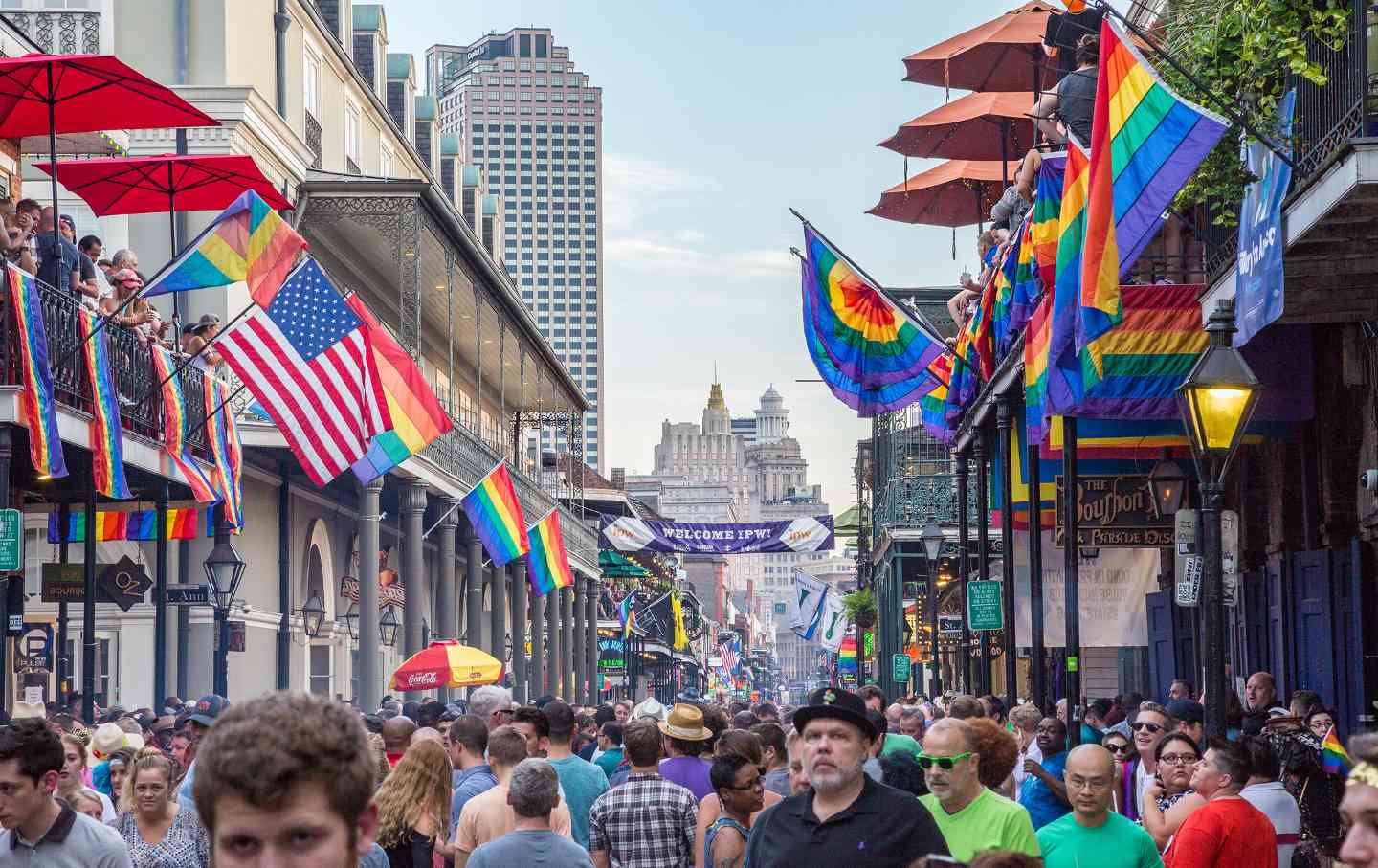
A pride parade in New Orleans, Louisiana.
(Tony Webster / Flickr)On a blistering June afternoon in small-town Abita Springs, Louisiana, local Democrats gathered for a meet and greet with candidates for governor and treasurer. While attendees mingled under the comfort of air conditioning, Mel Manuel sat outside the town hall talking about their congressional campaign for next year’s election.
Manuel, a nonbinary former public school teacher and cofounder of the local LGBTQ organization Queer Northshore, has taken an outsize role in progressive advocacy in St. Tammany Parish. They’re a member of the Democratic Parish Executive Committee and a spokesperson for the St. Tammany Library Alliance. Alongside other members of Queer Northshore, Manuel was present at the state capitol in Baton Rouge to protest the several anti-queer bills introduced in the legislature.
They’re running for the state’s first congressional seat, currently occupied by Republican House leader Steve Scalise. It’s a tall task, to be sure—especially in a majority-red district. In 2022, Scalise won with over 70 percent of the vote, beating Democratic candidate Katie Darling.
Despite the electoral challenges, their policies, ranging from economic issues to queer rights, are unflinchingly progressive. “Last summer, the calls to ban books started. I went to a library board meeting and the room was full of LGBTQ supporters. After that meeting, there were plenty of people who couldn’t believe there were so many queer people and allies in St. Tammany Parish; they thought we didn’t actually exist here. I realized that we’re invisible,” said Manuel. The experience in that meeting ultimately convinced them to run for office.
For Louisiana leftists and progressives, queer candidates like Manuel are a breath of fresh air. The Pelican State has a dearth of left-leaning political figures in office; Manuel and others like them are the very few in the state who work to fill in gaps for queer and economic justice.
“Individual LGBTQ leaders are playing a critical role right now, especially in very conservative states/cities. Our fight is for both visibility and representation and you can’t have one without the other,” said Jeremy Thompson, a cofounder of Queer Northshore alongside Manuel. Their presence in Louisiana politics is a welcome addition to the state’s organizing and advocacy infrastructure.
They are desperately needed for the Pelican State’s marginalized citizens, given the state of affairs for Democrats in power, who aren’t too concerned with advocating for progressive legislation. On June 1, the beginning of Pride Month, Louisiana House lawmakers advanced a pair of anti-queer bills to the Senate, including Republican Representative Dodie Horton’s “Don’t Say Gay” legislation, a harsher version of Florida’s infamous law. Six Democrats in the House—Roy Adams, Chad Brown, Mack Cormier, Kenny Cox, C. Travis Johnson, and Pat Moore—voted in favor. “In Louisiana, there are Democrats that have bought the lies being sold as part of this anti-LGBTQ agenda,” said Thompson.
“At this point, [Louisiana Democrats] are the more moderate wing of the state Republican Party,” said John Lewis, the outgoing chair of the Baton Rouge Democratic Socialists of America (DSA). With each session, John’s assertion seems increasingly true; during a summer session, eight Democrats from both chambers were among those who successfully voted to override Governor John Bel Edwards’s veto on a bill banning gender-affirming care for minors, further endangering the lives of the children lawmakers are supposed to protect.
Queer representation is at the forefront of Manuel’s Democratic campaign. On their website, Manuel outlines the high stakes of queer issues in Louisiana and nationwide, including that queer youth are four times more likely to commit suicide thanks to immense levels of discrimination. If elected, Manuel wants to continue the work they’ve done through Queer Northshore in Congress: namely, providing queer people with vital, hard-to-obtain resources. “We’re increasing visibility in the community. We’re offering resources such as helping people find legal services, mental health services, or doctors they’d feel comfortable seeing,” Manuel said.
They are also a champion of unconditional universal basic income and single-payer health care. “In America, even though we are the wealthiest nation on Earth, life expectancy is going down, housing is becoming increasingly unaffordable, wages have stagnated since the 70s, the majority of American bankruptcies are the result of medical expenses, nearly 60 percent of workers live paycheck to paycheck, and nearly a quarter of Americans can’t afford prescription drugs,” reads Manuel’s campaign website. In St. Tammany, 14 percent of residents live under the poverty line, including 19 percent of children. Louisiana in general is among the poorest states in the Union, according to the Friends Committee on National Legislation.
“I want everyone in Louisiana to think, ‘Why do I bust my ass all day, every day and I’m barely getting by?’ Whatever your political leanings are, it shouldn’t be this way. We’re the wealthiest nation on Earth, we can take care of people,” Manuel said. In their eyes, establishing a single-payer healthcare system and a universal basic income system would help working-class people “thrive, not survive.”
Before heading back inside the town hall, Manuel expressed their understanding of the massive disadvantage they face against Scalise. “We don’t have the numbers to win. Katie Darling ran last time and she got about 25 percent of the vote. Even if your candidate doesn’t win, if we can move the needle to 35 percent or 40 percent of the vote, that means the next progressive candidate will get more funding,” said Manuel. “There’s a very, very small chance at winning, and I understand that, but we can still use the role of candidacy as a platform in and of itself.”
Popular
“swipe left below to view more authors”Swipe →Their campaign functions as a tool to build powerful voting coalitions and educate people on progressive issues, and while Manuel’s prospects for victory are very slim, they certainly have major potential to cause disruption in the district. Darling, a staunchly pro-choice candidate famous for a campaign ad showing her giving birth, garnered around a quarter of the vote in a conservative stronghold. With the help of Generation Z, the potential for a progressive coalition is alive in Louisiana.
Young people—especially young women, people of color and queer people—continue to vote overwhelmingly for Democrats. With millions more young people reaching voting age in 2024, making sure they’re registered to vote will be a crucial task for Manuel and other progressives. Polling numbers for establishment Democrats such as President Joe Biden suggest their presence isn’t the reason young voters are galvanized each election; instead, it’s progressives who push them to vote blue. They understand that young people, who’ve grown up around individuals from diverse populations and will have to endure the brunt of the climate catastrophe, want to see these issues directly addressed by their leaders.
While Manuel has to wait until 2024 for their race, another progressive in southeast Louisiana has already proven the left’s viability in Louisiana electoral politics. Public Service Commissioner Davante Lewis is a Democratic official countering the establishment’s messaging. In the December runoff elections, the long-time political activist defeated incumbent commissioner Lambert Boissiere, III, garnering 59 percent of the vote and becoming the first Black, openly queer statewide elected official. His renewable energy platform and his staunch opposition to large energy corporations have been crucial for a wetland state suffering heavily from climate change.
Since writer Grey Moran’s Nation profile in April, Lewis has been mapping out the blueprint for progressive political power in Louisiana. In his district, which encompasses pieces of parishes stretching from Baton Rouge to New Orleans, he’s been leading the battle against corporate utility titans such as Entergy, which made over $1 billion last year—while its customers are struggling to pay their bills. Entergy has profited off the recent hellish temperatures, leaving New Orleanians in particular with energy bills around 18 percent higher than the national average.
Lewis prides himself on being a “consumer advocate commissioner,” a personable regulator that puts people’s interest over the utility companies. He regularly engages with his district’s community through initiatives such as text updates and making his meetings closed-captioned. He attended STEM NOLA’s annual Rocket Day in order to “expose our youth to the pathways of opportunities in utilities and green energy.” His initiatives have paid dividends; according to him, people are more engaged now that the commissioner is willing to engage with them. He successfully put a face on an elected position that before him was obscure to the public, and yet paradoxically had substantial influence over the public’s utility costs.
“We’ve seen success in pushing back against utilities, making them have to answer [to their customers], not just their shareholders. We are starting to see the cracks of progress,” Lewis stated.
He’s involved with a community staple, New Orleans DSA, where he was the keynote speaker at its convention in June. He talked about his position as an openly queer progressive in statewide elected office, a rarity in the South. He’s contributed to New Orleans DSA’s “Make Entergy Pay” campaign, which demands that Entergy cancel all residential bill debts dating back to the pandemic and ban residential power cutoffs, or residents will stop paying their bills.
“His work is intentionally helping the average person who has exorbitant electric fees…making our public services better for everyone,” said Aspen Williams, a member of the New Orleans chapter.
Moving forward, Lewis looks to continue investing in a cleaner, more efficient future for Louisianians. For example, he’s pushing for better net-metering guidelines, ensuring constituents are adequately compensated for installing solar panels on their homes, and he’s spoken to the US Energy Secretary Jennifer Granholm and Treasury Secretary Janet Yellen on investments in renewable energy via the Inflation Reduction Act. Each will reduce energy costs for customers and provide better, cleaner energy to the energy grid.
Beyond his actions for climate justice, Lewis has used his platform as commissioner to advocate for social justice in Louisiana. His lawsuit against the state highlighted the racist redistricting efforts from Republicans, and now a similar case has produced a positive Supreme Court decision in Alabama. On multiple occasions, he’s made impassioned pleas to Senate committees, asking them to protect Black voting power by creating two majority-Black districts and protect the rights of queer citizens.
“I came here earlier this year pleading the same thing: see me because I’m Black, and this body said no…. In this session, you come back, and you’re attacking me again. So, when I say it’s hateful, that’s what I mean, because your words don’t matter,” said Lewis during the June 1 Senate Education Committee session discussing Horton’s Don’t Say Gay bill. “Recognize that you see me, and you hear me, and that you won’t use policy as a violence tool, as it has been used every step of the way in American history.”
This is progressive political power in motion: constant, relentless engagement and advocacy for the electorate, fighting against the exploits of wealthy corporations and the social injustices committed by the major political parties. “What [the people] expect me to do is never lose sight of them, never lose sight of what you’re fighting for,” Lewis said. This power doesn’t have to just exist in New Orleans or be pursued in St. Tammany Parish; intersectional justice can be brought to all corners of the state.
Meaningful coalition building—strong enough to truly aim for greater electoral heights—is within reach. Voting trends are in favor of progressivism, and with Louisianians like Manuel and Lewis running for office, a better Pelican State may be on the horizon, after all. The political tides are turning in favor of the left, and those tides are finally reaching Louisiana’s Gulf shore.
Support independent journalism that does not fall in line
Even before February 28, the reasons for Donald Trump’s imploding approval rating were abundantly clear: untrammeled corruption and personal enrichment to the tune of billions of dollars during an affordability crisis, a foreign policy guided only by his own derelict sense of morality, and the deployment of a murderous campaign of occupation, detention, and deportation on American streets.
Now an undeclared, unauthorized, unpopular, and unconstitutional war of aggression against Iran has spread like wildfire through the region and into Europe. A new “forever war”—with an ever-increasing likelihood of American troops on the ground—may very well be upon us.
As we’ve seen over and over, this administration uses lies, misdirection, and attempts to flood the zone to justify its abuses of power at home and abroad. Just as Trump, Marco Rubio, and Pete Hegseth offer erratic and contradictory rationales for the attacks on Iran, the administration is also spreading the lie that the upcoming midterm elections are under threat from noncitizens on voter rolls. When these lies go unchecked, they become the basis for further authoritarian encroachment and war.
In these dark times, independent journalism is uniquely able to uncover the falsehoods that threaten our republic—and civilians around the world—and shine a bright light on the truth.
The Nation’s experienced team of writers, editors, and fact-checkers understands the scale of what we’re up against and the urgency with which we have to act. That’s why we’re publishing critical reporting and analysis of the war on Iran, ICE violence at home, new forms of voter suppression emerging in the courts, and much more.
But this journalism is possible only with your support.
This March, The Nation needs to raise $50,000 to ensure that we have the resources for reporting and analysis that sets the record straight and empowers people of conscience to organize. Will you donate today?
More from The Nation

An Argument Against Voting for the “Electable” Guy An Argument Against Voting for the “Electable” Guy
In this week’s Elie v. US, The Nation’s justice correspondent shares his thoughts on the Texas primaries. Plus, a terrible Supreme Court decision and a bad play by Major League Ba...

A Conflict Without Reason Has Become a Dangerous Holy War A Conflict Without Reason Has Become a Dangerous Holy War
Lacking a clear rationale for the attack on Iran, Trumpists are increasingly talking like crusaders.
RFK Jr.: America’s Snake Oil Salesman RFK Jr.: America’s Snake Oil Salesman
Raw truth: MAHA is NUTS.

The Unfathomable Toll of the Syrian Civil War The Unfathomable Toll of the Syrian Civil War
How to make sense of the 13-year conflict?
Celebrate Kristi Noem’s Firing. But Keep Protesting ICE. Celebrate Kristi Noem’s Firing. But Keep Protesting ICE.
Finally, someone in the administration is paying for their cruelty and incompetence.

