
Abdul El-Sayed Wants to “Throw Some Righteous Punches”
As the Democratic Party debates its identity, this progressive primary candidate and doctor is primed for a breakout moment in the race for Michigan’s Senate seat.
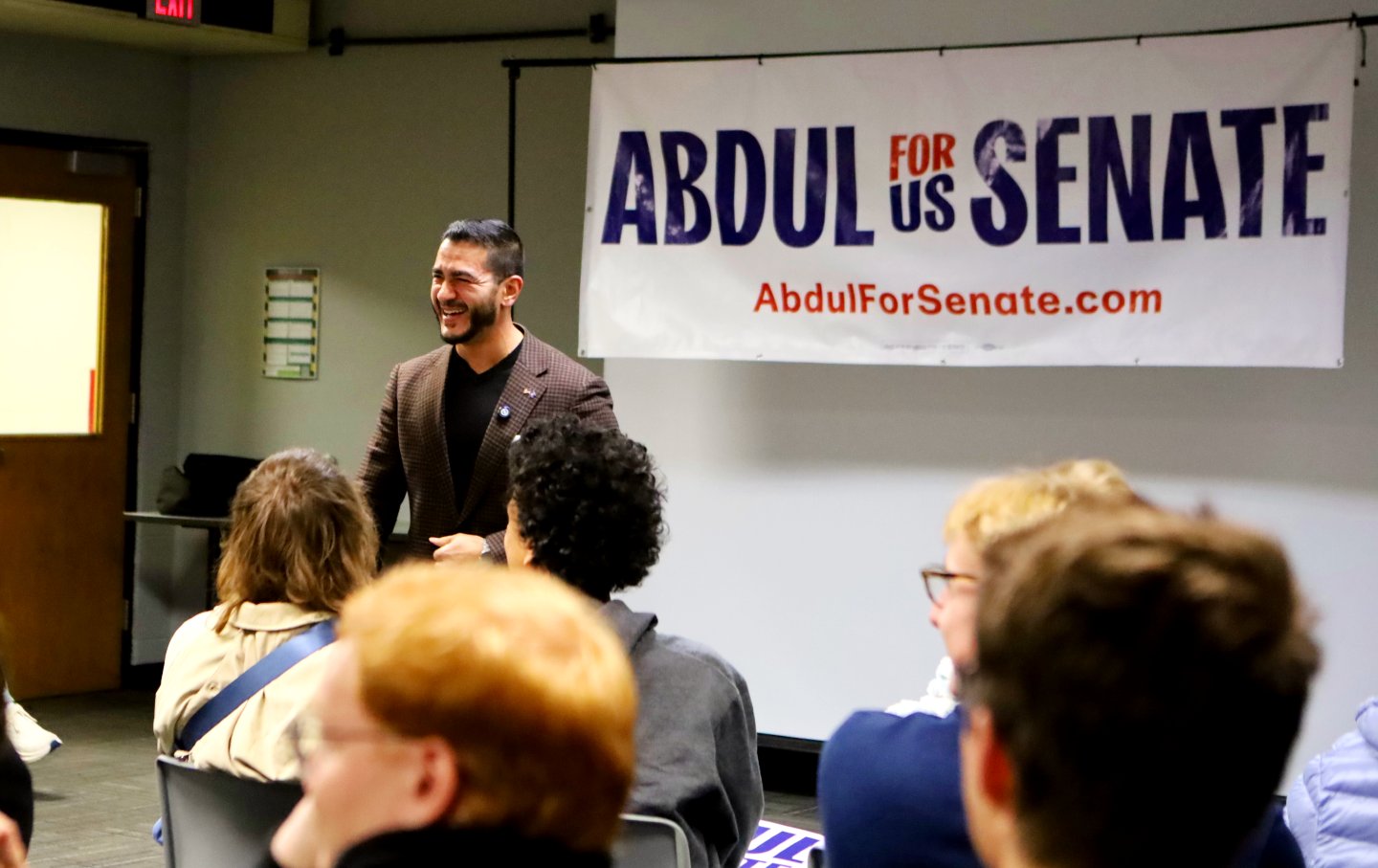
Abdul El-Sayed was only 32 when he first ran for office in 2018, facing off against Gretchen Whitmer and Shri Thanedar in the Michigan governor’s race. With a background as a public health official, he was a relative unknown to most voters. But by the time the primary election day rolled around, El-Sayed had surged in the polls, claiming just under a third of the vote.
His candidacy was defined by a progressive vision for America, centered on healthcare, public education, and fighting poverty—and bolstered by an endorsement from Senator Bernie Sanders. Now, eight years later, El-Sayed will be on the ballot again in 2026 in the primary for Michigan’s Senate seat.
Like in 2018, El-Sayed is one of several Democratic candidates, along with Representative Haley Stevens and state Senator Mallory McMorrow, vying to represent the party in November’s general election. Stevens, who has received support from the party establishment, is by far the most conservative, and McMorrow, whose policies fall somewhere in between Stevens and El-Sayed, is a rising star in her own right. While polling results show Stevens ahead, anything could happen with much of the race yet to come.
The election comes at a moment when the Democratic Party is debating its identity, and El-Sayed is primed for a breakout moment. Unabashed on his stance about Palestine, ICE, Medicare for All, and getting corporate money out of politics, he has fired up a younger voter base in Michigan. Those issues, after all, are what made him so compelling to voters the last time around.
“He’s the most person-forward and the least corporation-forward,” said Elisabeth Beer, a senior at the University of Michigan. Beer learned about El-Sayed through a friend and has since been collecting petition signatures for the candidate. Like several of the students I spoke to, she was drawn in by his support of Medicare for All.
“He’s been calling what’s happening in Gaza a genocide from very early on, and has been part of the pro-Palestine cause for decades now. A lot of people react very positively to that,” said Bill Lewis, a student at the University of Michigan and a student fellow for the campaign.
I spoke with El-Sayed about his Senate run, Trump’s attack on higher education, and how he’s reaching out to young voters this time around. This interview has been edited for length and clarity.
—Heather Chen
Heather Chen: Since 2018, the country has changed in many ways. We weathered the Covid-19 pandemic, faced the reckonings of the Black Lives Matter movement, and had four years of Joe Biden’s presidency before reelecting Donald Trump. How do you think the needs and priorities of young voters have changed since you last ran for office?
Abdul El-Sayed: They’ve just gotten more urgent. When I ran last time, I said something that folks weren’t quite ready to hear at the time, which is that Donald Trump himself is not the disease of our politics. He’s just the worst symptom of the disease. And the disease is the system that allows big corporations, billionaires, and would-be oligarchs to buy and sell politicians to do their bidding for them. And that system has been perpetuated.
For four years, we dealt with the symptom, but we never actually dealt with the disease, and we watch as life has gotten less and less affordable, particularly for young people. If you’re in college right now, you’re taking on a record level of student debt to graduate into an economy where Big Tech is on the verge of automating out the job you otherwise would have taken. You can’t dream of ever owning a home, and too often the social circumstances of your life are dominated by algorithms that steal your attention through your eyeballs and eardrums.
I think all of this has left people more lonely, more destitute, more frustrated, and priced out of the life that, in the American dream, we should be able to offer any young person thinking about their life in the future.
HC: You held 10 student town halls in 2025 at campuses across the state. Where did the idea for these events come from? And what have you learned from them?
AES: They’re essential to the way we do politics. It was really critical for us as we were building our campaign to go and listen to young people first, to engage them on the issues that are the most important in their lives, and to assure that they understood that we were there to listen and to learn and to share about what we could build together.
I’m never going to forget a conversation I had with Bernie Sanders back when I ran in 2018. I was 32 years old, mind you. I asked him for some advice, and he said, “Abdul, never lose touch with young people.” It was funny, ’cause I was like, “I am the young people.” But it reminds you why he’s been so relevant for so long, because he’s never really lost touch with young people. And so, to me, I see young people as being a foundational engine of this movement. And so it only made sense to start reaching out to them.
HC: Are there any conversations in particular that stick out as you reflect on these town halls?
AES: We always had folks who would come in a little bit late and they’d sit in the back. You could tell they were curious, and they weren’t fully bought in. And most of the time, I try to make an effort to go reach out to some of those folks right after the town hall to ask why they came. Most of the time, the answer is “I don’t really believe that any politician does what they say they’re gonna do, or has any solutions for me. But I was curious, my friends were excited about you, so I decided to come.” And I’ve had some iteration of that conversation in three or four different places.
There’s an overwhelming sense of nihilism that has taken hold in a lot of our communities, in particular among young people. One of the points that I often try to make to folks is that we may not solve all the problems, but the question of our lives is whether or not we tried. We’re trying to build something here that folks feel the righteous opportunity to try.
HC: You were previously a professor at Columbia’s Mailman School of Public Health. Last year, the Trump administration cut hundreds of millions of dollars in funding to the university, decimating many medical research labs. Given your background as a medical professional and as a professor, what role should research universities play in our nation?
AES: We assume, by virtue of our size and our power, that we are always gonna be on the leading edge of science, technology, and thought. And I think we take that for granted.
I think about my dad, who came to this country to pursue a PhD at Wayne State University. As a kid, growing up in a household of eight in a one-bedroom apartment, his ticket out was his ability to study and learn. He knew he wanted to be an automotive engineer, and in Michigan, Detroit was the best place to do that. He got the opportunity to come here and study for a PhD in Detroit, and went on to have an illustrious career as an automotive engineer, and now a professor. And that was a choice he made because of the investment, and the choice America made in being a leader.
We’re seeing the Trump administration rip us backward in a way that is only really, truly going to manifest in decades to come. It’s a pretty scary thing, you know, to think through what my dad’s decision would have been had he been thinking about in 2026 instead of 1978.
HC: What should our senators or congresspeople be doing to defend our universities?
AES: Well, it starts with having folks who understand how they work. I would be the first Democratic doctor elected since 1969. And as someone who began my career at a university, and understands the ways universities work, there’s a lot that we can do both to restore what has been broken, but more importantly, actually, to think ahead for what needs yet to be done.
There has been a certain set of inefficiencies that have set in around agencies like the NIH and what they fund, or NSF and what they fund, and universities and what they prioritize. In some respects, they sort of failed to make sure that they can offer a great research and educational product that everybody can access. So the mistake would be to try and rebuild this system exactly as it was. The silver lining is that while I very much would have liked to reform, now we have the opportunity to rebuild.
So what is it that we’re trying to rebuild? That every young person, anywhere in this country, can have access to these incredible institutions, and that they can afford them, that they’re actually building for the jobs and the opportunities we have tomorrow, and that they are leading when it comes to big ideas and research and development.
HC: Despite the majority of high schoolers not being able to vote, many of these students across the country and also in Michigan, are politically vocal and active. This week, for example, your campaign announced its high school leadership program. How did you engage with politics when you were in high school, and what did that political journey look like for you?
AES: You know, to be honest, when I was in high school, I was thinking about sports and then begrudgingly thinking about math and science—only because my parents basically told me that if my grades weren’t good enough, that I wasn’t gonna get to play. I got into politics kind of by happenstance because of 9/11. All of a sudden, I went from being a darkly complexioned kid with a funny name to being a very particular kind of darkly complexioned kid with a very particular kind of funny name.
I was a junior in high school when 9/11 happened, and I got a lot more involved in college around advocacy for democracy, standing up to the insane wars that launched when I was a senior in high school, and advocating for freedom of speech. And then I remember being in medical school when President Obama was elected and being just so proud that I’d been able to cast my vote for someone else with a funny name whose family had come from Africa.
I’d never really wanted to be a politician. That was not part of what I saw myself doing. I wanted to be a surgeon, and I wanted to work between urban communities in America and sub-Saharan Africa. Clearly, I’ve failed miserably at doing that. But, at some point, you get curious about why people get sick in the first place, which led me down this path in public health and, ultimately, to running for office.
HC: Young people came out in droves—both over the summer and in November—to help elect Zohran Mamdani as New York City’s mayor. Some people, on social media and in the press, have compared you to Mamdani. How do you feel about that comparison?
AES: I wonder why they would compare us? [Laughs] Look, the movement that was built in New York City was impressive, and, most impressively, they were able to bring out young people to vote at higher proportions than their elders. That’s not something most political movements are able to do, and we’re aiming to do exactly the same thing. I want to fundamentally rebuild the electorate, so that young people come out and take a stake in the future that they want for themselves—a future that they see in this movement.
HC: You’ve also made appearances on podcasts or with political influencers like Hasan Piker, who is popular with a lot of young people. What can the Democratic Party learn from him and other party outsiders?
AES: Last winter, as we moved out of 2024 into 2025, there was this big debate among Democrats about why we don’t have a Joe Rogan of the left. And it’s funny because we are, on the left, so censorious of ideas that we would stifle the Joe Rogan of the left before the Joe Rogan of the left ever showed up.
I think the reason that folks like Hasan resonate with young people is because he openly rejects that censoriousness. He knows that some of the things that he’s saying may not actually prove out in the future, but if you want to have an open dialogue of ideas, I think for young people, they’re sick and tired of being framed in boxes, or told that some ideas aren’t worthy of conversation. That’s probably why he resonates.
Now, you’re never gonna agree with anybody about everything. I’ve been married for 20 years and my wife is the love of my life, but we don’t agree on everything. This notion that, somehow, if there’s something that somebody said that you disagree with, that you cannot possibly listen to what they have to say, or appear with them, is part and parcel of the kind of ideology that people have just been so sick and tired of among Democrats.
I don’t have to agree with somebody on everything to be able to connect with them or have a conversation with their audience. And I think that if Democrats did more of that, having conversations anywhere and everywhere, reaching out to folks who have felt left out of our politics, who may be engaged on different platforms, I think they would be a lot more successful.
Popular
“swipe left below to view more authors”Swipe →HC: Voters tend to expect some sort of waffling from politicians when it comes to divisive issues, but, in contrast, you’ve used the word “genocide” to describe what’s going on in Palestine and Gaza. And, more recently, you’ve stood by your previous statements calling for the abolition of ICE. How intentional is that choice in language? And what do you see as the value of taking an unambiguous stance?
AES: You know, the frame of the question you’re asking implies that I’m making political calculations. And that’s just it—I’m not. I’m trying to call things how I see them, and predict how they’re gonna end up, and call for the kind of intervention that prevents the worst from happening, or creates the opportunity for the best to happen.
I called it a genocide because that word has a meaning, and the circumstances met that meaning. And I called for the abolition of ICE because even back in 2018 you could see where this was going. When you create an agency and you allow it to flout the basic principles of our democratic republic and our Constitution, and you weaponize it against a very particular kind of people, where do you think that’s gonna go?
It’s interesting because folks are out there being like, “Well, then you must not believe in having a safe and secure border.” But, yes, I do. If you have a house with black mold in it, you’re not saying that you wanna be homeless; you just don’t want a house with black mold in it. ICE has been corrupted since the first Donald Trump administration. And what we’ve experienced now, what we’ve seen now, the shooting of a mom in the face by ICE, I hate to say it, but that’s a logical consequence of the trends that we have been seeing for eight years. We should have done something about it, and we still should.
I know that there’s gonna be a lot of politicians who hem and haw—who care more about their political future than they care about actually being morally correct—who will rush to this position now. But at the end of the day, for me, the value of running for office or holding office is to make what is right popular, not so that you can wait until what is right is popular.
HC: You’re currently in this competitive democratic primary where the other candidates are similar to you in age, and you’re all over two decades younger than the median age of a US senator. What do you think sets you apart from the rest of the field when it comes to meeting young voters where they’re at?
AES: Moral clarity. I’m not pulling my punches so I can get elected. I hope to get elected so that I can throw some righteous punches.
Support independent journalism that does not fall in line
Even before February 28, the reasons for Donald Trump’s imploding approval rating were abundantly clear: untrammeled corruption and personal enrichment to the tune of billions of dollars during an affordability crisis, a foreign policy guided only by his own derelict sense of morality, and the deployment of a murderous campaign of occupation, detention, and deportation on American streets.
Now an undeclared, unauthorized, unpopular, and unconstitutional war of aggression against Iran has spread like wildfire through the region and into Europe. A new “forever war”—with an ever-increasing likelihood of American troops on the ground—may very well be upon us.
As we’ve seen over and over, this administration uses lies, misdirection, and attempts to flood the zone to justify its abuses of power at home and abroad. Just as Trump, Marco Rubio, and Pete Hegseth offer erratic and contradictory rationales for the attacks on Iran, the administration is also spreading the lie that the upcoming midterm elections are under threat from noncitizens on voter rolls. When these lies go unchecked, they become the basis for further authoritarian encroachment and war.
In these dark times, independent journalism is uniquely able to uncover the falsehoods that threaten our republic—and civilians around the world—and shine a bright light on the truth.
The Nation’s experienced team of writers, editors, and fact-checkers understands the scale of what we’re up against and the urgency with which we have to act. That’s why we’re publishing critical reporting and analysis of the war on Iran, ICE violence at home, new forms of voter suppression emerging in the courts, and much more.
But this journalism is possible only with your support.
This March, The Nation needs to raise $50,000 to ensure that we have the resources for reporting and analysis that sets the record straight and empowers people of conscience to organize. Will you donate today?
More from The Nation

Trump’s War Is Destroying the Global Economy Trump’s War Is Destroying the Global Economy
Spiraling financial chaos might be the only thing that can force the president to pull back from this conflict.

Make America Great Again Make America Great Again
Who are the immigrants?
OppArt / Anonymous and Peter Kuper
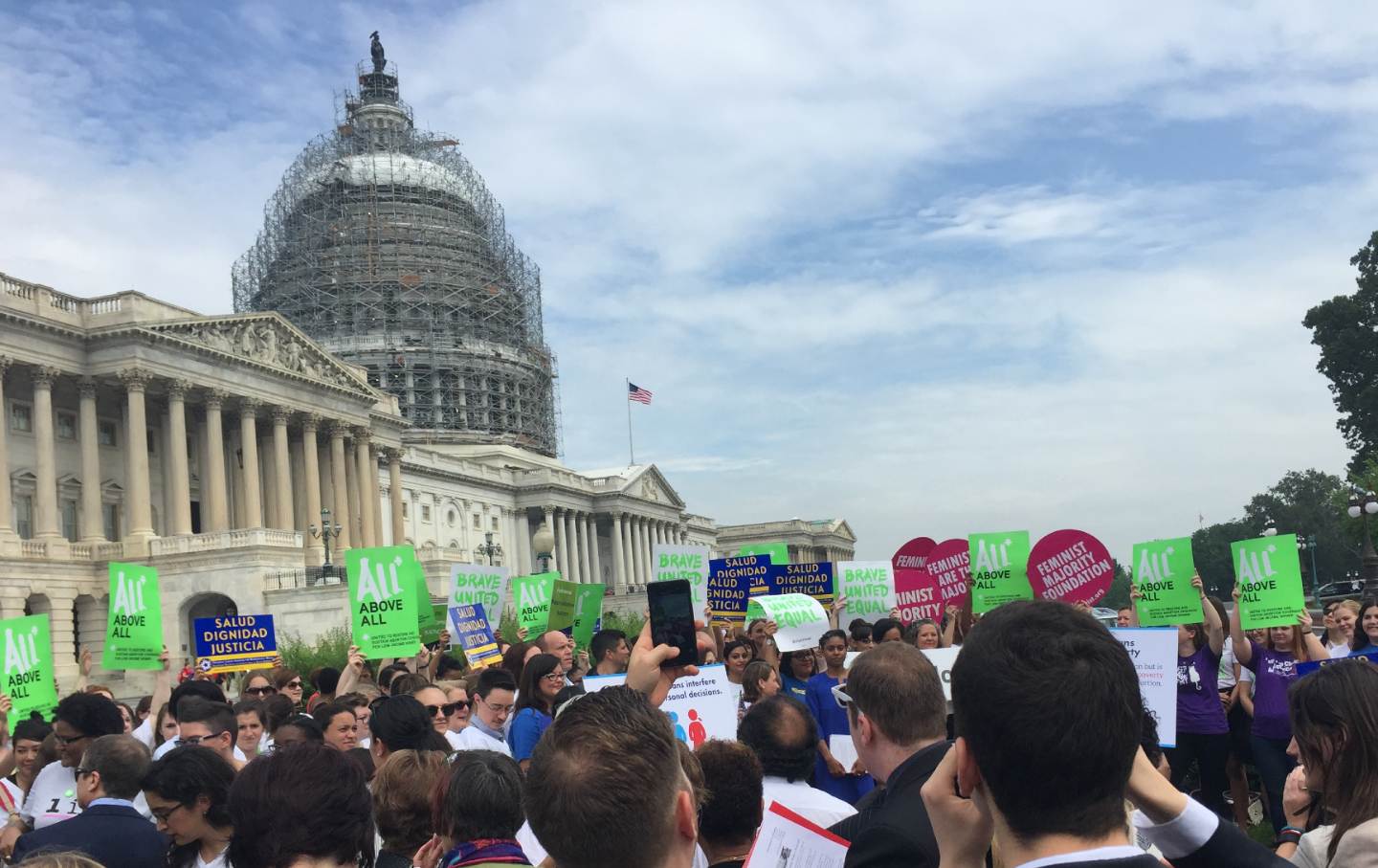
How the Abortion Rights Activists Found Their Radical Imagination How the Abortion Rights Activists Found Their Radical Imagination
A long-shot campaign to restore public funding for abortion turned into the movement’s biggest success in a generation.

An Argument Against Voting for the “Electable” Guy An Argument Against Voting for the “Electable” Guy
In this week’s Elie v. US, The Nation’s justice correspondent shares his thoughts on the Texas primaries. Plus, a terrible Supreme Court decision and a bad play by Major League Ba...

A Conflict Without Reason Has Become a Dangerous Holy War A Conflict Without Reason Has Become a Dangerous Holy War
Lacking a clear rationale for the attack on Iran, Trumpists are increasingly talking like crusaders.

