Our Back Pages / November 28, 2024

A 150-Year Critique of the Electoral College

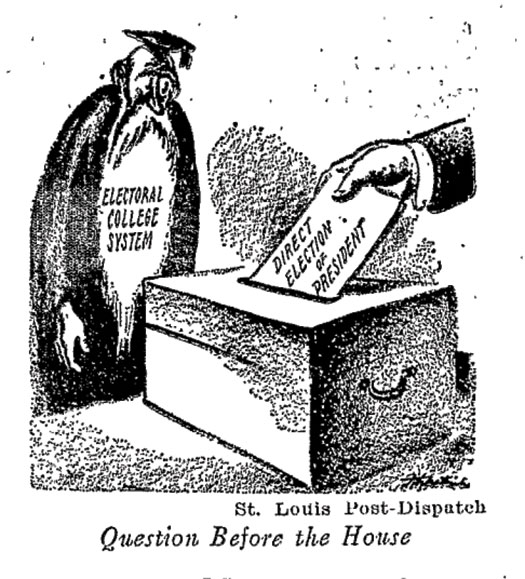
As far back as the 1870s, The Nation opposed the existence of the Electoral College as “so grotesque as to be almost ludicrous.”
Richard Kreitner

One of the many mysteries that future historians will have to try to explain as they mull what exactly befell the American Republic in the first quarter of this century is our failure to dismantle the decrepit piece of constitutional machinery known, bizarrely, as the Electoral College. Twice already, in 2000 and in 2016, a president was elected despite losing the popular vote—in the latter case, by nearly 3 million ballots. In 2020, the incredibly slow, needlessly complicated tallying of Electoral College votes left an opening for the defeated incumbent to launch an attempted coup d’état. The fact that this year’s gruesome election results spared us such a fiasco is a mighty slim silver lining.

As befuddled as future historians will be, Americans of the past would likewise be horrified to learn we let things go on this long. The Nation has opposed the Electoral College since at least 1876, when competing voter-fraud claims after the heated presidential contest between Rutherford B. Hayes and Samuel Tilden stalled the Electoral College count—and almost led to a second civil war. (Eventually, the crisis ended with a compromise that handed the victory to Hayes, a Republican, in exchange for his agreeing to sacrifice what remained of Reconstruction in the South.)

As the crisis unfolded, The Nation took aim, in an editorial, at the Electoral College. Its continued existence was “so grotesque as to be almost ludicrous,” the magazine said. While Alexander Hamilton had argued in The Federalist Papers that the system was designed to “afford as little opportunity as possible to tumult and disorder,” the Electoral College had never worked as intended. Instead, it had become a national embarrassment: Anyone looking for “a clear case of political sham and humbug,” The Nation argued, could “scarcely find a better instance in any country than the Electoral College of to-day.”

Fast-forward some 85 years, and The Nation was still singing the same song. After John F. Kennedy’s historically narrow 1960 victory, the veteran journalist Ted Lewis noted that a change of a few thousand votes could have swung the election to Richard Nixon. Observing that the close call had produced an “unprecedented public revulsion against the complicated electoral-college procedure,” Lewis warned that the institution would eventually have to be scrapped “when the nation, in some future Presidential election, finds its will has been thwarted to the point where it revolts against the results.” The national will has been thwarted twice since Lewis made that prediction—and still we wait for the revolt.

An urgent message from the Editors

As the editors of The Nation, it’s not usually our role to fundraise. Today, however, we’re putting out a special appeal to our readers, because there are only hours left in 2025 and we’re still $20,000 away from our goal of $75,000. We need you to help close this gap. 

Your gift to The Nation directly supports the rigorous, confrontational, and truly independent journalism that our country desperately needs in these dark times.

2025 was a terrible year for press freedom in the United States. Trump launched personal attack after personal attack against journalists, newspapers, and broadcasters across the country, including multiple billion-dollar lawsuits. The White House even created a government website to name and shame outlets that report on the administration with anti-Trump bias—an exercise in pure intimidation.

The Nation will never give in to these threats and will never be silenced. In fact, we’re ramping up for a year of even more urgent and powerful dissent. 

With the 2026 elections on the horizon, and knowing Trump’s history of false claims of fraud when he loses, we’re going to be working overtime with writers like Elie Mystal, John Nichols, Joan Walsh, Jeet Heer, Kali Holloway, Katha Pollitt, and Chris Lehmann to cut through the right’s spin, lies, and cover-ups as the year develops.

If you donate before midnight, your gift will be matched dollar for dollar by a generous donor. We hope you’ll make our work possible with a donation. Please, don’t wait any longer.

In solidarity,

The Nation Editors

Richard Kreitner

Richard Kreitner is a contributing writer and the author of Break It Up: Secession, Division, and the Secret History of America's Imperfect Union. His writings are at richardkreitner.com.

More from The Nation

Mayor-elect Zohran Mamdani celebrates with Senator Bernie Sanders during an election rally with Sanders and US Representative Alexandria Ocasio-Cortez at Forest Hills Stadium on October 26, 2025, in Queens, New York.

Zohran Mamdani on Welcoming Bernie Sanders for a “Bread and Roses” Inaugural Celebration Zohran Mamdani on Welcoming Bernie Sanders for a “Bread and Roses” Inaugural Celebration

In an exclusive interview with The Nation, the incoming democratic socialist mayor discusses making New York a “showcase of light” through the political darkness.

John Nichols

Stephen Miller’s Monstrous Tentacles

Stephen Miller’s Monstrous Tentacles Stephen Miller’s Monstrous Tentacles

The driving force behind Trump’s illegal immigration actions.

OppArt / Matt Mahurin

Staining the Labels of History

Staining the Labels of History Staining the Labels of History

The Kennedy Center Board of Trustees voted to rename the institution The Donald J. Trump and The John F. Kennedy Memorial Center for the Performing Arts.

OppArt / Felipe Galindo

The Story of the Year

The Story of the Year The Story of the Year

How did we allow this to happen?

Steve Brodner

A Movement-Building Strategy for All Workers

A Movement-Building Strategy for All Workers A Movement-Building Strategy for All Workers

Why we need a freedom agenda.

Peter Olney and David Bacon

Gentrifier Go Home

Gentrifier Go Home Gentrifier Go Home

Gentrification fuels displacement and dismantles communities.

OppArt / Motyko Morales