
Trump Promised to Bring Back Coal. This Town Listened.
Through executive orders, Congress, and a loyalist cabinet, the Trump administration has delivered big for enclaves of coal country like Colstrip, Montana. But how long can it last?
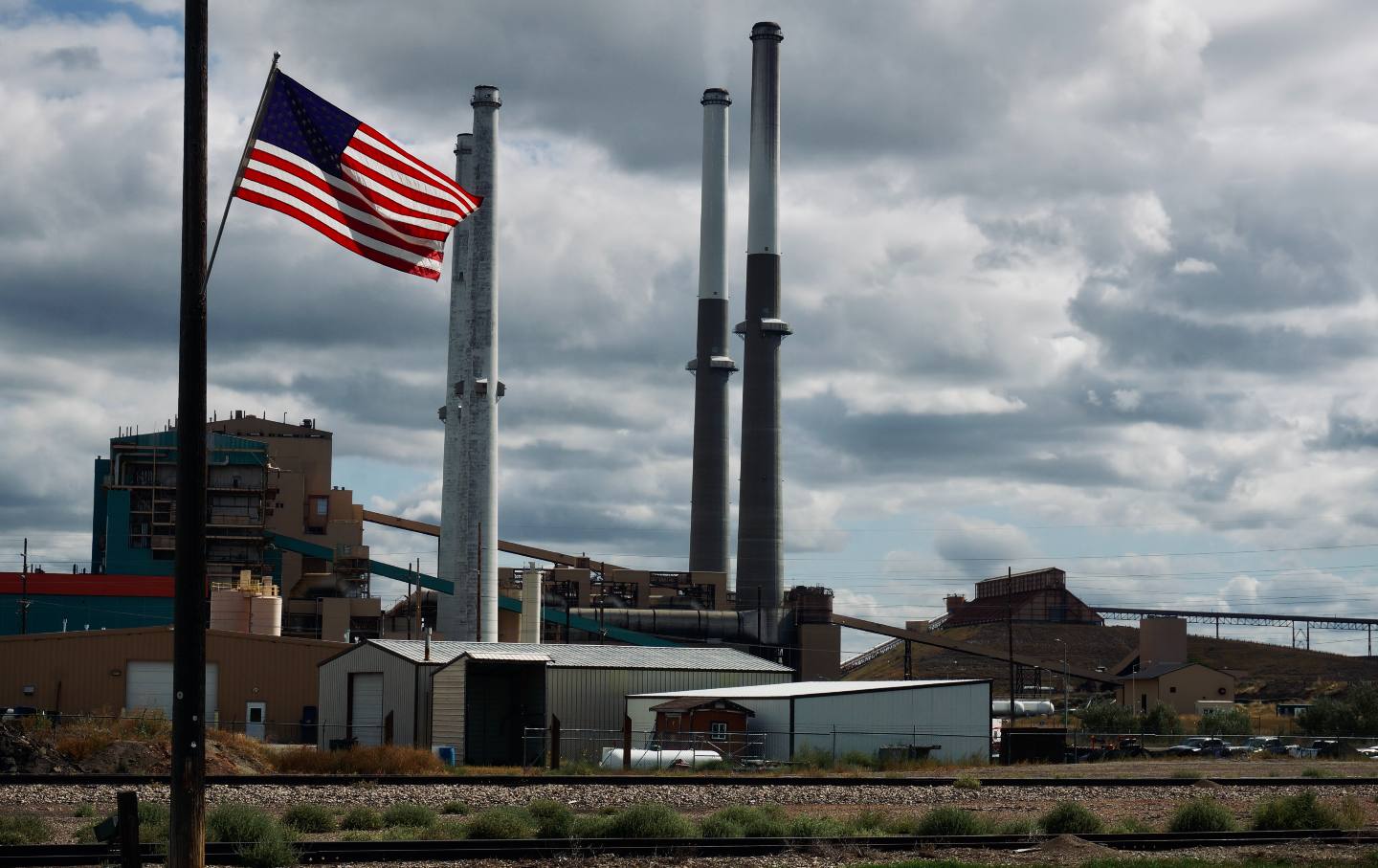
A power plant in Colstrip, Montana.
(Ezra Graham)
Standing beneath the power lines situated off Power Road in Colstrip, Montana, you can almost feel the current. Energy audibly crackles above as a covered conveyor belt running under Highway 39 transports coal from the local Rosebud Mine to an enormous power plant, supplying thousands of homes with electricity.
In many American towns like this one, the fossil fuel industry has been economically vital—while carrying enormous environmental burdens. A recent study from the Rocky Mountain Institute, a nonpartisan nonprofit working towards a clean energy future, found that “emissions from the Colstrip plant have been linked to $2.1 billion in health costs with 151 premature deaths, 188 emergency room visits, and more than 90,000 cases of asthma symptoms” over the last decade.
In 2020, two of the Colstrip plant’s four units were shut down. The Montana Environmental Information Center, along with the Sierra Club, forced the closure after the settlement of a 2013 Clean Air Act lawsuit. Yet the units were retired more than two years earlier than originally ordered, based on rising fuel costs and a failure to create economic viability for the owners. Another lawsuit filed against the Rosebud Mine concluded that an environmental analysis completed for a region now being permitted by the Trump administration was flawed, and the district court judge ruled that Rosebud’s permit did not adequately consider climate change or hydrological impacts.
Now the approval of an Environmental Impact Study, repeatedly delayed by the Biden administration, has allowed mining in a crucial region of the Rosebud Mine to continue. Mining was initially estimated to stop in October, according to the Department of the Interior, but under President Trump, the mine’s longevity will continue until 2039.
“This new authorization ensured that Rosebud Mine could expand its operations,” in an area “which contains approximately 4,200 additional acres with about 33.75 million tons of federal coal,” according to the department. NorthWestern Energy, which will become the plant’s majority owner next year, would not comment on whether energy production will increase at the Colstrip plant, and Jon Heroux of Westmoreland, the owner of the Rosebud Mine, does not anticipate an increase in coal yield. But Heroux stressed the importance of the area because of its higher quality coal.
NorthWestern will acquire a majority of the plant at zero cost after Washington state passed the Clean Energy Transformation Act, forcing the exit of Washington-based Puget Sound Energy by the end of 2025. “We are happy to find a partner in NorthWestern and for the future of the Colstrip plant to be in Montana’s control,” said Ron Roberts, the company’s senior vice president of energy resources, in a statement last year.
While in office, President Biden sought to halve national carbon emissions by 2030, a goal aided by the 2022 Inflation Reduction Act, which invested hundreds of billions into renewables. But under Trump, changes from the executive branch and from Congress, namely through the One Big Beautiful Bill Act, have undone those actions. According to some projections, the bill will reduce renewable energy available in 2035 by a figure larger than the amount of coal and nuclear energy produced today.
On Donald Trump’s first day back in office, he declared a “national energy emergency,” blaming the Biden administration for “a precariously inadequate and intermittent energy supply, and an increasingly unreliable grid” which required “swift and decisive action.” In response, the administration ramped up offshore drilling auctions and aided other fossil fuel expansions while canceling renewable energy projects across the country. Mining plan modifications or leases allowing companies to continue or start extraction have been announced at multiple sites in Montana, Wyoming, Utah, and Alabama.
Recently, the Department of Energy released $625 million to fund infrastructure improvements at America’s coal plants, and the Interior Department opened 13.1 million acres of federal lands to coal leasing. This marks a cross-agency effort to invest in coal, including weakening EPA regulations regarding pollutants and wastewater.
Through this nationwide push, tens of millions of acres of federal coal reserves will be “recovered” as the administration rescinds hundreds of millions in funds for renewable technology.
Through executive orders, Congress, and a loyalist cabinet, the second Trump administration has delivered big for enclaves of coal country like Colstrip. Once bracing for layoffs and closures, the town of 2,100 is now entering a period of relative stability as the administration rejects the progression of clean energy. But though the federal government has provided a lifeline for the fossil fuel industry, many wonder how long it can last.
President Trump attempted similar actions propping up the coal industry during his first term, including ending extraction moratorium on federal lands. He also considered plans to compel grid operators to buy energy derived from coal. In 2024, 66 percent of voters in Rosebud County, where Colstrip is located, cast their ballots for Donald Trump.
Throughout Colstrip, the motto “Tomorrow’s Town… Today!” is branded across signs and banners. Parks host legions of kids playing football while relatives use public pickleball courts. A free recreation center sits a block away from a library and fire station, connected by freshly paved streets. A billowing Trump flag flies on the stretch of highway outside of the town, and many local businesses display “coal keeps the lights on” posters.
Rose Hanser, a Colstrip city councillor, said her husband worked in the Rosebud Mine as a heavy equipment mechanic until 2010, when he was eligible for retirement after working more than 25 years in a physically demanding job. “It just feels like a sigh of relief,” said Hanser of the administration’s pro-coal stance. Maintaining the town’s coal industry was a top issue last year, according to Robert Pontius, a local construction company owner. He voted for Donald Trump three times and said that he has seen benefits to his business, which has included working with power companies during Trump’s two terms. According to Pontius, the companies have “opened up their wallets and they’re spending a bit more” since the 2024 election.
While the Bureau of Labor Statistics expects fossil fuel jobs to decrease at an annual rate of 0.2 percent until 2034, a recent report showed that companies have cancelled $22 billion in clean energy projects—which were expected to create 16,500 jobs in mostly Republican congressional districts—during the first half of the year.
Mayor John Williams moved to Colstrip in 1971 and worked for the Montana Power Company during the construction of the power plant, becoming mayor in 1999 after Colstrip was formally incorporated as a town. Lines drawn during incorporation included the power plant, and have lessened the tax burden for residents. Williams called the rock “buried sunshine.” “There’s no other industry in modern Montana that has provided as good an economic future as has coal for the last 50 years,” said Williams.
But what about the next 50 years? A recent study from the investment firm Lazard shows that the cost of fossil fuel production is higher than that of renewables—even without subsidies, many of which were stripped away under the One Big Beautiful Bill Act.
Natural gas has increasingly outcompeted coal, producing around 45 percent of American energy. The challenge of countering market pressures stymied President Trump’s past actions. During his first administration, fossil fuel companies shut down around 100 coal plants. More recently, Trump’s Bureau of Land Management postponed a coal lease sale in Wyoming and another in Montana received only one bid, potential signs of weak market interest. Another barrier to coal expansion comes from the maintenance cost of decades-old facilities. In Colstrip, NorthWestern Energy is seeking to cover an annual $18 million operational cost as it gains more shares in the plant.
Of course, there are plenty of other tradeoffs Colstrip’s industry has created in the region. “Coal plants can be directly attributed to thousands of deaths in the US every year. They spew out heavy metals like mercury and lead and asthma-inducing gases like nitrous oxide,” said Noah Rott of the Sierra Club, who referenced research that links 460,000 deaths to coal plants nationally in 20 years.
But the people of Colstrip have become wary of any environmental reporting showing the climate impacts of fossil fuels. “It was politicized when Biden put it together,” said Mayor John Williams of a 2023 EPA memo which ranked one of Colstrip’s units as emitting the most particulate matter—including heavy metals—of hundreds of plants surveyed nationwide. “It was to fit [Biden’s] agenda.”
The owners of the Colstrip plant have been “cutting corners out of that plant for decades and avoiding having to install industry-standard pollution control technology,” said Derf Johnson, the deputy director at the Montana Environmental Information Center. Johnson believes state environmental regulators need to do more to institute pollution reduction. Colstrip’s Plant received an air pollution exception waiver this year, a process used by similar facilities, and a recent EPA proposal could eliminate the Greenhouse Gas Reporting Program, an action that mandates reporting to curb global warming, altogether.
Southeastern Montana Development Corporation executive director Jim Atchison predicts that Colstrip could mine and burn coal for another 15 to 20 years. Atchison contrasted this view from the belief during the Obama and Biden administrations that coal was on its way out: “You could see the storm coming, but you just didn’t know when it was going to hit.” At the same time, “coal communities need to diversify to survive,” says Atchison, who cautions that some have seen their population plummet. In Colorado, six coal powered plants face a 2031 deadline to cease operations, with companies citing stricter environmental legislation and economic instability. Elsewhere, the coal output in West Virginia, once synonymous with the industry, was down 40 percent in 2023 compared to twenty years prior.
“I think the Trump administration is trying to find ways of meeting the power demands that we have, using an ‘all of the above’ approach and a ‘bridge’ approach,” said Heroux, who says a recent uptick in energy demand the company has seen stems from AI data centers, population increases, and electronics. He says that the company has entertained discussion surrounding solar and nuclear production on reclaimed mining lands.
Rott and the Sierra Club are critical of this “bridge” approach. “An ‘Energy Emergency’ seemingly would require the Trump administration to encourage the build out of as much energy as possible,” said Rott. The day after President Trump’s inauguration, 15 billionaires connected to the fossil fuel industry gained over $3 billion in wealth. “This is about picking winners and losers,” said Rott, “and fossil fuel lobbyists are on top.”
Popular
“swipe left below to view more authors”Swipe →Even fossil fuel economies have looked towards a similar pivot to new industry, a step that is stymied by Trump’s federal push to extend the lives of drilling, mines, and plants scheduled to sunset. Jo Dee Black, of NorthWestern, said that the company “has begun evaluating [small modular nuclear reactor] technology, vendors, and potential project sites,” and alternative energy production, including SMRs, “could be located in the Colstrip area” in the future.
Republican state Representative Gary Parry, who represents an area including Colstrip, believes the town’s future may lie in these small modular nuclear reactors. Parry, who worked in the area’s coal industry and is supportive of its continuation, nevertheless passed two bills in the state legislature to send a signal that Montana is open to nuclear energy. “Most of your workforce would transfer right over,” said Parry of nuclear energy, pointing out that the process to capture energy is comparable to coal. His goal is to introduce these reactors to Colstrip in six years, while maintaining the coal industry. But NorthWestern Energy “is not going to look at uranium or any nuclear facility until coal goes away,” according to Parry.
The Rosebud Mine no longer has to worry about federal environmental approval that may not have materialized under a Democratic administration, a development that makes environmental advocates wary. Johnson of MEIC didn’t rule out a lawsuit when asked about future action in Colstrip, and the Sierra Club “is committing to use whatever means we can to stop these expansion[s]” of the Rosebud Mine, he said.
At the same time, Johnson believes that market forces will naturally allow renewable technologies to prevail. “Unless there’s an administration that wants to force coal plants to run,” says Johnson, “this transition is underway. And it’s really hard to stop at this point.”
Become a Sustaining Donor This September
Between the reemergence of right-wing red-baiting and Donald Trump’s use of the chilling National Security Presidential Memorandum–7 to criminalize left political organizing, we’re seeing McCarthyism reborn before our eyes.
This assault on democracy cannot be ignored or wished away. Resisting it requires bravery in the face of threats and repression, a steadfast commitment to the truth, and the unwavering belief that we can—and will—overcome this darkness.
We must have an independent media that sets the record straight, unearths corruption and abuses of power, and advances a politics of justice and dignity for all if we’re to win this fight.
That’s why I’m writing to you today. This September, The Nation needs to add 100 monthly donors to sustain our progressive journalism. Your contribution makes the next investigative report, the next truth-speaking column, and the next pathbreaking essay all possible.
I hope you’ll support our work with a recurring donation today. If you donate $10 or more a month, we’ll send you a brand new “Hands Off the Free Press!” sticker to recognise your commitment to our cause. Please, donate today.
Onward,
Katrina vanden Heuvel
Editor and Publisher, The Nation
More from The Nation
Big Oil’s Origin Story Big Oil’s Origin Story
Amy Westervelt’s new book, Brought to You By, exposes the deep history of today’s “information pollution.”

Two Years After Helene, North Carolina’s Unsettled Recovery Two Years After Helene, North Carolina’s Unsettled Recovery
The state has become a testing ground under an eviscerated FEMA and a missing-in-action “recovery czar,” Michael Whatley, with big political ambitions.

A Reckoning Comes for Nepal A Reckoning Comes for Nepal
A year after its Gen Z uprising, Nepal faces a struggle not only for democracy and human rights but for climate survival.

How a Creative Mind Lives in Nature How a Creative Mind Lives in Nature
Working in the wilderness could not satiate my intellectual impulses. But for the protagonist of Hothouse Bloom, the binary between mental and physical labor is what calls her.
Is Nepal a Turning Point in Climate Coverage? Is Nepal a Turning Point in Climate Coverage?
Even CBS News and Bari Weiss, who fired the outlet’s entire climate unit, have used Nepal as a watchword for environmental disaster.
How Will Nepal Pay for the Latest Climate Disaster? How Will Nepal Pay for the Latest Climate Disaster?
An interview with Nepali UN climate expert Manjeet Dhakal on what the massive Himalayan flood will cost Nepal.

