
The Toll of the Olympics on the Environment
Paris promised a green Olympic Games, but is that even possible?
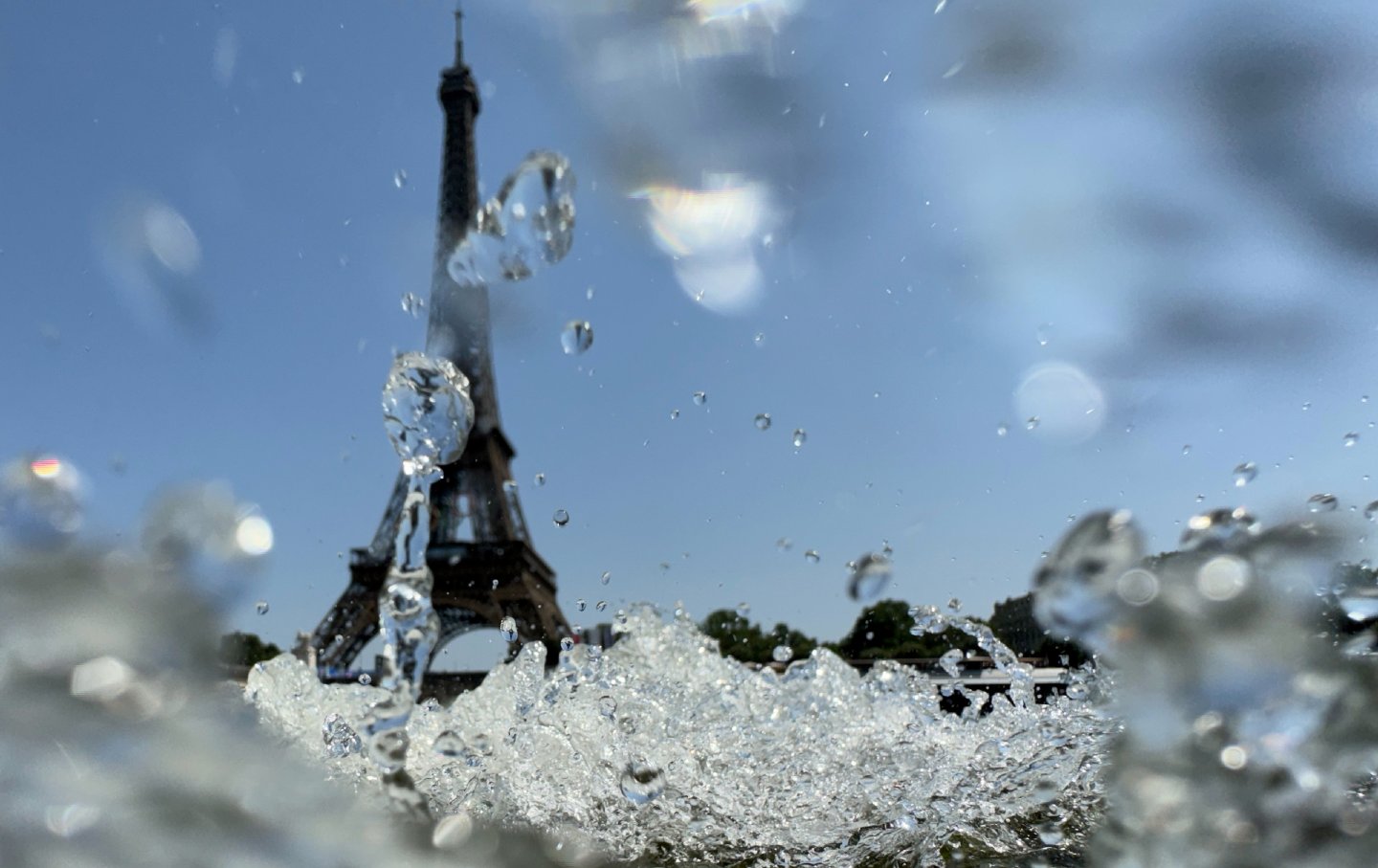
The Eiffel Tower can be seen behind the Seine. The men’s triathlon at the Olympic Games in Paris has been postponed due to dirty water in the river.
(Marijan Murat / picture alliance via Getty Images)
Climate change is stalking the Olympic Games. Earlier this week in Paris, dozens of social activists from the organization Extinction Rebellion attempted to peacefully protest the ways the Olympics are harming Paris and the wider environment. But before they were able to carry out their action on the Pont des Arts bridge over the Seine, police swooped in and preemptively arrested them. A group of journalists were trapped alongside them as they were encircled by the heavily armed authorities wearing Paris 2024 Olympics patches on their shoulders.
The activists’ demonstration could also be read as solidarity with the athletes in events like the triathlon and marathon swim. These world-class competitors are slated to compete in the murky waters, if they meet safety standards. (They do not as of this writing.)
French Olympic security forces smothered an urgent message: The world is on fire, and mega-events like the Olympics are hastening environmental calamity. These kinds of mega-events typically leave a harmful ecological legacy. But Paris 2024 organizers said that these games would be different. They made sustainability a centerpiece of their rhetoric. They pledged that the Games will be “historic for the climate,” the greenest Games in the history of the Olympics. The reality, as Extinction Rebellion was trying to convey, has been quite different. The reality is that the very idea of gigantic sporting extravaganzas like the Olympic Games must be radically reevaluated if the world is to meet the Paris Agreement’s climate emissions targets by 2050.
In the early 1990s, power brokers in the Olympic movement allied, at least rhetorically, to address the climate crisis. One academic analysis, however, revealed that when it came to the sustainability practices of 16 Olympics stretching from 1992 to 2020, environmental follow-through was severely lacking. In fact, the four least “sustainable” Olympics—Sochi 2014, Rio 2016, Tokyo 2020, and London 2012—were all relatively recent. In other words, as the International Olympic Committee’s pro-environment banter ramped up, their follow-through actually decreased. To be sure, Paris 2024 organizers have made some positive steps forward—limiting fresh venue construction, offering more vegan options at the Olympic Village where athletes reside during the Games, and using recycled materials—but there is still a long way to go.
Here in Paris, we met up with Madeleine Orr, assistant professor of sports ecology at the University of Toronto and author of Warming Up: How Climate Change Is Changing Sports. In the shadow of the Eiffel Tower, she bluntly stated, “A sustainable Olympics is an oxymoron. And the [Olympic] model is completely untenable. They’re not going be able to continue to do it much longer.”
In other words, the IOC and local host organizing committees engage in “greenwashing”—saying they care for the environment while doing very little, if anything, to materially address the ecological problems that plague our world.
This absence of genuine sustainability can be seen in the saga of the aforementioned river. France invested some $1.5 billion to make the Seine swimmable for the first time in more than a century. It was an audacious goal given the amount of sewage, toxic plastic, trash, agricultural run-off, and pharmaceutical refuse dumped in the storied body of water over decades of industrialization.
In the days before the Olympics there were two swimming spectacles staged by the leadership to showcase their green efforts, with French Sports Minister Amélie Oudéa-Castéra taking a dip in the river before Paris’s socialist Mayor Anne Hidalgo followed through on her promise to do the same. This was meant to assuage fears that athletes would be risking their health when plunging into the Seine.
This may have been a savvy public relations move, but was it safe? The Surfrider Foundation, an environmental group that has been carrying out water testing along the Seine for months, has consistently found that the river failed tests when it came to the bacterias E. Coli and enterococci. People who swam in the river risked serious intestinal illness, skin rashes, and eye damage. Until the very month the Games began, tests revealed the Seine to be alarmingly dangerous.
We spoke with the Surfrider Foundation’s Lionel Cheylus. He pointed out that although Surfrider does scientific water-quality evaluation, it does so in accordance with the European Bathing Water Directive, which zeroes in on fecal bacteria, but does not require testing for pesticides, pharmaceuticals, and other chemical pollution. The French government may be testing for those chemicals, but officials are not willing to share their data and protocols with the public. Cheylus said, “Transparency is really important in these kinds of issues.” He added, “I think they could be more transparent and give more information sometimes.… They could really improve.” Until then, he noted, it’s impossible to know the full effects of the water on swimmers, including Olympic athletes.
The International Olympic Committee often sloganizes with phrases like “Athletes First,” but if the Seine doesn’t meet the safety standards, the backup plan is to postpone events in the river, which organizers announced on Tuesday that they will, in fact, have to do. If that doesn’t resolve the issue, then Olympic organizers will take the extreme action of eliminating the swimming portion of the triathlon, leaving only biking and running. To say that this would disfigure the competition for which these athletes have trained is to make a massive understatement. Veteran sports reporter Martyn Ziegler called it “farcical.” It sounds like athletes are coming in closer to last than first.
But when activists from Extinction Rebellion and other environmental groups tried to draw attention to the safety of the Seine, the response was intense repression to protect the Olympic spectacle.
We asked Orr whether someday in the near future the Olympics won’t be able to be staged because of the climate. Her response was sobering: “I think that’s going to happen on the Winter [Olympics] side sooner than we think. I think we’ll get through the next couple rounds. But…we are going to see places be too hot to host the Winter Games. And on the Summer [Olympics] side, a 2016 study out of the UK said actually, there’s maybe a dozen cities across the Northern Hemisphere that will be tenable to host the Games by mid-century, if it continues to be in July and August.… Something’s got to give.”
Popular
“swipe left below to view more authors”Swipe →The choice for the future of the Olympics and other mega-events is simple: Either they will have to be radically rethought and reconfigured to reduce their carbon footprint, or they must cease to continue as the number of cities dwindles that are safe for athletes and fans. The choice for the future of sports mega-events is clear: real-deal sustainability or extinction.
More from The Nation

Trump Is Making Deals With Big Oil Trump Is Making Deals With Big Oil
Democrats and the press should be paying attention to how this pay-to-play behavior relates to the midterms
This Lawsuit Could Make Big Oil Pay for the Harm It’s Caused This Lawsuit Could Make Big Oil Pay for the Harm It’s Caused
The question is whether the Supreme Court will let it.
Germany and California Make Up an Environmental Superpower Germany and California Make Up an Environmental Superpower
The world’s third- and fourth-largest economies have pledged to environmental protections. Will others follow suit?

Gavin Newsom Comments on Climate Gavin Newsom Comments on Climate
On the sidelines of the UN General Assembly meeting and New York Climate Week, the California governor called AOC “the real damn deal.”

Cities as Climate Labs: Inside the U20 Summit Cities as Climate Labs: Inside the U20 Summit
Mayors at the Urban 20 Summit worked across borders to confront the climate crisis at the local level.

Big Oil’s Origin Story Big Oil’s Origin Story
Amy Westervelt’s new book, Brought to You By, exposes the deep history of today’s “information pollution.”

