July 17, 2025

Americans Are Concerned About Climate Change—but They Should Be Afraid

Americans still don’t comprehend how imminent, dangerous, and far-reaching the threat is—and journalists are partly to blame.
Mark Hertsgaard
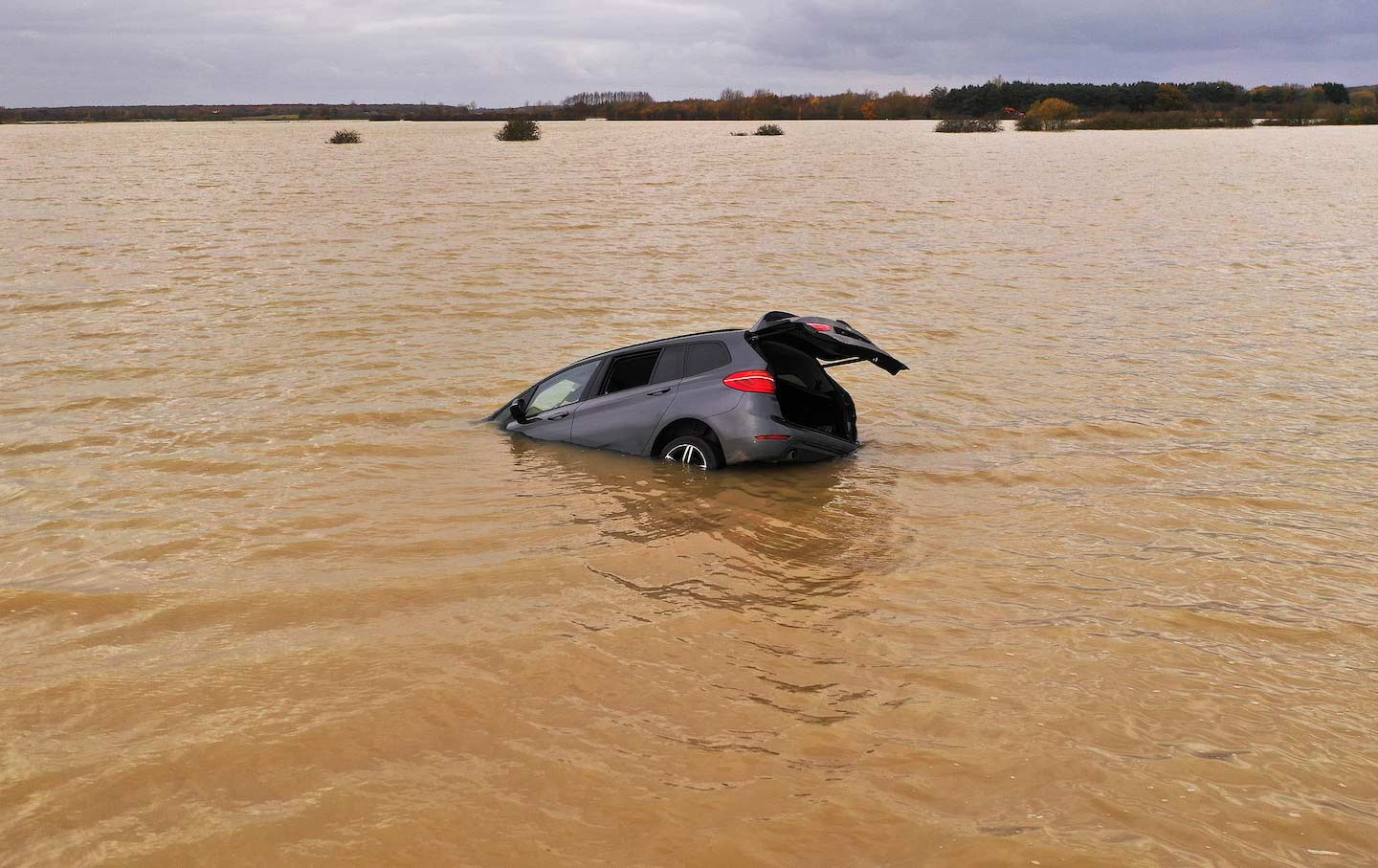
A car is seen part submerged in floodwater in England, 2019.
A car is seen part submerged in floodwater in England, 2019. (Christopher Furlong / Getty Images)

Last Thursday, CNN ran a story that inadvertently underscored the fact that most journalism is still not getting across the full truth about climate change. Harry Enten, CNN’s polling analyst, displayed Gallup data showing that 40 percent of Americans are “greatly worried” about climate change. But this 40 percent is “the exact same percentage as [were worried] back in 2000,” he pointed out, “despite everything we see [today] on our television screens, our computer screens…the hurricanes, the tornados, the flooding.”

“Americans aren’t afraid of climate change,” Enten concluded. “Climate activists have not successfully made the case to the American people.”

Perhaps not, but neither have most journalists. The extreme weather events Enten cited have gotten extensive news coverage, but most of that coverage did not make the climate connection. As we noted last month, “In the summer of 2024, for example, when record high temperatures brutalized outdoor workers, withered crops, and worsened hurricanes, only 12 percent of US national TV news segments mentioned climate change, though its role in driving such extreme heat has long been scientifically indisputable.”

Anthony Leiserowitz, the executive director of the Yale Program on Climate Change Communication, said Yale’s latest survey found that only 29 percent of Americans are “very worried” about climate change—a remarkably low number, considering that climate change is already killing people and devastating communities around the world and threatens much worse if left unchecked.

“I constantly make the point that only 29 percent are very worried, when it should be 100 percent,” Leiserowitz told Covering Climate Now. “This reflects [climate change’s] lack of salience for most Americans. There are many who are not deniers, but do not adequately understand the risks, that the impacts are here and now, and the urgency of action.”

These numbers also shed light on The 89 Percent Project that CCNow and dozens of news outlets have been reporting this year. The project is grounded in a cluster of scientific studies finding that 80 to 89 percent of the world’s people want governments to “do more” about climate change.

In the United States, the percentage of people supporting stronger climate action is 74 percent. Why, then, are significantly smaller percentages “greatly worried” about climate change?

“There’s a big difference between general support for stronger climate action and prioritizing climate action,” Leiserowitz said. He invoked a concept from political science, the issue public, defined as “a relatively small proportion of the general public that is both passionate about an issue and directly engaged in taking political and personal action.” He added, “While it’s important to have a large majority of the public supporting action (e.g., 89 percent), most issues also need an organized, powerful ‘issue public’ that is loudly demanding policy change and implementing personal change.”

The fact that less than half of the public is “greatly worried” about climate change shows that most Americans still don’t comprehend how imminent, dangerous, and far-reaching the threat is. There is a “critical need for better climate communications,” Leiserowitz said, “especially quality media reporting.”
Time is running out to have your gift matched 

In this time of unrelenting, often unprecedented cruelty and lawlessness, I’m grateful for Nation readers like you. 

So many of you have taken to the streets, organized in your neighborhood and with your union, and showed up at the ballot box to vote for progressive candidates. You’re proving that it is possible—to paraphrase the legendary Patti Smith—to redeem the work of the fools running our government.

And as we head into 2026, I promise that The Nation will fight like never before for justice, humanity, and dignity in these United States. 

At a time when most news organizations are either cutting budgets or cozying up to Trump by bringing in right-wing propagandists, The Nation’s writers, editors, copy editors, fact-checkers, and illustrators confront head-on the administration’s deadly abuses of power, blatant corruption, and deconstruction of both government and civil society. 

We couldn’t do this crucial work without you.

Through the end of the year, a generous donor is matching all donations to The Nation’s independent journalism up to $75,000. But the end of the year is now only days away. 

Time is running out to have your gift doubled. Don’t wait—donate now to ensure that our newsroom has the full $150,000 to start the new year. 

Another world really is possible. Together, we can and will win it!

Love and Solidarity,

John Nichols 

Executive Editor, The Nation

Mark Hertsgaard

Mark Hertsgaard is the environment correspondent of The Nation and the executive director of the global media collaboration Covering Climate Now. His new book is Big Red’s Mercy:  The Shooting of Deborah Cotton and A Story of Race in America.

More from The Nation

Salmon swimming against the current to spawn in the streams in Alaska in August 2025.

The Fight for the Last Wild Salmon The Fight for the Last Wild Salmon

In Alaska, the last stronghold for wild salmon, Native tribes and conservationists are working to save the fish from both climate change and decades of corporate greed.

StudentNation / Colin Warren

What Your Cheap Clothes Cost the Planet

What Your Cheap Clothes Cost the Planet What Your Cheap Clothes Cost the Planet


A global supply chain built for speed is leaving behind waste, toxins, and a trail of environmental wreckage.

Feature / Sachi Mulkey and Rebecca McCarthy

Chris Packham addresses the audience at a National Emergency Briefing on the climate and nature crisis, at Central Hall Westminster on November 27, 2025, in London, England.

The UK’s Climate National Emergency Briefing Should Be a Wake-Up Call to Everyone The UK’s Climate National Emergency Briefing Should Be a Wake-Up Call to Everyone

The briefing was a rare coordinated effort to make sure the media reflects the science: Humanity’s planetary house is on fire, but we have the tools to put that fire out.

Mark Hertsgaard

A man on a rooftop looks at approaching flames as the Springs fire continues to grow on May 3, 2013, near Camarillo, California.

AI Will Only Intensify Climate Change. The Tech Moguls Don’t Care. AI Will Only Intensify Climate Change. The Tech Moguls Don’t Care.

The AI phenomenon may functionally print money for tech billionaires, at least for the time being, but it comes with a gargantuan environmental cost.

Juan Cole

People participate in a demonstration in front of the main entrance of COP30 in Belém, Brazil, on November 10, 2025.

Backsliding in Belém Backsliding in Belém

Petrostates at COP30 quash fossil fuel and deforestation phaseouts.

Mark Hertsgaard

Nun stands in front of Cop30 Mural in Brazil

Wake Up and Smell the Oil. Your Nation’s Military Is Hiding Its Pollution From You. Wake Up and Smell the Oil. Your Nation’s Military Is Hiding Its Pollution From You.

A fact all but ignored at COP30.

Ashley Gate