
We Took CBS’s Money. We Won’t Trade It for Silence.
Four Mike Wallace Scholarship recipients on the rebellion at CBS News and the future of an American institution.
We are often told not to bite the hand that feeds us. In our case, we were not explicitly told not to speak. No one needed to tell us. CBS News funded our education and honored our work—our role was to acknowledge the network’s generosity and graciousness.
The implicit lesson here was that gratitude should speak for itself. The expectation was simple: accept the recognition, cash the check, and leave the criticism to someone else.
We cannot. We are the four most recent recipients of the Mike Wallace Memorial Scholarship, funded entirely by CBS News. The network has invested tens of thousands of dollars in our education and recognized us as representatives of journalism’s future. That future—thanks to the corporate leadership of CBS News editor in chief Bari Weiss, whose editorial interventions in the network’s flagship newsmagazine, 60 Minutes, spurred the firing of several of the network’s veteran producers and reporters—is now in jeopardy. The shameful attack on 60 Minutes hasn’t happened because the program, or the network, is losing ratings, revenue, and respect; it’s occurred as part of the bid to impose ideological orthodoxy on the network’s news division. Weiss’s agenda to appease the Trump administration sends the message that institutional loyalty matters more than editorial independence, and that the truth is merely one side of a debate. The upshot of this timorous model of newsgathering is that neutrality, not objectivity or accountability, is the highest virtue of journalism. Mike Wallace didn’t think so, and neither do we. Below, each of us offers our personal reflections on our tenure as Mike Wallace scholars amid the corporate news crisis at CBS.
Silence Is Complicity
Santiago Campos
When I accepted a scholarship in Mike Wallace’s name, I knew I had a responsibility to call out the counter-journalistic practices at the organization he worked for. Staying silent at such a moment would have made me complicit in the disgraceful repudiation of the high standards set by Wallace and his colleagues at 60 Minutes. While I was not expecting the remarks I delivered in acceptance of my scholarship to leave the room, I was not surprised when they did go viral. At a time when public trust in mainstream media is at record lows, my remarks captured a widespread frustration with journalists who are unwilling to take a stand against the ways in which corporate consolidation is disfiguring the work they do at their own outlets. My speech shouldn’t have made headlines—aspiring journalists should be expected to speak out against threats to the profession.
Professional journalists should not need a high school student to ask these questions. Yet my remarks were met by an eruption of applause from nearly every journalist in the room that night. I was glad that they clapped. But the real question is whether they have the courage, integrity, and willingness to speak truth to power when it matters most. Afraid of losing their jobs in a hyper-competitive market, many of them see staying quiet as the safer option.
That’s not a luxury extended to the people they cover. As a student journalist who has spent the past two years covering US immigration policy, I have reported firsthand on the grave threats posed by mass deportation campaigns—not just to undocumented migrants but to the broader American public. Today, ICE has detained green-card holders, American citizens, and has violently menaced protesters, culminating in the killings of Renée Good and Alex Pretti. Under the ownership of David Ellison, a public ally of President Trump, and the direction of his appointed lackey Bari Weiss, CBS is suppressing the distribution of stories on the administration’s handling of immigration. Before 60 Minutes correspondent Scott Pelley introduced me at the Emmys, he recognized his ousted colleague Sharyn Alfonsi. Earlier that day, Alfonsi had lost her contract at the network after management worked to suppress her segment on the harsh conditions experienced by Venezuelan migrants at CECOT, the Salvadoran mega-prison used to hold US deportees.
Pelley was soon penalized for speaking out. After a venerable 37-year career, he was fired by the network after criticizing the policies of Weiss and her management team in a contentious staff meeting. Alfonsi and Pelley put their jobs on the line to resist efforts to silence and marginalize their work. All journalists at CBS should follow their lead. Their fear is understandable, but it doesn’t excuse their silence. The stakes are too high.
Truth, Above All Else
Talan Collins
Last year’s Wallace awards ceremony was rife with tension—the scheduled speeches seemed to take place against the backdrop of a ticking clock, the signature soundtrack of 60 Minutes. As I sat on a vented windowsill in Paramount’s corporate headquarters 50 floors above Times Square, I was so caught up in the surreal mood of the evening, I almost overlooked the fact that I was sitting right beside Lesley Stahl. This was real. This was CBS.
As I had just been let in the door, another man had just walked out. After 26 years, Bill Owens had resigned from 60 Minutes, protesting the news division’s constriction of his editorial autonomy and news judgment. After the reception, my scholarship liaison marched me over to him. I didn’t know where to begin. Should I lead with deferential shows of respect and admiration? That seemed unequal to the moment—what Owens had demonstrated, first and foremost, was courage. That’s what inspired me. So when I accepted my 2025 scholarship before a room full of faces I had known from TV news broadcasts since my childhood, I was determined to heed Owens’s courageous example. “The pursuit of truth demands curiosity, but also courage,” I said that night, my own voice trembling at the sight of my heroes. “Courage to confront power, even when truth becomes threatening. Courage to speak, even when silence is safer; when authority threatens access, approval—or acquisition.” I asked the seasoned journalists in the crowd just how many more of their principled colleagues would have to resign before they recovered the courage and audacity to continue serving the public interest.
Mike Wallace once found himself caught between loyalty to CBS and loyalty to a tobacco-industry whistleblower whose allegations threatened one of America’s most powerful industries. That conflict, which reportedly haunted Wallace for years, was immortalized in Michael Mann’s 1999 film The Insider. Veteran anchorman Dan Rather’s final months at CBS News were overshadowed by his efforts to defend a disputed report on President George W. Bush’s National Guard service and the producers who stood by it. His final sign-off was both a warning and a call to arms: “Courage.” Wallace, Rather, and Owens were key figures who made 60 Minutes tick. They were willing to lose what many journalists spend their entire careers chasing: stability, prestige, and—most vitally—access. Journalism, it turns out, is tested when telling the truth carries a cost. As I accepted my Wallace scholarship in 2025, I tried to imagine a place for myself in that reception room. I wanted to believe that the institution still rewarded the qualities that made me admire it in the first place. I now believe the CBS that inspired me is dead. Sooner or later, those who remain there will have to decide what matters more: the comfort of remaining in the room, or the courage to risk their place in it for the sake of truth. Scott Pelley made his choice. Now I’ve made mine.
Heat and Light
Sebastian Broche
After accepting the Mike Wallace Memorial Scholarship in 2024, I was approached by Fordham University professor Beth Knobel. She handed me a copy of Heat and Light, the book she co-authored with the late Mike Wallace. As I reread it, one statement from the opening chapter struck me: “Objectivity remains paramount at CBS News to this day.” Two years later, Scott Pelley’s termination reveals that’s no longer the case. Knobel and Wallace argued that the central goal of journalism is to separate fact from fiction. Truth, they wrote, involves nuance and an understanding that a simple both-sides narrative isn’t a substitute for factual inquiry.
That vital lesson has been lost in the present drive to turn CBS News into a messaging platform for the Trump administration. Sharyn Alfonsi’s firing took place because she refused to water down a report on CECOT with an irrelevant interview in which a senior administration official delivered empty talking points. The journalist who spent more than a decade at 60 Minutes was let go because she stood up for the truth as Mike Wallace understood it. CBS News has long presented itself as the gold standard of objective broadcast journalism—which is why industry insiders dubbed it the Tiffany Network. Knobel and Wallace cite the legacy of widely trusted journalist Edward R. Murrow, whose role in facing down the McCarthyist witch hunts set a benchmark for the network’s professional standards. Now CBS has turned those standards on their head, with the firings of Pelley and Alfonsi and many other accomplished and seasoned reporters and producers. As Knobel and Wallace observe, journalists cannot turn a blind eye to truthful reporting because of the “financial consequences of controversy.” The second you step on-screen or you put pen to paper, your allegiance is no longer to the people who sign their names on your checks—it is to the truth. My scholarship is named for Mike Wallace, and he would be the first one to speak out if he saw his legacy tainted by a version of CBS that had lost sight of its fundamental mission to broadcast the truth. Under Bari Weiss’s direction, CBS News is seeking to strike an unsustainable balance between fact and self-interested political fiction. I believe, as Mike Wallace did, in the balance of heat and light.
Three Years Ago
Chris Gloff
Three years is a long time. Three years ago, I had a mop haircut and was seriously considering an offer to play college baseball. Three years ago, I wanted to work for CBS. That’s when I got to stand on the stage of the Palladium Times Square to accept a scholarship from one of the country’s most esteemed journalistic organizations. My mantra at the time was a quote from Christiane Amanpour: “Be truthful, not neutral.”
Since then, CBS and its parent company, Paramount, have paid President Trump $16 million to settle a meritless lawsuit claiming deceptive editing of an interview with his 2024 opponent for the presidency, Kamala Harris. CBS/Paramount also canceled The Late Show in the wake of host Stephen Colbert’s persistent criticism of the administration. The network claims that decision was “purely financial,” even though Colbert’s show drew the highest ratings in the late-night time slot. CBS also fired longtime 60 Minutes producer Tanya Simon, who, despite the program’s top ratings and a growing digital audience, was replaced by print journalist Nick Bilton, who has never worked in broadcast news. Paramount reported a 9 percent increase in ratings for the 2025–26 season of 60 Minutes compared to the prior year; the show’s online engagement doubled over the same period.
Popular
“swipe left below to view more authors”Swipe →Clearly the lead motivating factors in the network’s recent decisions are political, not financial—and these political pressures are corrupting an historic institution. I believe CBS is failing those who built its reputation by prioritizing political accessibility over journalistic integrity. I received a scholarship in Mike Wallace’s name because I endeavored to uncover the truth—not because I conformed to the pressures of those with authority. Wallace would be ashamed of the network that had aired his landmark Watergate interviews. Walter Cronkite would be appalled that the network that had broadcast his groundbreaking coverage of the Vietnam War also fired Scott Pelley for questioning authority. I received money under Wallace’s name to continue the public service of uncovering and broadcasting truth. Journalists like Scott Pelley fought to preserve the institution I wanted to dedicate my life to.
Three years ago, CBS’s legacy was tied to names like Wallace and Cronkite. Three years ago, CBS funded my education. Three years ago, I wanted to work for CBS. Now I can only say that I wanted to work for what CBS used to be.
Biting the Red Wire
We took CBS’s money because we revered the journalists who built it. We now believe the institution that invokes Mike Wallace’s name has betrayed his legacy. We were inspired by—and once aspired to work for—programs like 60 Minutes. But from our perspectives, CBS News no longer resembles the institution that inspired us to pursue journalism. For those prominent anchors, reporters, and producers who remain there, we ask why? Each passing minute the leading voices at CBS sit with their hands tied, something slips away: the trust of the American people. And the clock is ticking. The sound of that clock is no longer the somber passage of time evoked during the credits of 60 Minutes; it’s now a countdown to the detonation of a time bomb, poised to vaporize what little remains of the public trust that an independent press needs to continue surviving. The management of CBS News is threatening to destroy the traditions of truth-telling created during the past seven decades at a once storied news network. From their perspective, we’re biting the hand that feeds us. But they’re bent on setting off an explosion that threatens an American institution—so we’re biting the red wire.
More from The Nation
Can James Carville Please Just Be Quietly Wrong Somewhere Else? Can James Carville Please Just Be Quietly Wrong Somewhere Else?
The omnipresent consultant-cum-tantrum-thrower has long outlived whatever relevance he once had, but cable producers, podcast hosts, and Democratic campaigns haven’t got the memo....
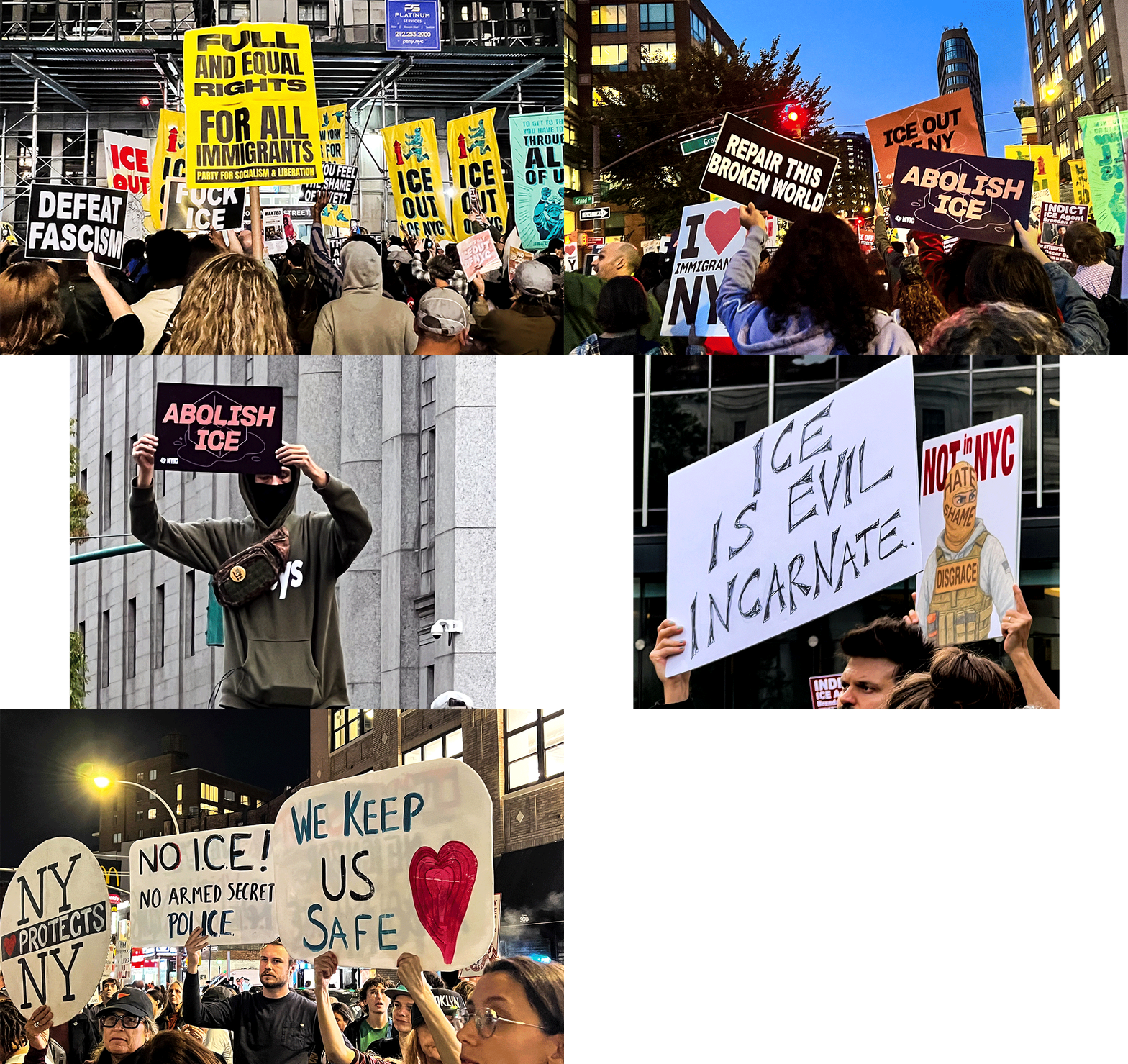
Abolish ICE Abolish ICE
Demonstrators take to the streets in protest against an ICE shooting in New York City. Foley Square, October 2026.
Mamdani Is Facing Heat Over the NYPD. Here’s What He Should Do. Mamdani Is Facing Heat Over the NYPD. Here’s What He Should Do.
The mayor is being given a series of false choices over his public-safety agenda. But there is another way forward.
Why Calling Anti-Trans Hate a “Distraction” Is So Troubling Why Calling Anti-Trans Hate a “Distraction” Is So Troubling
It’s a familiar line in the midterms: Anti-trans attacks are a “distraction” from “kitchen-table” issues. That sends a chilling message about whose rights are worth fighting for.
So What Is Socialism, Anyway? So What Is Socialism, Anyway?
In a world dominated by neoliberal market fundamentalism, “socialism” is what will make a more moderate, regulated form of capitalism work for most people.

