
Why We’re Still Fighting Over Elgin’s Marbles
In A.E. Stallings’s Frieze Frame, the poet retells the many conflicts, political and cultural, the ransacked portion of the Parthenon has inspired.
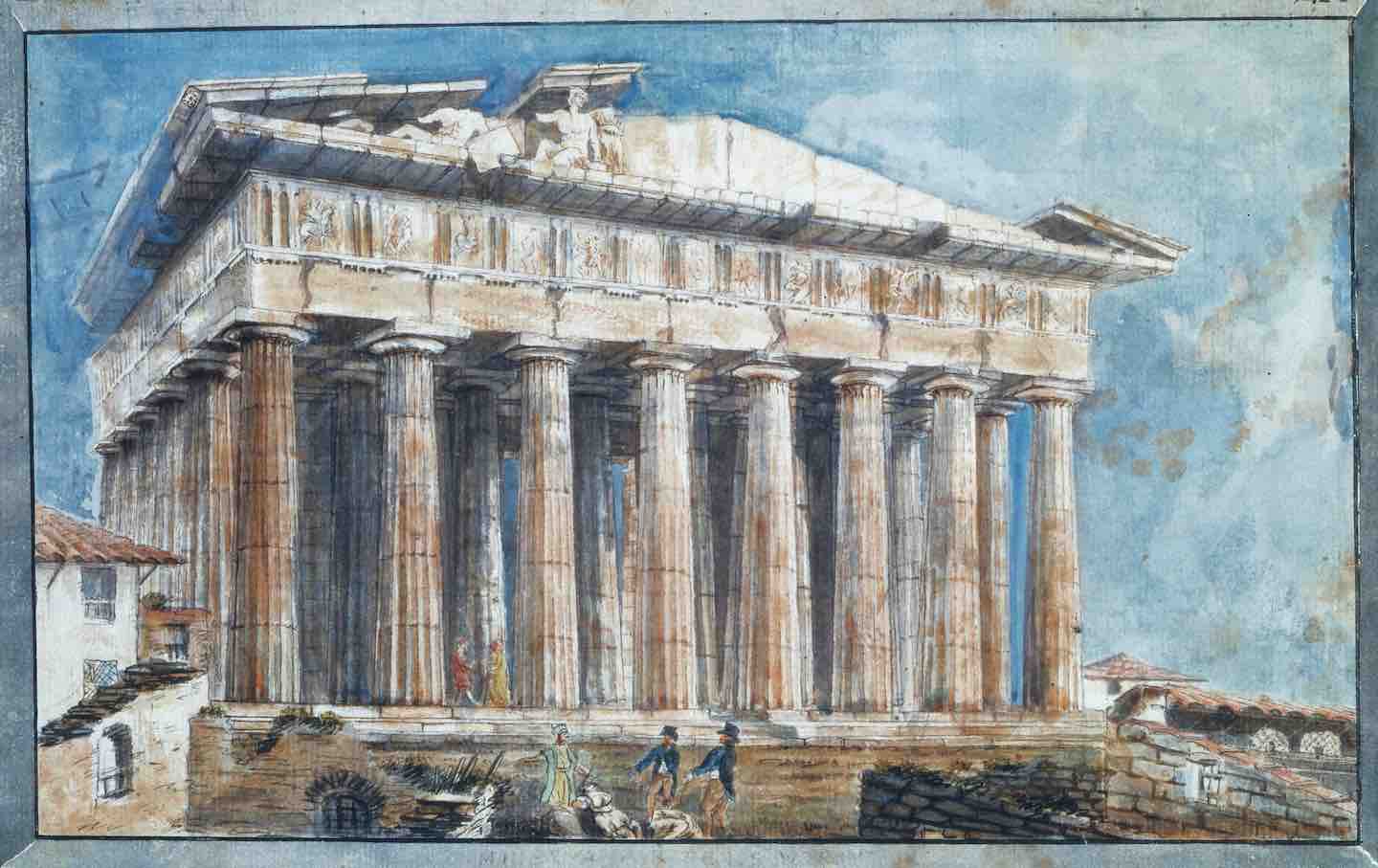
Sir William Gell (British, 1774–1836), The Removal of the Sculptures from the Pediments of the Parthenon by Lord Elgin, 1801, watercolor and pencil on paper, 20 x 31 cm (7.9 x 12.2 in), Benaki Museum, Athens, Greece.
(VCG Wilson / Corbis via Getty Images)
Arguably the world’s most famous Greek temple, the Parthenon was constructed in a flurry of building activity on the Acropolis of Athens, under the direction of the indefatigable statesman Pericles in the middle of the fifth century BC. It was a monument to recent tragedy in Athens as much as a celebration of the city’s glory: The Acropolis had been leveled by Persian invaders in 480 BC, and its temples had been left in ruins for 30 years, a colossal absence reminding citizens how close they had come to annihilation.
Books in review
Frieze Frame: How Poets, Painters, and Their Friends Framed the Debate Around Elgin and the Marbles of the Parthenon
Buy this bookThis changed along with Athens’s emergence as a Mediterranean superpower. As head of a defensive alliance of Greek states known to us as the Delian League, Athens siphoned off its funds to rebuild and beautify the city. The Parthenon was the centerpiece of this rebirth—the largest temple on mainland Greece, built entirely of local Pentelic marble and decorated with an extravagant sculptural program broadcasting the foundational mythology of Athens, as well as a continuous frieze around the inner chamber depicting a mysterious procession. The mastermind behind this project was allegedly the esteemed sculptor Phidias, a close friend of Pericles.
Today, the Parthenon is perhaps more famous for what is missing from it. When visitors clamber up the steep incline of the Acropolis to admire the temple, there is very little left of its sculptural program to see. This is largely thanks to Thomas Bruce, the seventh Earl of Elgin and British ambassador to the Ottoman court, who in the early 19th century removed roughly half of the Parthenon’s surviving pediment statues, metopes, and frieze—along with other elements from the Acropolis, including a caryatid from the nearby Erechtheion—and had them shipped to England.
The legality of this act was fabulously murky and has been much debated. Elgin’s claim rested on a permit—a firman—that he said had been issued by the Ottoman Sublime Court. When asked by a House of Commons Select Committee to reveal the document, only an Italian translation with ambiguous wording could be produced. Elgin put forward various moral arguments to vindicate his actions, detailed in a Memorandum published anonymously in 1810: He was saving the Marbles from the barbarity of the Ottomans, from the indolence of the Greeks, or simply from the unrelenting march of time. Just what Elgin had originally intended to do with the Marbles is unclear, but less selfless motivations are evident: His letters to his aide-de-camp in Athens, the Italian painter Giovanni Lusieri (Byron called him “an agent of devastation”), insinuate plans to use the Marbles as decorations for his family seat, Broomhall House. In the end, severely in debt, Elgin sold them to the British government at a discount rate. Since 1817, the sculptures have been housed at the British Museum.
Almost as soon as the Marbles touched the shores of England, they ignited controversy, and the subject of their fate remains a bitterly divisive one. To some, Elgin was a cultural hero, preserving the best examples of Western art and glorifying England in doing so. To others, he was an imperialist chancer who had robbed Greece. In Frieze Frame, the poet and translator A.E. Stallings traces these early responses to the Marbles and how they have shaped much of the subsequent debate. For Stallings, it was not the politicians or pundits of the 19th century but rather the artists, writers, and poets who played the most important role in both representing and shaping public opinion. Poets, after all, are the “unacknowledged legislators of the world,” as Shelley put it, a tenet that underpins Frieze Frame, which makes the case for poetry’s unique capacity to evoke and persuade—but also to preserve.
That anyone should have cared so much about the Marbles, in a period in which dubiously acquired antiquities collections were growing rapidly across Europe, is perhaps surprising. But the Parthenon has proven to be unusually susceptible to political and cultural manipulation, for both ancient and modern viewers. This was particularly the case in the years and decades that followed Elgin’s pilferage; as Stallings notes with only slight exaggeration, “the Marbles touch on nearly every topic of the long nineteenth century,” a claim that Frieze Frame unpacks in a highly entertaining manner, tracking the responses to the Marbles through Regency and Victorian England, a newly independent Greece, and into the 20th century. The result is a brilliant riot of characters, personalities, and voices that jostle together across continents and centuries. But if Frieze Frame covers enormous territory, the onslaught of detail can overwhelm, and just how the Marbles’ cultural history can be transformed into political clarity in the present is left an open question.
The most well-known English poem on the Marbles is surely John Keats’s much-anthologized sonnet “On Seeing the Elgin Marbles.” The title can feel slightly misleading: There is very little about the sculptures themselves, and much more about the sublime effect that they have on the poet’s weak and mortal spirit. Stallings aptly calls the poem a “hymn to Stendhal syndrome.” The poem is also pointedly unmoored from time and space, and we certainly don’t get a feel for the original context of Keats’s profound encounter—the British Museum’s Temporary Elgin Room, where the Marbles had been installed and unveiled to the public after being purchased the previous year. Indeed, as Stallings points out, Keats’s poem is the first to “see” the Marbles as we do, in the British Museum.
It’s a clunky poem, full of em dashes, uneven caesuras, and incomplete images. You can feel Keats struggling to fit form to content, and the poem also cleverly mirrors the fragmented statues, as well as “the rude / wasting of old time” that has eroded their “Graecian grandeur.” While Keats would have been aware of the welter of negative opinions regarding Elgin’s removal of the Marbles and their recent acquisition—the poem was published in 1817, just after the infamous “year without summer” and amid failing harvests and a food crisis, which made the government’s extravagant purchase appear quite wrong-headed indeed—he gives away nothing about the political or social context, remaining resolutely in the domain of aesthetic experience.
Part of the reason for this is no doubt Keats’s addressee. The poem was originally published in Leigh Hunt’s The Examiner alongside another, less memorable sonnet that begins “Forgive Me, Haydon.” Keats had first visited the Elgin Room with Benjamin Robert Haydon, a painter of immense energy and vanity, if of debatable artistic merit (Dickens remarked that “he most unquestionably was a very bad painter”), who was also Elgin’s most vocal champion and defender. Haydon had seen the Marbles privately displayed years before in Elgin’s rooms on Park Lane and had been deeply impressed by their anatomical fidelity and expression, with none of the contrived languor of Hellenistic sculpture but instead infused with “vigorous activity, beauty, and nature.” Haydon was dazzled and communicated his infatuation in letters, in his autobiography, and no doubt directly to Keats. Whatever you make of Keats’s sonnet, it has Haydon’s excitable fingerprints all over it, and in a way, it’s not the Marbles themselves but the loquacious painter that left Keats schtum.
Haydon was enthusiastic about the ability of the Marbles to improve the state of the arts in England, and he harbored a Whiggish belief in the progress that could be traced from the classical world to the glorious present, culminating conveniently in 19th-century Britain. This was also a key part of Elgin’s own defense: “The exertions I made in Greece were wholly for the purpose of securing to Great Britain, and through it to Europe in general, the most effectual possible knowledge.” There was a political dimension too, an impulse to compare Athens—so successful in expelling Xerxes and establishing its empire—with post-Napoleonic England, now ready to extend its military and political supremacy into the cultural sphere. Wordsworth certainly exploited this comparison and also called for English art to reflect “those high achievements” in “imperishable Columns” and “Sculpture’s patient toil.” Felicia Hemans’s long poem “Modern Greece,” published in the same year as Keats’s sonnet, predicted that the Marbles would foster a new flowering of English artistic genius.
If Keats and Haydon were rapturous, others were more circumspect, and certainly more callous. The Marbles’ aesthetic value was one sticking point. Richard Payne Knight, a leading member of the Dilettanti Society, testifying as an expert witness before the Select Committee, declared that the Marbles were not the original works of Phidias, were not even Greek but rather “Roman of the time of Hadrian,” hardly worth Elgin’s energy and certainly not the money he demanded. It was a false claim, one that irritated Haydon greatly, but it gained a rapid consensus, undermining Elgin’s sales pitch.
Elgin’s Marbles also struck a nerve in Lord Byron, who repeatedly placed the Scottish earl in his crosshairs. In his adolescent, highly incendiary “English Bards and Scotch Reviewers,” Byron accused Elgin of wasting “useless thousands” on “Phidian freaks, misshapen monuments and maim’d antiques” and also mocked his syphilitic nose; he did much the same, with the volume turned up, in the unpublished “The Curse of Minerva,” a mock-epic poem that ridiculed both Elgin’s theft and London society’s swooning response. Although “Childe Harold’s Pilgrimage” catapulted Byron to instant fame, his attacks on Elgin continued. Contemplating the ruins of the Parthenon, Childe Harold rails against “the modern Pict,” “the last, the worst, dull despoiler,” who has stripped “the last poor plunder from a bleeding land.”
Byron cared little about the aesthetic quality of the Marbles. He was adamant that he was “not a collector” and wrote that he had little interest in antiquities, “except a wish to immolate lord Elgin to Minerva and Nemesis.” Byron was more invested in a radical commitment to Greek independence, which he had developed since his Grand Tour in 1809 with Cam Hobhouse, and for which he would later fight. But Byron’s philhellenism was also the product, first, of a classical education that promoted an ideal Greece that, he felt, its contemporary state fell seriously short of, and second, of a common theme in 18th-century literature: that the Greeks might rise up against their Ottoman overlords and join modern Europe. The Parthenon—even in its ruined and fragmented state—symbolized the rebirth of classical Greece to Byron and others.
Byron’s disdain for what had been done to the Marbles was shared by other English travelers who had themselves witnessed Elgin’s acts. Edward Dodwell, an Irish painter who was in Athens at the time, wrote of Elgin’s “insensate barbarism,” and the English mineralogist Edward Daniel Clarke decried Elgin’s “spoliation.” While their accounts echo Byron’s sentiments, their vitriol toward Elgin also arose from aristocratic squabbling, pettiness, and jealousy. Elgin may have committed the most egregious example of the pilfering of Greek antiquities, but he certainly wasn’t the only one to have done so. His crime was one of degree, not necessarily of kind. The British classicist John Morritt declared Athens to be “a perfect gallery of marbles”: “some we steal, some we buy, and our court is much adorned with them.” Dodwell had removed artifacts from the Parthenon, as had Clarke. The competition was fierce and sometimes bloody: According to Byron, Lusieri challenged the aide of Lord Aberdeen to a duel over a collection of vases. Satire and libelous verse offered other ways of competing, any irony or hypocrisy generally lost on those who composed them. The Scottish writer John Galt, Byron’s early biographer, wrote a blistering mock-epic on Elgin called the Athenaid, while elsewhere openly lamenting just how close he had come to acquiring the Marbles himself.
Stallings offers a witty account of these early responses and ripostes, but she also works hard to place it within the intellectual history of the period, and it is instructive to see just how widely the Marbles were pressed into the service of various agendas and reflected various anxieties in Europe at the time.
Race theory was one particularly salient topic. Benjamin Haydon, so impressed by the anatomy of the figures in the Marbles, also declared that they exhibited the characteristics “of an intellectual European” and used them to form extraordinarily disparaging comparisons with Black people in the pages of The Examiner, attempting to demonstrate their physical and mental inferiority. He took casts of an African American sailor named Wilson to prove his point, almost killing him in the process, as he cheerfully recounts in his autobiography.
Robert Knox, the Scottish anatomist who advanced similarly sinister views in his 1850 treatise The Races of Men, also emphasized “the superiority of the Elgin Marbles to all others” and praised their anatomical detail. Knox suggested as well that the ethnic makeup of modern Greeks was “Asiatic” and entirely different from that of the ancients, Pelasgians who had intermingled with Saxon and Scandinavian invaders; tellingly, the impressive physiognomy displayed in Greek sculptures like Elgin’s Marbles was now best exemplified on the streets of London. His argument had its roots in Jakob Fallmerayer’s theory, expressed 20 years earlier, that “not the slightest drop of undiluted Hellenic blood flows in the veins of the Christian population of present-day Greece”—a view that would later prove popular with Nazi occupiers. Offhand remarks about the “mixed little population which now lives upon the ruins of ancient Greece,” as James Knowles, editor of The Nineteenth Century, quipped, were made repeatedly to undermine any claim that modern Greeks might have on the Marbles. These put-downs reached Greece: Snapping at Knowles’s “prolixity of cheap wit,” a young C.P. Cavafy called out his “half-truths” and demanded the restitution of the Marbles.
Debate over whether the Marbles were originally white or had been painted was also ideologically tinged. Orthodox views of Greek sculpture cleaved to Johann Winckelmann’s claim that “a beautiful body will…be the more beautiful the whiter it is,” but throughout the 19th century, the counterclaim that the sculptures had been painted in exuberant colors grew louder. Antiquarians who had observed the Marbles before Elgin removed them had noted traces of color, but the concept that they had been painted was almost too much for most Victorians to bear. When Alma-Tadema’s famous painting Phidias Showing the Frieze of the Parthenon to His Friends was displayed in 1868, with the Marbles shown in a kaleidoscope of bright tones, its “fairground colors” were cause for much dismay.
Concerns over race and ethnicity certainly informed these debates, but so did a Victorian obsession with cleanliness and purity, both physical and moral. Persistent cleaning of the Marbles removed whatever traces of color had been extant and did much damage to the sculptures themselves. In 1858, Richard Westmacott Jr., the principal restorer of the museum’s sculptures, who also feared that traces of color might render classical sculptures “an instrument of corruption,” used a harsh abrasive to remove oil and grime from the Marbles—to much public outcry.
Writers in the United Kingdom bickered interminably with Europeans, with those across the Atlantic, and mostly with each other. Much of this story is well established, and Stallings draws heavily on authoritative scholarship, especially that of the late William St Clair. Frieze Frame is perhaps more interesting for what it tells us about Ottoman and Greek attitudes toward the Parthenon and its Marbles, both when Athens was a part of the Ottoman Empire and after the modern Greek state had been established in the 1830s.
Before Elgin’s intervention, the Parthenon had already enjoyed a long history of changes and transformations. By the seventh century, it had been turned into the Orthodox Cathedral of the Panagia Atheniotissa, the “All Holy Mother of Athens.” In 1204, Crusaders transformed it into a Catholic church, and when the Ottoman Sultan Mehmed II occupied Athens in 1458, the Parthenon was reborn as a mosque, and remained so until 1687, when a Venetian cannonball struck an ammunition depot and blew the place apart, reducing it to its current state. As Stallings notes, Greek writers and poets might consider Elgin a nuisance, but the real villain is often Francesco Morosini, the general who ordered the strike.
This strange alloy of classical pagan temple and Islamic mosque didn’t present any major theological friction. The Ottoman explorer Evliya Çelebi described the Parthenon as “a light-filled mosque” and had no compunction in marveling at its sculptures: “the human mind cannot indeed comprehend these images.” Although Elgin had claimed that removing the Marbles had saved them from the Ottomans, other English travelers, like Clarke and Dodwell, spoke of the abiding “religious veneration” the Ottomans had for their converted mosque. Whatever permission was actually granted to Elgin by Ottoman authorities when he took the artworks, the Disdar—the commander of Athens—bore “evident marks of dissatisfaction,” according to Clarke, and once the sculptures began coming down, he tearfully tried to stop things, “declaring that nothing should induce him to consent to any further dilapidations of the building.”
Unsurprisingly, it was the Greeks themselves who identified most emphatically with the Parthenon, which symbolized their glorious past and the possibility of a brighter future, once independence could be achieved. It was, as the actress-cum-cultural-minister Melina Mercouri put it, “the soul of Greece.” For Athenians, it was more than symbolic: It represented a deep connection between place and people and was, effectively, a sacrosanct space. Ancient Athenians were said to have descended from Erichthonius, who had risen autochthonously from the soil of Athens. The temple’s marble was taken from Mount Pentelikon, just outside of Athens. A legend from the Greek War of Independence, popularized by Mercouri in her UNESCO speech in 1982, gets the point across: When Turkish infantry, besieged on the Acropolis and low on ammunition, began to strip the Parthenon for lead, the Greeks responded by sending munitions, along with a note: “Here are bullets, don’t touch the columns.”
Frieze Frame began life as a two-part essay for The Hudson Review, and it never quite breaks free from its original form. It is discursive and often meandering. Many chapters are over before they really get started. It can feel as fragmented a work as the Marbles under discussion. This can beguile and frustrate in equal measure, but it also has a mysteriously mimetic effect, representative of the tumult that has raged around the Marbles for so long.
But Stallings is first and foremost a consummate poet, and she is at her best when delivering honed readings of poems that have responded to the Marbles over time, in both English and Greek. These readings quietly make the case for poetry’s special role in shaping the story of the Marbles and the debate over them, as well as our emotional responses. Generally, these poems are not jingoistic, chest-thumping defenses or critiques of national interests but soft voices of internal reflection and uncertainty. In many, the statues take on a life of their own, not just blocks of marble to be gawped at but active beings that move through time and space, communicate directly with us, and offer forms of communality and solidarity.
Popular
“swipe left below to view more authors”Swipe →A.E. Housman’s 1896 poem “Loitering With a Vacant Eye” is a good example of this. The narrator finds himself in the British Museum, in a “Grecian gallery,” in which the sculptures stare back at him. The speaker feels homesick, unsure of London. So does a statue, and Housman imagines it speaking back to him: “I too would be where I am not.” It’s a meditation on the emotional affinity you can feel with art, and the resolution, or staying power, it can provide. But if the narrator has the power to change his life, the statue does not, and the affinity is gently severed: “years, when you lay down your ill / I shall stand and bear it still.”
The theme of displacement is frequent in poetry on the Marbles, connecting to our cultural and political world in surprising ways. Thomas Hardy’s “Christmas in the Elgin Room” also imagines the melancholy and detachment that the exiled Marbles feel in bleak London, now interred in “the gloom / of this gaunt room / which sunlight shuns.” The contemporary Greek poet Anna Griva connects the caryatid, the sole female-figure column removed from the portico of the Erechtheion, to her Congolese friend, living in Athens without her family. Her friend remarks, “I am like that Caryatid of yours, the one in exile.” Griva contemplates this claim and the loaded symbolism of the statue: “how did it define / beyond borders and languages / the longing for home?” As much as poems on the Marbles tend to ventriloquize the statues in order to empathize with them, Griva also reminds us how easily people—migrants, women—can be silenced and reduced to inanimate material: “A girl who lives all by herself / in a strange place / wants to show she is stone…. / But it takes only a blow / to turn it into fragments.”
Stallings is particularly good on the responses of Greek poets, and she is attentive to the meanings and associations of words, in English and in Greek, and the different capacities of each language. Frieze is, for Stallings, a “cold, static, icy word,” but its Greek equivalent, zoophoros—literally “animal bearing”—is more “vivid and animated.” If Keats was overwhelmed by the “unimaginable chasm of time,” then “Zoophoros,” a sonnet by the early-20th-century poet Angelos Sikelianos on the Parthenon frieze, “brings the horses and riders into the continuous present,” a fracas of color and action that reminds us how alive and consequent the past can be. But Greek responses to the Parthenon have been more ambiguous than one might expect. The Parthenon’s cultural significance can be an unwanted burden as much as a rallying point. Much as with the Italian Futurists, there was an ambivalence among Greek Modernists toward the past, and a morbid fascination with the destruction of the Parthenon: The avant-garde poet Nicolas Calas was explicit (“art is a gun powder keg, and the proof is the Parthenon”), and in George Seferis’s posthumously published novel Six Nights on the Acropolis, the protagonist Stratis imagines “two thousand years of compacted time” exploding a still-new Acropolis.
The debate over whether the Marbles should be returned to Athens rages on. The top floor of Bernard Tschumi’s Acropolis Museum, completed in 2009, waits expectantly for their return. In England, the mood is mixed: The current government has attempted to depoliticize the issue, but the Greek foreign ministry and the British Museum have been in serious negotiations to establish a long-term loan of the Marbles to Greece.
What does Stallings think? She has little time for the claim, made by the trustees of the British Museum, that the Marbles should remain in their current location “in order to deepen our understanding of their significance within cultural history,” as if “cultural history somehow exists apart from human history,” as if the Marbles can be separated from their long, complex biography. Nor does she offer a solution. But Frieze Frame attempts to “look on this seemingly insoluble stalemate of a controversy with fresh eyes,” and makes the powerful observation that the Marbles are part of a story, as much as there is a story about the Marbles: They have been part of a series of creative actions and reactions, in which different forms of meaning and value have been created and contested in regard to them, for better and for worse. This is the story that Frieze Frame tells, and it is also the story, Stallings insists, that the British Museum can attest to, even without the Marbles.
What Frieze Frame shows is that, in fact, there are a multitude of ways to understand the Marbles, and that there is a persistent ambiguity around the value and power of these stories, who controls them, and who ultimately decides their direction—an ambiguity Frieze Frame doesn’t quite resolve. The turbulence and chaos of the Parthenon’s history might be able to provide “fresh eyes” and new political understanding, but the link is a little too tenuous here, a little too quiet, to show how this is achieved. But perhaps this is outside Stallings’s remit. If anything, what the poets of the Parthenon can teach us is of Keats’s “rude wasting of old Time,” how to connect the past with the present, and how to move forward into the future.
Your support makes stories like this possible
From Minneapolis to Venezuela, from Gaza to Washington, DC, this is a time of staggering chaos, cruelty, and violence.
Unlike other publications that parrot the views of authoritarians, billionaires, and corporations, The Nation publishes stories that hold the powerful to account and center the communities too often denied a voice in the national media—stories like the one you’ve just read.
Each day, our journalism cuts through lies and distortions, contextualizes the developments reshaping politics around the globe, and advances progressive ideas that oxygenate our movements and instigate change in the halls of power.
This independent journalism is only possible with the support of our readers. If you want to see more urgent coverage like this, please donate to The Nation today.
More from The Nation

Is it Too Late to Save Hollywood? Is it Too Late to Save Hollywood?
A conversation with A.S. Hamrah about the dispiriting state of the movie business in the post-Covid era.

The Melania in “Melania” Likes Her Gilded Cage Just Fine The Melania in “Melania” Likes Her Gilded Cage Just Fine
The $45 million advertorial abounds in unintended ironies.

Nobody Knows “The Bluest Eye” Nobody Knows “The Bluest Eye”
Toni Morrison’s debut novel might be her most misunderstood.

Melania at the Multiplex Melania at the Multiplex
Packaging a $75 million bribe from Jeff Bezos as a vapid, content-challenged biopic.

Ishmael Reed on His Diverse Inspirations Ishmael Reed on His Diverse Inspirations
The origins of the Before Columbus Foundation.

How Was Sociology Invented? How Was Sociology Invented?
A conversation with Kwame Anthony Appiah about the religious origins of social theory and his recent book Captive Gods.

