The Melania in Melania Likes Her Gilded Cage Just Fine
The Melania in “Melania” Likes Her Gilded Cage Just Fine
The $45 million advertorial abounds in unintended ironies.
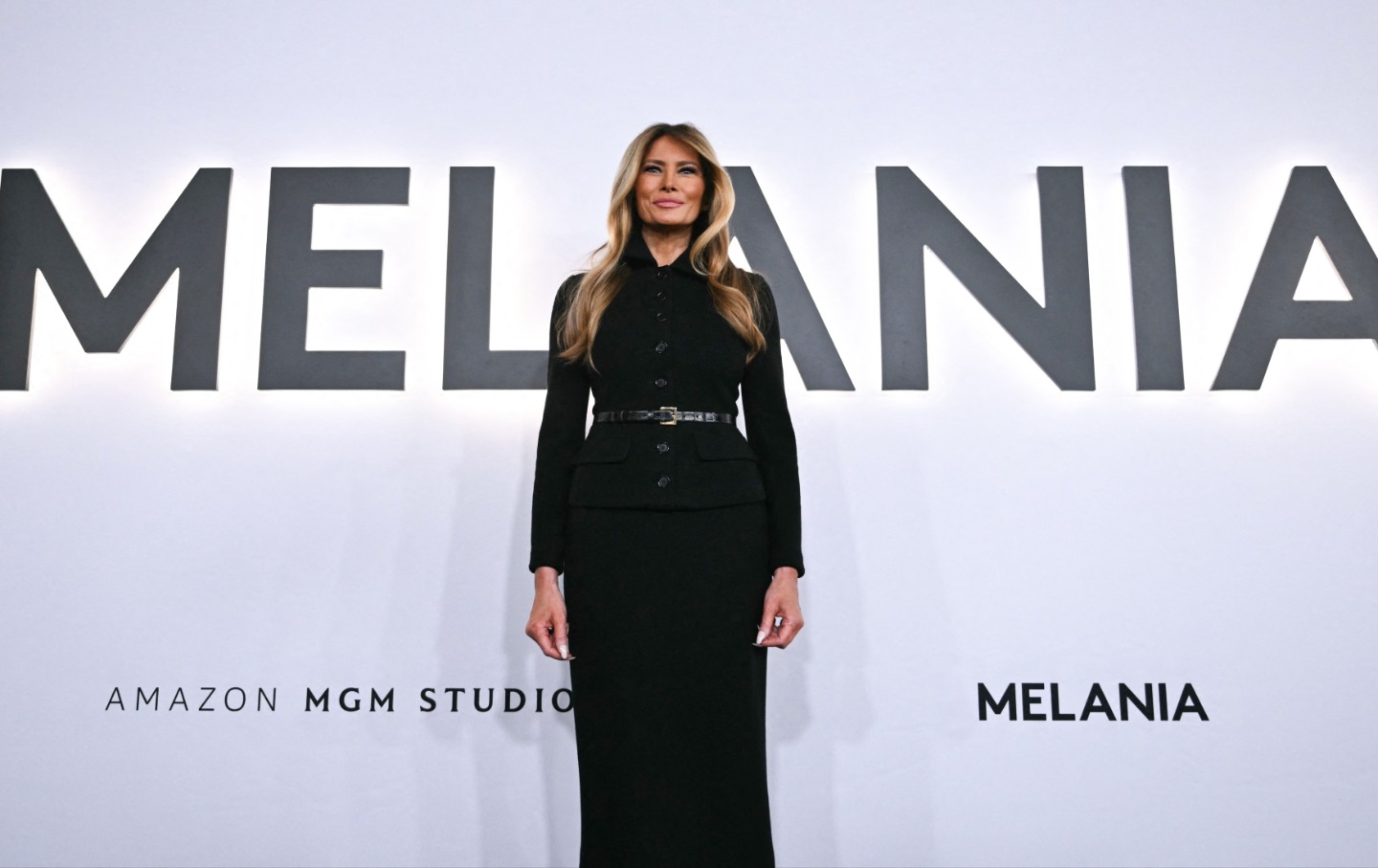
Melania Trump attends the premiere of Melania at the Kennedy Center in Washington, DC, on January 29, 2026.
(Brendan Smialowski / AFP via Getty Images)My husband and I saw the Melania documentary, at 10:45 am on the Upper West Side, which I admit was not a fair test of its audience appeal—there were only six people there besides us. They had all left by the time the movie was over—maybe journalists on deadline, like me—so I missed my chance to interview them about their responses. I did catch a middle-aged woman who showed up early for the next screening, well-armed with an enormous bucket of popcorn. Why was she there, I asked? To see Melania of course! What did she like about Melania? “She’s so confident and she does so much to help people.” Confident, I give you.
I used to feel sorry for the wives of rich and powerful men. I saw them as trapped—birds in gilded cages, who had made a terrible mistake in youth, and now had to endure endless rounds of tedious socializing with a frozen smile on their Botoxed faces, to say nothing of having to be nice to their ghastly husbands, who were probably all having sex with prostitutes. I wasn’t alone—remember all those Free Melania memes? The way people endlessly retweeted photos of her looking fed-up and frowny and not holding Donald’s hand? Quite a few women I know believed that Melania was miserable but couldn’t leave him for some unlikely reason, like she would have no money or he would have her murdered. What century did they think this is? Melinda Gates and Mackenzie Scott divorced their unsatisfactory husbands and are living the dream today as fabulously rich philanthropists.
Melania, this documentary makes perfectly clear, likes her gilded cage just fine. After all, it lets her produce this movie starring her clothes, her hair, her shoes, and her complexion, and how many women can say the same? Could you, middle-aged women of America, spend all day every day wearing six-inch spike heels with never a wince or moan? The rewards for aching feet and wrinkle-free face are on full display: Melania is attended every minute by people paid to be deferential and pleasant; everything around her is beautiful and expensive, and she has all the designer dresses she wants. She gets to talk about helping children with Queen Rania of Jordan and the evils of screens for children with Brigitte Macron. She gets to look somber and serious placing lilies on the Arlington graves of three soldiers killed in the withdrawal from Afghanistan—take that, Joe Biden! All your fault! If she has to spend a few hours pretending to care about the tablecloths for the Inaugural dinner and the golden caviar-filled eggs planned as the appetizer, well, that’s not too high a price to pay for luxury and admiration, is it?
As you might expect, the film abounds in unintended ironies. Melania is famously a private person, but she makes a movie about herself. She says she loves the White House, with all its storied history, while she tears up Jackie Kennedy’s rose garden and her husband tears down the East Wing. She says she cares about young people, while her husband destroys USAID, resulting in hundreds of thousands of deaths of African children. She reminds us that she is an immigrant, as are her French friend Hervé Pierre, whom we see designing her Inaugural ball gown, and Tham Kannalikham, the White House interior decorator, who arrived from Laos at the age of 2. And of course there are her parents. (Her mourning for her mother, the first anniversary of whose death takes place during the filming, is a rare moment when she expresses deep feeling.) Meanwhile, her husband presides over the mass detention and deportation of immigrants, many of whom have lived in this country for decades, maybe longer than she has. Cherry on top: The director, Brett Ratner, was persona non grata in Hollywood after being accused of sexual misconduct by six women—way to remind us of the ongoing scandal of the Epstein files.
I know there is a real human being hidden inside those severe, stiffly constructed outfits and beneath that famous black hat that hides half her face and makes her look like a sinister fembot or maybe a very confident assassin. This is, after all, the first lady who wore a jacket painted with I REALLY DON’T CARE DO U on her trip to the Mexican border. This is the first lady who plagiarized a speech by her nemesis Michelle Obama. And—my favorite Melania moment— this is the first lady who complained to her former close friend Stephanie Winston Wolkoff about having to “work my ass off” on the White House Christmas. “Who gives a fuck about the Christmas stuff and decorations?” Remember those scary blood-red trees that looked like they came from Dracula’s own forest?
That Melania was remote, haughty, mysterious, beset by grievance and resentment. She didn’t even try to ingratiate herself with the public. That was kind of weird—but a lot more interesting than this dutiful fashion plate delivering platitudes about how “in the end family is what really matters.” On the other hand, this Melania has managed to get Jeff Bezos to pay $45 million for the right to make this absurd advertorial, and $35 million to promote it. Bezos stands to lose most of it, but (sorry, Dems) the film is on track to be one of the highest-grossing documentaries ever. In a family of champion grifters, Melania holds her own.