Brian Wilson’s Endless Summer
His music, by turns joyous and melancholy, wide-eyed and masterful, transformed the meaning of pop.
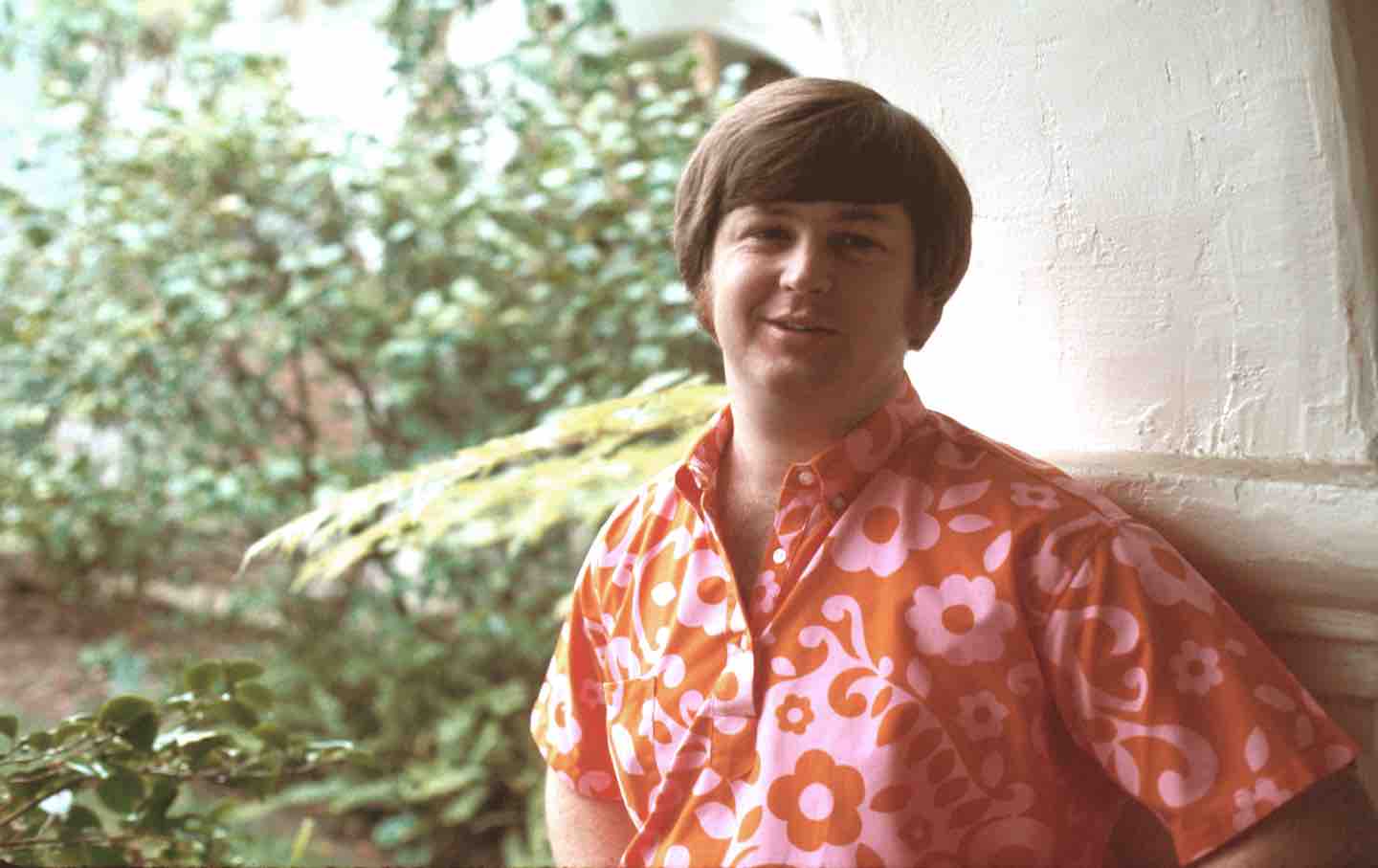
Brian Wilson, 1968.
(Michael Ochs Archives/Getty Images)
It goes without saying that Brian Wilson, who died last week at the age of 82, was a pure product of Southern California. His earliest work with the Beach Boys, created when he was barely out of his teens, preached a regional gospel of sun, sand, and surf, plus girls in bikinis and that perennial symbol of escape, the little deuce coupe.
Yet Wilson, from the very beginning, approached this mythology from an unconventional angle—as an introvert and nonparticipant. He preferred to stay indoors, eventually shoveling a representative pile of sand into his living room, then parking his piano in it. Depending on your point of view, this might indicate his lack of fitness for sunny hedonism, or a dark underside to the culture itself. In any case, it ensured that a beautiful melancholy would creep into the music early on, and sometimes swallow it whole. For every anthemic endorsement of “Fun, Fun, Fun,” the anxiety-prone Wilson would admit that he just wasn’t made for these times, and make you wonder the same about yourself.
Remembering Brian Wilson
The earliest Beach Boys hits were a cunning fusion of Chuck Berry and the Four Freshmen—like a barbershop quartet with a beat. Yet Wilson had barely established this formula when he began to abandon it. The ballad “In My Room,” from 1963, memorialized the composer’s agoraphobia with exquisite, deep-pile harmonies. (“I had a room,” Wilson declared, “and I thought of it as my kingdom.”) “I Get Around,” a Number One hit the following year, opened with a lush a cappella statement of the chorus, then broke up the verses with oddball guitar-and-organ riffs. It also featured Wilson’s falsetto, so often an instrument of vulnerability.
The early ’60s turned into the middle ’60s. Out went the candy-striped shirts, with their wholesome vibe of suntan lotion and the senior prom. In came the caftans, the beards, the blotter acid—which initially seemed to supercharge Wilson’s prodigious mastery of not just songcraft but sound.
Of course he was able to write beautiful melodies. “God Only Knows” is currently in heavy rotation on humanity’s jukebox; only a monster could fail to sing along. But what really astonished the ear and stirred the heart on Pet Sounds (1966) was Wilson’s sense of the pop song as sonic construction. To match the sounds he heard in his head, he deployed instruments seldom encountered in the Top Forty: oboe, harpsichord, sleigh bells, accordion, bass clarinet, theremin. For Wilson, these were not embellishments, in the manner of, say, the baroque piano solo that George Martin dubbed onto “In My Life.” They were the core of his musical vision, conveying emotion no less richly than the vocal harmonies, whose intricacies had also long since outgrown the sock-hop sentiments of the early Beach Boys records.
Wilson’s collapse after Pet Sounds, and his ragged attempts to finish Smile, his “teenage symphony to God,” are richly documented. Mental stress and substance abuse cut him down in his prime, according to the standard narrative, which turns out to be something of a distortion.
For one thing, the cobbled-together version of Smile issued by the Beach Boys in 1967 as Smiley Smile is a wild piece of work—the minimalist bookend to the maximalism of Pet Sounds. Its manipulation of texture and acoustic space now seems prescient, as does its alt-rock whimsy. Meanwhile Wilson, despite his heartbreaking difficulties, managed to emerge from time to time with another gem: “Surf’s Up,” “Cabin Essence,” “Sail On, Sailor,” even the endearingly nutty “Johnny Carson” from The Beach Boys Love You (1977).
For the most part, however, Wilson’s resurrection took place outside the sphere of his old group. In 2004, with a bunch of enthusiastic studio pros at his elbow, he recorded the high-gloss version of Smile he had always intended. The final product, with its rococo lyrics by Van Dyke Parks, was a vision of America in primary colors, Whitmanesque in its reach and musical curiosity, and full of wide-eyed innocence despite its brief excursions into the Great Chicago Fire and the colonization of North America. It inaugurated a lengthy victory lap for Wilson that continued, more or less, until the day of his death.
The question of innocence is crucial to Wilson’s entire output. The man singing “Song for Children” or “Vega-Tables” in 2004 was then 62 years old. Many a performer would have erected a small barrier of irony between himself and the creations of his youth, especially creations that relied so heavily on youthfulness in the first place (they weren’t the Beach Boys by accident, after all). Wilson, who had suffered the aches and pains of adulthood in extremis, remained in the protective kingdom of his room, hanging on to a child’s sense of wonder and eternity. It was a strength and, perhaps, a limitation. Still, one of his loveliest late-career accomplishments was “Summer’s Gone,” on the valedictory Beach Boys release That’s Why God Made the Radio (2012), a sonic throwback to Pet Sounds and an acknowledgment that the endless summer so celebrated by Wilson and his brothers was anything but.
Support independent journalism that does not fall in line
Even before February 28, the reasons for Donald Trump’s imploding approval rating were abundantly clear: untrammeled corruption and personal enrichment to the tune of billions of dollars during an affordability crisis, a foreign policy guided only by his own derelict sense of morality, and the deployment of a murderous campaign of occupation, detention, and deportation on American streets.
Now an undeclared, unauthorized, unpopular, and unconstitutional war of aggression against Iran has spread like wildfire through the region and into Europe. A new “forever war”—with an ever-increasing likelihood of American troops on the ground—may very well be upon us.
As we’ve seen over and over, this administration uses lies, misdirection, and attempts to flood the zone to justify its abuses of power at home and abroad. Just as Trump, Marco Rubio, and Pete Hegseth offer erratic and contradictory rationales for the attacks on Iran, the administration is also spreading the lie that the upcoming midterm elections are under threat from noncitizens on voter rolls. When these lies go unchecked, they become the basis for further authoritarian encroachment and war.
In these dark times, independent journalism is uniquely able to uncover the falsehoods that threaten our republic—and civilians around the world—and shine a bright light on the truth.
The Nation’s experienced team of writers, editors, and fact-checkers understands the scale of what we’re up against and the urgency with which we have to act. That’s why we’re publishing critical reporting and analysis of the war on Iran, ICE violence at home, new forms of voter suppression emerging in the courts, and much more.
But this journalism is possible only with your support.
This March, The Nation needs to raise $50,000 to ensure that we have the resources for reporting and analysis that sets the record straight and empowers people of conscience to organize. Will you donate today?