Why I Didn’t Report My Rape
In 2021, six men sexually assaulted me in a Las Vegas hotel room. Something more than abolitionism prevented me from reporting the crime.

Rays from the setting sun break through storm clouds west of the Mandalay Bay Resort and Casino.
(Ethan Miller / Getty Images)In the heart of Las Vegas, there’s a hotel with a phone that never rings. It’s been silent for over four years. The hotel, a huge casino resort, is busy. Guests check in and check out; gamblers come in the early evenings and stumble out the next morning; and hundreds of rooms are endlessly dirtied and then made clean again by hotel workers. But the phone remains silent. I like to think that the rotating check-in staff are always alert and prepared even for the call that they don’t know is coming. Meanwhile, all the way across the country in New York, I wake up every day and wonder if today is the day that I’ll finally make the hotel phone ring.
Of course, I know that isn’t true. The phone has rung countless times since that morning in June of 2021 that I checked out of that hotel, and nobody is waiting for my call. But to me, it’s frozen in time.
There in that hotel, a little over four years ago, I was raped by a group of men during a three-day trip I took to Las Vegas with two of my best friends. Of the rape, which lasted all night, I remember both too much and too little. I never did anything about it. I didn’t tell anyone who could have done something about it, either, such as the hotel staff or the Las Vegas police. I never considered taking any kind of action at the time, but ever since the possibility has haunted me as a particularly cruel version of a path not taken. And although in my mind, the hotel phone remains permanently available to my call, that isn’t true either—and in more ways than one.
With the passage of time comes the passing of statutory deadlines. There’s no room in the law for my personal combination of indecision, confusion, and avoidance. Put differently, the legal frameworks we have for processing crimes often conflict with our emotional and affective responses to those crimes. But more than anything, the looming deadline of the statute of limitations for pressing criminal charges against those men has forced me to confront the reasons why I never pursued legal action against them in the first place, although it hasn’t yet allowed me to accept that I never will. To me, there will always be a phone in a Las Vegas hotel waiting for my call.
The simple answer to the question of why I never reported the rape is that I believe in the abolition of police and prisons. The less simple, less articulate answer is that to pursue prosecuting and potentially incarcerating other people is inconceivable to me, even when they have hurt me more than I could have ever believed possible. Because of this, I can only vocalize what I want in negative and inherently impossible terms: that all I want is for it to never have happened. The prospect of being a participant in other peoples’ incarceration is as alien to me as anything could be, to the point that I can only conceive of it in childish terms—how silly and strange it would be to have a group of people incarcerated at my expense when doing so would do nothing to fix the damage they have already so thoroughly done.
The difference between those two answers—prison abolition or that other, never fully articulated sense of my existence in relation to other people in the world—is not a question of competing ideologies. It’s not that on a personal level I want to prosecute my rapists but that instead my intellectual and political belief in abolitionism prevails. Rather, it is a different and more complicated question of what it is that separates a feeling from a thought: what separates an inchoate mess of affects, drives, impulses and sensations from the clear-mindedness of a deeply held political ideal.
I have believed in and used the term prison abolition for at least a decade, but for less time than I’ve felt in my bones that I could never participate in any chain of events that might send someone to prison. I’m not sure that the latter even led to the former; rather, the belief and the feeling both exist inside of me like parallel lines.
Abolitionism advocates for the complete dismantling (not reform) of the prison system. Reading abolitionist literature and scholarship by the likes of Francoises Verges or Angela Davis was an academic and political awakening for me; a series of realizations for which I was entirely conscious, the content of which, now, I could easily talk about at length, defend, and argue passionately.
I’m not sure I could say the same about the feeling, which I don’t know how to define or characterize other than to say that I feel it on an immediate, instinctual level and that it has taken such strong, all-encompassing hold inside of me such that to think about calling that phone number in Las Vegas feels akin to jumping off a building: Both actions fight against every instinct in my body, and instincts are not necessarily rational or conscious. It’s just how I see the world and I cannot see it any other way, no matter how hard I’ve tried.
Others have tried, too; friends have spoken patiently to me about how, even if I don’t want to do it for myself, pursuing legal action against those men who hurt me might protect other women someday. Many people say domestic and sexual violence are the only exceptions to prison abolition; those same people accuse abolitionists of professing to speak for what victims want (responses to rape that doesn’t involve someone’s incarceration) in their supposedly real aim of advancing a political movement. I’m skeptical of this charge, especially when it materializes much more urgently in the reverse. Supporters of the criminal justice system as it currently exists also proclaim that they are speaking for victims; they insist that prosecution and incarceration are the outcomes that victims want and deserve. When there is so little available to sexual violence victims in the way of justice or fairness, the current shape of criminal justice can begin to look appealing, if only because it is the most straightforward type of response to rape that currently exists. In fact, it’s because on some level that I suspect that carceral logic creeps, however unconsciously or unintentionally, into the minds of those who encouraged me to prosecute my rapists, that I cannot fully welcome that advice. Like any ideology, carceral logic presents itself as invisible and natural, the commonsense response to a crime and way of preventing future violence. I can’t be sure that this logic hasn’t inadvertently creeped into the guidance my friends offered. And so after all these years, I haven’t been able to pick up the phone; instead it hangs there suspended in time forever.
There are some things we say to ourselves over and over in a lifelong attempt to convince ourselves of their truthfulness: “I am worthy of love,” for instance, or “it was not my fault,” or “I am not the reason other women might be hurt.” But I don’t want to ruin the lives of my rapists and I don’t know if they have children. The only thing I want is for them to never have done what they did to me—and nothing, including sending them to prison, will ever change that reality.
There’s a lot wrapped up in this feeling that is hard to explain or justify. My empathy for these men is perverse, its recipients undeserving. Maybe it simply stems from the fact that (as I’ve been told) I’ve always been too nice, too apologetic, which is a characteristic itself I feel tired of apologizing for.
But neither the law nor even prison abolition—two opposing frameworks for responding to and structurally processing violent crime—seem to make room for this feeling. Abolition is a structural worldview which ultimately contends that eliminating prisons and addressing systemic inequities will create a more just world; it does not emerge from one individual’s emotional hesitancy to prosecute someone else. Meanwhile, the law promises justice in the form of legal, adjudicated processes: if it can be adequately proven that someone has raped you, their punishment (whether incarceration or something milder) is the repair available to you. Yet the law is notoriously flawed when it comes to prosecuting rape in particular, and not only because of the now-common pieces of knowledge we used to see only in Law & Order: that most victims never report the crime, that most cases never go to trial, and those that do are brutally hard on the victims seeking justice—facts that hover around many of our minds variously, somewhere on the spectrum between abstraction and painful resonance.
Much of what complicates the solutions that institutional and legal processes offer is that they are contingent upon instances of violence meeting standardized definitions of and timelines for violence to be processed that often diverge from a victim’s own experience of harm: If sex is full of gray areas, then so is sexual violence and how it can be experienced. But institutional frameworks for processing sexual violence are black-and-white. They demand empiricism about something that can’t always be enumerated. Similarly, rape’s social meaning and our understanding of what kind of injury and harm it is has always been unstable. To trace rape’s evolution from being conceived, variously, as a “crime of property, to crime against honor, to gender violence and a potential affront to sex equality or autonomy principles, to a violation of human rights,” as Rana Jaleel has written, is to question what we tend to assume are the right ways to respond, politically and socially, to rape. There is no single, inherently right way to respond to rape that exists outside of its own social and historical conditions.
When you yourself struggle to articulate what rape even is—what kind of injury it is, how to measure its impact on a life—it becomes easier for others to speak for you. A helpful example comes from Eva Victor’s 2025 film Sorry, Baby. Agnes, the protagonist, after having been raped by her graduate school adviser, refers to the rape only by the phrase “the bad thing,” unable to fully describe or even understand exactly what was done to her, beyond the fact that it felt bad. Like Agnes, I too can only articulate rape through negative, oblique terms. As Agnes says at one point in Sorry, Baby to a lawyer when being questioned for jury duty, she doesn’t wish to prosecute her rapist; as she says, “I don’t want him to be arrested. I want him to stop being someone who does that. And if he went to jail, he’d just be a person who does that who’s also in jail.” Like Agnes, I feel a paradoxical longing for the absence of something rather than a clear-minded sense of the ways in which I’ve been injured and the exact damage those injuries have done.
In contrast to the sense that rape is something hard to fit into a perfect container, healthcare institutions and the law work primarily at an individual level, adjudicating on a case-by-case basis what did or didn’t happen between two individuals. The success of the #MeToo movement of course hinged on this individuality: it handed out consequences to isolated bad men. It was measured by how many Harvey Weinsteins it could send to jail.
For some, the legal framework for rape might be clarifying; one could see why there may be comfort or assurance in knowing some kind of an external standard exists to define violence that has been done to you that is hard to explain or quantify otherwise. But personally, I’ve found it not only irrelevant but also a vehicle towards painful self-doubt and obscurity.
Even though what happened to me was so extreme, brutal, and unambiguous that it would meet any legal standard for rape, I still sometimes find myself thinking of everything that I did wrong. It is easy for me to come up with examples. I consider the tone of my voice that night when I first started speaking to those men as we lingered around the windowless casino floor, or my demeanor and what it might have signified to them; I direct my interior monologues against some imaginary jury. I know in my heart that none of this is the cause of what they did, although I slip into these thoughts at lower points. And yet I don’t think my tendency for these kinds of monologues is simply a product of my own self-blame. When I think about rape the way that the law does, it is inevitably punishing. Despite the law’s promise to punish the criminal, it only realizes that punishment through the ruthless interrogation of victims—legal justice’s necessary cruelties.
Legal frameworks for rape encourage this type of thinking; the type that warps our rightful sense of woundedness or victimhood and instead seems to anticipate an imaginary prosecutor’s line of questioning: Is it possible you suggested your consent through physical actions or gestures? Why didn’t you leave that hotel room? Wasn’t it you who said hello to them first on the casino floor?
The legal burden for proving rape colonizes my own mind, shaping the very way I conceive of what happened to me even as I refuse to subscribe to to its external pressures. There is a kaleidoscopic collection of moments that appear to me from that night in the hotel in which I could have done something differently. I replay every minute, every moment within a minute and then within a second, forever landing upon exponentially smaller and smaller units of time in which I could have avoided what happened: The minute I walked with those men toward the hotel elevator becomes an infinite array of minuscule, failed opportunities that would have meant my life went another, better way. On a grander scale, this same type of questioning creates an automatic, even reflexive doubt of victims. When whether something “is rape” or not is also always a question of a standard to be proved, then rape itself becomes a pardadox: a violent act that occurs at such high rates it can be technically considered an epidemic, and yet also always a open question attached to a standard that must be proven. Unless rape can be recognized and adjudicated by a court, the rape has effectively not occurred. I don’t mean this merely as just some external measure that exists at odds to a rape victim’s knowledge of what’s happened to her. Institutional standards for sexual assault creep into and infiltrate our private, most intimate understandings of our own lives—our felt experiences are, after all, not at all immune from being discursively constructed.
When our most powerful institutions tell us what healing and repair are and aren’t, and how the versions of them that are available should make us feel, turning to the realm of the experiential and the emotional counters that wish fulfillment logic of the state and institutions. How institutions monopolize our sense of what rape is, our knowledge of it as a crime and violent harm, takes hold not only of our intellect, our conscious and logical understanding of rape, but our affects and emotions as well. The disparity between what institutions tell us we should want or desire as rape victims, or what they tell us was or was not our real experience of sexual assault, creates a cognitive dissonance that is confounding to reconcile.
In part, this happens because unlike Sorry, Baby, most media portrayals of rape often also endorse institutional logic and knowledge. For instance, the 2018 film She Said, a slightly fictionalized, narrative depiction of the reportage behind the bombshell New York Times article that publicly outed Harvey Weinstein as a serial rapist, emotionally reconstructs both interviews with Weinstein’s victims as well as his ultimate downfall, and in doing so, links victims’ emotional catharsis with Weinstein’s loss of institutional power. The film does this so effectively that it becomes difficult as a viewer to pry apart its emotional constellation of sorrow, agony, and ultimate triumph from the institutional logic that guides the film’s sense of what constitutes justice for rape victims. This mirrors a wider scale confusion that rape victims are faced with: the dissonance between their emotional and experiential realities and the solutions that are made available to us. As a result, it becomes ever more difficult to locate and identify our actual feelings, experiences, and wishes when they are constantly filtered through the logic of institutional repair.
And yet the grammar of institutions is that of the subjunctive, the ‘as if”: as if arresting and incarcerating someone could change them, as if arresting and incarcerating someone could change what they did to you. Without such fantasies, we are left with stark reality, with the realization that this did happen to you, hurt you, and change you irreparably. That means that to counter such insidious, impossible fantasies, I’ve found my only refuge is to return relentlessly to the reality of what happened to me and to accept the daily heartbreak that there is no form of repair, institutional or otherwise, that exists that will ever change what happened, as much as I might wish otherwise. When I was young and dreamed of one day being a writer, I never thought that this would be what I’d write about.
It also means relentlessly, painstakingly turning to the realm of emotion and experience as a means to counter the fantasy of institutional justice. For me, when I think about rape, I think about sorrow, about loss, about how it made everything in the world around me ugly, how for months it felt like someone had died, and about how I am always screaming at people who will never hear me. Rape acquainted me with a new category of sadness. I think about how hard it still is to keep my face frozen and not cry whenever I hear mundane words and phrases like “Las Vegas,” or “girl’s trip,” or “gang.” I think about how lonely I still feel so often because I do not know anyone in my life who can precisely intuit or inhabit the exact nature of what it is I feel. I think about how whenever I have to tell someone new in my life what happened, I tell them that it’s all OK, that it happened a long time ago now, and with every day that passes that comes closer and closer to one day being true.
Abolition takes such reality as it is and dares to dream of a better world regardless. It is also, crucially, a movement and belief system that allows us to mourn rape and its devastating emotional truths. Outside of abolitionist frameworks, the suffering and pain caused by rape and other violent crimes become fodder for mass incarceration. When grief is so easily transformed into the justification for carceral (and genocidal) aims, it can feel as if publicly grieving for rape is an irresponsible or outright dangerous thing to do.
In my own writing and scholarship about rape, I can often feel within myself a hesitancy or nervousness in my emphasizing rape’s sorrows, in my attempt to give language to rape’s category of sadness, for fear of how that sadness can so easily be repurposed towards structures and systems that I utterly disavow. Abolition, which refuses to repurpose that sadness, is not the framework that has offered me answers about what kind of repair it is I seek, but perhaps this is because it is a movement that is necessarily speculative—it conceives of and plans for a world that does not yet exist. Instead, it is the framework that has accommodated my grief. It expands in response to, listens to, and carefully considers grief, even if the exact answers it might offer are still to come, unlike the overdetermined and singular responses to rape—to grief—that legal frameworks offer.
If I have any aim in this essay, it is to try to use my language and the reconstruction of my feelings to articulate a grief that I do not want to be repurposed. If my writing in this essay has seemed devoid of hope or optimism, it is because I want to see how hard I can press down on grief without letting it be stripped from me toward ends that would only ever defer a solution to the kind of violence I’ve experienced. This seems to me a better goal than to continue wondering about a phone out there halfway across the country, locked in time.
Your support makes stories like this possible
From illegal war on Iran to an inhumane fuel blockade of Cuba, from AI weapons to crypto corruption, this is a time of staggering chaos, cruelty, and violence.
Unlike other publications that parrot the views of authoritarians, billionaires, and corporations, The Nation publishes stories that hold the powerful to account and center the communities too often denied a voice in the national media—stories like the one you’ve just read.
Each day, our journalism cuts through lies and distortions, contextualizes the developments reshaping politics around the globe, and advances progressive ideas that oxygenate our movements and instigate change in the halls of power.
This independent journalism is only possible with the support of our readers. If you want to see more urgent coverage like this, please donate to The Nation today.
More from The Nation

The American Academy of Pediatrics Punished Me for Speaking Up About Gaza The American Academy of Pediatrics Punished Me for Speaking Up About Gaza
The AAP has shown sustained moral failure when it comes to confronting the genocide—as I know firsthand.

How Eating on Camera Is Helping College Girls Pay Tuition How Eating on Camera Is Helping College Girls Pay Tuition
Mukbang videos have become a lifeline for university-age women, whose content pays college fees, supports their families, and supplants traditional career paths.
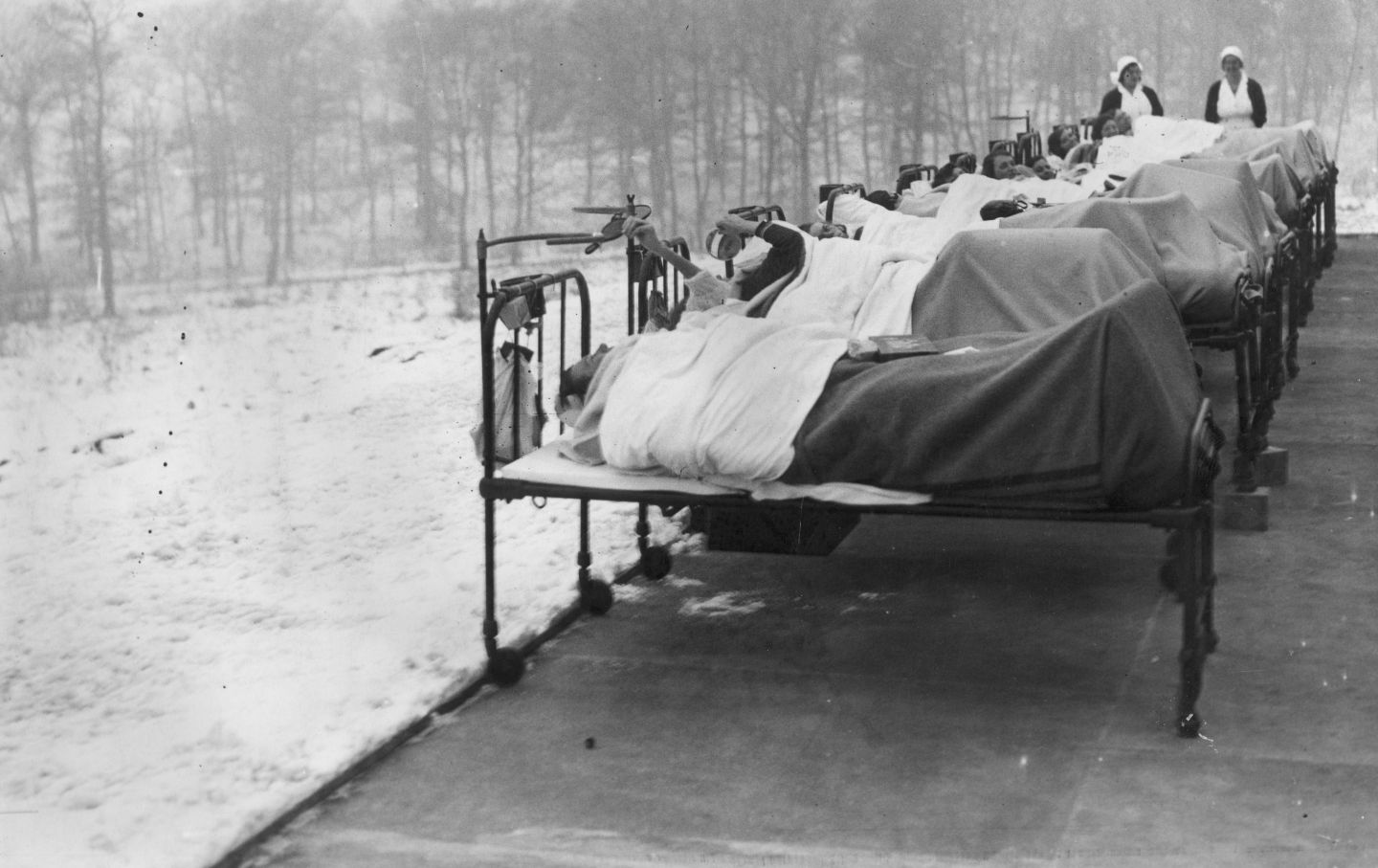
I Was Treated for Tuberculosis While Millions Were Robbed of Care I Was Treated for Tuberculosis While Millions Were Robbed of Care
And RFK Jr.’s HHS leadership will only make contracting arcane illnesses like this one a more common affair.
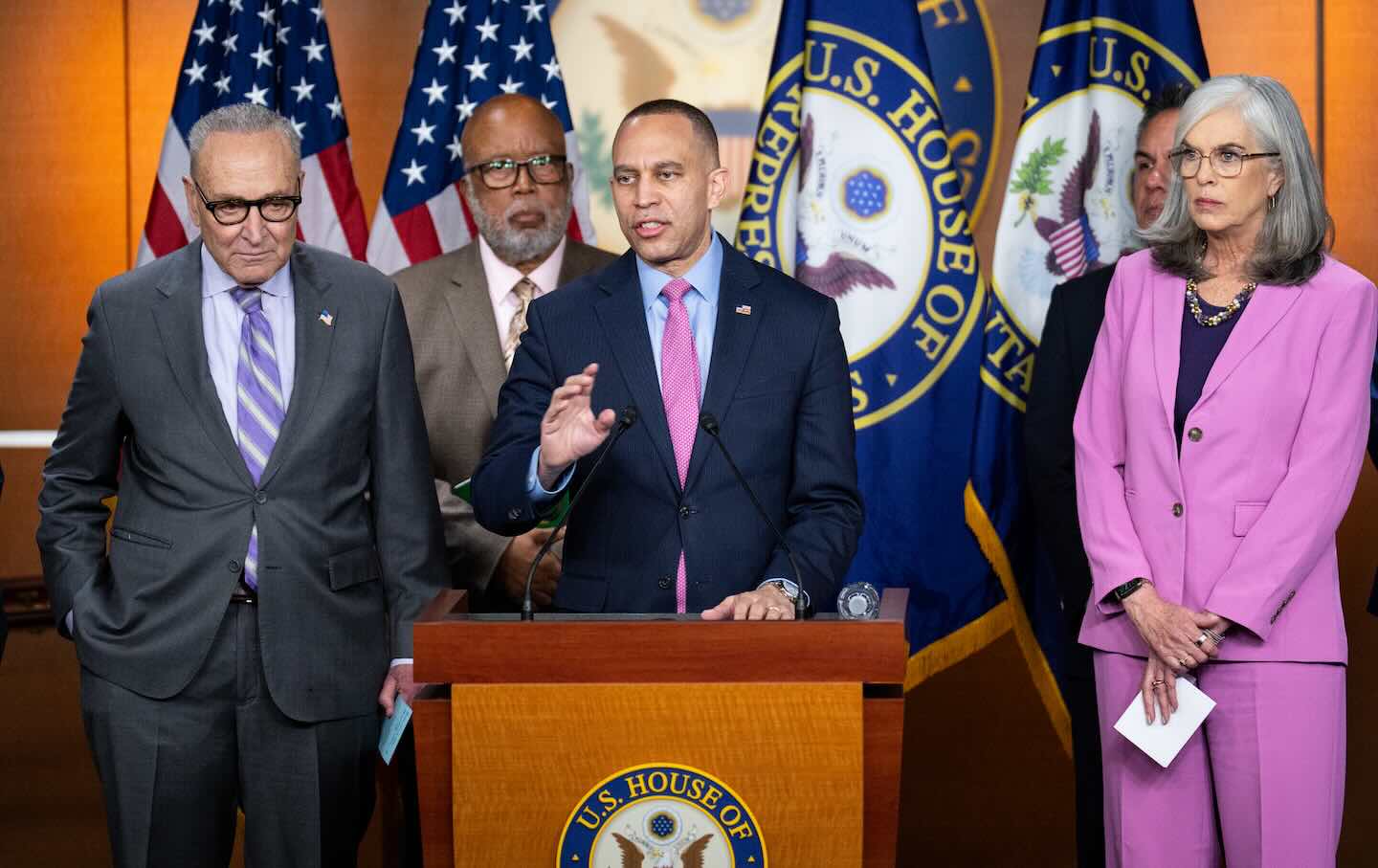
Why Do the Democrats Keep Expanding the Institutions They Claim to Oppose? Why Do the Democrats Keep Expanding the Institutions They Claim to Oppose?
The pattern is always the same: The public demands change, but the Democrats cave to political pressure and maintain the status quo, allowing the machinery to grow.

Palantir’s Manifesto Promises a Dystopian Future Palantir’s Manifesto Promises a Dystopian Future
The tech company’s CEO Alex Karp delivers a self-serving broadside that’s steeped in oligarchic hubris and authoritarian nihilism
What Happens When ‘Your Honor’ Is a Robot? What Happens When ‘Your Honor’ Is a Robot?
As AI seeps ever deeper into our judicial system, boosters insist it will bring fairness and efficiency. The way AI is being developed suggests otherwise.

