
 AP Images
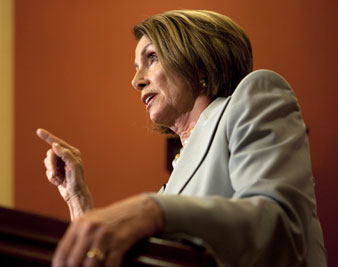
Rep. Nancy Pelosi
This article originally appeared on The Media Consortium.
A plan to reform healthcare that includes a robust public option would actually cut the deficit, according to preliminary estimates by the Congressional Budget Office (CBO). For the purposes of this analysis, a robust public option was defined as one that reimburses doctors at Medicare rates plus five percent. The latest CBO estimate is critical for Democrats because President Barack Obama said he wouldn’t sign a healthcare bill that adds to the deficit. (There’s a double standard at work. Health care has to pay for itself or save money. But as Jo Comerford notes for Democracy Now!, the president has no compunction about bloating the budget with defense spending.)
As healthcare reform moves into the closed-door, intra-party negotiation phase, House of Representatives Speaker Nancy Pelosi is emerging as a champion of a public option. Pelosi has always said that she can’t pass a bill without some kind of public plan, though she has wavered about how tough that plan should be on payouts to providers. But according to Brian Beutler of TPMDC, yesterday’s favorable CBO report seems to have settled all that, and Pelosi’s decided to go all in for a public option.
And why not? A clear majority of Americans now favor a public option, as John Byrne reports in Raw Story. According to a Washington Post/ABC News poll published on Tuesday, 57 percent of respondents favor a public health insurance option to compete with private insurers. That’s an increase of five percentage points in two months.
Two bills made it out of committee in the Senate, one with a public option (the Health Education Labor and Pensions Committee’s effort) and one without (the Senate Finance bill). So proponents of the public option are putting pressure on Senate Majority Leader Harry Reid to include one in the final bill. The Progressive Change Campaign Committee is running ads in Reid’s district that ask if he’s strong enough to back a public option. Reid might be more susceptible than usual to progressive pressure because he’s up for re-election and facing dismal poll numbers, according to Alex Koppelman at Salon.
Popular
"swipe left below to view more authors"Swipe →
The public option has come back from the abyss several times, thanks to a combination of popular appeal, political courage and determined progressive activism. But Mike Lillis of the Colorado Independent argues that Democrats shot themselves in the foot by taking single-payer off the table early on. Single-payer healthcare would abolish private health insurance and cover everyone through a Medicare-like system. It would be an easier and cheaper way to achieve universal coverage than any of the options Congress is considering now, but it’s anathema to the insurance industry.
As Lillis observes, a basic principle of negotiation is to ask for more than you think you’re going to get and negotiate down from there. But the White House made a point of shooting down single payer in May and Congressional Democrats held but one hearing on the prospect. Talk about lousy business skills.
By choosing the public option–not single payer–as the left-most negotiating point, Democrats left themselves with few places to go but toward more conservative proposals for insurance reform, experts say, including the co-op model and a system of triggering public plans only if private insurers fail to meet certain cost and coverage targets. In the blood sport of congressional negotiating–which dictates that you over-ask, and then move toward your goal during the subsequent bartering–Democrats were asking merely for the public plan they wanted in the final bill.
While we’re on the subject of pre-emptive concessions to unreasonable political parties, Amanda Marcotte of RH Reality Check describes how Democrats have bent over backwards to accommodate the antichoice lobby on funding abortions under a public plan. Democrats have proposed elaborate bureaucratic workarounds to make sure that abortions are only covered by private money. Still, antichoice militants like Michelle Bachmann (R-MN) are accusing them of backing abortion field trips for school kids. Speaking of starting high and negotiating downward, Democrats should threaten to overturn the Hyde Amendment, which bans the use of federal funds for most abortions. Let’s see what the anti-choicers are prepared to give up in exchange.
In a sense, it’s reassuring that legislators are taking the public option seriously enough to argue about how it might pay for abortions. If they didn’t think we were going to get a public option, it would be a moot point.

