
“There’s Only One Cause”
Showing solidarity with Palestine isn’t just the right thing to do, it’s tactically smart for all justice and liberation movements.
We Can’t Silo Our Struggles for Justice, Freedom, and Liberation
Showing solidarity with Palestine isn’t just the right thing to do, it’s tactically smart.
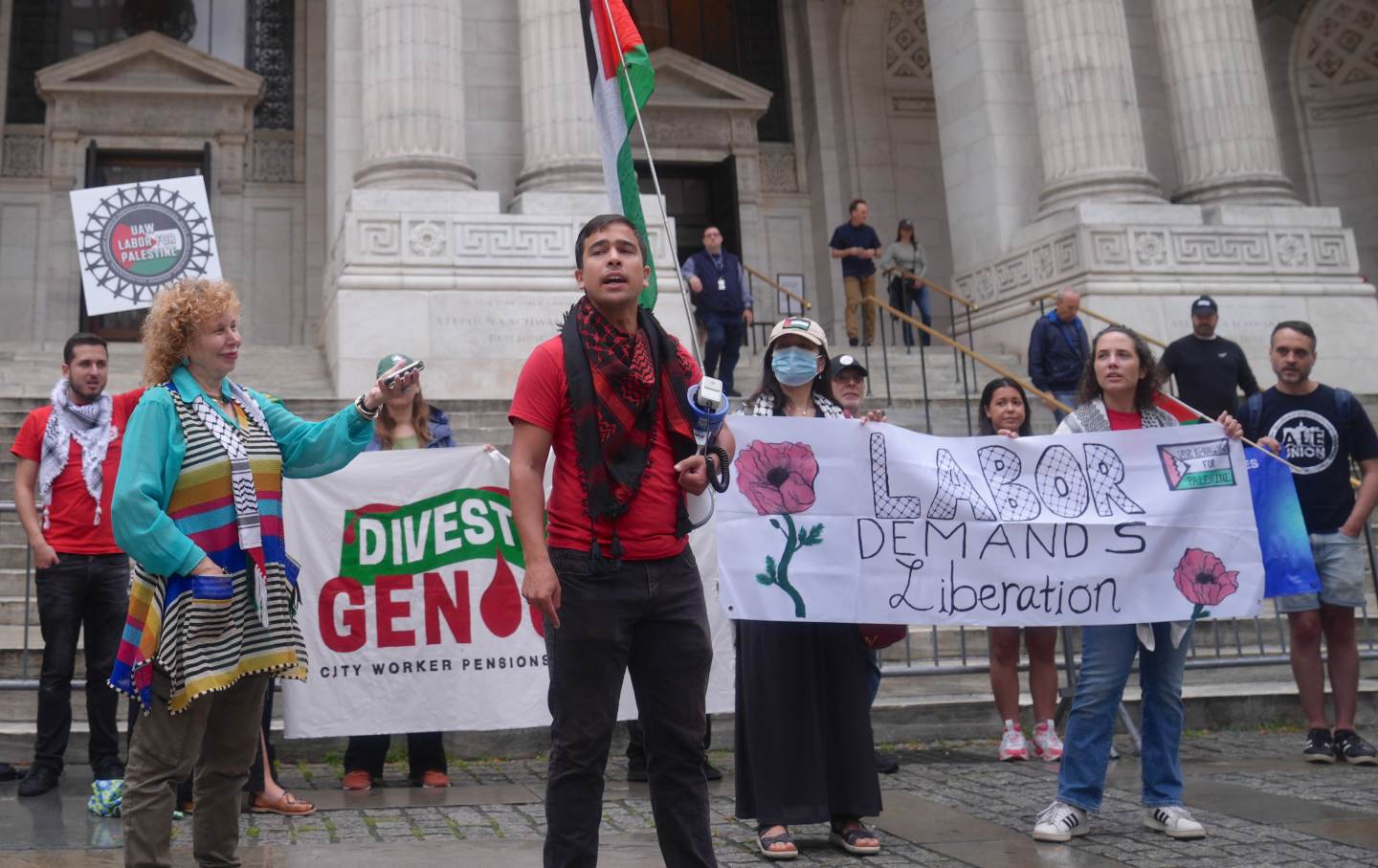
A solidarity demonstration in support of Palestine held in front of the New York Public Library ahead of the Labor Day March in New York on September 7, 2024.
(Selcuk Acar / Anadolu via Getty Images)On June 1, the Freedom Flotilla’s ship Madleen set sail from Sicily, carrying a crew of activists, including Greta Thunberg, known for her climate-justice campaigning, and Rima Hassan, a French Palestinian member of European Parliament. They were attempting to break Israel’s blockade of Gaza and deliver aid, including baby formula and prosthetics.
Their mission was a dangerous one. Israel has attacked previous flotillas. In 2010, Israel killed 10 passengers aboard the Mavi Marmara, and a month before the Madleen’s voyage, drones attacked another Freedom Flotilla boat, the Conscience. Since 2010, no boats have reached Gaza, despite the efforts of people like Holocaust survivor Hedy Epstein and author Alice Walker, who set sail but were quickly intercepted.
Thunberg’s participation in the most recent flotilla journey garnered international attention and may have ensured the relative safety of the passengers—although Israel detained some members of the kidnapped crew for much longer when they refused to sign papers inaccurately stating that they entered Israel illegally. Hassan and another activist, Thiago Ávila, went on hunger strike after Israel put them in solitary confinement. Meanwhile, thousands of activists—from unions, human rights organizations, and aid groups—are marching toward Gaza by land to demand the opening of the Rafah border crossing and the lifting of the blockade. The Egyptian and Libyan governments have tried to block the march, detaining and deporting participants, but more activists continue to join.
These efforts—and Thunberg’s support—have attracted condemnation and scorn from many defenders of Israel. “Greta Thunberg should thank Israel for intercepting her Gaza selfie ship,” ran one Spectator headline. In 2023, after Thunberg had begun speaking out in solidarity with Palestine, the German news magazine Der Spiegel ran a story titled “An Idol Loses Her Way: Has Greta Thunberg Betrayed the Climate Movement?” The New York Post ran a roundup of vitriolic commentary—“Let’s hope it’s a one-way voyage”—while Ben Shapiro attacked her journey as “performative.”
Many of those urging Thunberg to “focus on climate” while decrying her human rights advocacy have no sincere interest in environmental justice. They are merely repeating hasbara, or Israeli propaganda: The Spectator article quotes Israeli military communications as legitimate sources, while the Spiegel piece conflates criticism of Israel with antisemitism, a common tactic to silence pro-Palestine advocates.
There are, however, other activists who do sincerely believe that Palestine is too divisive a topic, or who want to separate their particular cause from other struggles. Recently, Unite All Workers for Democracy, the caucus of the United Auto Workers that has pushed for democratic reforms including one member one vote, voted to dissolve itself, citing “internal divisions.” One of these divisions appears to have been many members’ advocacy for the union to take a stronger position on Palestine, which others within the group viewed as a detriment to organizing new members and retaining existing supporters.
My experience indicates the opposite: Solidarity isn’t just the right thing to do; it’s also tactically smart.
In October 2023, I posted a “Solidarity with Palestine” tweet on the Starbucks Workers United account. Starbucks workers overwhelmingly supported taking that stance: After union leadership ordered the initial tweet’s deletion, the rank and file voted by 97 percent to release a stronger statement. Initially, many people—from top union leaders to supporters of the campaign—accused me of using the union’s platform to advance personal political beliefs or told me that supporting Palestine was a liability for the union effort. Starbucks reacted intensely, suing the union and publicizing a list of union stores in order to direct angry messages toward unionized baristas. This very response prompted a global boycott, significantly dropping Starbucks sales. The company lost $11 billion in market value over 12 days, and the boycott has continued long after that. That pressure brought the company to the bargaining table.
As a brand-new activist in Mississippi, I asked one of my friends and comrades which cause was his favorite, knowing he’d supported a range of issues, from civil rights to labor to Palestine to closing the School of the Americas to abortion rights. He laughed: “I don’t have a favorite. There’s only one cause.”
I was surprised by this response. At the time, I was conflicted about which issues to focus my efforts on, but I’ve since realized how true his statement was.
Struggles do not exist in a vacuum and cannot be siloed. Deported from Israel, Thunberg spoke to journalists in the Paris airport who asked why so many governments around the world are ignoring what’s happening in Gaza. “Because of racism,” Thunberg responded, before adding, “desperately trying to defend a destructive, deadly system that systematically puts short-term economic profit and to maximize geopolitical power over the well-being of humans and the planet.”
From Palestine to Los Angeles—where ICE is abducting people and police, many of whom train in Israel, are brutalizing protesters—to Standing Rock to Ferguson, Missouri, those responsible for oppression and injustice are closely linked. (Recognizing the interconnectedness of their struggles, Palestinians gave protesters in Ferguson advice on dealing with tear gas and police repression after the murder of Michael Brown.) Francesca Albanese, the brilliant human rights scholar who serves as United Nations Special Rapporteur on the Occupied Palestinian Territories, calls it “colonial racial capitalism,” a term reflecting the ways that capitalism’s colonial extraction relies not just on racialized labor but also on changing human relationships with land itself and turning land into a commodity.
Those who are profiting from suffering, who stand to gain from war, and who are trying to roll back human rights standards understand that their fights are fundamentally the same. Capital and government are organized and work together to expand their power and control over people around the world. They don’t see one issue as separate from another, and—now more than ever—the lines between business and government are blurry. The US government has tapped Palantir— the software company founded by Peter Thiel, a mentor of JD Vance’s and close associate of Elon Musk—to create personal profiles of US residents using the data DOGE scraped from government agencies. Palantir was just awarded an even larger contract with ICE, and it provides the Israeli military with surveillance technology.
Popular
“swipe left below to view more authors”Swipe →There are countless other examples. The same governments and companies that have a vested interest in war are also destroying the climate: The environmental impact of Israel’s genocide has been immense. The same religious fundamentalists who overturned abortion access and are stripping away queer and trans rights are also often Christian Zionists—far-right evangelicals whose antisemitic views do not prevent them from supporting the Israeli state, which they consider a precondition for a biblical Armageddon.
Companies like Amazon and Google—known for their union busting—have also donated to and are profiting from the United States’ descent into fascism. Likewise, they’re also complicit in Israel’s genocide in Gaza, with a joint billion-dollar contract, “Project Nimbus,” to provide cloud services to the Israeli military. When Google workers, members of the “No Tech for Apartheid” movement, spoke out against the company’s involvement, they were fired. Presented with a choice between ethics or profits, the company that had once used the slogan “Don’t Be Evil” doubled down on being evil. (Google previously fired workers who called out the company’s collaboration with ICE and customs and border patrol during the first Trump administration.)
Our enemies understand that there’s only one cause. We must, too. Intersectionality isn’t a quid pro quo: We should not enter a “you support my cause, I’ll support yours” relationship. True solidarity is the only way to overcome the combined forces of corporations and governments bent on extracting resources and profits, destroying human rights, and razing the earth. Our survival depends on linking our resistance efforts and securing collective liberation. As the Mississippi civil rights leader Fannie Lou Hamer said, “Nobody’s free until everybody’s free.”
Support independent journalism that does not fall in line
Even before February 28, the reasons for Donald Trump’s imploding approval rating were abundantly clear: untrammeled corruption and personal enrichment to the tune of billions of dollars during an affordability crisis, a foreign policy guided only by his own derelict sense of morality, and the deployment of a murderous campaign of occupation, detention, and deportation on American streets.
Now an undeclared, unauthorized, unpopular, and unconstitutional war of aggression against Iran has spread like wildfire through the region and into Europe. A new “forever war”—with an ever-increasing likelihood of American troops on the ground—may very well be upon us.
As we’ve seen over and over, this administration uses lies, misdirection, and attempts to flood the zone to justify its abuses of power at home and abroad. Just as Trump, Marco Rubio, and Pete Hegseth offer erratic and contradictory rationales for the attacks on Iran, the administration is also spreading the lie that the upcoming midterm elections are under threat from noncitizens on voter rolls. When these lies go unchecked, they become the basis for further authoritarian encroachment and war.
In these dark times, independent journalism is uniquely able to uncover the falsehoods that threaten our republic—and civilians around the world—and shine a bright light on the truth.
The Nation’s experienced team of writers, editors, and fact-checkers understands the scale of what we’re up against and the urgency with which we have to act. That’s why we’re publishing critical reporting and analysis of the war on Iran, ICE violence at home, new forms of voter suppression emerging in the courts, and much more.
But this journalism is possible only with your support.
This March, The Nation needs to raise $50,000 to ensure that we have the resources for reporting and analysis that sets the record straight and empowers people of conscience to organize. Will you donate today?
More from The Nation

How Brothel Workers in Nevada Just Made Labor History How Brothel Workers in Nevada Just Made Labor History
The courtesans at Sheri’s Ranch were staring down a horrifying new contract. So they did what workers everywhere do: They got organized.
Democrats Must Listen to Workers Democrats Must Listen to Workers
How winning people’s trust involves listening to their challenges, ambition, ideas, and stories.
Zohran Mamdani Is Putting Corporate Sick-Leave Cheats on Notice Zohran Mamdani Is Putting Corporate Sick-Leave Cheats on Notice
The mayor announced that the Department of Consumer and Worker Protection will investigate employers where more than half their workers take no paid time off in a given year.
The Ghosts of Colonialism Haunt Our Batteries The Ghosts of Colonialism Haunt Our Batteries
With its cobalt and lithium mines, Congo is powering an energy revolution. It contains both the worst horrors of modern metal extraction—and the seeds of a more moral economics.
The Trump Administration Wants to Make It Easier Than Ever to Exploit Farmworkers The Trump Administration Wants to Make It Easier Than Ever to Exploit Farmworkers
What is being described as “reform” in Washington will only make the abuse and wage theft that plague the program even worse.
Is Union Power Growing in Mamdani’s New York? Is Union Power Growing in Mamdani’s New York?
Following the Mamdani administration’s talks with the CUNY faculty union, three professors have returned to class after losing their jobs for their pro-Palestine activism.

