
How Microsoft Workers Helped Halt a Major Contract With the Israeli Military
A grassroots campaign successfully pressured the tech monopoly to take an unprecedented step toward suspending its complicity in the Gaza genocide.
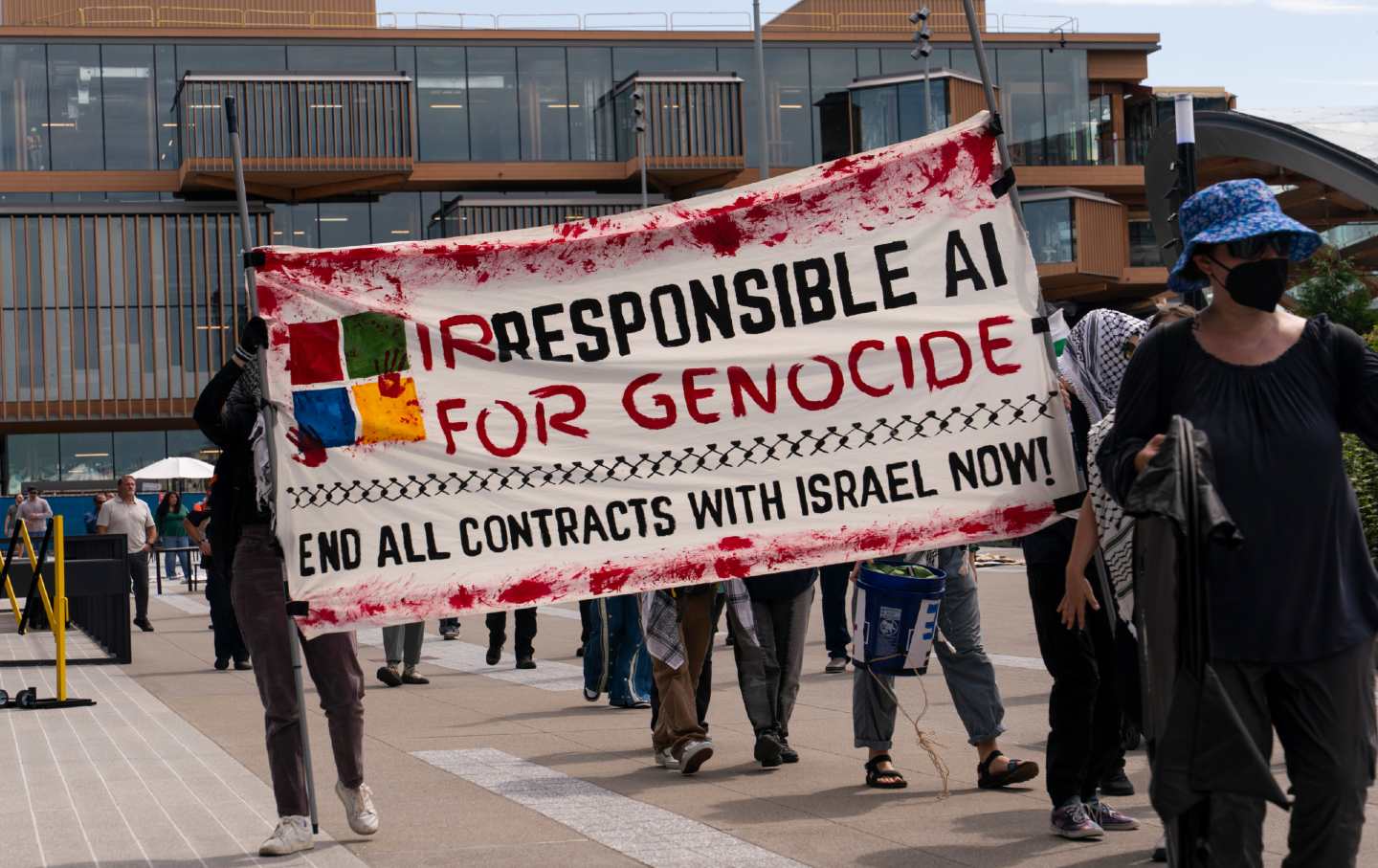
Protesters against the Gaza genocide march away from the Microsoft campus in Redmond, Washington, last month after the company called police to disburse them.
(David Ryder / Bloomberg via Getty Images)Something remarkable happened last week. Tech giant Microsoft announced that it is partially terminating the Israeli military’s access to proprietary technology that it was using to conduct mass surveillance and targeting of Palestinians in Gaza and the West Bank. As The Guardian reports:
Microsoft told Israeli officials late last week that Unit 8200, the military’s elite spy agency, had violated the company’s terms of service by storing the vast trove of surveillance data in its Azure cloud platform, sources familiar with the situation said.
The decision to cut off Unit 8200’s ability to use some of its technology results directly from an investigation published by The Guardian last month. It revealed how Azure was being used to store and process the trove of Palestinian communications in a mass surveillance programme….
In response to the investigation, Microsoft ordered an urgent external inquiry to review its relationship with Unit 8200. Its initial findings have now led the company to cancel the unit’s access to some of its cloud storage and AI services.
The phrase “vast trove of surveillance data” doesn’t properly communicate just how enormous and far-reaching this surveillance campaign is. The bombshell August investigation collaboratively produced and published by The Guardian, the Israeli-Palestinian publication +972 Magazine, and the Hebrew-language outlet Local Call revealed that—with the dystopian aid of AI and Azure’s “near-limitless storage capacity”—Unit 8200 “had built an indiscriminate new system allowing its intelligence officers to collect, play back and analyse the content of cellular calls of an entire population.” By July of this year, “11,500 terabytes of Israeli military data—equivalent to approximately 200m hours of audio—was held in Microsoft’s Azure servers in the Netherlands.”
Brad Smith, president and vice chair of Microsoft, notified company employees of the decision over e-mail on September 25. “I want to let you know that Microsoft has ceased and disabled a set of services to a unit within the Israel Ministry of Defense (IMOD),” Smith writes, going on to say:
We do not provide technology to facilitate mass surveillance of civilians. We have applied this principle in every country around the world, and we have insisted on it repeatedly for more than two decades.…
While our review is ongoing, we have found evidence that supports elements of The Guardian’s reporting. This evidence includes information relating to IMOD consumption of Azure storage capacity in the Netherlands and the use of AI services.
We therefore have informed IMOD of Microsoft’s decision to cease and disable specified IMOD subscriptions and their services, including their use of specific cloud storage and AI services and technologies.
While Microsoft’s reversal happened in remarkable fashion, it didn’t just happen, and this story is far from over.
To be sure, Microsoft would not have taken this step without the vital joint-investigative work of reporters at The Guardian, +972 Magazine, and Local Call. This is, in one respect, a story about how real, good journalism can still make a difference in our bloody “post-truth” hellscape.
But this is by no means the first time Microsoft’s technological and financial complicity in Israel’s crimes has been exposed—and this wave of reporting was far from the only force putting pressure on Microsoft executives to explain themselves and change course. As much as the self-righteous journalist in me wants to believe this is all about reporters holding powerful corporate and state entities accountable, the on-the-ground journalist in me who was in Redmond, Washington, last month reporting from Microsoft’s global headquarters knows it wasn’t.
I went to Redmond because, in my opinion, the biggest labor story in the United States is happening there: a tech-worker-led revolt from within Microsoft, one of the most powerful corporations in the world, under the banner of the “No Azure for Apartheid” (NOAA) campaign. Highly specialized, well-paid workers in the heart of Big Tech, in the most corporate, nerdy, non-union, Northface-wearing-ass environment you can imagine, have been repeatedly putting their jobs, safety, and even their immigration status on the line to answer Gaza’s call and use their position as tech workers to try to stop a genocide. They delivered petitions with thousands of employee signatures imploring Microsoft leadership to stop providing tech for and making money off Israel’s war crimes. They disrupted Microsoft’s 50-year anniversary celebration in April and CEO Satya Nadella’s keynote speech at the company’s annual developer conference in May. They’ve defied company policy, speaking out about Microsoft’s complicity on company listservs.
When those actions didn’t yield a productive response from management, they escalated and set up a “liberated zone” encampment on the East Campus Plaza of Microsoft’s global headquarters, very much inspired by the student encampment movement that exploded on campuses the previous year. Then they conducted a sit-in in Microsoft president Brad Smith’s executive office. In other words, workers of conscience have erected a disciplined grassroots campaign to pressure Microsoft “to divest and put an end to [its] role in the economy of genocide and apartheid.”
Throughout the year, NOAA has consistently reminded Microsoft’s executive team that this issue won’t simply go away. In direct and occasionally disruptive fashion, Microsoft workers have insisted that their company should not be producing tech to aid a state in carrying out a genocide. In its “Microsoft Company Complicity Profile,” NOAA charges that
The Israeli military is a Microsoft S500 (top 500) customer, meaning that it gets top priority status as one of the company’s most important customers globally. The Israeli military is the second largest military Microsoft customer. In 2021, Microsoft expected its partnership with Unit 8200 of the Israeli military to generate hundreds of millions of dollars for the company over a 5-year period because the unit’s leadership intended to multiply the amount of data stored in Microsoft servers “tenfold” over the next few years. Additionally, in 2021, Microsoft signed a three-year contract with the Israeli Ministry of Defense worth $133 million. 50% of Microsoft’s consulting revenue is from the Israeli military.
And as Israel’s society-erasing bombing, displacement, and forced starvation of Gazans reaches its inhumane end stages, NOAA has felt the urgency and dialed up the pressure. Microsoft has primarily responded to these actions by calling the cops on NOAA members and firing the workers involved. That’s why just about every Microsoft employee involved with these actions I’ve spoken to over the past two months is now a former Microsoft employee. Yet none of them regret losing their jobs, and all of them have vowed to keep the pressure up. They also stress that support from within Microsoft’s workforce continues to grow. “Our internal petition has over 2,100 signatures, and our internal pledge to refuse to work on tickets from the Israeli military has over 200 pledgers,” NOAA organizers say. “Our messaging is also resonating with the public: our public petition has over 11,000 signatories.”
It also reached Microsoft’s executives—but only after NOAA’s persistent and disruptive campaign to hold them accountable. “After two years of genocide; after four years of this shameful deal between Microsoft CEO Satya Nadella, and the head of Unit 8200 at the time, approving the mass theft of all Palestinian communications using Microsoft technology; and after 34 years of direct entrenchment in Israeli apartheid and occupation, Microsoft only took this decision less than one month after our escalatory protests in August at Microsoft’s headquarters and executives’ homes,” former Microsoft worker Nisreen Jaradat said via e-mail. Without such concerted pushback, she adds, “Microsoft would have continued facilitating the mass surveillance of Palestinians in silence.”
Jaradat’s colleague Anna Hattle, who also lost her job in the wake of the recent NOAA protests, stresses that company employees have been pressuring management about Microsoft’s IDF contracts since the onset of the full-scale destruction of Gaza two years ago—and that, as workers began publicizing their cause and joining forces with other anti-genocide activists across the globe, management grew much more skittish, which made them, in turn, much more responsive to workers’ demands. “When we sent our worker petition to executives in May, they released their blog post about the first investigation that same afternoon,” Hattle recalls. “Brad Smith held a press conference in his office addressing Microsoft’s complicity publicly just hours after we sat in that same office. The campaign has had support from people and groups all over the world that have added their voices to ours and helped us exert pressure on all fronts. That wider general pressure, when exercised behind more targeted, direct, and pointed actions is what has achieved results.”
The August campaign of direct actions brought the conflict to a head—and the company’s brass responded with force. “Microsoft demonstrated that our organizing threatened their business by calling multiple county police departments, as well as the Washington State Police, who then inflicted several injuries on people in our community,” says Julius Shan, another Microsoft employee fired in the wake of the confrontation. “Sending multiple militarized police forces after protestors demonstrates that Microsoft views organizing as a serious threat to its bottom line.”
Popular
“swipe left below to view more authors”Swipe →The company may be calculating that cutting off Azure access to Unit 8200 will be enough to quell the protests from its workforce—but NOAA activists stress that the pressure campaign will continue until the company severs all ties with the IDF. “We will continue to organize until Microsoft meets all of our demands,” Shan says. “Microsoft continues to supply more than 600 technology subscriptions to the Israeli military. We reiterate that there is no moral, legal, or ethical way to do business with an entity that is committing genocide and ethnic cleansing.”
Part of NOAA’s success was rooted in the activists’ familiarity with how Microsoft harnessed in-house communication platforms to serve management’s interests and closely choreographed forums to make disaffected workers “feel heard” while maintaining the status quo. They the established effective end-runs around such top-down mechanisms of controlling dissent. “Oftentimes, the status quo will include companies giving workers internal channels to voice their concerns,” Shan says. “We know from experience that these pathways—employee groups, forums, Town Halls, Q&A events—are manipulated by company leaders to placate workers by creating a facade that leadership listens to their workers, while in reality, they often dodge the questions that matter most. These internal channels are valuable for finding allies and holding important discussions among workers, but often are not sufficient for holding leadership accountable and forcing actions like cutting ties with the Israeli military. Our actions show that escalating outside of ‘proper’ channels is a significant force of change: Be creative and imaginative with your escalations.”
The scope of last week’s policy change from Microsoft, which NOAA justly claims as a victory, is nonetheless limited. The Guardian’s latest report suggests that a good portion of the “trove” of surveillance data that was formerly stored on Microsoft’s Azure platform has already been moved to Amazon Web Services. But this still marks an important precedent in an American tech industry that supplies critical support to the genocide in Gaza. “Though this falls far short of achieving our goals of complete divestment, it’s still very significant,” Hattle says. “According to The Guardian, this is the first time a US tech company has suspended any services to the Israeli military since this genocide began. It sets a new precedent for the industry, which often moves in lockstep, that it is realistic and possible to stop providing services to the Israeli military.”
That message, combined with the lessons of the Unit 8200 win, will fuel the coming struggle to get Microsoft to divest completely from its contracts with the Israeli military. “It’s critical that workers see that our actions truly can have an impact,” Hattle observes. “You don’t need as much as you think to make that impact. This campaign is a group of workers of conscience going up against a giant multinational corporation, and we have been able to move the needle. Because we often underestimate our own power, one of our greatest obstacles is the limit of our own imaginations. Many of us are jaded and pessimistic, but if we get creative, there’s so much more we can achieve. We owe it to our people in Palestine to be more ambitious and to try new strategies to win.”
Support independent journalism that does not fall in line
Even before February 28, the reasons for Donald Trump’s imploding approval rating were abundantly clear: untrammeled corruption and personal enrichment to the tune of billions of dollars during an affordability crisis, a foreign policy guided only by his own derelict sense of morality, and the deployment of a murderous campaign of occupation, detention, and deportation on American streets.
Now an undeclared, unauthorized, unpopular, and unconstitutional war of aggression against Iran has spread like wildfire through the region and into Europe. A new “forever war”—with an ever-increasing likelihood of American troops on the ground—may very well be upon us.
As we’ve seen over and over, this administration uses lies, misdirection, and attempts to flood the zone to justify its abuses of power at home and abroad. Just as Trump, Marco Rubio, and Pete Hegseth offer erratic and contradictory rationales for the attacks on Iran, the administration is also spreading the lie that the upcoming midterm elections are under threat from noncitizens on voter rolls. When these lies go unchecked, they become the basis for further authoritarian encroachment and war.
In these dark times, independent journalism is uniquely able to uncover the falsehoods that threaten our republic—and civilians around the world—and shine a bright light on the truth.
The Nation’s experienced team of writers, editors, and fact-checkers understands the scale of what we’re up against and the urgency with which we have to act. That’s why we’re publishing critical reporting and analysis of the war on Iran, ICE violence at home, new forms of voter suppression emerging in the courts, and much more.
But this journalism is possible only with your support.
This March, The Nation needs to raise $50,000 to ensure that we have the resources for reporting and analysis that sets the record straight and empowers people of conscience to organize. Will you donate today?
More from The Nation

What We Must Learn From the Revelations About Cesar Chavez What We Must Learn From the Revelations About Cesar Chavez
The sexual predations of the late labor leader follow a depressingly familiar pattern in left organizing circles.

Dolores Huerta: “My Silence Ends Here” Dolores Huerta: “My Silence Ends Here”
The labor movement icon speaks out after revealing that she was sexually assaulted by Cesar Chavez.

Trump Wants to Criminalize Dissent. This Texas Case Could Help Him Do It. Trump Wants to Criminalize Dissent. This Texas Case Could Help Him Do It.
The Prairieland Defendants are on trial in a case that could set a chilling precedent for the right to protest in the United States.

A Motto for All Health Workers: Resist, Resist, Resist A Motto for All Health Workers: Resist, Resist, Resist
Doing our work and keeping our heads down isn’t a victory. We need to fight this regime every day, in every way.
How Jane Fonda Is Rethinking the Hollywood Resistance How Jane Fonda Is Rethinking the Hollywood Resistance
The actress’s revived Committee for the First Amendment is taking aim at industry mergers as well as threats to the freedom of expression.

