Columbia Expelled Me for My Palestine Activism, but I Won’t Be Silenced
And neither will anyone else targeted by the university. We are not afraid, we are undeterred, and we will continue to fight.

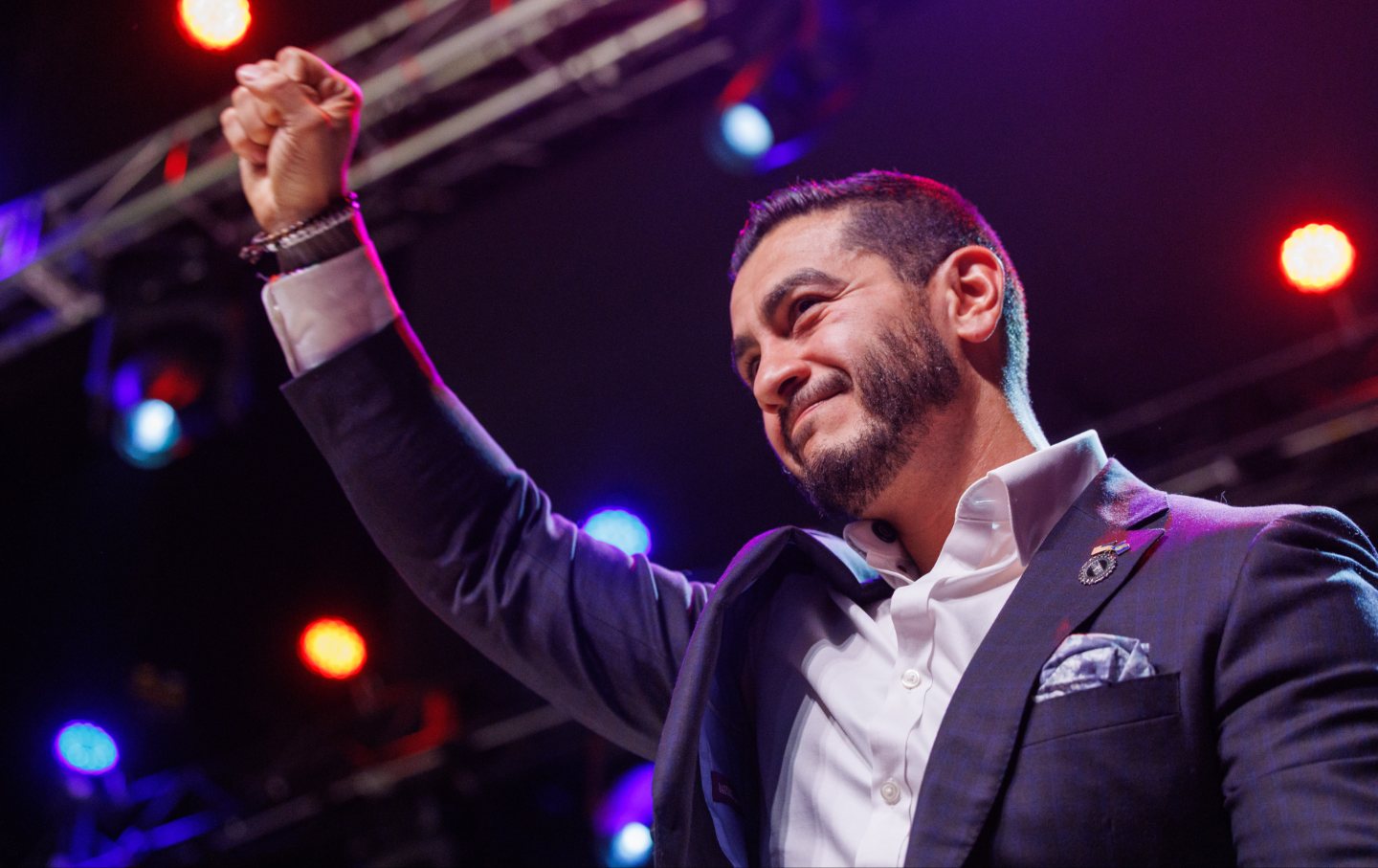
Grant Miner speaks at a rally in support of detained Columbia graduate Mahmoud Khalil.
(Breakthrough News)On March 13, I was expelled from Columbia University for participating in the protest movement against the ongoing genocide in Gaza.
I was not the only one: Twenty-two students, all of whom, like me, had been cleared of any criminal wrongdoing, were either expelled, suspended for years, or had their hard-earned degrees revoked on the same day—all for allegedly occupying a building that has been occupied at least four times throughout Columbia’s history. This followed the extrajudicial arrest of recently graduated student Mahmoud Khalil by DHS, who still remains in custody at the time of writing.
In my particular case, I serve as the president of the Student Workers of Columbia—UAW 2710. As a PhD student, I am also a student worker—this was my fifth year teaching and learning at Columbia—and for us, expulsion is synonymous with being fired. We lose our pay and health insurance, and student workers who rent from Columbia face the immediate nonrenewal of their leases (Columbia, for their part, will try to evict you immediately).
Amid the university’s retaliation for solidarity with Palestine, it’s not lost on us that my firing occurred the night before we were going to begin bargaining for our next contract. The next day, Columbia unilaterally canceled our first bargaining session amid the backlash.
Columbia says that it is simply enforcing its rules. But that’s not what’s happening. Instead, the university is participating in a targeted attack on its students’ First Amendment rights to oppose genocide—an attack that the Trump administration has now eagerly joined. The same day that I was expelled from Columbia, the federal government sent Columbia a ransom note reiterating its desire to see protesters expelled or suspended, as well as a host of other demands the university would need to fulfill as a precondition for getting back over $400 million in already-appropriated research grants.
Contrary to Columbia’s claims, there is no individualized evidence against any student charged with wrongdoing. Specifically, students are charged with being in university spaces (variously, lawns or buildings) after closure, “misappropriation” of university property, and campus disruption.
According to Columbia’s rules, it is necessary to provide concrete proof, such as photos or eyewitness testimony, that an individual participated in a violation. Instead, Columbia has drawn up a list of “suspects,” and, using the argument that we can’t prove we weren’t involved, has found us guilty of all charges. That’s not just my interpretation—my expulsion letter cited the fact that there was “no countervailing evidence that [I] was not present or did not participate.” The only rational conclusion to draw is that the outcome of these investigations are strictly political in nature.
Trump is eager to brand protests for Palestine as antisemitic, as can be seen from the coordinated smear campaign against our students and coworkers over the past two weeks. It is regrettable that I have to mention this at all, as I would hope every reader already understands that there is nothing antisemitic about opposing a genocide. But in the current moment, when definitions have been twisted and manipulated beyond recognition, it is worth noting.
Like many of those protesting, I am Jewish, and to compound the irony, I also work in Jewish studies. As many have said more eloquently than I ever could, being Jewish and growing up with the knowledge of what our people have gone through is precisely what makes me stand up against the ongoing genocide of the Palestinian people. On a more practical note, I hope one can infer that if I was a particularly “self-hating” Jew, I could have simply not spent hundreds of hours reading medieval Hebrew literature. Nevertheless, I, along with so many others, have been swept up in Columbia and Trump’s witch hunt.
But these attacks threaten more than just the movement for Palestine. Trump is just as eager to weaponize accusations of antisemitism in order to cut public spending on vital research on topics deemed politically inconvenient, such as LGBTQ health and environmental science. What is unfolding at Columbia is a blueprint, a testing ground for things to come. Federal funding will be used as a cudgel. Charges of “antisemitism” or “support for terrorism,” despite the lack of any supporting evidence, will be used as the justification.
In some ways, it is easy to see why Columbia would easily throw its students under the bus for $400 million, because it has already done the same to its Palestinian and Arab students who tirelessly struggled to end our institution’s complicity in apartheid and genocide. Instead, the institution chose to back a wealthy minority of donors and trustees who would rather destroy this university than see it divest.
On March 21, Columbia caved to the rest of the Trump administration’s demands. Now, protests “in places where academic activities occur” are generally banned, as are masks “for the purpose of concealing one’s identity.” While Columbia has declined to adopt the IHRA definition of antisemitism, its new definition effectively makes Zionism, a political ideology, another protected class on campus. Most concerningly, Columbia has now agreed to hire 36 new officers who have the power to use force and arrest students who violate these new rules.
Beyond cracking down on protest on campus, Columbia has essentially ended its status as an independent intellectual institution. The Department of Middle Eastern, South Asian, and African Studies has effectively been put under academic receivership; they, along with the Institute of Palestine Studies and other departments focused on the Middle East, have a new administrator who will ensure that their courses are “comprehensive and balanced.” What will constitute “balanced” depictions of Israel is anyone’s guess, but prevailing winds suggest a crackdown on any effort to teach Palestinian history from the perspective of its Indigenous inhabitants.
At each step, Columbia has had the opportunity to fight back against genocide and censorship, as the UAW already has and continues to do. All across the country, students and workers are mobilizing to stop similarly politically motivated cuts at other universities. Why aren’t our universities taking up the same banner? Labor organizers know that there’s no placating the bosses. No matter how much you concede, they’ll always come back for more.
The only option is to stand firm. This applies not just to the fight against cuts, but to the broader struggle for equality everywhere. In its proudest moments, the labor movement has stood squarely on the side of the oppressed, and therefore on the side of justice. As a union president, I had an even greater responsibility to stand with my members who were beaten by the police just for protesting, and with my workers who stood up for what they believe in.
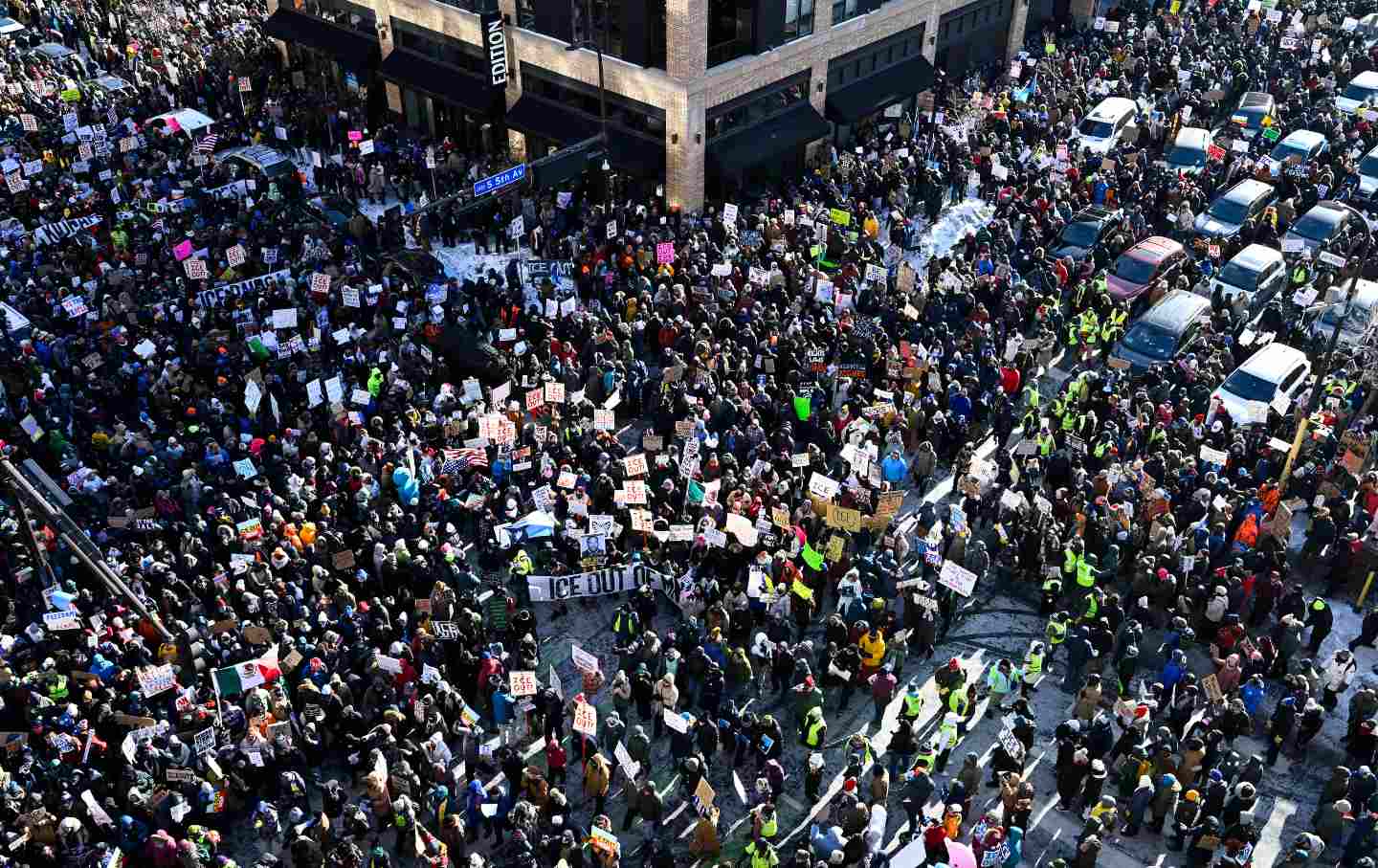
But we know that people of conscience will not accept this reality so easily. Trump’s crackdown has already failed. Since Mahmoud’s arrest, there have been protests across the nation, with thousands taking to the streets to demand his release almost overnight. ICE and DHS may be prowling the halls of our workers’ apartment buildings, but every day more and more people get involved in our union. At Columbia, in our upcoming contract campaign, we will fight to make sure that our international students are safe, and that Columbia will neither surveil our members nor turn their information over to the authorities.
Israel has officially resumed its genocide, killing over 1,000 Palestinians in the last 48 hours. In their attempts to stifle our demands, the Trump administration and our educational institutions remain complicit in that very same violence and are responsible for its escalation. As organizers and students who have been fighting for an end to the genocide for the past 16 months, we feel the weight of the devastation that Israel is choosing to rain down on Gaza—both in our grief, but also in our resolute determination to continue fighting for a free Palestine.
We know that this was what Mahmoud was fighting for, and he is one among the thousands of students and workers across who see clearly what was required of us in the call for justice. We are not afraid, we are undeterred, and we will continue to fight for the protection of workers, students, and our movement, and for an end to the genocide.
Become a Sustaining Donor This September
Between the reemergence of right-wing red-baiting and Donald Trump’s use of the chilling National Security Presidential Memorandum–7 to criminalize left political organizing, we’re seeing McCarthyism reborn before our eyes.
This assault on democracy cannot be ignored or wished away. Resisting it requires bravery in the face of threats and repression, a steadfast commitment to the truth, and the unwavering belief that we can—and will—overcome this darkness.
We must have an independent media that sets the record straight, unearths corruption and abuses of power, and advances a politics of justice and dignity for all if we’re to win this fight.
That’s why I’m writing to you today. This September, The Nation needs to add 100 monthly donors to sustain our progressive journalism. Your contribution makes the next investigative report, the next truth-speaking column, and the next pathbreaking essay all possible.
I hope you’ll support our work with a recurring donation today. If you donate $10 or more a month, we’ll send you a brand new “Hands Off the Free Press!” sticker to recognise your commitment to our cause. Please, donate today.
Onward,
Katrina vanden Heuvel
Editor and Publisher, The Nation